112 résultats
1958réf. 101095AB1958. Dublin Sealy Bryers and Walker 1958. Octavo. 24 12 pages. Original Softcover. Some minor dogears and a small lesion to the cover of Pamphlet 1. Otherwise in very good condition with only minor signs of external wear. paperback
1942Paper Wrappers, 8vo; 32, 40, 48, 40, 64, 71, 80, 23 pages. 23 cm. Contents: 1. Why study post-war problems. --2. The two world wars, a comparison and contrast. --3. How the Jewish communities prepared for peace during the first world war. --4. Europe between the two world wars (1919-1939) --5. The position of the Jews in the post-war world. --6. Palestine in the new world. --7. Relief, reconstruction and migration. --8. Jewish survival in the democracy of the future. SUBJECT(S) : World War, 1939-1945 -- Jews. Reconstruction (1939-1951) . Vol VII includes the errata slip. Very Good Condition. (p-4-3)
19301st edition. Original Paper Wrappers, 8vo, 77 pages. "'Can we establish our life here,' he asked in his 1930 pamphlet Like All the Nation? 'not upon the basis of force and power, but upon that of human solidarity and understanding?' His tireless pursuit of a cooperative relationship between Jews and Arabs was a manifestation of his philosophy of life; his effort on behalf of the binational plan stands as one in a series of efforts by him to change Jewish public life in both American and Mandatory Palestine" (Kotzin, 2010). In this pamphlet, Magnes includes his essay with the pamphlet's title, as well as his recent New York Times article and Philby's plan. He also republishes his 1921 letter to the editor of the London Jewish Chronicle in which he claims that redemption would come to the Jews only if they stop infringing on Arab national aspirations in Palestine. He placed this article in the pamphlet, he says, "to show that my present attitude is not new, and that it is the result of a view of life and a conception of the ethical function of Judaism and does not just spring from tactical or strategic motives." Finally, he also includes an English translation of Ahad Ha-Am's 1921 Preface to a new edition of his works. Important. Light wear & stains to cover, Very Good Condition. (zion-9-1) xx
19301st edition. Original Paper Wrappers, 8vo, 77 pages. "'Can we establish our life here,' he asked in his 1930 pamphlet Like All the Nation? 'not upon the basis of force and power, but upon that of human solidarity and understanding?' His tireless pursuit of a cooperative relationship between Jews and Arabs was a manifestation of his philosophy of life; his effort on behalf of the binational plan stands as one in a series of efforts by him to change Jewish public life in both American and Mandatory Palestine" (Kotzin, 2010). In this pamphlet, Magnes includes his essay with the pamphlet's title, as well as his recent New York Times article and Philby's plan. He also republishes his 1921 letter to the editor of the London Jewish Chronicle in which he claims that redemption would come to the Jews only if they stop infringing on Arab national aspirations in Palestine. He placed this article in the pamphlet, he says, "to show that my present attitude is not new, and that it is the result of a view of life and a conception of the ethical function of Judaism and does not just spring from tactical or strategic motives." Finally, he also includes an English translation of Ahad Ha-Am's 1921 Preface to a new edition of his works. Important. Institutional stamp on half title, title penned on spine, rust to staples, otherwise Very Good Condition. (zion-9-1A) xx
1973réf. 2406050188xbvkNo publisher mentioned (U.S.A., 1973*). 47 (1) pages (cover included in pagination), photographically illustrated throughout. - Publisher's photograph. illustrated softcover; 4to.(ca. 28 x 21 cm).
1965réf. 34122Paris J.J. Pauvert 1965 In-12 Étroit Volumes de formats 9 X 18 cm, couverture Kraft Imprimée, tranches noires, maquette de Pierre Faucheux *Cette petite Collection comprend : 1 Revel - Pourquoi des Philosophes - 2 Voltaire Lettres Anglaises - 3 Diderot Écrits Philosophes - 4 Hugo, Napoléon le petit - 6 Pascal, Provinciales - 8 Rousseau, profession de foi du Vicaire Savoyard - 10 - Julien Gracq, La littérature à l'estomac 13 Panizza, Le Concile d'Amour - 15 Balzac Monographie de la presse Parisienne - 17 Revel J-F., la Cavale des Dévots - 27 Raymond Picard, nouvelle critique, nouvelle imposture - 29 Berl Emmanuel Mort de la morale Bourgeoise 32 Benjamin Constant Polémiste 35 Michelet et Quinet Des Jésuites 36 Lichtenberg Aphorismes 38 Crevel - Le Clavecin de Diderot 39 Rougier, une faillite, La scolastique 42 Weber Néo-critique et paléo-critique 45 - Trotsky, Leur morale et la nôtre - 46 Rochefort Henri La Lanterne - 49 Boissel, Gobineau Polémiste - 50 Papaioannou L'idéologie froide - Picard raymond, Racine Polémiste 52 Viau Théophile de , Théophile en Prison 56 Fourier Charles, L'attraction passionnée - 24 volumes sur les 59 parus pour la collection " Libertés " . Le numéro correspond à celui de l'éditeur dans l'ordre de parution.
19461st edition. Original paper wrappers. 8vo; 10 pages. A call by US Jewish Chaplains and others for the Jewish refugees of Europe, sitting in DP camps, to be allowed into Palestine. "We submit as supplementary evidence on the position of the displaced Jews now in Germany, the following: a statement signed by 133 Jewish chaplains who served with the U. S. Armed Forces on land and sea and in the air; a statement by the Executive Director of the Committee on Army and Navy Religious Activities of the National Jewish Welfare Board; [and] individual testimony from five Jewish chaplains who served with U. S. Forces in the European theatre. " A kind of call to action to aid the surviving remnant. SUBJECT(S): Jews -- Palestine. Zionism. Jews. Zionism. OCLC lists 12 copies worldwide. Light wear, Good+ Condition. (HOLO2-117-66-AM)
1934réf. 3748Firenze: Casa Vinicola Barone Ricasoli 1934. Eight octavo booklets 15; 34; 20; 39; 23; 14; 14; and 14 pages. FIRST EDITIONS. Complete set of individually authored instructional booklets for the Italian hospitality industry for use in the promotion of gastronomical tourism in Tuscany. Subjects include characteristics of "genuine" wine; where to find the best Italian wines; the wine production process; and how to best present wine to customers. Published by the Barone Ricasoli winery notably a continuously run family business since 1141 and still in operation today. Baron Bettino Risacola Italy's second prime minister wrote the modern formula for Chianti wine in 1872. In variously colored wrappers with some chipping and discoloration otherwise very good. Rare. OCLC locates no copies. Casa Vinicola Barone Ricasoli unknown
1934réf. 3748Firenze: Casa Vinicola Barone Ricasoli 1934. Eight octavo booklets 15; 34; 20; 39; 23; 14; 14; and 14 pages. FIRST EDITIONS. Complete set of individually authored instructional booklets for the Italian hospitality industry for use in the promotion of gastronomical tourism in Tuscany. Subjects include characteristics of "genuine" wine; where to find the best Italian wines; the wine production process; and how to best present wine to customers. Published by the Barone Ricasoli winery notably a continuously run family business since 1141 and still in operation today. Baron Bettino Risacola Italy's second prime minister wrote the modern formula for Chianti wine in 1872. In variously colored wrappers with some chipping and discoloration otherwise very good. Rare. OCLC locates no copies. Casa Vinicola Barone Ricasoli unknown books
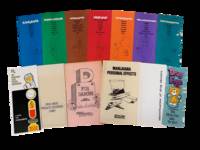
1960réf. 232671960. Drug education pamphlets issued across the late twentieth century recording the shift from the publicization of recreational drug use in the 1960s into the broader drug crisis language of the crack era and the AIDS years when intoxication dependency overdose and injection risk became central subjects of school and public health. These pamphlets reduce a wide range of drugs into a simple public warning system meant for students parents and other non-specialist readers. They sort marijuana stimulants depressants narcotics hallucinogens and inhalants into clear categories translate drug culture into recognizable slang and everyday terms and stress the bodily psychological legal and social consequences of use. Archive of 13 educational drug safety pamphlets. 1960s-1990s chiefly 1980s. United States. Multi-page folded and staple-bound pamphlets ranging from 2.5" x 8" to 5.25" x 8.5" including seven color-coded Channing L. Bete drug-class pamphlets which include slang terms for each category and their side affects; a foldout Drug Abuse Products Reference Chart; a Pharmaceutical Manufacturers Association identification folder; and six additional educational pieces on prescription drugs marijuana and drug-abuse identification with references for educators and parents identifying "the effects of drug abuse" and "how to identify the user." Across these pieces the public view of drugs after the counterculture era's focuses on the long term affects of usage with language centered on dependency traffic injury social incompetence arrest and health deterioration with cocaine heroin and injectable drug use entering a climate already shaped by crack panic and by heightened fear surrounding blood-borne disease in the AIDS years. Prescription medicine abuse is not separated from illicit consumption here with tranquilizers barbiturates methaqualone diet pills and doctor-prescribed drugs appearing in the same educational field as heroin and crack. Minor creasing and toning; overall very good condition. This archive traces the broader American perspective shift on drugs from deviant recreation to public health and safety. unknown
1960réf. 232671960. Drug education pamphlets issued across the late twentieth century recording the shift from the publicization of recreational drug use in the 1960s into the broader drug crisis language of the crack era and the AIDS years when intoxication dependency overdose and injection risk became central subjects of school and public health. These pamphlets reduce a wide range of drugs into a simple public warning system meant for students parents and other non-specialist readers. They sort marijuana stimulants depressants narcotics hallucinogens and inhalants into clear categories translate drug culture into recognizable slang and everyday terms and stress the bodily psychological legal and social consequences of use. Archive of 13 educational drug safety pamphlets. 1960s-1990s chiefly 1980s. United States. Multi-page folded and staple-bound pamphlets ranging from 2.5" x 8" to 5.25" x 8.5" including seven color-coded Channing L. Bete drug-class pamphlets which include slang terms for each category and their side affects; a foldout Drug Abuse Products Reference Chart; a Pharmaceutical Manufacturers Association identification folder; and six additional educational pieces on prescription drugs marijuana and drug-abuse identification with references for educators and parents identifying "the effects of drug abuse" and "how to identify the user." Across these pieces the public view of drugs after the counterculture era's focuses on the long term affects of usage with language centered on dependency traffic injury social incompetence arrest and health deterioration with cocaine heroin and injectable drug use entering a climate already shaped by crack panic and by heightened fear surrounding blood-borne disease in the AIDS years. Prescription medicine abuse is not separated from illicit consumption here with tranquilizers barbiturates methaqualone diet pills and doctor-prescribed drugs appearing in the same educational field as heroin and crack. Minor creasing and toning; overall very good condition. This archive traces the broader American perspective shift on drugs from deviant recreation to public health and safety. unknown books
193412mo; 134 pages; Very Early (1934) anti-Nazi booklet by this heavily Jewish organization led by Samuel Untermeyer. "Selected addresses and writings by Samuel Untermyer" appear on pages 55-128. Also includes speeches by the Archbishop of Canterbury, Sir Austin CHamberlain, Sir John Simon, Lady Violet Bonham-Carter, Rev. James N. Gilli, Hon. Samuel Seabury, Prof. Raymond Moley, William Green (pres. Of AFL) , Dr. Abba Hillel Silver, David Brown ("Nazi Peace with Jews Unthinkable") Walter M. Citrine, etc. "Public Opinion as the force, the Boycott as the weapon, will break the power of Hitlerism." Certainly larger than most pamphlets, but has an ephemeral, agitational feel. Removed from later binding, so spine area on cover is worn, otherwise Very Good Condition. (Holo2-159-19)