4 résultats
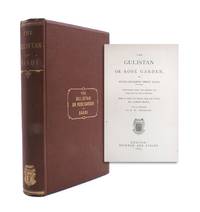
1823réf. 52767London: J. M. Richardson 1823. 8vo pp. 4 475 1; recent half tan calf over marbled boards gilt-lettered direct on gilt-paneled spine; fore-edge of first two leaves very slightly chipped; all else near fine and sound. This is the first volume in the proposed series of English translations of select Persian classics "chiefly intended for the use of the students at their colleges." Wikipedia notes that Abū-Muhammad Muslih al-Dīn bin AbdallÄh ShīrÄzī better known by his pen-name Saadi also known as Saadi of Shiraz was a major Persian poet and literary figure of the medieval period. He is recognized for the quality of his writings and for the depth of his social and moral thoughts. Saadi is widely recognized as one of the greatest poets of the classical literary tradition earning him the nickname "Master of Speech" or "The Master" among Persian scholars. The Gulistan containing stories and personal anecdotes was completed in 1258. It is "interspersed with a variety of short poems which contain aphorisms advice and humorous reflections demonstrating Saadi's profound awareness of the absurdity of human existence. J. M. Richardson unknown books
1865réf. 333537Boston: Ticknor and Fields 1865. First American edition and first edition thus of this translation with preface by Emerson. 379pp. 8vo. Original brick cloth. Binding has light soiling with rubbing and few tiny tears at tips of spine else a very good bright copy with text fresh and clean. First American edition and first edition thus of this translation with preface by Emerson. 379pp. 8vo. A nice association copy; John Albee was a friend of Ralph Waldo Emerson and he wrote 'Reminiscences of Emerson' 1882; reprinted in 'Concord Lectures in Philosophy'Myerson E202 and 'Remembrances of Emerson' 1901; revised edition 1903. Persian poet Musle-Huddeen Sheik Saadi 1184-1291 was born in Shiraz. In Emerson's introduction he explains the reason for the late date of publication "The slowness to import these books into our libraries-mainly owing no doubt to the forbidding difficulty of the original languages- is also due in part to some repulsion in the genius of races. At first sight the Oriental rhetoric does not please our Western taste . " Francis Gladwin translated several of the Oriental writers and wrote a "History of Hindostan." In addition to his numerous translations he also produces several vocabularies and grammatical works including a Persian-Hindustani-English dictionary which was published in 1809. In the 1860's there was a revival of interest in the Persian poems at the time of and following the publication of the "Rubaïyat." Sa'dî was an early 12th century Persian poet described by the "Encyclopedia Britannica" as "the greatest didactic poet and the most popular writer of Persia." Richard Burton and Sir Edwin Arnold both were interested in him and translated his works as did several others. This work is described by Gay Wilson Allen as a "humorous miscellany of ethical subjects in rhymed prose." p. 481 Saadi was Emerson's favorite poet in fact apparently he considered using Saadi in "Representative Men" in place of Shakespeare. Emerson became acquainted and then enamoured of the Persian poets in the late 1830's. Originally he had read Saadi in a German translation. In 1841 he wrote a poem for "The Dial" entitled "Saadi" German thought Oriental influences and Platonic thought were all integral parts of the New England Transcendentalists. Myerson D55 Ticknor and Fields unknown books
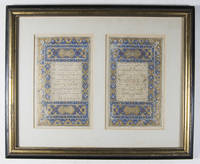
réf. 43594Persia ca. late 15th century. Framed. 2 beautifully illuminated manuscript leaves from the Kulliyat collected works of Saadi the famed Persian poet from Shiraz. Remounted and matted. Wood frame painted in black and gold measuring 13x16". Possibly early Safavid Era. Text in Persian. unknown books
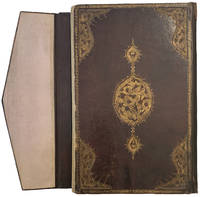
1800réf. MEE1104Persia: undated pre-1800. 1800. 11.25 x 7.5 inches. ca. 228 leaves Written mostly in old Farsi with some Arabic marginal notes. With one leaf f. 66 illuminated on upper quadrant another 2 leaves with a penciled sketch where an illumination was planned but never completed ff. 108 170. There are numerous decorative motifs of flowers throughout the manuscript. Each leaf is variously partitioned perhaps suggestive of a garden! in this case with flowers adorning most leaves. Binding style suggests 18-19th centuries. Bound in Islamic style Ottoman period full Turkey morocco with elaborate gilt rule corner and centre ornamental flourishes with leather flap; some minor repairs to the sides of the binding are evident when examined closely. MANUSCRIPT OF SAADI' GOLESTAN THE GREAT PERSIAN POET: ORIGINAL COMPLETE MANUSCRIPT OF ONE OF THE MOST FAMOUS OF ALL PERSIAN POETS SA'ADI OF SHIRAZI. The calligraphic style and the binding are suggestive of the 16th or 17th century. This piece is embellished with numerous leaves many of which are decorated by hand with small compartments of flowers each realized from the title of Sa'adi's Gulistan Golestan Flower Garden of Sa'adi. Sa'adi is "probably the single most influential work of prose in the Persian tradition completed in 1258 by Mosarref-al-Din Mole known as Shaikh Sa'di of Shiraz." – Encyclopaedia Iranica. The manuscript is mixed with both poetry and stories or narratives along with a moral as well as some commentaries. PROVENANCE: Signed Kiffin Yates Rockwell 1892–1916 later label of: Kiffin Ayres Rockwell Beloit Wisconsin June 28 1942. Kiffin Yates Rockwell was a World War I fighter pilot and the first American to shoot down an enemy aircraft in WWI. He shot down a German pilot. Thus the manuscript is clearly in the United States and kept there since before 1942. "Kiffin Yates Rockwell the youngest son of James Chester and Loula Ayres Rockwell." see below. What may clear up some confusion here is that there are at least two persons with this name and there may be three. Kiffin Ayres Rockwell II or III Oct. 8 1917-Jan. 27 1998 who served in the air force in Korea is buried in Black Mountain North Carolina. Sa'adi opens with poems of Sa'eb of Tabriz a Safavid poet of Indian style of poetry added to the text. "Back of the shell kingly gems are orphans." undated [pre-1800]. hardcover books