4 552 résultats
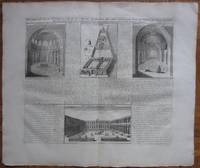
1720réf. 144611720. Chatelain Henri Abraham. Atlas Historique 1720. Original large-format engraving depicting the architectural design and interior arrangement of a Persian mosque during the late Safavid period 1501-1736. Published for European readers in the early eighteenth century the plate presents several views of the mosque including its exterior interior and monumental central courtyard surrounded by arched structures. The illustrations record architectural features associated with Persian Islamic religious buildings particularly the arrangement of open courtyards arcaded galleries and enclosed spaces for worship. Accompanying French explanatory text identifies and describes elements of the complex documenting how Persian religious architecture was presented to European audiences during the reign of Shah Sultan Husayn 1694-1722. Chatelain Henri Abraham. Atlas Historique ou Nouvelle Introduction à l'Histoire à la Chronologie et à la Géographie Ancienne et Moderne. Paris 1720. Original copperplate engraving measuring 54 x 43 cm. The large sheet combines multiple architectural perspectives of a Persian mosque with descriptive text in French. The principal illustrations show the building's exterior and interior while a separate view presents its spacious central courtyard enclosed by arched galleries and surrounding structures. Architectural details repeated arches and the arrangement of the mosque's principal spaces are rendered through precise engraved linework. The plate was issued in connection with Chatelain's Atlas Historique an illustrated geographical and historical encyclopedia published in Amsterdam between 1705 and 1720. Its text was compiled by Nicolas Gueudeville and Garillon with supplementary contributions by H. P. de Limiers while Chatelain produced maps and engravings many of his maps drawing upon the cartographic work of Guillaume de l'Isle. The engraving dates from the final years of Safavid rule when Persian mosque architecture was widely associated with the monumental religious buildings developed under Shah Abbas I and his successors particularly in Isfahan. Chatelain's Atlas Historique combined geography chronology genealogy topography heraldry and architectural illustration to introduce European readers to the histories and cultures of different regions. This plate's combination of exterior elevations interior views courtyard architecture and French explanations provides a detailed example of early eighteenth-century European documentation of Persian Islamic architecture. In very good condition. unknown books
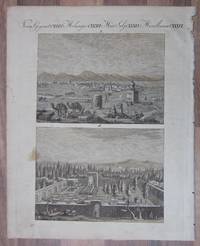
1790réf. 143591790. Bertuch Friedrich Justin. Engraved views of Shiraz and the tomb of Hafez circa 1790 to 1830 present the Persian city and the burial place of its celebrated fourteenth-century poet to a European readership through Bertuch's illustrated educational publishing project. Issued as part of a series published in monthly installments across twelve volumes the plate is accompanied by explanatory text in German French English and Italian. The English text describes Persia as one of "the remarkable empires" of Asia and supplies contemporary European descriptions of Shiraz and the burial place of Hafez preserving both the geographical information and cultural perceptions through which European readers encountered Persia. Bertuch Friedrich Justin. Engraved views of Shiraz and the Tomb of Hafez. Circa 1790-1830. Page measures 8.5 x 7.25 inches. The sheet contains two separate engraved views. The first presents Shiraz spread across a broad valley beneath surrounding mountains with camels and travelers occupying the foreground. Its accompanying English text describes Shiraz as "situated in an extensive and beautiful valley; but now-a-days its ancient splendor is greatly gone to decay." The second view depicts the tomb of the Persian poet Hafez amid tall trees and distant hills. Two original double-sided sheets of descriptive text accompany the engraving with parallel accounts in German French English and Italian. The text identifies the burial site as containing the tomb of Hafez together with those of two of his disciples and a prince. Originally published by Friedrich Justin Bertuch as part of his long-running illustrated series intended to disseminate information about the natural world geography history and different cultures the plate records the transmission of information about Persia to a multilingual European audience around the turn of the nineteenth century. Its treatment of Hafez is particularly tied to the period's growing European attention to Persian literature: the engraving presents the poet not through his verse but through his burial place making the Shiraz landscape and Hafez's tomb part of the visual geography through which European readers encountered Persian culture. The survival of the two original multilingual text sheets preserves the explanatory apparatus issued with the images and allows the engraved views to be read alongside their contemporary descriptions. Engraving with a few marks and one .25-inch brown spot; accompanying sheets present. Overall good condition. unknown books
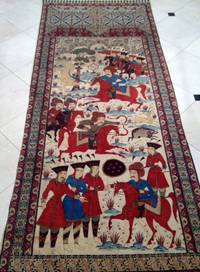
1890réf. 146641890. Hand painted Persian textile depicting Shah Abbas I nineteenth century a monumental example of Qajar period revivalist visual culture that reinterprets Safavid imperial iconography to articulate Persian kingship martial virtue and historical memory. Centered on one of the most mythologized rulers in Iranian history the composition presents a continuous figural narrative in which Shah Abbas I appears mounted on horseback in a royal hunt sword drawn as he confronts a lion while turbaned cavalry attendants bearing spears observe. A secondary vignette shows the Shah pursuing a wild boar reinforcing long standing Persian associations between sovereignty mastery over nature and military prowess. Rendered in a frontal highly legible style with flattened perspective and rhythmic repetition the imagery translates the visual language of Persian manuscript illustration into large scale textile form reflecting nineteenth century Qajar engagement with earlier Safavid models of centralized authority and dynastic legitimacy. Hand painted Persian figural textile. Qajar period nineteenth century. Approximately 117.5 x 51 inches 9.8 x 4.25 feet. The upper register introduces a martial tableau of Persian warriors confronting Indian soldiers mounted on elephants imagery that evokes enduring visual memory of imperial expansion and recalls narratives associated with Nader Shah's eighteenth century campaigns against the Mughal Empire. In the Qajar period particularly in the later nineteenth century Safavid rulers such as Shah Abbas were repeatedly invoked across painting lacquer and textile production as symbols of national continuity and restored sovereignty. This textile operates within that historicist framework layering Safavid royal imagery with later martial memory to construct a composite vision of Persian power across centuries. Minor edge tears including one approximately 1 inch and three approximately 3 inches within the border and along the edge not affecting the central figural imagery; colors remain bold and composition visually strong. Overall condition: very good. unknown books
1906réf. 144731906. Jackson A. V. Williams. Persia Past and Present: A Book of Travel and Research 1906. First edition of the American scholar's account of his 1903 journey through Persia combining firsthand observations of Zoroastrian religious communities with investigations of ancient Persian history archaeology language and literature. Jackson 1862-1937 professor of Indo-Iranian languages at Columbia University and an authority on Zoroastrianism and the Avesta traveled to Persia principally to meet Zoroastrians and examine the religious traditions and historical sites associated with their faith. His narrative follows a journey through Qajar Iran during the reign of Mozaffar al-Din Shah 1896-1907 recording religious practices archaeological monuments and conditions in Persian cities and provincial settlements. Published three years after his travels the book preserves observations of Zoroastrian communities in Yazd and other regions shortly before the Persian Constitutional Revolution transformed the country's political institutions. Jackson A. V. Williams. Persia Past and Present: A Book of Travel and Research. New York: The Macmillan Company 1906. First edition. One volume 8vo 471 pp. complete with all 136 illustrated plates 220 photographic illustrations and a large color folding map of Persia and Afghanistan at the rear. Original dark blue cloth binding with gilt pictorial decoration on the front cover gilt lettering on the spine and top edge gilt. Jackson's itinerary includes Tabriz Lake Urmia Hamadan Isfahan Persepolis Shiraz Yazd Tehran and Mazandaran. His chapters examine Zoroastrian religious customs in Yazd ancient fire temples the Behistun inscription the ruins of Persepolis and the tomb of Cyrus the Great at Pasargadae. The photographic illustrations and plates reproduce archaeological remains religious sites historical monuments and contemporary Persian landscapes while the folding map provides geographical context for his travels. Jackson's investigations connected the study of ancient Iranian religious texts with surviving Zoroastrian practices in early twentieth-century Persia. His descriptions of the Zoroastrians of Yazd their religious observances and their historical relationship to pre-Islamic Persian traditions extend beyond conventional travel writing into the comparative study of religion and Iranian antiquity. His accounts of Achaemenid monuments and inscriptions also record the condition of major archaeological sites before extensive twentieth-century excavation and restoration. The original binding shows rubbing to the corners and edges some cover soiling not affecting the gilt illustration fraying at the spine ends and cuts at the spine tail. Hinges have been repaired. Complete with the illustrations and folding map present; overall in very good condition. unknown books
1885réf. 143011885. Iran Art Qajar School Lovers in Embrace gouache painting on paper nineteenth century represents the courtly aesthetic erotic refinement and dynastic visual language that defined Persian painting under Qajar rule. The composition situates a princely male figure and his adorned companion in intimate embrace reinforcing themes of aristocratic leisure romanticized sovereignty and elite identity in Qajar Iran. The work supports research in Persian court painting gender representation in Islamic art Qajar costume and regalia and nineteenth century Iranian material culture. Persian Qajar gouache on paper with gold illuminated border. Depicts a young prince wearing blue and gold coat and karakul headgear embracing female companion adorned with tiara and pearls. Floral and animal illuminated margins including deer and monkeys. Image size 18.5 x 11 inches. The prince's distinctive headgear confirms Qajar rather than Zand period attribution aligning the work with the heightened stylization and opulent textile rendering characteristic of nineteenth century Tehran ateliers. Comparable compositions appear in Qajar painting traditions associated with artists such as Mohammad Sadiq whose courtly embrace scenes similarly emphasize costume detail glassware and staged intimacy as markers of refinement. The illuminated border populated by floral and animal motifs situates the lovers within a cosmological and decorative framework typical of Qajar manuscript aesthetics adapted to single-sheet painting. Minor browning to margins and discreet restoration to verso margins not affecting image. Very good. A refined example of Qajar visual culture centered on dynastic elegance and performative intimacy. unknown books
1961réf. 126414New York: Pantheon Books 1961. Second edition. Hardcover. 239 pages. The Bilingual Edition with translation by Wallace Fowlie. Number 67 in the Bollingen Series. An about near fine copy with some wear to the top corners but otherwise a clean copy. No dust jacket. Pantheon Books unknown books
1961réf. 007445New York: Bollingen Series 1961. First Edition. wraps. Fine. Bloomfield & Mendelson B77. Published in an edition of 2500 copies none of which were for sale in white card covers with a grayish green printed wrapper. This is St.-John Perse's Nobel Acceptance Speech translated by Auden and printed here in both the original French and Auden's English translation. SIGNED by Auden on the title page. Quite uncommon especially signed. Bollingen Series paperback books
1977réf. 9034108Princeton: Princeton University Press 1977. 1st. Hardcover. Fine/fine. Translated from the French by Richard Howard. Bollingen Series LXIX:2. Princeton University Press hardcover books
1948réf. 88994Paris: Gallimard 1948. Fifth Edition first published in 1910 softcover. Octavo 23.5cm; beige paper wrappers; fore-edge untrimmed; unpaginated. Text in French. Some pages of text unopened. Tanned with modest shelf-wear and soil; Very Good. French poet's first collection of verse. 88994. Gallimard unknown books
1948réf. 88996Paris: Gallimard 1948. Fifth edition revised and corrected softcover. Octavo 24cm; beige paper wrappers; all edges untrimmed; glassine dustwrapper; unpaginated. Text in French. Some pages of text unopened. Light shelf-soil with pencilled price to front endpaper; Very Good. Glassine dustwrapper spine-tanned; Very Good. This edition includes a bibliography. 88996. Gallimard unknown books
1946réf. 88995Paris France: Gallimard 1946. First Edition. Softcover. Octavo 23.5cm; beige paper wrappers; adhered glassine wrapper; all edges untrimmed; unpaginated. Text in French. Some pages of text unopened. Light shelf-wear; Very Good. Glassine dustjacket is taped to wrappers and is spine-tanned; Very Good. Collection of verse. 88995. Gallimard unknown books
1957réf. 87422Paris: Gallimard 1957. First Edition. Trade issue after 680 copies making up various limitations. Small quarto. Orange printed paper wrappers; 1864pp. Text unopened. In the original wrappers sunned on spine slightly toned and dusted else a very nice copy Very Good or better. Text entirely in French. Gallimard unknown books
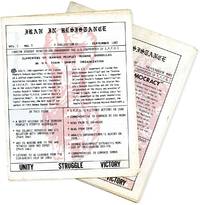
réf. 88373Philadelphia: Iran Student Association 1983. Two issues in original wrappers. Stapled paper self-wraps covers printed in two colors; 28pp 36pp; illus. Mild foxing at margins else Very Good. Text entirely in English. Organ of the American student arm of the Iranian People's Fedayee Fedai Guerrillas an Iranian guerrilla communist group that opposed both Western capitalism and the 1979 Islamic Revolution the latter chiefly from exile. This group is not to be confused with the Organization of Iranian People's Fedai Guerrillas from which the IPFG split in 1979 citing the former's lack of dedication to the principles of armed struggle. The magazine's contents are a combination of attacks on Iran's "imperialist" Islamic regime and on the foreign policy of the United States which the organization blames for laying the foundation for the Islamic revolution beginning with the CIA coup of 1953. A rare publication from a key period in modern Iranian history before the Islamic Republic had irrevocably consolidated power. This periodical rare; OCLC notes only about five locations for any holdings in the U.S. all for later issues. unknown books
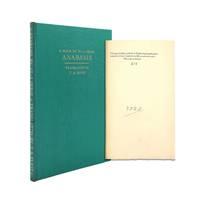
1971réf. 84004Princeton: Princeton University Press 1971. First French/English edition. Octavo 20.5cm; blue cloth-covered boards with titling and blocking stamped in gilt and blue on spine; dustjacket; 682pp. Number 87 LXXVII in Bollingen Series. Upper spine lightly convexed else Near Fine. Dustwrapper unclipped priced $15.00 tanned with modest rubbing to spine ends and extremities; Very Good. Includes Perse's Nobel Prize for Literature speech 1960 T.S. Eliot's translation of Anabase Anabasis Hugh Chisholm's translation of Vents Winds Robert Fitzgerald's translation of Oiseaux Birds and more. 84004. Princeton University Press unknown books
réf. 14787A set of 5 vintage black and white photographs measuring approximately 6x6" depicting landscapes and landmarks in Iran. In two of the photos Daniel's Tomb stands on an arid plain its conical spire rising above the nearby trees. In two other photos the remains of a watch tower jut out of the rocky desert landscape while in the foreground a man in Persian clothing observes his pack mules as they forage for grass. The final photo depicts an Iranian farmer and his two sons and they prepare the land for planting; they till the ground at the base of the mountains. All photos in very good condition. unknown books
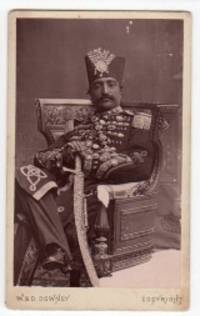
1880réf. 146901880. Carte de Visite CDV of Naser al-Din Shah Qajar of Persia Iran c. 1880. 4"x2.5" sepia photo depicts the shah seated confidently in full royal uniform including elaborate jewelry on his jacket and headgear with his jewel encrusted sword prominently displayed. Naser al-Din Shah Julywas the Shah of Qajar Iran from 5 September 1848 to 1 May 1896 when he was assassinated. Below the image is the photographer's imprint "W&D Downey." On the verso is the photographer's emblem "W&D Downey Photographer to Her Majesty." Some minor scratches including a small tiny emulsion missing on the armchair. Overall very attractive. unknown books
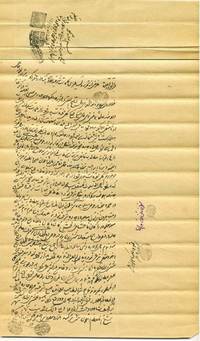
1916réf. 146831916. Antique Qajar hand written Document dated AH 1335 1916 about the leasing/ renting/purchasing of some commercial or residential places in Gilan province of Iran. Approximately 14" x 8.4" includes 8 seals. A scarce historical item with some expected folds for storing the document. In very good condition. unknown books
1900réf. 145631900. Collection of two photographic lantern slides of Iran circa 1900 documenting village commerce vernacular architecture and camel transportation at the turn of the twentieth century. The images record daily activity within mud-brick settlements including villagers gathered in a public square and camels resting inside a walled enclosure. Particularly notable is the presence of a traditional wind tower or badgir an architectural feature associated with Yazd and other arid regions of central and southern Iran. The photographs preserve details of settlement design commercial activity and animal transportation during the late Qajar period when camel caravans continued to carry goods and travelers between Iranian towns and regional markets. Two photographic glass lantern slides circa 1900 each measuring approximately 3 1/4 x 4 inches. The first depicts an open square surrounded by mud-brick buildings with men women and children gathered in small groups near large sacks or bundles possibly containing merchandise or provisions. A prominent badgir rises above the surrounding structures identifying a traditional method of passive ventilation employed in Iran's hot dry climate. The second slide shows several saddled camels resting within a walled village courtyard or caravan enclosure. One camel lies prominently in the foreground while additional animals and villagers occupy the space beside the surrounding mud-brick buildings. The saddles and enclosed setting suggest a stopping place associated with caravan travel although the precise location is unidentified. The photographs date to a period when established caravan routes connected Iranian settlements and commercial centers with camels providing transportation across regions where wheeled vehicles faced difficult terrain and limited road infrastructure. The wind tower and mud-brick buildings also record architectural adaptations to local climatic conditions while the populated square preserves details of everyday activity in a provincial settlement. Both slides in very good condition. Two early photographic views preserving distinct aspects of Iranian village life regional transportation and traditional architecture during the Qajar era. unknown books
1882réf. 146821882. Very Rare early lithographic printed Qajar Newspaper Urduye Humayun Number 6 issued on 23 Ramazan AH 1300 1882. The newspaper is regarding the Qajar ruler Naser Al-Din Shah's trips in the country. 4 complete pages approximately 13"x 8.6" in size. The first newspaper ever printed in Tehran was published in 1837 with only three issues printed from May-August 1837. The first lithographic book to be published in Tehran was in 1838. However as one observer to Tehran reported in 1843 the lithographic press in Tehran "remained mainly idle". Berezin p. 248. In the latter part of the 1840s the State Printing House began its work; and was operative until the end of the first decade of the 20th century. As of February 1851 the first Persian regular official newspaper was printed there. Early into the 20th century the lithographic press was being forced out by typeset printings and from 1911-on the official newspapers in Iran was printed typographically. Encycolpaedia Iranica online ed Our Qajar newspaper from 1882 is a rare example of the very early lithographic printing to take place in Iran before the switch to typographical printing. Small paper loss to top right corner of margin does not affect the text. Overall in very good condition. unknown books
1970réf. 19821Paris: Union des Etudiants Iraniens en France n.d. but ca.early 1970's. Original silkscreened poster printed and illustrated in black on white Gaubert Japon stock measuring 32.5cm x 50cm 12 7/8" x 19 6/8". Creasing and light wear to extremities with a single tiny tear to right margin; Very Good. Poster created by the Union of Iranian Students in France in opposition to Shah Reza Pahlavi's directive to send Iranian troops into Oman. The UK Jordan and Iran provided military support to Sultan Qaboos bin Said Al Said against guerrilla forces during the Dhofar insurgency in the early 1970's. The poster is not listed in OCLC and any material produced by the Union des Etudiants Iraniens en France held institutionally is represented by 3 or fewer examples. Union des Etudiants Iraniens en France unknown books
1949réf. 338782New York: Pantheon Books/Bollingen Series 1949. First edition. 166 pp. 4to. Black boards with white lettering and gilt on front board and spine pages are bright; fine. Dust jacket is perished head of spine with tearing and creasing along top of verso. Tear along bottom of verso and some small tears on bottom of front with light bumping at corners and rubbing at edges; overall a very good copy. Publisher's advance slip laid in. First edition. 166 pp. 4to. Pantheon Books/Bollingen Series unknown books
1930réf. 324915London: Faber 1930. First edition. One of 350 copies signed by T. S.Eliot. 75 pp. 1 vols. Tall 8vo. Green cloth titled in gilt t.e.g. Fine copy light paste action to endpapers in edgeworn publisher's slipcase. First edition. One of 350 copies signed by T. S.Eliot. 75 pp. 1 vols. Tall 8vo. T. S. Eliot won the 1948 Nobel Prize in Literature. Gallup A16b Faber unknown books
1957réf. 311800Paris: Gallimard 1957. First edition number 91 of 105 copies on velin pur fil Lafuma-Navarre. 189 pp. 4to. Original wrappers; glassine. Wrappers evenly toned small edge-tear to front wrapper otherwise near fine. First edition number 91 of 105 copies on velin pur fil Lafuma-Navarre. 189 pp. 4to. Gallimard unknown books
1951réf. 91416Buenos Aires: Editorial Sudamericana 1951. First edition. 141 pp. Very good plus in printed wrappers with light sunning to spine a small chip and a clip to the rear flap. INSCRIBED by Larreta de Alzaga to St. John Perse in Buenos Aires in 1960 with a long inscription in her hand incorporating some of his own lines. Perse of course in addition to being a Nobel prize winning poet had a distinguished parallel career as a French diplomat in Asia and South America. Buenos Aires: Editorial Sudamericana unknown books
1950réf. 91417Buenos Aires: Editorial Sudamericana 1950. First edition. 158 pp. Light tanning and rubbing to spine else near fine in printed wrappers. Prologue by Juan Ramón Jiménez. INSCRIBED by Munoz Larreta to St. John Perse in Buenos Aires in 1960 and with a correction to one poem in her hand. Buenos Aires: Editorial Sudamericana unknown books