4 879 résultats
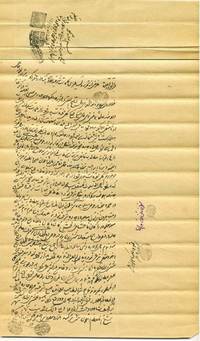
1916réf. 146831916. Antique Qajar hand written Document dated AH 1335 1916 about the leasing/ renting/purchasing of some commercial or residential places in Gilan province of Iran. Approximately 14" x 8.4" includes 8 seals. A scarce historical item with some expected folds for storing the document. In very good condition. unknown books
1900réf. 145631900. Collection of two photographic lantern slides of Iran circa 1900 documenting village commerce vernacular architecture and camel transportation at the turn of the twentieth century. The images record daily activity within mud-brick settlements including villagers gathered in a public square and camels resting inside a walled enclosure. Particularly notable is the presence of a traditional wind tower or badgir an architectural feature associated with Yazd and other arid regions of central and southern Iran. The photographs preserve details of settlement design commercial activity and animal transportation during the late Qajar period when camel caravans continued to carry goods and travelers between Iranian towns and regional markets. Two photographic glass lantern slides circa 1900 each measuring approximately 3 1/4 x 4 inches. The first depicts an open square surrounded by mud-brick buildings with men women and children gathered in small groups near large sacks or bundles possibly containing merchandise or provisions. A prominent badgir rises above the surrounding structures identifying a traditional method of passive ventilation employed in Iran's hot dry climate. The second slide shows several saddled camels resting within a walled village courtyard or caravan enclosure. One camel lies prominently in the foreground while additional animals and villagers occupy the space beside the surrounding mud-brick buildings. The saddles and enclosed setting suggest a stopping place associated with caravan travel although the precise location is unidentified. The photographs date to a period when established caravan routes connected Iranian settlements and commercial centers with camels providing transportation across regions where wheeled vehicles faced difficult terrain and limited road infrastructure. The wind tower and mud-brick buildings also record architectural adaptations to local climatic conditions while the populated square preserves details of everyday activity in a provincial settlement. Both slides in very good condition. Two early photographic views preserving distinct aspects of Iranian village life regional transportation and traditional architecture during the Qajar era. unknown books
1882réf. 146821882. Very Rare early lithographic printed Qajar Newspaper Urduye Humayun Number 6 issued on 23 Ramazan AH 1300 1882. The newspaper is regarding the Qajar ruler Naser Al-Din Shah's trips in the country. 4 complete pages approximately 13"x 8.6" in size. The first newspaper ever printed in Tehran was published in 1837 with only three issues printed from May-August 1837. The first lithographic book to be published in Tehran was in 1838. However as one observer to Tehran reported in 1843 the lithographic press in Tehran "remained mainly idle". Berezin p. 248. In the latter part of the 1840s the State Printing House began its work; and was operative until the end of the first decade of the 20th century. As of February 1851 the first Persian regular official newspaper was printed there. Early into the 20th century the lithographic press was being forced out by typeset printings and from 1911-on the official newspapers in Iran was printed typographically. Encycolpaedia Iranica online ed Our Qajar newspaper from 1882 is a rare example of the very early lithographic printing to take place in Iran before the switch to typographical printing. Small paper loss to top right corner of margin does not affect the text. Overall in very good condition. unknown books
1949réf. 338782New York: Pantheon Books/Bollingen Series 1949. First edition. 166 pp. 4to. Black boards with white lettering and gilt on front board and spine pages are bright; fine. Dust jacket is perished head of spine with tearing and creasing along top of verso. Tear along bottom of verso and some small tears on bottom of front with light bumping at corners and rubbing at edges; overall a very good copy. Publisher's advance slip laid in. First edition. 166 pp. 4to. Pantheon Books/Bollingen Series unknown books
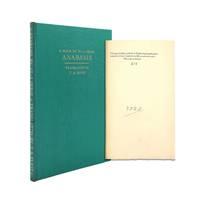
1930réf. 324915London: Faber 1930. First edition. One of 350 copies signed by T. S.Eliot. 75 pp. 1 vols. Tall 8vo. Green cloth titled in gilt t.e.g. Fine copy light paste action to endpapers in edgeworn publisher's slipcase. First edition. One of 350 copies signed by T. S.Eliot. 75 pp. 1 vols. Tall 8vo. T. S. Eliot won the 1948 Nobel Prize in Literature. Gallup A16b Faber unknown books
1957réf. 311800Paris: Gallimard 1957. First edition number 91 of 105 copies on velin pur fil Lafuma-Navarre. 189 pp. 4to. Original wrappers; glassine. Wrappers evenly toned small edge-tear to front wrapper otherwise near fine. First edition number 91 of 105 copies on velin pur fil Lafuma-Navarre. 189 pp. 4to. Gallimard unknown books
1951réf. 91416Buenos Aires: Editorial Sudamericana 1951. First edition. 141 pp. Very good plus in printed wrappers with light sunning to spine a small chip and a clip to the rear flap. INSCRIBED by Larreta de Alzaga to St. John Perse in Buenos Aires in 1960 with a long inscription in her hand incorporating some of his own lines. Perse of course in addition to being a Nobel prize winning poet had a distinguished parallel career as a French diplomat in Asia and South America. Buenos Aires: Editorial Sudamericana unknown books
1950réf. 91417Buenos Aires: Editorial Sudamericana 1950. First edition. 158 pp. Light tanning and rubbing to spine else near fine in printed wrappers. Prologue by Juan Ramón Jiménez. INSCRIBED by Munoz Larreta to St. John Perse in Buenos Aires in 1960 and with a correction to one poem in her hand. Buenos Aires: Editorial Sudamericana unknown books
1964réf. 91415Paris: Le Terrain Vague 1964. First edition. 106 pp. Bump to one upper corner else near fine in printed wrappers with light tanning to spine. Contemporary presentation admiringly inscribed by the author on the half-title to St. John Perse whose AMERS 1957 provided the first of five printed epigraphs to the present work. Perse has evidently tipped onto the initial blank the return address from the envelope in which this copy reached him. Paris: Le Terrain Vague, unknown books
1962réf. 79958NY: Pantheon 1962. Second US printing with new bibliographic note. 99 pp. Near fine in near fine clipped and re-priced dust jacket. Inked owner’s name on title page. Cover art by E. McKnight Kauffer. Original French poems with facing English translations by Denis Devlin. Bollingen Series XV. NY: Pantheon unknown books
1971réf. 51584Washington DC: Library of Congress 1971. First edition. iii 82 pp. Very near fine in printed wrappers. An essay and substantial bibliography. Laid-in are review and promotional materials. Washington DC: Library of Congress, unknown books
1961réf. 25535NY: Bollingen 1961. First edition. 21 pp. Fine in stiff wrappers and near fine integral dust jacket with lightly sunned spine. Perse’s original French text followed by W.H. Auden’s English translation. NY: Bollingen unknown books
1949réf. 25508New York: Pantheon Books The Bollingen Series 1949. Cloth. Near Fine/Very Good. A solid copy of the 1949 1st American edition translated from its original French by Denis Devlin. Tight and Near Fine in a crisp price-clipped VG example of the E. McKnight Kauffer-illustrated dustjacket with very light chipping and creasing --and several small closed tears-- along the top-edges and mild chipping at the spine crown. Tall quarto #15 in Pantheon's and soon to be Princeton University Press's formidable Bollingen series. Pantheon Books (The Bollingen Series) unknown books
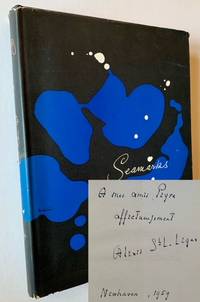
1958réf. 19209New York: Pantheon Books The Bollingen Series 1958. Decorative Cloth. Near Fine/Near Fine. WARMLY INSCRIBED BY SAINT JOHN PERSE USING HIS REAL NAME "ALEXIS SAINT LEGER" TO PRE-EMINENT LITERARY SCHOLAR AND YALE PROFESSOR HENRI PEYRE on the front free endpaper. A very sharp copy to boot of the 1958 1st American edition. Clean and Near Fine just a touch of light offsetting at the front inner hinge in a crisp price-intact Near Fine dustjacket with very mild chipping along the spine ends and the top-edges. Tall quarto wonderful dustjacket design by Paul Rand. Translated from its original French by Wallace Fowlie part of the formidable Bollingen Series in this case LXVII. Pantheon Books (The Bollingen Series) unknown books
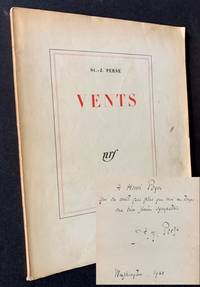
1946réf. 19265Paris: Librairie Gallimard 1946. Original wraps. Very Good . WARMLY INSCRIBED BY ST.-JOHN PERSE TO PRE-EMINENT LITERARY SCHOLAR AND YALE PROFESSOR HENRI PEYRE on the front free endpaper. A solid very presentable copy to boot of the 1946 1st edition. #2236 of 2350 copies "sur papier de chataignier". Bright and VG in its off-white wrappers with very light soiling to the front panel and mild offsetting creasing and soiling at the rear panel. Very small paper cuts along the fore-edges of the preliminaries otherwise clean as could be internally with no writing or markings to speak of. Tall quarto one of the Nobel Prize winner's long poems written during his American "exile Librairie Gallimard unknown books
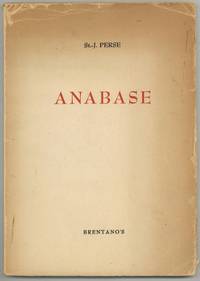
1945réf. 594912New York: Brentano's 1945. Softcover. Very Good. Limited Brentano's edition. Text in French. Small quarto. Printed wrappers. First page with ink owners name toned chipped and creased along the wrap edges very good overall. Includes a four-page essay by T.S. Eliot at the back printed in English. Numbered 82 of 1200 copies. Brentano's unknown books
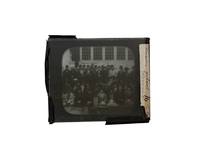
réf. 17100Vintage Optical Lantern images of school students in Iran circa late 19 cent glass size is about 4" x 3.25" . One image hand-labeled "Persian School" in ink and "Teheran" in pencil show around 40 students and their teachers in traditional Persian Qajar era outfit and hat. Many are seated on a carpet and some standing in behind them all are in front of their schoolhouse. In the front we see the typical water basin "hose" that would be found at the center of most courtyards of that period. The studentsrange in age from children to young men the older ones are probably the teachers. in very good condition. Original images of the Qajar period are scarce. unknown books
1682réf. 144001682. De Vries Simon. Persian royal court scene 1682 depicts kingship judgment and punishment in a European publication describing Persia and other regions of Asia Africa and the Americas. Issued during the Safavid period the scene places a Persian ruler above assembled courtiers and judges while a kneeling governor is restrained before him presenting Dutch readers with a visual account of royal authority and judicial punishment in seventeenth-century Persia. De Vries compiled his extensive geographical work from earlier travel and eyewitness accounts rather than presenting it as the record of his own travels. De Vries Simon. Curieuse aenmerckingen der bysonderste Oost en West-Indische verwonderens-waerdige dingen; nevens die van China Africa en andere gewesten des werelds. Utrecht: Johannes Ribbius 1682. Original etching on laid watermarked paper. Image 6" x 7.5"; overall sheet 8.25" x 6.5". A Persian king occupies an elevated carpeted throne above an assembly of courtiers and judges. Below him a governor kneels while another figure restrains him establishing punishment as the central action of the composition. Most of the assembled figures wear turbans and long garments; several others have markedly different European-style headwear. Through an architectural opening additional guards appear within the palace setting. Small numbers incorporated into the composition correspond to explanatory text printed in early Dutch above the image linking individual figures and actions to De Vries's written account. Published at Utrecht by Johannes Ribbius De Vries's Curieuse aenmerckingen appeared in four parts in 1682 and compiled European accounts of geography customs religion government and court practices across numerous regions. Bibliographic records confirm both the four-part publication and its substantial series of engraved plates. The present scene documents how Persian royal government and judicial authority were explained pictorially to a late seventeenth-century Dutch readership with the numbered key allowing the image to be interpreted alongside the accompanying text. Uncut as published; overall excellent condition. The watermark surviving margins numbered explanatory system and detailed court scene preserve material and textual evidence of the engraving's original use as an illustration within De Vries's 1682 geographical compilation. unknown books
1959réf. 146941959. Collection of four large vintage black and white photos. The first three photos depict Mohammad Reza Shah Pahlavi Shah of Iran and U.S. President Dwight D. Eisenhower in the lavish Crystal Room of the Palace of Tehran in 1959. Images are approximately 9.5"x6.5". These photos are taken during the Tehran Conference. The first and second images show the full landscape of the palace's Crystal Room capturing its shimmering mirrored walls. The third image is a close up of the dignitaries. In all three the Shah and President are accompanied by Queen Soraya and Zahedi. The fourth photo shows the Shah and his new wife Farah Diba in wedding attire following their marriage in 1959. All 4 in very good condition. unknown books
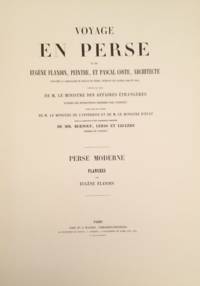
réf. 145801976. Flandin Eugène. Voyage en Perse. Perse Moderne Planches documents the architecture cities and landscapes of nineteenth century Iran through the drawings produced during a French archaeological and artistic expedition to the region in 1840. French artist Eugène Flandin traveled to Iran with architect Pascal Coste as part of a diplomatic mission supported by the Académie des Beaux Arts in Paris. During two years of travel across western and southern Iran the expedition produced extensive drawings of monuments urban centers and archaeological sites associated with the Qajar period. These images later formed the basis of Perse Moderne one of the most significant illustrated records of nineteenth century Iran produced by European artists. Flandin Eugène. Voyage en Perse. Perse Moderne Planches. London: Burness Faridany Limited 1976. Limited facsimile edition issued to commemorate the centennial of Flandin's death. Elephant folio measuring approximately 17 x 24 inches. The volume contains one hundred tinted lithographic plates reproducing the illustrations from the original nineteenth century publication. The plates depict architectural monuments and landscapes including royal mosques and palaces the city and ports of Tehran the ruins of Persepolis the tomb of Saadi and other locations recorded during Flandin's expedition. The original Perse Moderne was published in 1854 as part of a large multi volume series documenting the results of Flandin and Coste's travels through Iran. The expedition provided one of the earliest systematic visual surveys of Persian architecture and urban landscapes available to European scholars and artists. Flandin's drawings preserved detailed views of monuments and settlements during the Qajar period and have been widely cited by historians of Persian art and architecture as a major documentary source for nineteenth century Iran. The 1976 edition reproduces these images in a limited printing of six hundred copies allowing modern readers access to the visual material of a work that is otherwise difficult to obtain in its original form. One elephant folio volume with one hundred tinted lithographic plates housed in the original box. Minor handling wear to the box while the volume and plates remain well preserved. Overall condition very good. unknown books
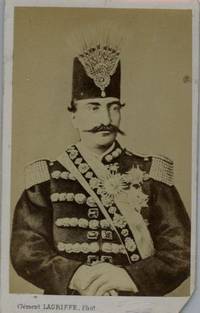
1875réf. 145911875. Iran A set of two vintage albumen photos of Qajar Shahs Nasser-al Din & Mozaffer Ed-Din. The first photo is an albumen Carte de visite photograph of Nasser-al-Din Qajar Shah published by Clement Lagriffe circa 1875. Size: 2.5x4" sepia tone. The second photo captures a stately pose from Qajar Shah Mozaffer Ed-Dine published circa 1900's. Size: 1.6" x 2.9." Bottom right corner of first photo missing. Overall both photos in very good condition. unknown books
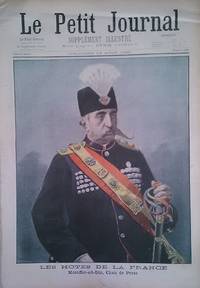
1896réf. 144101896. Three original French illustrated periodicals published between 1896 and 1909 documenting the Qajar monarchy during a period of political upheaval in Persia from the accession of Mozaffar al-Din Shah r. 1896-1907 to the Constitutional Revolution and the accession of Ahmad Shah in 1909. The publications include color portraits of Mozaffar al-Din Shah and photographic coverage of the young Ahmad Shah accompanied by contemporary French reporting. Their publication dates coincide with the expansion of diplomatic relations between Persia and European powers the establishment of constitutional government in 1906 and the revolutionary events that culminated in the deposition of Mohammad Ali Shah in July 1909. Three complete French illustrated magazines comprising 32 pages published in 1896 1900 and 1909. Two eight-page issues of Le Petit Journal each measuring 12" x 17.5" feature colored cover illustrations of Mozaffar al-Din Shah and accompanying articles. The third a sixteen-page issue of Le Monde Illustré measures 11.4" x 15" and includes photographs of Ahmad Shah alongside an article titled "Chah of Persia Ahmed Mirza The Revolution of Persia." The three issues are described chronologically below. 1 Le Petit Journal. Paris 1896. Eight pages. 12" x 17.5". Features a colored cover illustration of Mozaffar al-Din Shah with accompanying French-language reporting. Published in the year of his accession following the assassination of his father Naser al-Din Shah the issue dates from the beginning of a reign that would culminate in the establishment of Persia's first constitutional government. 2 Le Petit Journal. Paris 1900. Eight pages. 12" x 17.5". Features a second colored cover illustration of Mozaffar al-Din Shah with accompanying articles. Published during the Shah's first European tour which included an official visit to France during the Paris Exposition Universelle of 1900 the issue belongs to a period of increased diplomatic contact between the Qajar court and European governments. 3 Le Monde Illustré. Paris 1909. Sixteen pages. 11.4" x 15". Includes photographs of Ahmad Shah also identified as Ahmed Mirza accompanied by the article "Chah of Persia Ahmed Mirza The Revolution of Persia." The issue dates from the culmination of the Persian Constitutional Revolution when constitutionalist forces occupied Tehran deposed Mohammad Ali Shah and proclaimed his twelve-year-old son Ahmad Shah ruler on July 16 1909. The photographs and article provide contemporary French press coverage of the dynastic succession and the constitutionalist victory. The three publications span thirteen years of Qajar rule from the accession of Mozaffar al-Din Shah to the constitutional upheaval that brought Ahmad Shah to the throne. Their colored illustrations photographic portraits and accompanying articles preserve contemporary French reporting on the Persian monarchy before and during the Constitutional Revolution. All three magazines are in very good condition. unknown books
1888réf. 145681888. Collection of 3 chromolithographic prints from The Illustrated History of Costume : period styles and accessories by Albert Racinet published by Firmin Didot & Cie in Paris in 1888. Titled: PERSIA - PERSE- PERSIEN. 7 ½" x 8 ¾". These lithographs beautifully depict Persian costumes and interior décor from Iran. In the first lithograph we can see 10 men and one woman dressed in the various traditional Qajar attires of Iran. The second lithograph shows the beautiful interior décor including very intercate and vibrant Persian rugs elaborately scrolled door and window frames of a Kajar residence. The third lithograph captures five musicians playing various instruments and four women dancers. In very good condition. unknown books
1940réf. 149281940. Two black-and-white photographs of Iran during the 1940s document civilian transportation in Tehran and the Allied movement of American supplies north toward the Soviet Union during World War II. The subjects correspond to Iran's wartime role as the Persian Corridor the overland route through which American and British matériel moved from Persian Gulf ports toward Soviet territory. U.S. Army histories record extensive truck transport through Iran while contemporary diplomatic records document acute Iranian shortages of trucks and tires and Allied efforts to import both commodities during 1942. The first image shows a Tehran street lined with Persian architecture including arched entrances as horse-drawn carriages and wagons move through the roadway. In the foreground a carriage transports a load of imported rubber tires identified as intended for the war effort. The scene records the coexistence of animal-drawn transport and imported automotive supplies during a period when motor transportation had become critical both to Iran's domestic economy and to Allied operations. The photograph measures 8.5 x 6.75 inches. The second image shows a long convoy of American trucks carrying goods for the Soviet Union along a rugged mountain road in northern Iran. Comparable Office of War Information photographs from 1943 record American Army convoys negotiating Iranian mountain passes while carrying supplies for Russia identifying such movements as part of the Persian Corridor supply operation. The two photographs preserve contrasting aspects of wartime transportation in Iran: urban traffic and material shortages in Tehran and the mechanized Allied supply traffic moving through the country toward the Soviet Union. The first photograph has slight waviness at the middle edges and a bumped lower left corner; otherwise both photographs are in very good condition. The pair provides direct visual documentation of Iran's transportation landscape during World War II and of the logistical activity generated by the Persian Corridor. unknown books
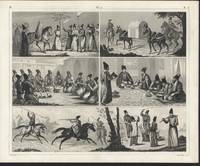
1851réf. 144081851. Winkles Henry. Scenes of Persian Life 1851. Original engraving depicting marriage ceremonies women's travel musical performance communal dining armed combat and corporal punishment in nineteenth-century Persia under the Qajar dynasty 1789-1925. Published for European and American audiences the illustration records contemporary Western depictions of Persian customs clothing social practices and judicial punishment. Its combination of domestic ceremonies public entertainment and scenes of violence provides a detailed example of how Persian society was illustrated in nineteenth-century ethnographic publications. Winkles Henry engraver. Scenes of Persian Life. New York and Germany 1851. Original engraved plate measuring 11.75" x 9.5" with an image measuring 10" x 8". Five principal panels contain scenes rendered with finely detailed linework and strong contrasts of light and shadow. The first portrays a veiled bride riding horseback to meet her prospective husband accompanied by members of a wedding procession. The second shows a Persian woman traveling in an enclosed litter supported by two animals. The third depicts musicians performing with wind and percussion instruments in a courtyard. The fourth portrays six men seated around a meal on a decorative carpet. The final panel combines two scenes: mounted warriors in confrontation one aiming a rifle toward an opponent holding a raised spear and the administration of the bastinado a form of corporal punishment involving blows to the soles of the feet. The engraving was published during the reign of Naser al-Din Shah Qajar 1848-1896 when illustrated encyclopedias and ethnographic publications circulated descriptions of Persian society among Western readers. The scenes distinguish ceremonial practices and domestic customs from military conflict and judicial punishment preserving the subjects selected by nineteenth-century publishers to characterize Persian life. The original engraving remains in very good condition. An illustrative record of Qajar-era Persia as presented to European and American audiences in 1851. unknown books