7 326 résultats
1833réf. 21111Philadelphia: James Kay ca1833. Unknown. Original publisher's gilt stamped roan. Good; some wear and chipping to the backstrip. 12mo Frontispiece Engraved title 2 - printed title 3 - 254 2 - adverts pp. A later printing indicated by the inclusion of the "Preface to the new edition". Atwater identifies three printings before 1836 that appear from our experience to be uncommon in trade. The anonymous author promises his readers that medical principles are few and easily understood. The preface states that the section of fevers and the teeth the second section of the book is entirely new. See Atwater #78 - #80. James Kay unknown books
1884réf. 21178Bristol UK 1884. Spine and front cover are gilt stamped; edges painted red. Near fine; a few minor scrapes. . 8vo. A compressed block of leather appx. 33 mm. thick machined and with gilt stamped decoration to look like a bound book. The rear cover is not finished and shows the original "hide" finish of the leather. An advertisement for the Avonside Tannery in Bristol England dated 1884. This is a solid block of compressed leather skillfully machined and decorated to resemble a bound book. unknown books
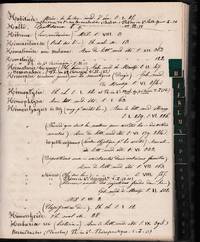
1850réf. 22054France: Unique ca1850. Contemporary half-leather marbled paper boards; fore-edge is letter indexed. Very good. 4to appx. 260 pp. Written in a clear French. An unusual alphabetical listing of medical terms that are acompanied with notations to their precise locations in the literature and medical periodicals of the period. The context contains everything from the common e.g. membrane to unique e.g. "mercurialisation". The annotations are detailed and precise. Unique hardcover books
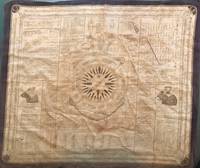
1890réf. 22046UK ca1890. As issued. Good; some light brown discoloration in sections; edges faded; printed text a bit faded; small hole in border inoffensive. Printed cotton scarf meas. appx. 31.5 x 27.5 inches; border appx. a 1.25 inch band of color on four sides. A printed cotton scarf with a naval theme. The date is derived from the depiction of the Webley Mark I revolver introduced into service in 1887 and the Lee Metford rifle introduced into service in 1888. A compass rose forms the central design motif around which is printed regulations weapon descriptions signals and coding some music seaman's proverbs full kit for what appears to be tropical engagements instructions in the use of the scarf as a temporary tourniquet etc. unknown books
1876réf. 22003Summer 1876. Original embossed calf with brass clasp. Very good; front cover is detached; spine somewhat abraded; clasp wanting. Oblong 4to commercial album for cdvs. Two to a page containing a total of 82 images. All are identified on the mount and some are dated. There are 18 that are American; 52 of Egypt and Turkey; 12 of Europe. A travel album. The american scenes are of the Adirondack Maine and Vermont and are dated 1870 through 1872. The trip to the middle east is in 1876 and takes in Cairo Thebes Luxor etc; the visitors also travelled to Constantinople. The photographs are the product of the P Sebah and Basile Kargopoulo studios in Constantinople. unknown books
réf. 21160Late 17th century. Overall in very good condition seemingly only having received light use; thread tarnished in spots; margin thread partially split along part of one edge of one inner compartment. . Rectangular envelope form meas. appx. 9 x 11 cm. Heavy raised "gold" thread embroidered decoration front only against a leather background within a plain border of equally heavy green thread that seals the edges; a small center fold front hook clasp. The purse is lined in a pale rosé colored leather with three inner compartments each with a pierced and blindstamped leather flap. Remarkable survival; most likely of Italian origin. hardcover books
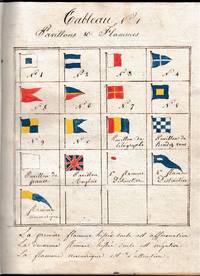
1820réf. 22002ca1820. Contemporary vellum backed paper covered boards. Very good; some rubbing to the binding. 4to appx. 200 pp. two color plates. Text is in a clear legible French throughout. A system of marine telegraphy based on numerical equivalents to signal complex messages. The text is made up of an explanation of the system both French and English warship signal flags each with its own color plate and an extensive signals.vocabulary. hardcover books
1747réf. 21140Amsterdam: H W van Welbergen May 1 1747. First Edition . Not bound. Good; blank margins cut-down; backed with a paper sheet of 18th century laid paper that has been glued at the perimeter on the verso; some glue stains showing. Folio letterpress illustrated broadside measuring appx. 510 x 375 mm. The engraved illustration measures appx. 120 x 190 mm. The son of John William Friso of the house of Nassau-Dietz William became stadtholder of Friesland and then later also of Groningen and of Gelderland. On March 25 1734 he married Anne of Hanover 170959 eldest daughter of George II of Great Britain. By the extinction of other branches of the Ottonians of Nassau he acquired a number of territories in Germany. In April 1747 during the War of the Austrian Succession the French invaded Dutch territory. A spontaneous popular movement arose first in Zeeland then in Holland in Utrecht and in Overijssel for the elevation of William to the stadtholdership in these provinces vacant since William IIIs death 1702 and to the ranks of captain general and admiral general. William was appointed and all his offices were made hereditary. The first man to be stadtholder of all seven provinces William IV now had more power than any of his predecessors; but he proved incompetent as a leader during his short reign. The Dutch people expected reforms to make the rule of the urban oligarchies in Holland less absolute. William made attempts to abolish the greatest abuses but when he died 1751 the most urgent problems were unresolved. The print illustrating the broadside at the head of the text celebrates his enthronement and illustrates the fealty of the colonized people of the Dutch empire. The text explains the iconography of the celebratory print and is accompanied by a 48 line poetical encomium printed in two columns at the base of the broadside. Unlocated. H W van Welbergen unknown books
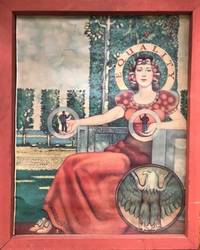
1935réf. 21174ca1935. As found. Very good with one abraded chipped circular gap on the necklace of the primary figure in the painted image that measures appx. 3/16 of an inch in diameter. The gap is on the verso of the screen. The screen mesh is in good condition i.e. not punctured. Color lithography on wire screen. The colored surface measures appx. 31 x 24.5 inches. It is stapled on to the plain painted framing boards. A most unusual representation of New Deal ideals within the genre of Baltimore screen painting. This manner of folk-art is singular to Baltimore and started some time around WWI. The "painting" offered here is actually some form of lithography we have seen an identical image as part of a set with the same framing and deviates dramatically from the typical subjects - country scenes or lifeless landscapes - of the genre. The artist is unknown but one assumes must have been a beneficiary of a WPA project somewhere at some time based on the prominent presence of the American "Federal" eagle on the lower right of the painting. This is one of a series of four whose subjects were "Truth" "Justice" "Liberty" and "Equality" that made up the set. They were most likely meant as wall decoration for a public building court house. It is remarkable that the medium of wire mesh screening was used to produce the image - perhaps a Baltimore artist reverting to his/her roots in the WPA program. The result is a graphic "icon" made inexpensively yet more lasting than a depiction on paper and employing more hands in its production. unknown books
1800réf. 21114ca1800. Not bound. Very good; colors somewhat faded; mounted; folded at one point. Folio measuring 492 x 730 mm. Utilizing 7 different colors to designate grounds buildings emplacements roads barriers water courses etc. with a 20 line legend and scale of distance upper right corner. The map bears an internal date for an identified location on the map of 1797 i.e. the named location is given with a date implying an unstated "as of". The Italian town of Osoppo sits northwest of Udine and demarcates the western most point of defense for the old Venetian Republic that ended with the French - Austrian Treaty of Campo Formio ceding Venice to Austrian rule. Napoleon himself is supposed to have sat at the heights of the fortress in Osoppo and opined that it was a natural barrier and defensive point for all travel from the Alps down to the coast. Hence its occupation by the French. The Treaty proved short-lived and the fortress changed hands a number of times between 1797 and 1814. It appears that this plan follows from a French occupation and reveals numerous details of that occupation and its strategic importance. Beginning in the early 16th century a fortress had been established on the high ground; here the Casa Savoignano is placed and identified apparently as a reminder of this legacy. unknown books
1793réf. 20083Ephrata: attributed to S Mayer 1793. Later printing. Original plain blue wrappers. Very good; a one inch tear into the text throughout probably caused by a thin string used to bundle this pamphlet with other items no loss. 12mo 24 pp. - printed on a thick Cloister paper. One of several printings in the 1790s and perhaps the scarcest with Arndt #881 locating only two obscure holdings. It is absent from the comprehensive Austin bibliography of American medical imprints. Rare in such nice condition - for any printing. [attributed to S Mayer] unknown books
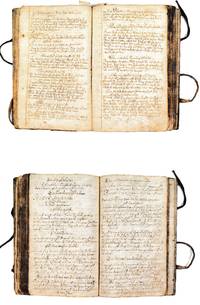
1780réf. 21044Unique. ca1780. Contemporary half leather over paper covered boards. The paper exhibiting a delicate floral design. Very good; some cover wear. Small 4to 114 pp. appx. 195 x 160 mm. Written in German gothic script on laid paper no watermark. Although this volume bears the signature of a John Shank and several lines in English establishing his ownership on January 29 1836 it dates from about 50 years before. It is continental in origin with no record of how Shank came to own it. The opening pages provide recipes for various color inks including the green used to record one other recipe later in the manuscript. It then moves on to colors. coloring metals writing on various surfaces the brazing of non-ferrous metals etching etc. At one point the writer addresses the dyeing of vellum and paper and the use of Lapis lazuli - both exotic topics not encountered in American manuscripts. There are occasional miscellaneous recipes recorded e.g. Dutch gin. The manuscript exhibits little wear or staining and one assumes Shank could not read the exotic text and had it as a keepsake. hardcover books
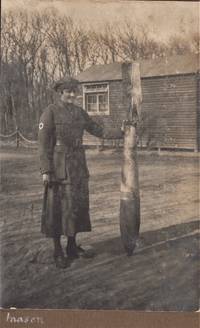
1619réf. 210021916 - 1923. Commercial album meas. 285 x 370 mm. Good; damp affecting some photos on the last four leaves toward the end of the album covering Patagonia. Oblong folio album of appx. 125 black and white silver photographs of various sizes. Those of Patagonia are of a small format. An eclectic album. The format of the WWI photographs is unusual for their large size. They are mostly "glossy" prints meas. appx. 185 x 240 mm. In composition and subject they are very much like the Frank Hurley photographs of Canadian troops at the Somme in the summer of 1917 e.g. open air shell bursts across fields etc. The most interesting portions of the album are the limited number dedicated to the Canadian female ambulance drivers and some scenes of the war itself. This is followed by a series of small format photographs of Patagonia. These are sparsely described but do provide enough information to ascertain the geographic locations. The compiler had the annoying habit of using initials for identification. The connection of these disparate subjects appears to be that she emigrated to Argentina following war service. The subject of the album indicates a residence or at least a lengthy occupation attributable to one of the female drivers. There is a third section given over to official ceremonies of WWI. In all an evocative grouping. There are also several pages of WWI photographic postcards included in the album which have been ignored in this description. It is however worth noting that one of the photographic postcards labeled "Canadian Official" - Hurley is also represented by a large original glossy print wrecked tank mounted in the album. The photographer apparently operated with some authority in the WWI section since she/he was able to marshal groups of drivers female staff and vehicles for group photographs. unknown books
1905réf. 20106Springfield MA 1905 - 1922. Original three quarter leather. Good; backstrip abraded; binding solid; text clean. 4to Indexed commercial notebook. Appx. 168 pp. recto/verso of entries. There is also an alphabetical index of patient names. A treatment record book for an unidentified masseur. It includes both men and women young and old. Most are identified by name ailments treatments and results. In many cases there are years intervening in successive treatment. Serious ailments and injuries are addressed. They are mostly severe breaks or crushing injuries. Illnesses like polio are dealt with as are numerous cases identified only by the symptoms of the debility. Occasionally treatments are referred to as "manipulations". But no matter how they were named the aim appears to have been to relieve pain and to improve circulation to the affected area or limb. The amount of detail varies through the entries but does provide sufficient information to understand what is being attempted. The author often states the goal and how or if it was achieved. hardcover books
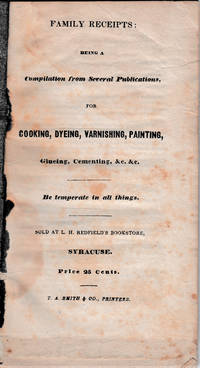
1840réf. 21006Syracuse: T A Smith Printer ca1840. First Edition. Original publisher's blue wrappers. Very good; diminishing tide mark to the last five leaves not offensive; untrimmed; looks to have been disbound from a larger collection. 8vo 60 pp. unsigned. A versatile local book of household and medical recipes and cures medicine takes up the last 13 pages of text. To accompany the varied cooking recipes are directions for setting the table and instructions on how to cut various joints of meat. The title page does not record a publisher but notes that copies were sold at Redfield's Bookstore. The text is unsigned and without copyright notice. There are a handful of copies in OCLC at major institutional libraries in the northeast. T A Smith Printer unknown books
1750réf. 21076France-Paris ca1750. Overall in very good condition with some small spots of surface wear. Oak box meas. appx. 85 x 195 x 140 mm. The box has been covered in dyed straw marquetry. Here the application mimics the 17th century "Hungarian stitch" a type of needlework with a colored flame-shaped pattern. The box is lined in paper daub blotted with a blue color. Hook and eye clasp. Commencing in the late 17th century straw marquetry was manufactured in many large cities throughout Europe. The first mention of such decorative objects and furniture is in Paris in 1652. General commerce in such goods was established by the 1750s when both Chervain and Delasson had workshops in Paris producing decorative objects with straw marquetry. The straw was first dyed then split length-wise and flattened with hammer blows. The marquetry pattern was then laid out and glued to paper that was mounted directly on to the object to be covered. Color dyes were fugitive a result of lack of penetration into the cellulose wall structure of the straw and rapidly faded in direct sunlight. The same process was also used as a book binding decoration. See Michael Peppiatt Architectural Digest August 1994; Barbara Scott Country Life January 1992; see "La Marqueterie de Paille" Hôtel de Sens Bibliotheque Forney winter 1992. unknown books
1780réf. 21038ca1780. Full contemporary vellum. Good; some toning. 4to appx. 320 pp. including index. In at least three distinct hands. Written in German gothic script. A comprehensive record of all kinds of recipes accompanied by considerable mis-spellings e.g. "Gereugert" sic Fleisch in 48 Stunden zu machen or "Hinbern Saff" sic zu machen. What appears to be an anonymous household recipe record that carries on through several owners and centers around traditional German foods - at least in the first 140 or so pages. Also somewhat exotic fare e.g. almond jelly. hardcover books
1902réf. 20128Washington DC: GPO 1902. First Edition. Original publisher's cloth. Very good; some rubbing to the cloth. 8vo 4 5 - 203 1 pp 8 very large folding plates. A highly detailed instruction manual for the survey of American public lands; including a history of the development of the instructions from the time of Jefferson forward to the publication date. Included are three specimen samples of surveying field notes for Montana undertaken by Richard Roods and then Robert Acres in 1890 and 1893. The large folding plates are in excellent condition overall. GPO hardcover books
1840réf. 21023Maryland ca1840. As issued. Near fine; old folds. Broadside meas. appx. 250 x 203 mm. What appears to be an amateurish printing of a six stanza poem printed within ornate steel-cut printed borders. The only identifier is what is an imprint at the base of the page: " 'Pledge' Pr." unknown books
1890réf. 20049ca1890. Commercial albums. Very good; one album is essentially disbound. Some interior photographs are improperly fixed. Oblong 8vo appx. 7 x 10.5 inches containing 71 mounted albumen prints. The photographs vary in size but most are 4.5 x 6.75 inches. The photographs are not captioned or identified. A handsome set of photographic albums recording the interior of a well appointed New York City townhouse and two rare photographs from Central Park of the then recently completed Temple Beth-El 5th Ave. & 76 St. dedicated Sept. 18 1891 and demolished in 1947 - one of the treasures of American synagogue architecture accomplished in the Romanesque style by A Brunner. There are additional street photographs and an unidentified country summer residence along with an Afro-American groundsman. A possible clue to the origin of the albums are the inclusion of photographs of the monument to A L Holley engineer located in Washington Sq. See Wischnitzer Synagogue Architecture in the USA pp. 87-89. unknown books
1860réf. 19066France: Unique ca1860. Original black full Russia leather with a fine pebble grain pattern; a.e.g. Near fine; binding bumped and a bit rubbed. Oblong 4to 33 unnumbered pages stiff glazed paper with 22 mounted star maps various sizes drawn on deep violet colored paper in black and gold ink. An accomplished manuscript beautifully rendered by an individual with advanced knowledge of interstellar space. It is also unusual in that the text initially emphasizes findings in the southern hemisphere. Discussion involves fixed stars double stars and variable stars and the seasonal variation as to what is observable. The color of stars distances culminate in the author's consideration of observable nebulae and reference to the then recent discoveries of Lord Rosse of new spiral galaxies beautifully illustrated in this text. Robert Grant History of Physical Astronomy pp. 568 - 577 London 1852 provides contemporary context for the speculations of the author and for Rosse's important discoveries - only possible with the use of the largest reflector constructed to date 1845. It is most unusual to find such a self-aware manuscript that is well in advance of any academic exercise. The author's avowed consideration - from the title - of the large structures of the observable universe segue to informed speculation about the processes that made possible these structures. Unique hardcover books
1930réf. 190901930 - 1933. Commercial albums. Fine. Three oblong folio commercial albums. 332 identified captions in French black and white photographs 125 x 175 mm with an additional 11 fold-out photographic panoramas. A detailed photographic record of the engineering construction of the Mole d'Escale du Verdon the albums omit the art-deco finished appointments of passenger lounges. This multi-year harbor project was planned before WWI but only begun once German war reparations began to be paid to France. The reparations financed this project. The pier was designed as a long gradual arch out into the Gironde River and incorporated the most up-to-date technology e.g. hydraulic dampers for docking ships. In conjunction with this the SNCF undertook the extension and electrification of rail connections not depicted. The photographs offer an elaborate and meticulous record of engineering work and appear to have benefited from unlimited access to the site. This would indicate official sanction but there is no record of this in the albums. Great care was taken to identify and date each of the photographs. unknown books
1900réf. 18035South Africa: Not published. ca1900. Not bound. Very good; some wear to the panorama. Archive of 76 original photographs: a warehouse for explosives offices laboratories housing carpenter shops and blacksmiths. Other photos show the governor and the community that are living on the construction site revealing a glimpse into their life culture dress and traditions. Neat holograph notes on the front or back of the photos identify scenes and people. The photographs are appx. 4x5 inches; some are cyanotypes The Somerset West factory development for the manufacture of explosives was the earliest and largest South African industrial development in the territory of the four colonies. It took place on a portion of the original Vergelegen Estate on parcels of land that had been consolidated by C Rhodes. "Many of the buildings both social and industrial have features of conservation merit while others are of national importance" Halkett & Hart: Assessment of Heritage Resources . Somerset West 1996. The buildings shown in this archive were all designed by Herbert Baker and are considered to be of national importance to South Africa. The archive illustrates the construction of these buildings appointments etc. One of the photographs map drawing room interior appears in the Halkett & Hart report. The photographs in this archive also supersede the illustrations of the Halkett & Hart report which has very few original photographs of the site and none of the building construction and land development. Not published. unknown books
1676réf. 180541676 noted. Contemporary vellum. Very good; recased; some finger soiling throughout; binding darkened with signs of use. Folio appx. 350 pp. At least three distinct hands in the text. German Gothic script. A comprehensive and contiguous journal of cures and analysis e.g. several pages are given over to urine analysis by color running from 1676 into the eighteenth century. The text seems to be arranged by symptom or subject e.g. women pregnancy elements of insanity etc. The journal appears to be the work of successive generations of apothecaries. There are only a handful of mentions of other physicians in the body of the text. An early compilation and therefore an uncommon survival. hardcover books
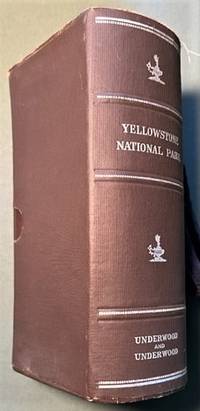
1903réf. 18067New York: Underwood & Underwood Text 1904; Map 1903. Later issue. Near Fine. Printed cloth slipcase containing a printed pamphlet 68 pp. with folding map 30 stereoscopic views of the park with printed explanatory text on verso of the mounts. An excellent early visual record of the park and its attractions. The views show the geysers bison dramatic scenery etc. The map is keyed to the views so that viewers can orient themselves. Underwood & Underwood hardcover books