AnonBiblio.com

7.425 Ergebnisse
1963Best.-Nr. mon0001615056D C Thomson 1963T. hardcover. Good. . No dust jacket. D C Thomson hardcover
Best.-Nr. mon0001538329Office Of The Law Times. Hardcover. Good. . The Law Times The Journal And Record Of The Law And The Lawyers. All are in good but worn condition. Pages are secure to the bindings. Solicitors stamp to end papers. No obvious annotation. Office Of The Law Times hardcover
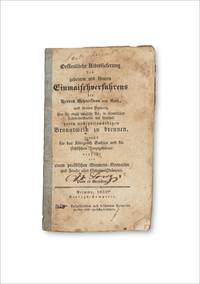
Best.-Nr. 3734355Grimma Saxony Germany: Verlags-Comptoir 1835. vi 1 1 blank 38 2pp. 6¾ x 4 inches. Self-wrappers with period paper-covered spine. Contemporary ownership inscriptions “C.W. Longs’” and “Karl P. indistinct surname”. Small losses no text loss in final leaf’s margins; two leaves loosened some others starting; scattered foxing; good. Apparently unrecorded this is the first and only edition of a rare 1835 work on mashing and distilling brandy. The text reveals the secret methods of distillers Schneefuss and Gall detailing processes such as malt preparation use of fermentation agents mashing techniques distillation and the removal of fusel oils. The anonymous author an experienced distillery manager and “Enemy of All Secrecy” “Feinde aller Geheimnißkrämerei” promises readers valuable trade secrets. Published in Grimma at a price of 16 groschen the work is aimed at distillers in the Kingdom of Saxony and the surrounding duchies. The publisher warns against the return of cut or soiled copies and the final two pages advertise additional works including a treatise on Jamaica rum by Christian Neubert and an illustrated work Der Selbstlehrende Tanzmeister The Self-Taught Dance Master by F.G. Häcker. Unrecorded in OCLC KVK and Deutsch National Bibliothek. Full-title page in German: Oeffentliche Ueberlieferung des geheimen und theuren Einmaischverfahrens der Herren Schneefuss und Gall nebst schlichter Belehrung über die einzig mögliche Art in sämmtlichen Zollvereinstaaten mit Vortheil guten und preiswürdigen Branntwein zu brennen. Zunächst für das Königreich Sachsen und die sächsischen Herzogthümer verfaßt von einem praktischen Brennerei-Verwalter und Feinde aller Geheimnißkrämerei. Preis 16 Groschen. Grimma 1835. Verlags-Comptoir. Aufgeschittene und beschmuzte Exemplare werden nicht zurückgenommen. Approximate English translation: Public disclosure of the secret and expensive mashing process of Messrs. Schneefuss and Gall together with simple instructions on the only possible way to distill good and price-worthy brandy with advantage in all the Customs Union States. Written primarily for the Kingdom of Saxony and the Saxon duchies by a practical distillery manager and enemy of all secrecy. Price 16 groschen. Grimma 1835. Publisher’s office. Cut and dirty copies will not be taken back. For a similarly rare work published for the firm of Herren Gall und Schneefuss see Die Einmaischungsgeheimnisse der Herren Gall und Schneefuss enthüllt und beleuchtet von einem praktischen Brenner: nebst dessen eigner Einmaisch-Methode welche einen dreimal größern Gewinn als das Schneefuߑsche Verfahren gewährt Breslau 1834 held in the collection of Munich’s Deutsches Museum. unknown
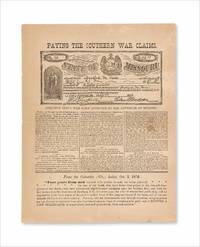
Best.-Nr. 3734344America. np.1876. 12¼ by 9½ inches. Tanning; minor staining and margin wear; very good. This rare anonymous broadside from 1876 attacks Governor Samuel J. Tilden the Democratic Party’s presidential candidate by citing excerpts from Southern newspapers in Alabama Georgia and Virginia. Popular argument at the time stated if the Democrats should come into power that they would spend two billion dollars in Southern war claims which would ruin the credit of the United States abroad. Northern voters would likely be outraged by the broadside’s illustration which shows a Missouri governor’s scrip for thirty-five dollars payable to one Woodford M. Paris for losses attributed to “the cotton tax damages to land and property during the war the emancipation of slaves” among other claims. The 1876 presidential election was highly contentious. Although Tilden won the popular vote he ultimately lost to Rutherford B. Hayes in the electoral college. The Hayes-Tilden Compromise led to the removal of federal troops from the South diminishing the hopes of African Americans in their struggle for civil rights and equality. The Reconstruction Era came to a close. unknown
Best.-Nr. 3734140America: N.p. no backmark n.d. 19th c. after 1863. 3¾ x 2¼ inches. A rich and sharp image; light surface wear; very good. An expression of Confederate sympathetic folk art this printed souvenir CDV portrait of Thomas Jonathan “Stonewall” Jackson was turned into an object of mourning. This transformation likely occurred shortly after Jackson’s death by friendly fire on May 10 1863. An exceptionally strong image with dark tonal contrast. unknown
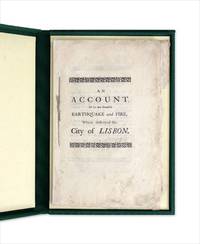
Best.-Nr. 3731167London: Printed. Boston; New-England Re-printed and sold by Green & Russell at their Printing-Office near the Custom-House and next to the Writing School in Queen-Street. MDCCLVI. 1756. half-title 23 1 pages. 8vo. “The Second Edition.” In fact the First American Edition preceded by printings in London and York both dated 1755. Expertly washed conserved and stitching renewed; scattered staining. A very good copy housed In a custom cloth clamshell box with a gilt-stamped leather spine label. Partly-untrimmed. First American edition of this eyewitness account of this terrible disaster on All Saints Day November 1 1755 that shook perspective views in the Old World and the New. The Lisbon Earthquake alarmed New England clergy and perplexed philosophers in France. For the former some ministers interpreted the event to show God expressing his angry will. For the latter some thinkers saw the disaster as evidence that no such will existed. The Lisbon Earthquake is estimated to have been 8.5–9.0 magnitude on the Richter scale and lt triggered a tsunami. The devastation was enormous: "“Not long after…a general Panic was raised from a Crowd of People’s running from the Waterside all crying out the Sea was pouring in and would certainly overwhelm the City. This new Alarm created such Horrors in the agitated Minds of the Populace that vast Numbers of them ran screaming into the ruinated City again where a fresh Shock of the Earthquake immediately following many of them were buried in the Ruins of falling Houses. This Alarm was however not entirely without Foundation. For the Water of the River rose at once above twenty Feet perpendicular and subsided again to its natural Pitch in less than a Minute’s time.”" From the Rev. Thomas Prince to John Winthrop in to Voltaire to Rousseau —the intellectual luminaries of the world weighed in. Years later Goethe would write in his autobiography of his memory as a six-year old of the event: “Perhaps the Demon of Fear had never so speedily and powerfully diffused his terror over the earth.” The earthquake was the “subject of anxious Church sermons across the Atlantic in New England. In fact an earthquake had also occurred in Massachusetts on the 18th of November 1755 centered east of Cape Ann. In Boston most of the damage occurred where buildings had been constructed over landfill near the wharves. John Adams who was at Braintree wrote in his diary: ‘The house seemed to rock and reel and crack as if it would fall in ruins…’” Kenneth Maxwell The Lisbon and Boston earthquakes became in tandem seismic cultural events as ministers philosophers and scientists contextualized one to the other. Some ministers compared the heavy damage of the Lisbon quake to the minimal damage from Boston’s and drew conclusions of moral American exceptionalism. Others used the Lisbon earthquake’s date of All Saint’s Day to suggest that God was punishing the Catholics. At Harvard professor and astronomer-scientist John Winthrop blamed volcanoes. By and large An Account of the Late Dreadful Earthquake and Fire… is written from neither a secular nor philosophical viewpoint. Rather it is a richly-detailed moment by moment account. It is a linear timeline written by an eyewitness who was literally on the shaky ground —when and where the dramatic event transpired. Charles Edwin Clark’s “Science Reason and an Angry God: The Literature of an Earthquake” in The New England Quarterly describes this narrow field of literature of the New England earthquake of 1755 —from the sermons to accounts such as the present example— as documenting a “science struggling to be born; a vigorous aggressive Protestantism on its way to becoming humanized and rationalized; a continuing consciousness of the uniqueness and special mission of America; and a scholarly approach in the best Puritan tradition to the problems of this world and the next.” Clark also provides an excellent and granular timeline of Boston’s printing and publication history concerning these two earthquakes. The verso of the half-title has an advertisement for the Boston edition of the Indian captivity of William and Elizabeth Fleming which is worth quoting at length: “A NARRATIVE of the Sufferings and surprizing Deliverances of William and Elizabeth Fleming Howes F-183 who were taken captive by Capt. Jakob Commander of the Indians who lately made the incursions on the frontiers of Pennsylvania as related by themselves. A NARRATIVE necessary to be read by all who are going in the Expedition The Kittanning Expedition a.k.a. the Armstrong Expedition as well as every British subject. Wherein it fully appears that the Barbarities of the Indians is owing to the French and chiefly their Priests. Price six Coppers.” After Braddock’s Defeat Capt. Jacob had terrorized the Pennsylvania population until a force armed Pennsylvanians killed Jacobs September 8 1756 in an retaliatory raid. The reader of this pamphlet would not have known of Jacob’s death because according to Clark it was published on April 1 1756. Evans 7602. ESTC W10073. Howes L-371 ref. ESTC records only 6 institutions all in America owning this. The “third American edition” i.e. the second is likewise rare. Ref. Maxwell Kenneth V — Lisbon 1755: The First ‘Modern’ Disaster but if modern how is it so accessed online. unknown
Best.-Nr. 3731482Tamworth England: Cotton Printer n.d. ca. 1780s; pre-1783. 12½ x 7½ inches. Woodcut two ornamental chain lines. Printed in four columns. Three old manuscript corrections in last column; two lines of text are mostly worn off at the top one partly legible. Archival mat window mylar sheet. An unrecorded 18th century broadside commemorating Sir Lancelot du Lake and Sir Tarquin’s hand-to-hand combat battle. The sheet was sold to tourists at Tamworth Castle in Tamworth Staffordshire where a 16th century mural on the castle’s Great Wall depicted the fight. The mural was whitewashed over in 1783. Friends of Tamworth Castle and Museum The broadside states: “If Travellers who pass that way Tamworth Castle On Serjeant Willcox call He to this Day can shew these Knights Fighting against a Wall.” Prefatory text wraps around a woodcut of Sir Tarquin falling to the ground mortally wounded by Lancelot. Based on Thomas Deloney’s The Noble Acts newly found Of Arthur of the Table Round the verse has has 144 lines consisting of 36 hymnal stanza quatrains. A lesser-known character in Arthurian lore Tarquin had imprisoned 44 knights of King Arthur’s court. When Lancelot confronts him Tarquin at first does not recognize him as the slayer of his brother: "“If thou be of the Table Round Quoth Tarquin furiously Both thee and all thy Fellowship I utterly defy. / Tarquin that’s over bold reply’d Du Lake courageously; Then clapping Spurs unto their Steeds They at each other fly. /. Both wounded were and bled full sore For breath they both did stand. Leaning upon their Swords awhile Quoth Tarquin Hold thy hand /. Why that’s well said quoth Lancelot then Thy motion likes me well; But who’s this Knight thou so do’st hate. His name I pray thee tell / His name quoth Tarquin is Du Lake He slew my Brother dear… / Strait at each other like two Boars They both enraged fly; And two long Hours by Tamworth They fought most furiously. / The Ground besprinkled was with gore Long Time was hard to say Which of these knights the bravest was Or which would win the day; / Till Lancelot with one mighty Stroke His foe did so assail That Tarquin stagger’d and his strength Therewith began to fail; / With loss of blood he then grew faint Which when Sir Lancelot found With all his Force a blow he gave Which brought him to the Ground. / Then forthwith taking off his Helm Smiting his Neck in twain His Body and his Bason threw Into the River Tame. /. God bless our King and may his Knights When put upon the Trial Approve themselves as Lancelot did As Valiant and as Loyal.”" We find no 18th century items with this imprint in OCLC or ESTC. Not in ESTC or OCLC and no entries in either of any items having this imprint. Not to be mistaken for ESTC N8306 i.e. A famous battle fought between Sir Lancelot du Lake and the famous giant Tarquinwhich begins: “Within this ancient British land…” unknown
Best.-Nr. 3732887London: Sold by A. Becket . and R. Faulder 1779. Half-title 71 1 advert.pp. Bound into green gilt-lettered cloth. A very good or better copy. With contemporary manuscript annotations on two pages. First English edition of this American Revolution era political satire and bibliographical hoax. Anonymously written by Richard Tickell the text purports to publish the letters of Benjamin Franklin the “trading Ambassador” with de Sartine among others and various secret state papers. The sum of it all exposes France’s motives for aiding America and satirizes Benjamin Franklin’s activities in Paris. In the margins of p69 a brief indistinct sentence is scribbled. On p51 at the end of a “Franklin” letter this is written in a contemporary hand: "“What was the Effect strikethrough Consequence of all this silly indistinct word lined out flattery to our Ministers No-Body was concerned by it & our affairs went from bad to worse. Scarce was this Pamphlet out of the Press when Spain took part in the War & we lost indistinct word & Grenada British naval loss at the 1779 Battle of Grenada the combined Keels off Plymouth.”" It seems unlikely that a reader writing marginalia in the spur of the moment would have struck out words and replaced them for their own private benefit. Of the subsequent revised editions that we examined none printed the above commentary. From the collection of Matt B. Jones who likely bought it from Goodspeed’s “1239” penciled beneath his bookplate. Michael Walsh wrote that Jones “chose things with the finest judgment. They always had to be in good condition; they had to be significant. A Matt Jones book in an American institution today is a book to be proud of….” The Green Box went through multiple editions and became popular in both England and on the continent. Ford 973 gives no priority to the so-called French original edition La Casette Verte… or the English edition both undoubtedly printed in London. Sabin 95796. Adams Controversy 79-107g. ESTC T035872. Butterfield L.H. Anticipation by Richard Tickell pp90–91. unknown
Best.-Nr. 3731940Boston: Pinkham Press 1917–1918. 22 x 14 inches printed on cardstock. Illustrated. Lightly soiled; near fine. “Our Fathers are Fighting in France.” A rare and unrecorded first World War photo-illustrated broadside documenting a little-known display of Franco-American friendship. Across America various patriotic societies often organized by women raised funds and sent baby clothes and necessities to France. These funds went to help babies orphaned by the War or to help French mothers with children whose fathers were fighting with the American solders. As one American soldier described it: “We will say for instance that this is Baby No. 4000. She wears wooden-soled shoes and half-length woolen stockings and a blue calico dress and her mother does the washing for the Sammies who are billeted out in the barn with Toto….” “Right in Touch with the Babies” in Life Magazine 1918. Here at the French Baby Fund Festival Exhibition the Boston community lent a benevolent hand and declared “May Day” to be “Baby Day” as part of a three day festival at Liberty Cottage Boston Common. The raised funds were likely funneled to the Fraternité Franco-Américaine. The broadside is printed with the colors of France and all of its text is printed in a pale lavender. unknown
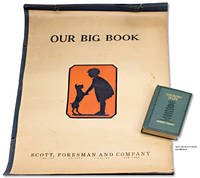
Best.-Nr. 3731978Chicago Atlanta Dallas and New York: Scott Foresman and Company ca. 1920s–1930s. 2 39 1 pp. Bound by two large rings along top. One sheet with small crayoned area all cloth reinforcement strips very rubbed; scattered stains and toning; overall very good. Rare. Our Big Book is catalogued by Princeton as a Dick and Jane precursor; a series of wall charts issued ca. 1920. The stories are displayed in strong colors across twenty-one large sheets each 30 x 22 inches. They feature the soon-to-be ubiquitous Dick and Jane Baby Spot and Little Mew later Puff. The Dick and Jane primers had a landmark impact upon the millions of children that were taught to read by using the look-and-say method. In the classroom setting Our Big Book would have educated that very first wave of American children to “See Spot run” and to learn a host of other catchphrases —phrases now engrained burned into the subconscious minds of literate Americans everywhere. Outside of Princeton’s copy we find only one other example in the Osborne Collection. They date the text to the 1930s. Not to be confused with much later common and smaller Dick and Jane charts/posters. unknown
Best.-Nr. 3732652Blitar East Java Indonesia. Circa 1890s albumen photograph 8¾ x 10¾ inches on its original card mount 12½ x 15¾ inches with pencil caption titling to photograph. Old glue stains along edges of mount. Save for light fading along edges of photograph a clean clear image. Circa 1890s photograph showing the Javanese ceremony “rampok macan” rampokan a ritualized big cat fight typically occurring at the end of Ramadan and the beginning of the Muslim new year. In a gladiator-like setting this public spectacle pitted men against tiger and it likely contributed to the population decline and eventual extinction of the Javanese tiger. We find one example of this image at the Tropenmuseum in Amsterdam. See Wessing Robert. “A Tiger in the Heart: The Javanese Rampok Macan.” Bijdragen Tot de Taal- Land- En Volkenkunde 148 no. 2 1992: 287–308. unknown
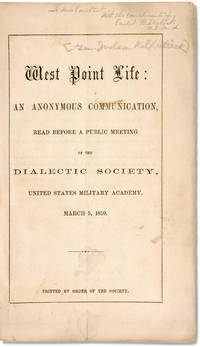
Best.-Nr. 3733009New York 1859. 16pp. 8vo. First edition and “Printed by Order of the Society.” Original printed wraps are darkened; general creases and soft fold lines from mailing and handling. bjcb 352231 Entirely in verse West Point Life: An Anonymous Communication Read Before a Public Meeting of the Dialectic Society… “details the intense social life at West Point on the eve of the Civil War with amusing accounts of balls and dances and courtships as well as learning soldiering.” Jenkins Authorship has been attributed to Horace C. Porter Class of 1860. The copy at hand gives this penciled inscription on its title-page: “To Miss Constant. With the compliments of Cadet Kilpatrick U.S.M.A.” In a later hand beneath: “Gen. Judson Kilpatrick.” Later nicknamed “Kill-Cavalry” the Irish-American Hugh Judson Kilpatrick 1836–1881 was a fellow member of the Dialectic Society who acted in numerous club performances. Martin p17 Kilpatrick graduated with the Class of 1861 as did Custer and it has been claimed that he was the first regular army officer to be wounded during the Civil War. Kilpatrick’s exploits during the War were numerous if not at times controversial or amusing. Surprised by Confederate forces while taking his bath purportedly sprang naked into his boots and onto his horse and then led a charge against the enemy. He served under Sherman as cavalry chief on the March to the Sea and as a “cavalry commander he was a brilliant leader having originated the saying that ‘cavalry can fight anywhere except at sea.’” DAB In 1874 Kilpatrick co-authored Allatoona: an historical and military drama in five acts and described by Benet’s as being “one of the earliest plays to deal with the Civil War . a tale in which two classmates at West Point fight on opposite sides in the great struggle.” The play was re-interpreted in 1930 by Christopher Morley and published as The Blue and the Gray: Or War is Hell. Kilpatrick’s inscription here as a twenty-three year old West Point cadet is one of the earliest examples one could hope to find for this colorful Union General. Ref. Farley West Point in the Early Sixties. With Incidents of the War. 1902. Martin Kill-Cavalry : The Life of Union General Hugh Judson Kilpatrick… 2000. unknown
Best.-Nr. 3731804Harrisburg Pa.: Department of Labor and Industry Bureau of Employment Security 1954. Single sheet printed on one side. 11 x 8½ inches. Mailing folds; near fine. Advertising broadside for the Pennsylvania Industrial and Construction Exposition held at the Farm Show Building in the state capital. Attendees of the six-day construction trade show were urged to “Join Pennsylvania on Parade” to view such exhibits as the “World’s Largest Model Railroad Layout” “Stars of Stage Screen TV and Radio” and “25 Bands…Pennsylvania’s Finest”. As an added attraction a six room house was to be given away. unknown
Best.-Nr. 3731946Pennsylvania. Mid-19th c. 3¾ x 4 inches. Printed textile pinked edges. Small rents forming. With: Small manuscript note 5½ x 3¾ inches. The Lord’s Prayer is printed here within a heart placed within a decorative printed border. An embossed sheet of note paper describes the gifting of the silk heart from a paramour: “To Edith — / May Angels attend thee / May their wings fan every / Shadow from thy brow / For none but bright and holy things / Should wait on one so good as thou. Valentine. Feb 14th.” unknown
Best.-Nr. 1447437306.Gpaperback. Good. Access codes and supplements are not guaranteed with used items. May be an ex-library book. paperback
Best.-Nr. 1447435583.Gpaperback. Good. Access codes and supplements are not guaranteed with used items. May be an ex-library book. paperback
Best.-Nr. 3730789New York: Century Flashlight Photographers Inc. 105 W. 47th St. 1925. 11 x 14 inches. Captioning within image; rubber stamp on verso. Small loss at lower right corner margin not affecting image; light creasing; Very Good. Photograph of the 40th “Stiftungsfest” or anniversary celebration of a New York branch of Schlaraffia a worldwide German-speaking fraternal group. The Schlaraffen as members were called were noted for their light-hearted fellowship and use of antiquated language here using “Nova Yorkia” instead of New York and pseudo-Medieval costume and regalia. The photograph shows the all-male group seated at tables with wine glasses and swords in a ballroom at the Hotel McAlpin in Herald Square. The members are wearing their club uniforms and regalia while their more splendidly dressed leaders stand at the dais. unknown
Best.-Nr. 3730175Washington D.C.: United States Department of the Interior. 1962. 142 pages. Illustrated. Comb bound with clear plastic covers and Very Good. An in-depth survey of Alaska Aboriginal culture. Contents include: Saint Lawrence Island Alaska in Asia; Sites near Bearing Strait; Kotzebue Sound; Aleutian Islands; The Pacific Forested Rim; Brooks Range; Kobuk River; Yukon - Kuskokwim Valleys; Southern Interior. unknown
Best.-Nr. 3730411Pittsburgh. 1835. 12¼ x 7½ inches. One page circular previously folded and bound. A Large notched-out area to inner margin does not affect text short edge-tears else Very Good. Subscription circular announcing a gathering of Pittsburgh’s citizens and trustees appointing Gilbert Morgan the second chancellor of what is today the University of Pittsburgh. Interestingly the Board of Trustees pledged and sought funds from the public to “build up and sustain a School of General Science in Pittsburgh”; “to meet the wants of a city like Pittsburgh and to place a thorough liberal education within the reach of all who might feel disposed to confer its blessings upon their children”; ”to endow professorships and “to purchase a Library and Chemical and Philosophical Apparatus.” “The University’s buildings along with most of its records and files were destroyed in a widespread 1845 fire that wiped out 20 square blocks of the most valuable part of Pittsburgh.” Wikipedia Unrecorded in OCLC. unknown
Best.-Nr. 3730412Pittsburgh. 1835. 12¼ x 7½ inches. One page circular previously folded and bound. A Large notched-out area to inner margin does not affect text short edge-tears else Very Good. Printed circular and subscription announcing to Pittsburgh’s citizens a meeting of the Board of Trustees to raise money to hire Gilbert Morgan the second chancellor of what is today University of Pittsburgh. Testimonials give on behalf of Morgan were made by Theodore D. Weld Dr. Miller of Princeton Rev. Breckenridge Rev. Uffold and so forth. The trustees announce: “The undersigned approve heartily of that part of Mr. Morgan’s plan which would impart a more popular cast to the Institution by enlarging the range of studies and yielding a prominent place and consideration to such as may be turned to account in active life in whatever sphere. Our citizens have had too much reason perhaps to regard it heretofore as something which stood apart in lofty seclusion from their pursuits and and sympathies. This erroneous notion will be discarded and a deep interest claimed from all in that which is designed for the common benefit of all.” “The University’s buildings along with most of its records and files were destroyed in a widespread 1845 fire that wiped out 20 square blocks of the most valuable part of Pittsburgh.” Wikipedia Unrecorded in OCLC. unknown
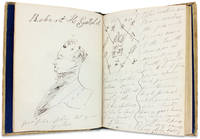
Best.-Nr. 3728502New York 1837. Small octavo. 1 engraved title 2 91 1 1 10pp. Album with manuscript additions and two hand-drawn star charts and 13 pen and ink outline portraits. Quarter green cloth with original pale yellow silk-patterned paper covered boards; dark blue endpapers; all edges gilt. Album with engraved title leaf with vignette illustration. Album re-backed with green cloth; new cloth reinforced hinges; rubbing to edges of boards; scattered foxing; very good. Unusual handwritten American astrological album dated 1837 containing detailed horoscope readings hand-drawn star charts predictive portrait drawings dream interpretations and lottery number advice. The manuscript records two full horoscope readings: an extensive analysis of Robert H. Gould not yet twenty-one and a separate “Lady’s Horoscope” for a woman apparently born in 1810. Each section is accompanied by a hand-drawn astrological chart mapping the celestial signs governing the subject’s birth with the individuals consistently described as “natives.” Gould’s horoscope is notably elaborate forecasting marriage career prospects travel to the southern United States and Mexico “In 7 years you will be in the South you will be Rich in Mexico and in the Southern States” longevity and specific advice on favorable days of action. It also provides recommended lottery numbers and predictions concerning children prosperity and personal relationships. The album includes pen-and-ink portraits depicting Gould at age twenty-one figures said to influence his future and a child identified as one of his sons. The lady’s horoscope offers comparable predictions including marriage faithfulness personal fortune bodily injury and death and is illustrated with drawings of her future husband or sincere friend. Written with confident authority the compiler explicitly distinguishes his interpretations from contemporary printed dream books suggesting familiarity with popular astrological and oneiric literature of the period. An exceptionally rare survival documenting antebellum astrology and popular belief in the United States. Note. 1. Album New York: Published by Solomon King 1830 unrecorded in OCLC. zxc unknown
Best.-Nr. 3726504Philadelphia: Robert Rae & Co. 1854. 15 1 blankpp. 3 in manuscript 2 blank. Printed front wrapper; lower wrap absent. Light vertical fold from mailing; small gnawing to lower portion of pamphlet’s spine; general wear; all legible and complete. Unlisted in OCLC an apparently unrecorded pamphlet devoted to the property definitions of Christ Church Hospital in Philadelphia. “Christ Church Hospital located at Forty-Ninth Street and Monument Avenue and pictured here in 1864 was established in 1772 as an almshouse to provide for poor women and widows in their old age.”—The Encyclopedia of Greater Philadelphia. unknown
Best.-Nr. 372430Np. c. late 1850s. Ninth-plate Tintype. 2½ x 2 inches. Book-form burgundy morocco case with gilt and blind decoration and silk lining; with wallet-style binding with brass closure. Tintype with brass mat and hand-tinting. Near fine. Diminutive tintype portrait of a man with delicately hand-tinted cheeks and lips mounted in a leather book-form case. The case housing the tintype is decorated using many of the same techniques used to create a luxury bookbinding: blind ruling frames on the exterior “boards” gilt rolled designs on the “turn-ins” and edges and a silk “endpaper” which in this case folds over to protect the glass covered tintype. The tintype is an early example of the process; these were typically not case-mounted after the 1850s. unknown
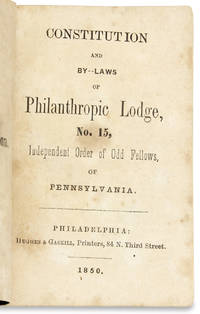
Best.-Nr. 3726619Philadelphia: Hughes & Gaskeill Printers 1850. 67 2 1 blankpp. 3¾ x 2½ inches. Unlettered black wraps. Foxing tanning; else very good. Ephemeral and unrecorded mid-19th century mark publication of the By-Laws and Constitution of a benevolent Pennsylvania fraternal organization. A most interesting section within is between pages 54–67 which detail the members’ names their method to obtain their daily bread and I.O.O.F. admit dates. The occupations are of the mechanic-variety: printers laborers chair makers varnishers tobbaconist mariner saddle tree maker; the list of occupations is lengthy and diverse. Printed in small type. The name of Harry Norman is stamped inside the front cover an early stamping; not modern but we do not find his name listed within as a member. Unlisted in OCLC. unknown
Best.-Nr. 146304Np. Norwich England 1760s. Broadside. 12½ x 8½ inches. Laid paper; printed in two columns. Superscription “Third Part” in manuscript written above title. Old fold lines; staining; some losses to paper at edges not affecting text; good. Unrecorded eighteenth century polemical broadside in the tradition satirist Ned Ward or the mock poem Hudibras. While the present broadside includes only a few lines of poetry like Hudibras it appears to describe a religious controversy between a “Methodist Grub-Street Printer” named Don Dismallo Thickscullo de Halfwitto and another printer Dicko-Don-Quacko.The broadside reports that the printers’ dispute was also carried out in dueling newspapers the eighteenth century equivalent of an internet “flame war.” That the dispute was ongoing seems to be implied in the manuscript addition written at the top of the broadside: “Third Part.” The broadside states: "The Methodists and their Printer having erected their Battery of Lampoonary against the Printer of the Paper call’d Helter Skelter He hereby declares a Paper War against all Dicko Don Quack’s Mendicant Crew…" A mention of a work printed by the “Methodist Grub-Street Printer” concerning Pondicherry may well help to date the broadside to after 1761 when British forces in India defeated the French at Pondicherry. An account of a legal dispute between two printers found in a 1768 English literary annual The British Palladium may well shed light on the controversy outlined in the present broadside and suggests a possible place of publication Norwich England. The account begins: "An eminent Printer in the City of Norwich was once personally aspersed by a single Quack distributing Hand-bills against him in that city who as a Remedy for his Disorder brought out a Pamphlet cried about the Streets intitled The History of Dicko Don Quacko Liliano Brazenfaciano who instead of considering it as a wholesome Remedy for his Evil took Offence at his Prescriber insisting on his being misnamed and misrepresented. In consequence whereof a Trial was appointed to come on before a certain Judge…" The tradition of such fantastically named characters hearkens back to Samuel Butler’s Hudibras 1663 1664 and 1678 and to Four Hudibrastick Canto’s Being Poems on Four the greatest Heroes That liv’d in any Age since Nero’s Don Juan Howlet Hudibras Dicko-ba-nes and Bonniface 1715 sometimes attributed to Ned Ward. Unrecorded eighteenth century satirical broadside concerning the press and the growing influence of print culture in England. Not in ESTC. Ref. The British Palladium; or Annual Miscellany: for the Bissextile Year 1768. London 1768. unknown