ESCUDER, Joaquín.MareMagnum

4 301 résultats
Zaragoza, Ayuntamiento, 1992. 4to. mayor; 44 pp., con ilustraciones fotográficas del mismo Escuder, en negro y color. Cubiertas originales.
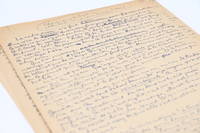
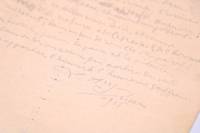
1948réf. 871601948. Fine. ""Pour moi l'amitié des assasins n'est pas l'amitié . tant pis si l'on me juge esclave et qu'on me juge sans coeur !"" For me the friendship of assassins is not friendship . too bad if I am judged a slave and judged heartless! s. d. 1948 21 x 30 cm 8 pages et demi sur 9 feuillets Exceptional autograph manuscript by Louis Aragon entitled ""Chronique de la pluie et du beau temps pour Europe mai"". 8 and a half pages in blue ink on 9 uniformly browned leaves. Numerous deletions and rewritings. Published in Europe no 29 May 1948 and does not appear in the book collecting these chronicles E.F.R. 1979. Superb nine-page militant profession of faith published in the anti-fascist literary review Europe. Aragon finds himself courted after the war in the name of ""friendship"" and ""freedom"" by various reviews but categorically refuses to publish alongside writers with Pétainist tendencies. The writer delivers his impressions after a radio interview in Belgium and meditates on ""two abstract monsters: freedom and friendship"" perverted at will in this early Cold War period when Sovietism becomes - to his great dismay - the new fascism. Very attached to the unified discourse advocated by communism which he calls ""national truth"" this notion serves as the guiding thread of his chronicle. Aragon writes in the midst of the Kravchenko affair and remains convinced by Sovietism which remains for him the great victor over Nazism. As a great literary witness to the suffering endured during the Occupation he is alarmed by the editorial choices of reviews seeking to obtain contributions from him: one shamelessly publishes a text by Montherlant totally oblivious to the Parisian martyrs during the war while the other affectionately justifies the allegiances of many French people to Marshal Pétain. It is also the occasion for a long and beautiful analysis of the idea of nation by Aragon who is unquestionably the national poet of this century. We find there in his inspired tirades the Aragonian ideal of healthy emulation among nations turned toward progress. Beautiful pages by Aragon in the midst of the crystallization of the Eastern and Western blocs. Aragon's ambition is to honor the memory of the Resistance by choosing to ""trust words when they are used for peace"". ""La Nation qui me paraît aujourd'hui encore être le groupe le plus étendu qui puisse se porter garant d'une vérité . la radio peut et doit transmettre à son public la vérité nationale . 'Qu'entendez-vous concrètement par vérité nationale ' Me demande-t-il comme il m'aurait sûrement demandé : qu'entendez-vous en disant qu'il fait grand jour en plein midi si je l'avais dit. C'est là le mécanisme des interviews. J'ai donc pris deux exemples concrets pour expliquer à quoi sert le maniement des abstractions. Deux cas récents où j'ai eu à me mesurer avec deux monstres abstraits : la liberté et l'amitié. La liberté d'abord. On sait comment les pires ennemis de la liberté font usage d'un livre qui s'appelle : J'ai choisi la liberté donnant le bénéfice d'un préjugé favorable de ce mot à tous ceux qui trahissent leur pays quand c'est pour choisir le système capitaliste . . Une revue qui s'édite à Montréal m'avait récemment écrit pour me demander ma collaboration. Son directeur littéraire faisait appel à l'homme libre l'italique est sienne que je suis. Cette façon de distinguer par la typographie en moi la possibilité d'être parfois un homme libre parfois non m'avait un peu inquiété. J'ai voulu voir sa revue . Mon Dieu le fait que ce numéro s'ouvre par un texte de M. de Montherlant me laisse libre de ne pas parler du contexte. On sait et j'imagine que M. Victor Barbeau de Montréal n'ignore pas que M. de Montherlant est sur la liste des écrivains avec lesquels les membres du Comité National des Ecrivains se refusent à collaborer. Ce qui doit sans doute m'expliquer pourquoi M. Barbeau s'adresse en moi à l'homme libre : c'est- unknown
Zaragoza, 1999. Folio apaisado; 217 pp., con 105 ilustraciones en color. Cubiertas originales.
Zaragoza, Diputación Provincial, 1998. 4to. apaisado; 72 pp. Con 16 ilustraciones en color. Cubiertas originales.
Zaragoza, 2000 [Separata de "Primer encuentro de estudios sobre El Justicia de Aragón"]. Folio; 15 pp. Cubiertas originales.
Zaragoza, Imprenta Eduardo Berdejo Casañal, 1935. Doce números en un volúmen en folio, con un promedio de 17 pp. por número. Con numerosas ilustraciones fotográficas y anuncios publicitarios. Encuadernación de época, en media tela con puntas.
1999réf. RO20222323France Loisirs / Gallimard. 1999. In-8. Relié toilé. Bon état, Couv. convenable, Dos satisfaisant, Intérieur frais. 662 pages. Une illustration en couleurs contre-collée sur le premier plat. Signet conservé. Un tampon sur le premier contre-plat.. . . . Classification Dewey : 843.085-Le roman sentimental
1967réf. RO30349750Gallimard. 1967. In-8. Cartonnage d'éditeurs. Bon état, Couv. convenable, Dos satisfaisant, Papier jauni. 520 pages. Un bandeau d'éditeur en bon état. Un signet. Auteur et titre dorés sur le 1er plat + auteur, titre et éditeur dorés au dos.. . . . Classification Dewey : 840.091-XX ème siècle
Zaragoza, Tipografía Tomás Blasco, 1918. Folio; 10 pp., 3 hs. Cubiertas originales.
Manuscrito datable entre 1616 y 1618. Un volúmen en 4to., compuesto de 395 folios útiles, de apretada caligrafía y con numerosas notas marginales. Encuadernación en pergamino, de la época. Un excelente documento de la enseñanza de la Escolástica en el Siglo de Oro. Fray Juan de Biescas, nacido en Graus, fue durante muchos años Catedrático en la Universidad de Huesca. Según se desprende de Latassa, que es quien únicamente recoge datos sobre el mismo, publicó entre 1637 y 1641 en Huesca, en las prensas de Pedro Bluson, dos "Partes" de Comentarios a Santo Tomás, dejando inédita una 'Tercera Parte' cuyo original sería el manuscrito aquí ofrecido.
Madrid, El Teatro Moderno, 1927. 4to. menor; 82 pp. Cubiertas originales.
1945réf. RO80244341A la Voile Latine. 1945. In-8. En feuillets. Bon état, Couv. convenable, Dos satisfaisant, Intérieur frais. 116 pages. Annotation au stylo en page de titre. Trois photos disponibles.. . . . Classification Dewey : 94.41-Editions numérotées (gros tirage)
Almería, 1997. 4to. alargado; 233 pp. Cubiertas originales.
Zaragoza, 1948 (Separata de "Actas de la Primera Reunión de Toponimia Pirenáica"). 4to.; mayor 10 pp. Cubiertas mudas en papel.
1972réf. R300329968Presses de la cité. 1972. In-12. Broché. Etat d'usage, Couv. légèrement passée, Dos plié, Papier jauni. 315 pages. Ex libris à l'encre en page de garde.. . . . Classification Dewey : 947-Europe de l'Est, URSS
1972réf. R300329490Presses de la cité. 1972. In-12. Broché. Etat d'usage, Couv. convenable, Dos satisfaisant, Papier jauni. 315 pages. Taches sur le 2e plat.. . . . Classification Dewey : 947-Europe de l'Est, URSS
1945réf. RO30373077Editions Pierre Seghers. 1945. In-12. Broché. A relier, Couv. fraîche, Dos fané, Papier jauni. 89 pages. Couverture jaunie, partiellement désolidarisée. Quelques rousseurs. Coins frottés.. . . . Classification Dewey : 841-Poésie
1945réf. R300323592Pierre Seghers. 1945. In-8. Broché. Etat d'usage, Couv. légèrement passée, Coiffe en pied abîmée, Papier jauni. 90 pages.. . . . Classification Dewey : 841-Poésie
réf. QWA-1377Messidor, 1986, 307 p., in-8 cartonnage toile rouge, présentation et notes d'Edouard Ruiz, dessins d'André Masson, deux taches de mouillures claires sans gravité sur le premier plat, bon exemplaire
1915réf. 92341n. l. 1915. Fine. Aragon's Earliest Known Poem: The Birth of a Poet Soon to be Buried Beneath the Shells of the Great War n. l. 31 mars 1915 15.3 x 19.7 cm Un feuillet Autograph poem by Louis Aragon signed and dated 31 March 1915. Fourteen lines written in pencil on a single leaf with unpublished autograph calculations on the verso. Published in 2008 by Michel Apel-Muller in Le Continent Aragon special issue of LHumanité 2008 p. 17 and reissued under the title Poème in Le Rayonnement international dAragon Strasbourg coll. Recherches croisées Aragon / Elsa Triolet no. 16 2018 p. 251. Numerous traces of handling with vertical and horizontal folds that have caused minor paper losses without affecting the text. A precious fragment of literary history this sonnet published only in 2008 is the earliest known poem by Aragon according to its discoverer Michel Apel-Muller. Aragon wrote this lyrical reverie inspired by Baudelaires Parisian tableaux and by the Parnassian poets at the age of eighteen. He gifted it to his schoolfriend and inspiration for his novel Anicet Pierre Maison who succumbed to the Spanish flu in 1918 after fighting in the war. The Seine The pontoons draw away toward the hill That bounds the horizon with a bluish silhouette. The river bends at the foot of the quivering slope Of April reborn amid the hawthorn. In the red reflection of the setting sun Rises the factory black smoking and alive. The smoke and the sky are tinged with sanguine; A house stands and smiles at the passer-by. How life rises from this valley and how The work of nature and the labour of man Unite in a tone of evening rust! One senses amid the peace and the silence The song of birds that will rise from the vale To bring love to human suffering. translation our own Absent from accounts of Aragons life up to Philippe Forests most recent biography the sonnet was given to Pierre Maison this schoolfriend who had enlisted ahead of his call-up and who like Apollinaire succumbed to the Spanish flu in 1918. Aragon portrayed him in Anicet before burying the painful memory by assuming the characters identity in the famous phrase Anicet is me. Before André Breton and Drieu La Rochelle it was with Pierre Maison that he shared a profound intellectual friendship. Paradoxically this newly discovered princeps sonnet by Aragon comes accompanied by a rare wealth of context. The verses can be read in the light of a letter itself long unpublished addressed to Pierre Maison a few months later. This sprawling letter reveals that this poetic landscape of the Seine is in fact a memory: I thought of our good old discussions of days gone by. The memory came back to me as I was defending Wagner from the day we had gone down the Seine together talking about The Flying Dutchman Do you remember The weather was fine but the sun had something indefinably sad about it and the new spring resembled an autumn. When we stopped on the bank past Javel the sun was already low though it was not yet five oclock sic. Its rays already weakened and horizontal came from behind the distant hill where the houses along the Seine cling the river vanishing swiftly around a bend. Despite the dark green mass of the trees on the opposite bank bent over the flowing water everything seemed covered with an imperceptible tinge of rust: one might have said sic it was the dusty grip of the great city so near at hand upon the countryside. rise. And behind in an evening haze the hills of Meudon rose tier upon tier their woods concealing arbours and open-air taverns. This bleak landscape animated only by the movement of the Seine still lives on intensely in my memory. Aragon makes an almost literal reference to the poem which had captured on the spot this aesthetic emotion of the young student during an escapade among a band of high-spirited companions soon to be separated by the war: Aragon reminded me in unknown
1999réf. RO20222840France Loisirs / Gallimard. 1999. In-8. Relié toilé. Bon état, Couv. convenable, Dos satisfaisant, Intérieur frais. 675 pages. Signet conservé. Une illustration en couleurs contre-collée sur le premier plat.. . . . Classification Dewey : 840-Littératures des langues romanes. Littérature française
1946réf. RO20222470Pierre Seghers / Gallimard. 1946. In-8. Relié demi-cuir. Bon état, Couv. convenable, Dos à nerfs, Intérieur frais. 72 + 153 + 90 pages. Auteur et titre doré au dos à deux nerfs.Epidermures. Plats jaspés. Couvertures brochées conservées. Signatures d'un particulier au crayon sur les pages de gardes.. . . . Classification Dewey : 841-Poésie
1993réf. RO20220097Gallimard. 1993. In-12. Broché. Etat d'usage, Tâchée, Dos satisfaisant, Intérieur frais. 255 pages. Quelques annotations au crayon dans le texte.. . . . Classification Dewey : 841-Poésie
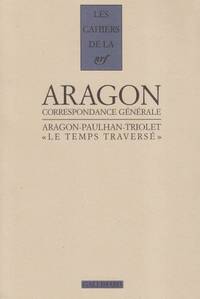
réf. 2070735575.Gpaperback. Good. Access codes and supplements are not guaranteed with used items. May be an ex-library book. paperback
Zaragoza, 1999. Folio; 279 pp., cincuenta y dos de ellas y tres láminas, dos de ellas plegadas, con la reproducción facsímilar del Códice. Cubiertas originales.