[BROADSIDE BALLAD]Biblio.com
214 resultados
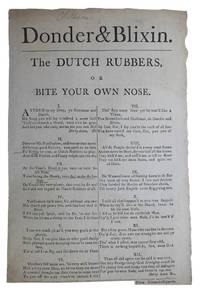
ref. AQ25363London: Printed by W. & T. Bailey s.d. c.1785-1799 Single leaf broadside edges uncut. Shaving to foot with loss of imprint. A remarkably rare survival of 'three-half-pence' broadside verse satire in which a fight breaks out among a group of Dutchmen in a Chelsea tavern. The title of the bawdy ballad is a corruption of the Dutch expression 'donder en bliksem' meaning 'thunder and lightning'. ESTC records a single copy Oxford. ESTC N71592. Dimensions 200 x 290 mm. [Printed by W. & T. Bailey], [s.d., c.1785-1799] unknown
1910ref. 3881910 1 Relié, demi-chagrin fauve serti d'un filet à froid, dos lisse décoré de frises et fleurons dorés, auteur, titre et illustrateur de même, tête cramoisie, couvertures parcheminées conservées. 29,5 x 21 cm, 109 p., nombreuses illustrations gravées. Paris, Auguste Blaizot - René Kieffer, Collection Eclectique, 1910.
1910ref. 3881910 1 Relié, demi-chagrin fauve serti d'un filet à froid, dos lisse décoré de frises et fleurons dorés, auteur, titre et illustrateur de même, tête cramoisie, couvertures parcheminées conservées. 29,5 x 21 cm, 109 p., nombreuses illustrations gravées. Paris, Auguste Blaizot - René Kieffer, Collection Eclectique, 1910.
1738ref. 16147London. 1738. Catching the British Lion by the Tail First edition first issue. An appealing 18th-century British ballad critical of Walpole's dealing with Spain. The full-page woodcut shows the Spanish king pulling the tale of the British lion which is about to mount a cart and be led away by a group of clerics harnessed to the wagon. The text attacks the British conciliation with Spain in 1738-39 and suggests that "you excise them in land I'll excise them by sea" in other words buccaneering. 7pp. Woodcut frontispiece. Folio. Later wrappers. Minor tears at folds of leaves else very good. unknown
1738ref. 16147London. 1738. Catching the British Lion by the Tail First edition first issue. An appealing 18th-century British ballad critical of Walpole's dealing with Spain. The full-page woodcut shows the Spanish king pulling the tale of the British lion which is about to mount a cart and be led away by a group of clerics harnessed to the wagon. The text attacks the British conciliation with Spain in 1738-39 and suggests that "you excise them in land I'll excise them by sea" in other words buccaneering. 7pp. Woodcut frontispiece. Folio. Later wrappers. Minor tears at folds of leaves else very good. unknown books
1902ref. 1150811902 Paris, imprimé pour Charles Meunier, "Maison du Livre", 1902, 1 volume in-folio de 240x310 mm environ, 235 pages. Tirage à 115 exemplaires, un des 100 exemplaires numérotés sur vélin de cuve, enrichi d'un dessin original signé de Robida, bien complet du frontispice et des 50 eaux-fortes, des deux suites des illustrations (une en noir, une bistre) et de la suite sur Chine des culs-de-lampe. Pleine reliure à la bradel en veau clair marbré sous emboîtage, dos portant titres dorés et petit décor doré, gardes couleurs, couvertures conservées. Marques d'usure sur l'emboîtage, ors du dos légèrement passés, quelques frottements sur la reliure, sinon bon état, intérieur frais.
1932Sensational vintage compilation of thirty-five 1930s lumberjack songs from the Pacific Northwest. Elmore Vincent was known as "The Northwest Shanty Boy" and the front cover art features his image superimposed over a scene of tall timber being brought down by hand, as chainsaws were but a dream at that time. 64 pages. Includes lyrics, guitar chords and piano sheet music for these songs: A Lumber Lad's Love, Ballad of the Lumberjack, Billy the River Driver, Canaday-I-O, Come With Me In My Little Canoe, Darling Janet, Down in That Lonely Valley, Drinking Song, Fair Charlotte, Grizzly Hogan, Lonesome Lumberjack, Lumberjack Memories, Moose Meat, Smart Johnny the Logger, Song of the Lumberjack, Strawberry Lane, The Death of George Phalen, The Flying Cloud, The Gambling Lumberjack and the Jim Creek Girl, The Good Old Times, The Great Fit, The Green River Girl, "The Jam at Gerry's Rock", The Lakes of Pontchartrain, Three Leaves of Shamrock, The Little Brown Bulls, The Lumberjack and the Pretty Girl, The Lumberjack's Alphabet, The Lumberjack's Bible, The Lumberjack in Town [as sung on Seattle's "Skid Road" by Syd Johnson], The Sandy Stream Song, The Stranger and the Maiden Fair, The Two Sisters, Who Feeds Us Beans, and Yodeling Lumberjack. Most songs have several verses or more. Unmarked with above-average wear. Binding intact. A rare and wonderful musical memento of the glory days of Northwest lumberjacking. Book
1918Signed and inscribed by author, dated 1918, atop first blank leaf. 66 pages. Accepted by the Royal Society of Canada as part of their Proceedings, 1918. "Tsoqalem, according to the Indians, was a real historic character, a member of the Cowichan tribe, a Vancouver Island division of that linguistic group of the Salish stock known to us under the term Halkomalem, whose habitat is and was the Lower Fraser Valley. How far the incidents of this story are literally true it is now impossible to say, as myth and fact are inextricably woven together in it; but there can be little doubt that an Indian of the character of Tsoqalem existed some generations ago among the Cowichans, and met with a tragic end at the hand of a woman, somewhat in the manner recorded in the story." - from Foreword. Front cover loose but present. Portions of backstrip missing. Age-toning to contents. Above-average external wear. Binding tender. (Amtmann 488, Watters p.88) Book
First and only edition, 12mo, [2], 45, [1]pp., with half-title, some minor spotting, orig. marbled paper wrappers, cont. manuscript notation of title and author on upper cover "The Battle of Newland 1790, By Benjn. Clarkson, Alverthorpe Hall". ESTC fails to attribute this to an any particular author, however, the contemporary inscription on the upper cover does give strong evidence to Benjamin Clarkson as being the writer of these poems. Benjamin Clarkson (d. 1820), a Wakefield attorney, resided at Alverthorpe Hall. "Several well known circumstances which happened some years ago in the town and neighbourhood of Wakefield, gave rise to the following Ballad". (Advertisement leaf). Rare; ESTC locating 4 copies (all in the UK).
1933ref. 002794Paris, Librairie Plon (Imprimerie Lahure), 1933
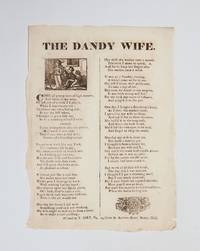
1828ref. 5421London: T. Birt 1828. First edition. Single sheet measuring 250 x 185mm and printed in two columns to recto. Some edgewear to margins not affecting text; a bit of foxing and toning largely confined to margins. A scarce and delicate survivor OCLC documents only one example at the National Library of Scotland. The present is the only example on the market. The Dandy Wife is narrated by a man who aimed "to choose me out a loving wife" at the age of twenty-one but whose experience becomes a warning to "all young men of high renown": "If you want a tidy wife Beware of a boarding school." What unfolds is a satire of how the marriage economy is affected when women have access to knowledge -- intellectual and physical -- and how by meeting a man's superficial expectations a woman can fulfill her own more pressing needs. Thinking that a boarding school girl will have the innocence submissiveness and domestic skill he desires the narrator selects a wife from among their ranks. Thinking only of what he can obtain from such a bargain he is unprepared for what an educated woman brings into his house. The Dandy Wife he describes understands the commodity value of her own beauty and material adornment and that these are her key means for acquiring wealth of her own. "She takes one-half of what I earn In drinking gin and tea; Besides such frills and furbelows My Dandy Wife does wear.Her sleeves upon her dandy gown Oh! Lack they're such a size You'd think they were two balloons that in the air would rise." Aside from staying on par with fashion trends her clothing assists her in avoiding domestic tasks she abhors. She refuses to do laundry more than monthly and through ridiculous cooking failures she rapidly establishes that the kitchen is not a showcase for her skillset. Accustomed to a life of learning she is not trained to conduct domestic business. By the ballad's end it becomes clear that the Dandy Wife was savvier in managing a marriage than her husband was. For not only does her superior intellect help her carve out a more satisfying role but she also has physical knowledge that predates him: "The day that I was married I thought I'd got a charming maid But I was much deceived.For scarce five months we'd married been When she had a darling son. T. Birt unknown books
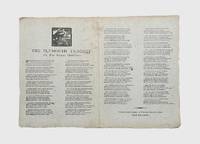
1809ref. 174972London: printed and sold by Jennings c. 1809. A ballad telling a tragic tale of lovers tricked apart by "cruel" and "covetous" parents. Similar ballads often feature an unfaithful and avaricious antiheroine who suffers a cautionary downfall. Here however Susan is a "harmless maid" and it is families who are warned against prioritizing wealth over the happiness of the younger generation. The love triangle between a woman her husband and a sailor was a common trope in 17th- to 19th-century ballads but most had several key differences to this version. The woman was normally the one to prioritize financial gain unlike Susan who declares that "No wealth nor riches shall make me disloyal". The sailor was typically a demonic character sometimes the Devil in disguise whereas "sweet William" is an honest and faithful man. In most ballads only the woman dies while the sailor-demon escapes; both Susan and William perish here. Such entertaining ballads were an outlet for people "to voice tensions to work over the contradictions of human life" Gammon p. 237. The Plymouth Tragedy reflects an exasperation with the requirements on the young especially women to conform with their parents' desires at the expense of their own happiness. Single sheet 255 x 360 mm printed in columns. Woodcut vignette. A little nicked at edges old centre fold reinforced on verso with paper; overall a well-preserved copy of a fragile publication. Vic Gammon "Song Sex and Society in England 1600-1850" Folk Music Journal vol. 4 no. 3 1982. unknown
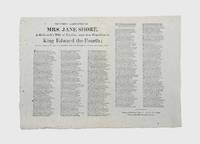
1810ref. 174973London: printed and sold by J. Pitts c. 1810. An ephemeral broadside ballad detailing the story of Jane Shore a mistress of Edward IV and a popular cultural reference for many centuries. Shore's heavily fictionalized story featured many elements considered to have mass appeal in the era: a sexually voracious woman a relationship that transcended social hierarchies and an ending that punished transgressive behaviour. In Mrs. Jane Shore the eponymous character is described as a married woman who became King Edward's concubine and "lived in the court/With lords and ladies of great sort". Whilst she had influence over the King she ensured "to help the people that were poor" and "sav'd their lives condemned to die". Regardless her infidelity ultimately led to her social disgrace and she died in a ditch in East London. As detailed in the ballad urban mythology claimed that her unfortunate death gave the Shoreditch district its name. Ballads such as this were sung in a variety of communal spaces including pubs lodging houses and the streets and typically took criminal or socially deviant behaviour as their subject. In their own time broadside ballads were believed "to foster immorality and to glorify crime" O'Brien p. 16. More recent interpretations appreciate their literary and social value and consider that "their job was to voice tensions to work over the contradictions of human life" Gammon p. 237. Landscape single sheet 362 x 252 mm printed in columns. A little chipped at the edges but overall a well-preserved copy of a fragile publication. Vic Gammon "Song Sex and Society in England 1600-1850" Folk Music Journal vol. 4 no. 3 1982; Ellen L. O'Brien "'The Most Beautiful Murder': The Transgressive Aesthetics of Murder in Victorian Street Ballads" Victorian Literature and Culture vol. 28 no. 1 2000. unknown
2014ref. 108521Museum. New. Paperback. FREE UPGRADE to Courier/Priority Shipping Upon Request - IN STOCK AND IMMEDIATELY AVAILABLE FOR SHIPMENT - Flawless copy brand new pristine never opened - -- with a bonus offer-- . 2014. 0942949382 . Museum paperback