VISSAC Marc deLivre Rare Book
175 resultados
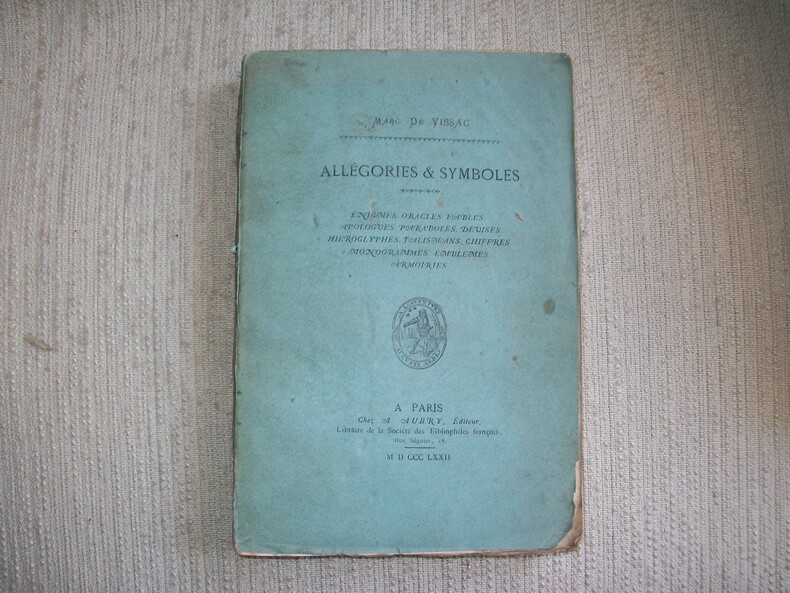
1872ref. GITj552A paris chez Aubry 1872. In-8 broché VIII 247pp 1 feuillet non chiffré table. Tiré à 400 exemplaires, celui-ci 1 des 340 non justifiés imprimés sur beau papier. Couverture poussiéreuse avec manques de papier sur le dos, intérieur en bon état et complet. Caillet 11240.
ref. 13375AUDRAN Gérard. CORIOLAN devant ROME AINSY SE DOIT FLECHIR LA COLERE ET L’ORGUEIL. CORIOLAN. Estampe gravée au burin, à l’eau forte et la pointe sèche, en deux feuilles, d’après le tableau de Nicolas POUSSIN. Format 992x663mm à la cuvette. 995x735mm .Marges courtes. Marge inférieure, et pliure, renforcées avec de pâles mouillures, surtout visibles au verso. En marge inférieure on peut lire : Caius Marcius Coriolan assiégea Rome irrité de ce que le peuple romain lui avoit refusé le consulat et l’avoit ensuite banni. I il rejeta toutes les propositions de paix qui lui furent proposées et ne se laissa fléchir qu’aux larmes de sa mère et de sa femme accompagnées des dames romaines qui lui montrèrent la fortune de Rome renversée. Nicolas POUSSIN pinxit en marge inférieure gauche gravée par AUDRAN Paris Rue St Jacques aux 2 piliers d’or, avec privilège du Roy « Alexandre vainqueur et maître du camp des perses après la bataille d’Issus, visite , accompagné seulement d’Ephestion, les princesses demeurée prisonnières. La Reine, épouse de Darius lui présente son fils. Statira et sa jeune sœur se jettent à ses pieds. Sisygalhis, mère du monarque vaincu, confuse d’avoir pris Ephestion pour Alexandre, reçoit du héros cette réponse : Non ma Mère, vous ne vous êtes pas trompée, celui-ci est un autre Alexandre. »
ref. est227t3Dimension extérieur 40 x 31 cm. Image : 30,5 x 21 cm. Petite gravure sympathique, à caractère allégorique, mettant en scène le printemps au travers d'une femme. On y trouve un petit texte qui loue les avantages et bienfaits de cette saison. Gravure dans son jus, contrecollée sur carton. Présence d'une déchirure (voir photos) mais restaurée.
ref. est164t3Dimension extérieur 44,5 x 55,5 cm, cuvette 43 x 53,5 cm. Très belle gravure, d'après Jean-Louis Ducis (1775-1847) et gravée par Jean Marie Gudin (1782-18..), représentant Orphée et Eurydice. En excellent état, épreuve réalisée peu de temps après le tableau de Ducis (1826).
ref. est165t3Dimension extérieur 44,5 x 55 cm, cuvette 42,5 x 53 cm. Très belle gravure, d'après Jean-Louis Ducis (1775-1847) et gravée par Jean Marie Gudin, représentant le mythe de Boutadès, raconté par Pline qui dit que Callirrhoé avait imaginé de tracer l'ombre de son amant au charbon sur une pierre. En excellent état, épreuve réalisée peu de temps après le tableau de Ducis (1826).
ref. 9197in 4 cartonné, premier de couverture avec titre, contrecollé. Faux-titre, titre, 474 pages, 1 page erratum, portrait de l’auteur, de profil 1912 en dernière page. 1290 plaques reproduites par la photo avec leurs descriptions, non rogné. Histoire des plaques- Ancien Testament-Nouveau Testament-Décor-allégories-divers-Armes de France-Armoiries déterminées-mythologie-histoire. En vente chez l’auteur. Chez J FLORANGE expert en médailles Paris 1912.Edition originale, numérotée et tirée à 225 exemplaires sur papier des papeteries du Marais. Tome 1er. Le second n’est jamais paru. Très bon état, pas de rousseurs. Fort rare
ref. 8619Lady Scord(La discorde)faisant de l’alchimie politique (allégorie n°6) lithographie originale en couleurs. 304x198mm et 335x270mm avec marge.Litho.Pernique & Cie. Quelques rousseurs Une satire sur la politique internationale,l’Angleterre qui attise les flammes de la guerre civile, pendant que d’autres essaient de les éteindre, avec en arrière plan Rome, Naples et la Suisse.
ref. 8574presentato e PARTENOPE accennato dal SEBETO, dalle SIRENE, e dalle Régia Villa di PORTICI-La Fede l’accoglie in Seno, l’éduca ASTREA,l’ornano Le Grazie, Pallade l’istruisce per la pace,e Marte per la guerre, onde La Fama la consacra all’immortalita.Gravure allégorique par Carlo GREGORI 370x500mm à la cuvette, marges courtes, Une restauration ancienne et maladroite au bas à droite
ref. 8433Elle Est acclamée par tous le Peuples.Lithographie originale en couleurs,rehaussée à la gomme arabique.Format 610x785mm et 470x610mm hors marges.Paris Vve Gosselin imp. Editeur.Vve Gadola éditeur Lyon. Une trace de pliure, petites rousseurs avec de petites déchirures réparées, en marge. Coloris frais. Peu courant.
ref. 2390ou la France telle qu’elle fut, telle qu’elle est et à peu-près telle qu’elle pourra être, Ouvrage traduit du Celte & suivi d’un commentairein 8 plein cuir fauve raciné à nerfs pièce de titre chagrin rouge,fers dorés.frontispice gravé (L. DESRAIS)XXVII, 26 pages,tranches rouges,à Londres,Paris Valleyre l’ainé Lacombe 1775.édition originale.Coiffes restaurées ; " Allégorie politique à travers laquelle l’auteur exprime ses critiques sociales et politiques présentée comme le récit prophétique d’une druidesse gauloise.Proche des philosophes des Lumières,franc-maçon c’est lui qui fit l’éloge funèbre de Voltaire lors de l’hommage rendu par sa loge (Loge des Neuf Sœurs)." Très rare
18758vo., on laid paper, with 2 woodcut frontispieces and 16 woodcut illustrations (a number full-page) in the text, endpapers very lightly browned; original brown cloth, boards with elaborate floral roll in blind, back with four flat bands, second compartment with label lettered in gilt, red edges, backstrip lightly pulled at head else a very good, crisp, clean copy. With the contemporary binder's ticket of Smith Brothers of Paternoster Row on rear paste-down. Bunyan's allegory was first published in 1678, less than a handful of copies are known to exist. This much-needed facsimile includes the frontispieces and titles to both parts, the 14 woodcut illustrations of the first part and the 2 woodcut illustrations of the second part. All marginalia (comprising arguments and biblical references) are faithfully retained. The work was not divided into chapters until Burder's edition of 1786. A notable and very scarce facsimile edition.
19458vo., with illustrations and facsimiles in the text; original dove-blue cloth, upper board blocked in blind, gilt back, red top, pictorial endpapers, a very good, bright, clean copy in unclipped dustwrapper, the latter lightly age-soiled and frayed (without material loss) at extremities. With 16pp series catalogue bound in at end. First published in Everyman's Library in 1907. EL 204; Seymour 142.0.
19538vo., some mild offsetting from fold-ins to free endpapers; navy cloth, gilt back, a very good, bright, clean copy in price-clipped, lightly age-soiled dustwrapper, the latter with small loss (not affecting lettering) at head of backstrip. Unusually bright copy of Lewis's classic study, first published in 1936. Hooper 4 (recording the first edition).
19468vo., Fourth Impression, some light offsetting to front free endpaper, tiny contemporary signature on front free endpaper; navy cloth, gilt back, a very good, bright, clean copy. With a relevant cutting loosely inserted, and the trade ticket of Watkins of Cecil Court on front free endpaper. Unusually bright copy of Lewis's classic study, first published in 1936. Hooper 4 (recording the first edition).
1995Mm 170x 240 Brossura editoriale di pp. 120 con centinaia di illustrazioni in bianco e nero fuori testo. Picola piegatura alla poertina. Opera in buone condizioni. SPEDIZIONE IN 24 ORE DALLA CONFERMA DELL'ORDINE.
1984Mm 255x285 Volume rilegato in tela, sovraccoperta, custodia editoriale, 259 pagine con 167 illustrazioni a colori. Ottima copia, spedizione in 24 ore dalla conferma dell'ordine.
1998Mm 240x310 Catalogo delle mostra della Galleria nazionale del Grand Palais di Parigi e della mostra del Museo d'Arte di Philadelphia. Volume cartonato rigido di 406 pagine, sovracoperta editoriale illustrata, ricco apparato iconografico in bianco e nero e a colori. Esemplare in ottimo stato. Testo in francese - french text. SPEDIZIONE IN 24 ORE DALLA CONFERMA DELL'ORDINE.
1963Mm 240x200 Brossura editoriale di 45 pagine con illustrazioni in nero. Lievi segni d'uso alla quarta di copertina. A cura di Brenno Bucciarelli. Buono stato. Spedizione entro 24 ore dalla conferma dell'ordine.
1976Mm 225x290 Volume rilegato in tela con sovraccoperta originale, 225 pagine in gran parte illustrate con tavole in nero e a colori fuori testo. Volume in ottime condizioni. Spedizione in 24 ore dalla conferma dell'ordine.
1992Mm 245x290 Volume in copertina rigida con sovraccoperta, custodia originale muta, 370 pagine profusamente illustrate a colori. Copia prossima al nuovo, spedizione in 24 ore dalla conferma dell'ordine.
2009Mm 170x240 "Centro Internazionale di Studi di Architettura Andrea Palladio" - Volume nella sua brossura originale con bandelle, 342 pagine con numerose tavole in nero nel testo. Opera in condizioni di nuovo, spedizione in 24 ore dalla conferma dell'ordine.
2002Mm 155x220 Prima edizione. Collana "Saggi" - Brossura editoriale con bandelle, xxx-250 pagine con figure in nero nel testo e tavole a colori fuori testo. Tracce di polvere alla copertina, peraltro esemplare in perfette condizioni, mai letto. SPEDIZIONE IN 24 ORE DALLA CONFERMA DELL'ORDINE.
19521 Vol. In-folio p t. editoriale, piatto ill pag. 32 64 tavv.col.sciolte in cartella editoria PROG 32366 CATT_ATT 44
1974H. Champion 1974, In-8 broché, 150 pages. Parfait état. Collection Nouvelle Bibliothéque du Moyen Age.
1690Opera tratta dall’Isolario dell’Atlante Veneto del P. Coronelli, In Venetia MDCXCVI. Coronelli visse un periodo di straordinaria fecondità editoriale a partire dal 1689, quando ebbe la cattedra di geografia presso l'Università alle Procuratie, con la pubblicazione, nel 1690, del primo volume dell'Atlante Veneto. In effetti sotto il nome di Atlante Veneto va tutta la raccolta di tredici opere composte nell'arco del decennio successivo, dall'Isolario allo Specchio del mare. L'Isolario mira, con una barocca e minuziosa ricerca del dettaglio, alla celebrazione dei possedimenti della Serenissima. Monumentale raccolta di carte e vedute di isole, rappresenta l'ultimo degli “isolari” concepiti, che, tra la fine del XVII e l'inizio del XVIII secolo, vennero progressivamente soppiantati dagli atlanti di moderna concezione, opere a stampa caratterizzate da crescente precisione scientifica e da sempre minore pregio artistico. Sulla scia delle nuove conquiste coloniali le rappresentazioni cartografiche vennero ad assumere un carattere sempre più tecnico, fino ad allora piuttosto arbitrario. Incisione in rame, in perfette condizioni. A finely engraved allegorical frontispiece by the eminant cartogapher Vincenzo Maria Coronelli.This highly attractive composition features the Royal Arms of England, including a garter featuring the motto: 'Honi Soit Mal Qui Pense' (Evil to him who thinks Evil). Below is the allegorical figure of Hercules bearing a tablet with another English royal motto: 'Dieu et Mon Droit' (God and my Right). To the right is the personification of the Enlgish Empire, 'Britannia', bearing the sceptre and orb of royal authority. To the right is St. George, the patron saint of England, slaying a Dragon. Likwise, Britannia and Hecules are shown to be vanquishing Britain's enemies below. The rhetoric is one of unadulterated Anglo power during a period when England was engaged in a long series of wars with Louis XIV's France. The map is taken from Isolario dell’Atlante Veneto del P. Coronelli, In Venetia MDCXCVI. Coronelli lived a period of extraordinary editorial fecundity starting from 1689, when he had the chair of geography at the University at the Procuratie, with the publication, in 1690, of the first volume of the Atlante Veneto. Under the name of Atlante Veneto goes the entire collection of thirteen works composed over the next decade, from the Isolario to the Specchio del mare. The Isolario aims, with a baroque and meticulous search for detail, to celebrate the possessions of the Serenissima. Monumental collection of maps and views of islands, represents the last of the "isolarios" conceived, which, between the end of the seventeenth and the beginning of the eighteenth century, were gradually supplanted by modern atlases, printed works characterized by increasing scientific precision and less and less artistic value. In the wake of the new colonial conquests, cartographic representations came to assume an increasingly technical character, until then rather arbitrary. Copperplate in very good condition.


