205 risultati
19538vo., some mild offsetting from fold-ins to free endpapers; navy cloth, gilt back, a very good, bright, clean copy in price-clipped, lightly age-soiled dustwrapper, the latter with small loss (not affecting lettering) at head of backstrip. Unusually bright copy of Lewis's classic study, first published in 1936. Hooper 4 (recording the first edition).
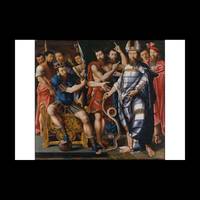
rif. 326764Contentum Ltd. Loose sheet. New. High-quality art print based on an original work from the Met. Created in the 16th century 1537. Professionally printed on premium fine-art paper Photo Rag Bright White premium quality in size A2. The artwork is printed with a white border museum-style presentation. Contentum Ltd. unknown
1904rif. 33489ABDresden, Stengel (Verlagsangabe auf Vorderdeckel und Titelseite überklebt mit 'Max Spielmeyer, Buchhandlung für Architektur und Kunstgewerbe, Berlin), o.J. [1904]. 2°, ein Blatt Titelseite, ein Blatt faksimilierte Titelseite sowie 3 beidseitig bedruckte Blatt mit dem franz. Text sowie 72 Blatt mit wunderbaren s/w-Illustr. (= alles), in der original Mappe mit den 3 Schließbändern, Neue Facsimile-Ausgabe in Photolithographie zwei der Textseiten seitlich mit winzigem Einrißchen, sonst ein erstaunlich schönes, sauberes und so gut wie nicht altersfleckiges Exemplar..
rif. DADAX0226497852New unknown
rif. DADAX0823242846New unknown
1922Legatura editoriale illustrata, ottima copia. Prima edizione con 91 tavole fuori testo a fine volume. Sc. U.
1808sc.: Gusman S., Dujardin - del. Cabasson, Hadamard 1 36x27 cm., estratto di 24 pagine, in francese con la biografie illustrata da ritratto dell'A. in testa (disegnato da DuJardin) e da 9 magnifiche incisioni eseguite dall'Artista stesso, mancano le pagine 19-20-21-22, ma ? allegata una bellissima incisione del ritratto di Prud'hon disegnato da Sabeta nell'aprile del 1837.
Inc. su rame, mm. 325x230 alla battuta, margini in barbe (con ombreggiature e aloni di muffa). Tenue coloritura coeva.
rif. DADAX0415537525New unknown
rif. 326765Contentum Ltd. Loose sheet. New. High-quality art print based on an original work from the Met. Created in the 16th century 1537. Professionally printed on premium fine-art paper Museum Etching museum quality in size A2. The artwork is printed with a white border museum-style presentation. Contentum Ltd. unknown
rif. DADAX0822319802New unknown
18758vo., on laid paper, with 2 woodcut frontispieces and 16 woodcut illustrations (a number full-page) in the text, endpapers very lightly browned; original brown cloth, boards with elaborate floral roll in blind, back with four flat bands, second compartment with label lettered in gilt, red edges, backstrip lightly pulled at head else a very good, crisp, clean copy. With the contemporary binder's ticket of Smith Brothers of Paternoster Row on rear paste-down. Bunyan's allegory was first published in 1678, less than a handful of copies are known to exist. This much-needed facsimile includes the frontispieces and titles to both parts, the 14 woodcut illustrations of the first part and the 2 woodcut illustrations of the second part. All marginalia (comprising arguments and biblical references) are faithfully retained. The work was not divided into chapters until Burder's edition of 1786. A notable and very scarce facsimile edition.
1996rif. 42102Köln, Weimar, Wien, Böhlau, 1996. XII, 374, [76] Seiten, mit zahlreichen Abbildungen. 23 x 16 cm, Broschur.
1600rif. 196861600 Une Gravure originale de la déesse grecque de la JUSTICE, technique eau-forte pointe sèche en noir, format : 14 x 20 cm, sur papier vergé crème contrecollée sur carton, sans date (XVIIème),
rif. est227t3Dimension extérieur 40 x 31 cm. Image : 30,5 x 21 cm. Petite gravure sympathique, à caractère allégorique, mettant en scène le printemps au travers d'une femme. On y trouve un petit texte qui loue les avantages et bienfaits de cette saison. Gravure dans son jus, contrecollée sur carton. Présence d'une déchirure (voir photos) mais restaurée.
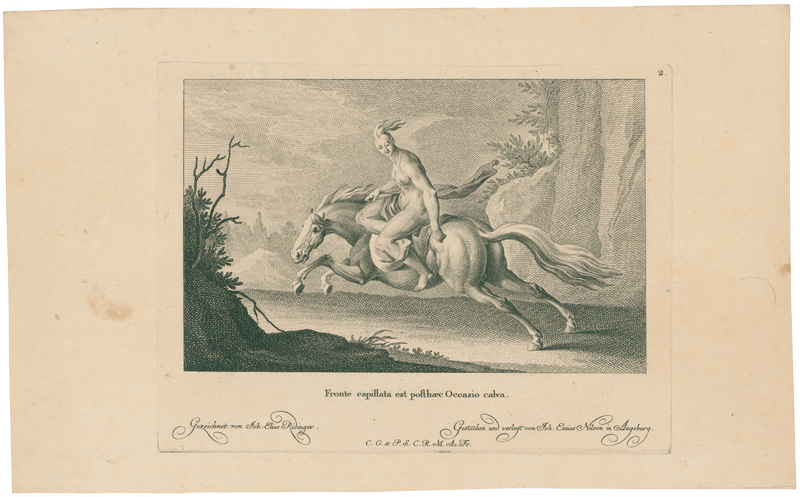
rif. 0451-Bo.J. Kupferstich, nach Johann Elias Ridinger (1698-1767), auf Bütten. 25,4:17,6 cm. Literatur: Schuster 145. Blatt 2 einer 2-Blatt-Folge. - Sehr guter und vollrandiger Abdruck. Einige kleinere Braunflecken.
1967rif. 851451967. Blattfüllende Darstellung in grau-violett Tönen mit aquarellierter Rahmenbordüre. 24,6 x 16 cm.
1589Frontespizio allegorico di Italia, Sclavoniae et Graeciae tabula geographicae (Duisburg, 1589) che comprende 22 carte geografiche della penisola, dei Balcani e della Grecia. Successivamente le carte sono ristampate nell’Atlantis Pars Altera (1595) pubblicato postumo alla morte del Mercatore, dallo stampatore di Duisburg Albert Buys, sotto la supervisione del figlio Rumold Mercator. Composto da sei parti – pubblicate separatamente tra il 1589 e il 1594 – comprende 107 mappe, tutte tranne la carta del mondo di Rumold, firmate da Gerard Mercator. Le lastre vennero poi acquistate da Jodocus Hondius, che tra il 1606 e il 1630 le utilizzò per il suo Atlas Sive Cosmographicae Meditationes de Fabrica Mundi, integrandole ed aggiornandole con proprie “nuove” carte. Delle mappe di Mercator sono note anche ristampe curate da Johannes Janssonius. Le edizioni Hondius e Janssonius ebbero un grande successo commerciale e furono stampate in più lingue, con il testo al verso della carta in latino, francese, tedesco e olandese. Incisione in rame, coloritura coeva, in buono stato di conservazione. Bibliografia cfr. Koeman II Me 11 e Koeman II Me 13A, 1595); Van der Krogt 1:002; J. Keuning, The History of an Atlas, in “Imago Mundi” IV (1947) pp. 37-43; World Encompassed p. 134. Title page of Italia, Sclavoniae et Graeciae tabula geographicae (Duisburg, 1589), which includes an allegorical frontispiece and 22 maps of Italy, the Balkans and Greece. Later, the maps are reprinted in the Atlantis Pars Altera (1595) published posthumously after the death of Mercator, by the Duisburg printer Albert Buys, under the supervision of his son Rumold Mercator. Composed of six parts - published separately between 1589 and 1594 - it includes 107 maps, all except Rumold's map of the world, made by Gerard Mercator. The plates were then purchased by Jodocus Hondius, who between 1606 and 1630 used them for his Atlas Sive Cosmographicae Meditationes de Fabrica Mundi, integrating and updating them with his own "new" maps. Of Mercator's maps are also known reprints edited by Johannes Janssonius. The Hondius and Janssonius editions had a great commercial success and were printed in several languages, with the text on the back of the map in Latin, French, German and Dutch. The map is engraved with the typical connotations of Mercatorian work. The mountains are aligned in a mountainous area concept, not to indicate true chains or valleys, and have a structure with some differences in size, but similar in shape, with vertical slopes and flat tops. The cities are shown through more or less large castles characterized by slender and pointed roofs, similar to wizard hats. Copper engraving, in good condition. Bibliografia cfr. Koeman II Me 11 e Koeman II Me 13A, 1595); Van der Krogt 1:002; J. Keuning, The History of an Atlas, in “Imago Mundi” IV (1947) pp. 37-43; World Encompassed p. 134
1688Frontespizio del "Itinerarium Italiae" di Martin Zeiler. Incisione in rame, in eccellente stato di conservazione. Frontespizio del "Itinerarium Italiae" di Martin Zeiler. Incisione in rame, in eccellente stato di conservazione. D. Cremonini, L’Italia nelle vedute e carte geografiche dal 1493 al 1894 libri di viaggi e atlanti, 1996, pp.37 e 64.
1655Frontespizio della serie Palazzi di Roma de' più celebri architetti designati da Pietro Ferrerio pittore et architetto. L'opera fu progettata e iniziata da Pietro Ferrerio nel 1638 circa; il secondo libro, Nuovi disegni delle architetture e piante dei palazzi di Roma de' più celebri architetti..., fu realizzato da G. B. Falda, che ne fu anche l'intagliatore, e venne pubblicato nel 1655 da G. G. De Rossi. Riguardo al primo libro non si conosce il nome dell'incisore: il Ferrerio firma le tavole solo in qualità di disegnatore. Le più importanti tipologie edilizie romane sono illustrate dal Ferrerio sia in alzato sia in pianta, a partire dall'età d'oro di Bramante, Raffaello, Peruzzi e Michelangelo per poi passare a Vignola, Ammannati, Ligorio, Della Porta, dedicando infine un modesto spazio agli architetti del nuovo secolo, quali Bernini, Borromini o Domenico Fontana: segnale evidente, questo, di quanto l'orientamento della cultura e del gusto del Seicento maturo tendesse verso un recupero ed una preferenza nei riguardi del classicismo cinquecentesco o del tardo manierismo controriformato. Ogni tavola è corredata da un'iscrizione di carattere storica che riporta sempre, tra le altre notizie, il nome dell'architetto che progettò l'opera, e l'anno di inizio della costruzione. Le incisioni si caratterizzano per la precisione del disegno, l'attenzione verso il particolare e la nitidezza dell'immagine. L'opera costituisce una sorta di guida all'architettura romana tra cinquecento e seicento, di grande valore storico-documentario. Acquaforte, stampata su carta vergata coeva, in buono stato di conservazione. Plate from the series Palazzi di Roma de' più celebri architetti designate da Pietro Ferrerio pittore et architetto. The work was projected and begun by Pietro Ferrerio in about 1638; the second book, Nuovi disegni delle architetture e piante dei palazzi di Roma de' più celebri architetti..., was done by G. B. Falda, who was also the engraver, and was published in 1655 by G. G. De Rossi. Regarding the first book we do not know the name of the engraver: Ferrerio signs the plates only as a draftsman. The most important Roman building typologies are illustrated by Ferrerio both in elevation and in plan, starting from the golden age of Bramante, Raphael, Peruzzi and Michelangelo and then moving on to Vignola, Ammannati, Ligorio, Della Porta, finally dedicating a modest space to the architects of the new century, such as Bernini, Borromini or Domenico Fontana: This is an evident sign of how much the orientation of the culture and taste of the mature seventeenth century tended towards a recovery and a preference for sixteenth-century classicism or late counter-reformed Mannerism. Each panel is accompanied by a historical inscription that always reports, among other information, the name of the architect who designed the work, and the year in which construction began. The engravings are characterized by the precision of the drawing, the attention to detail and the sharpness of the image. The work constitutes a sort of guide to Roman architecture between the sixteenth and seventeenth centuries, of great historical-documentary value. Etching, printed on contemporary laid paper, in good condition.
rif. SONG1596871725Used: Good unknown
rif. DADAX0333646185New unknown
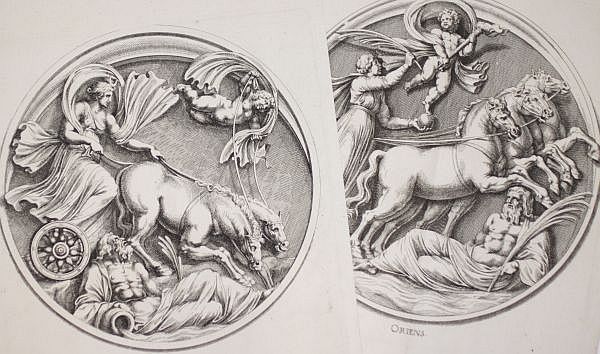
1772rif. 900627AGNürnberg:, Andreas Endter, 1772. Kupferstich, kreisförmige Darstellung, Plattengröße 27,5 x 25,5 cm, Blattgröße 40,5 x 34,5 cm. [3 Warenabbildungen]
1630rif. 87241630 Lugdunum Batavorum, Ex Officina Elzeviriana, 1630; in-12, plein veau fauve, double filet doré encadrant les plats, dos à nerfs , caissons de double filet doré ornés d'une rosace dorée, titre doré, tranches mouchetées de rouge; 690,(6)pp.; titre orné.
1768rif. 1601111768. Klarer Druck mit der vollen Darstellung auf Bütten. 15,2 x 23,6 cm. Papier: 17,5 x 25,2 cm.