2 603 résultats
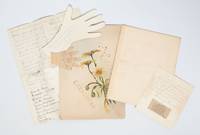
1894réf. 5648Lacon Illinois 1894. Handmade baby book on watercolor paper stitched at spine measuring 200 x 160mm and slipped into a folded sheet measuring 250 x 170mm. External wrap with a lovely original watercolor floral with the name Geraldine; tender with splitting along foldline. Baby book comprised of 16 leaves of manuscript and original pen drawings to rectos only. Additional 4 pieces loosely inserted include: a handwritten card from Carrie Bartlett with The Baby poem pinned to footer two child hand-tracings at various ages and a description of Geraldine's sixth birthday party and gifts on State of Illinois Senate Chamber letterhead. A beautiful testament to the bond between a 19th century mother and her first daughter as well as to her own artistic care and creativity. Jennie Richmond's excitement over each of the early moments of her first daughter's life is lovingly documented in this unique manuscript. Detailed and lovely half and full title pages open the piece with Jennie using red ink to create floral and cupid motifs and lines for manuscript text; to this she adds in dark ink and entries about Geraldine's infancy. These are no less detailed than the illustrations. "Born at Lacon Ill on Tuesday the 18th Day of April 1893 at the hour of 1.20 O'clock A.M. unto Mr. and Mrs. Richmond" this initial entry also includes the autographs of the parents as well as the attending physician and nurse. She weighed "five pounds and one half." Geraldine's "first picture was taken at five and one half months by Grant Rose. Oil painting made by Jennie L. Fitch.First tooth when ten months old. Learned to creep forward when the metronome was put before her. First step July 7 when almost 13 months old. Plaster of Paris hand taken when 3 months old." Geraldine's first bath a lock of her hair her first ring -- these and so many other tiny moments are made monumental in this book. It becomes clear not only that Geraldine is adored but also that she is surrounded by art music and intellectual activity. Jennie's husband Elijah an attorney afforded them a comfortable lifestyle that could allow all this. Census records show that Jennie and Elijah went on to have three more children -- all sons. And on being widowed Jennie took up living with Geraldine in a single household. Geraldine by 1940 had become a music teacher with her own studio. A lovely unique and research rich piece touching on the history of maternity the history of infant education women's domestic lives women's education and art and genealogy among other fields. U.S. Census 1900 1910 1920 1930 1940. unknown
2006réf. 0001772OAKLAND CALIFORNIA CA 'OAK TOWN'. Very Good. 2006. On offer is an absolutely fascinating pair 2 of startlingly candid and intimate contemporary manuscript diaries handwritten by a 'Chola' girl providing an unparalleled look into the life of a Latina woman living and loving within a gang. Dated November 12th 2006 through January 10th 2010 one reads of sex drugs court dates made and missed children multiple sexual partners and the internal politics of gang life. Due to the fact the books are contemporary we decline to name the woman fully in the description but she is identified in the diaries. Interestingly she always signs her entries 'Baby Girl'. From the mundane of buying her man boxers socks and wife beaters buying drugs taking drugs hanging curtains to servicing him sexually except after he comes directly from another woman and still smells of her dealing with her children and his infidelity the reader comes to understand that she is not happy. She admits that things have gone downhill since another lover went to jail. At one point we read of a potential altercation brewing as another woman accuses her of being a prostitute and ones expects to read that some violence between them will occur but it seems to fade away. Researchers and historians of the time and place will relish the intimacies she writes as they all point to a life that 99% of the world can only guess at or assume from the few movies about gang life. This is really one of the most extraordinary diaries we have read. While we did not find a specific reference to Oakland California she mentions 'Oak Town' and refers to a number of locations that clinch the fact she is in Oakland. The first book is almost entirely full and the second a bit spottier but a gripping narrative throughout. Overall VG.; Manuscript; 8vo - over 7¾" - 9¾" tall; KEYWORDS: HISTORY OF CHOLA HOMEGIRL OAKLAND OAK TOWN GANGS LATINOS MEXICANS HOME BOYS GANG BANGERS CHONGAS BARRIO GHETTO WOMEN'S STUDIES SOCIAL STUDIES GENDER STUDIES FIRME HYNA LATINA RAZA MEXICAN GANGSTA GANGSTERS GANGSTER LIFE AMERICANAHANDWRITTEN MANUSCRIPT DOCUMENT LETTER AUTOGRAPH DIARY JOURNAL LOG KEEPSAKE WRITER HAND WRITTEN DOCUMENTS SIGNED LETTERS MANUSCRIPTS HISTORICAL HOLOGRAPH WRITERS DIARIES JOURNALS LOGS AUTOGRAPHS PERSONAL MEMOIR MEMORIAL PERSONAL HISTORY AMERICANA ANTIQUITÉ CONTRAT VÉLIN DOCUMENT MANUSCRIT PAPIER ANTIKE BRIEF PERGAMENT DOKUMENT MANUSKRIPT PAPIER OGGETTO D'ANTIQUARIATO ATTO VELINA DOCUMENTO MANOSCRITTO CARTA ANTIGÜEDAD HECHO VITELA DOCUMENTO MANUSCRITO PAPEL . unknown
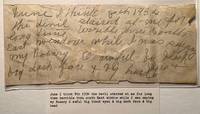
réf. 429Leadville Colorado Baby Doe Tabor Archive of Letters Notes Clippings Paperwork Scraps and Ephemera from Horace Tabor and Baby Doe Tabor. Collection all in protective sleeves. Most of the material has been well preserved and remains in very good condition. Many of Baby Does handwritten notes were written on scraps old calendars or envelopes and the condition reflects this. Her writing can be a little difficult to read but most of the longer notes have been transcribed. Overall very good condition. Horace Austin Warner "Haw" Tabor 1833-1899 also known as "The Bonanza King of Leadville" arrived in Colorado in April 1859 during the Pike's Peak Gold Rush. He was accompanied by his first wife Augusta and their son Nathaniel. In 1860 he tried prospecting at California Gulch in Oro City the area that would eventually become Leadville. But after those prospects were not successful he relocated to Park County settling in Laurette. There they operated a store and Horace served as the postmaster. In 1877 Tabor and family returned to the Oro City area and operated a general store. Heavy black sand had been plaguing miners and--in a discovery reminiscent of the Comstock Lode "blue muck" revelation--it was found to be the lead mineral cerussite rich in silver. Tabor made his first fortune in the Little Pittsburg Mine. Its mine owners were not able to pay their bill at Tabor's store so he accepted an interest in the mine as payment. His gamble paid off. On May 3 1878 the mine revealed massive silver lodes that kicked off the Colorado Silver Boom. In 1879 Tabor sold his interest in the mine for $1 million. He used this money to invest in other mining operations including the Chrysotile and the Matchless Mines as well as mines and real estate in Cripple Creek Aspen the San Juan Mountains and more. By 1879 his fortune was close to $6 million. Tabor and fellow mine owner August Meyer are credited with founding Leadville and Horace Tabor served as Leadville's first mayor. Tabor invested heavily in Leadville. He built the Tabor Grand Hotel the Tabor Opera House the Bank of Leadville newspapers public works projects the Tabor Block and more. He served as Lieutenant Governor of Colorado from 1878-1884 then briefly as a US Senator from Colorado Jan.-March 1883 replacing Senator Teller. Later he unsuccessfully ran for governor of Colorado. In 1879 the rich Tabor family moved to Denver. However it was not a happy home. Horace was a gambler and reckless with money and his marriage to Augusta became strained. In 1880 he met and had an affair with Elizabeth McCourt who would later be known as "Baby Doe." The pair met in a restaurant in Leadville and McCourt recounted her story of arriving in Leadville and working for Jacob Sands who was interested in her romantically. Tabor gave her $5000 and McCourt relocated to the Windsor Hotel in Denver. In 1882 he divorced Augusta and in 1883 he publicly married McCourt an event that was considered very scandalous at the time. At the time Tabor was 52 and McCourt was 28. For a time Horace and Baby Doe lived a life of luxury. They had two daughters Elizabeth Bonduel "Lily" and Rosemary "Silver Dollar" Echo. But in 1893 the repeal of the Sherman Silver Purchase Act caused a drop in the price of silver that destroyed Tabor's fortune. He went back to work in mining and even became postmaster of Denver. In 1899 he fell ill with appendicitis and died on April 10th. His last wish was for the Matchless Mine to remain in Baby Doe's possession. The Aspen Tribune reported that ten thousand people attended his funeral. Baby Doe moved back to Leadville with her daughters where they lived in a cabin on the Matchless Mine site. She tried to find investors to restart production in the mine but it had severe flooding problems. This began the final dark chapter in her once luxurious life. She lived in poverty wearing burlap sacks around her legs in the cold winters. With no money she ate very little living on stale bread and suet and refused to accept charity. This was her life for her final 35 years. Baby Doe lived in the cabin with her daughter Silver Dollar. Her older daughter Lily had left and lived with family in Wisconsin. Eventually Silver Dollar left Leadville for Denver working as a writer for the Denver Times but struggling with alcohol abuse. She moved to Chicago and after working as a dancer she became the mistress of a Chicago gangster. In 1925 Silver Dollar was found scalded to death under suspicious circumstances in her Chicago boarding house where she had been living under the name "Ruth Norman." For the rest of her life Baby Doe refused to believe the woman found as Ruth Norman had been her daughter stating "I did not see the body they said was my little girl." During her final decades on the Matchless Mine property Baby Doe wrote incessantly in diaries letters and scraps that she called "Dreams and Visions" consisting of about 2000 fragments later found bundled in piles of paper in her cabin. Some of these entries are included in this lot. She became very religious. Once the Queen of Leadville she was now considered an outcast madwoman wandering the streets of Leadville dressed in a mixture of women's and men's clothing. In March 1935 during a brutal winter in Leadville she was found dead in her cabin having frozen to death at the age of 81. Her body was taken by train to Denver and she was buried next to Horace at the Mount Olivet Cemetery in Wheat Ridge Colorado. The Archive Horace Tabor Items 1 Five Leadville billheads for Tabor businesses. 2 Extremely rare brass tag for the Pioneer Stage Company. Pioneer / Stage Co. / 164 / T. & W. Marked on the reverse: Novelty MFG Co / Denver Col. 1.5" heart shaped. c.1880. Tabor acquired an interest in this company in 1880. He formed a partnership with Perley Wasson the original Leadville stage owner hence "T.&W." on the tag. In 1881 Tabor bought out Wasson and focused the traffic between Rockwood and Rico. The company was renamed the HAW Tabor Pioneer Stage & Express Line. 3 Four stocks related to the Tabor Grand Hotel. 4 Ten revenue checks incl. Tabor autographs. Baby Doe Tabor Items 1 Personal notes/reflections by Baby Doe. These astonishing pieces are a window into Baby Doe's troubled thoughts and dreams during her years in poverty in the Matchless Mine cabin. This group includes approx. 15 pieces with all messages written in pencil on scraps of paper or postal covers. Her handwriting can be very difficult to read. They detail her descent into madness during her final years. Many of the notes come with transcription a June 8th 1934. "The devil starred at me for long time.terrible.thru south east window while I was saying my Rosary.O awful big black eyes & big dark face & big head." b Aug. 17 1923. "I Received Silvers letter about Marriage O how my heart aches Jesus will be done forever." Sat. 18th 1923. "Mrs. Shinek hunting men for No. 6 shaft. God guide us in all." c Small scrap of newspaper. Sept. 18 1923. "17 devils appeared." d Double sided letter from Sept. 18 1923 largely illegible. Appears to describe dream. e Five 1922 calendar pages with messages written in pencil on the reverse. Longest reads: "i dreamed this November. So terrible was my dream of to-day Nov. 15 1922.that I thought it would kill me that my darling Child Silver went down the Jungle & brought up her hand & arm a devil-snake mans head on its thick copper seething sissing steaming hot body all pores & steam coming out of each pore his head was too horrifying murderously horrible. he was over coming her she was fainting & as white as snow.God of Everlasting mercy you are the only mercy there ever was or is save my Silver & Lily & her poor children." Others: "Sept 6. Last food. no money or food." "July 9. in dream Pa came with paper in his hands elegant he looked & he brought with him Jake he wanted to renew old friendship." "June 6 1922 Jesus St. Anthony and Saint Anthonys tongue appeared in glory to me. 5 visions. saw vision of No. 17." f Undated half-sheet describing two strong visions given to her by Jesus about a man and a baby. g Jan. 26 1922 message about the mine: "I saw a strong vision.of our ore bucket going down No. 6 shaft.the water was flooding the Matchless Mine." h 1929 visions again involving a baby. "After the 18." "Before I saw the Vision of the Baby I saw a Vision of lots of light-purple clouds-It means a happy death because they were light purple." 1 A pencil sketch done by Baby Doe 2 Personal and business correspondence to Baby Doe. Covers and letters. Some have small handwritten notes in pencil from Baby Doe. Approximately 50 items. Includes: 1908/09 and 1925 correspondence related to her ownership of the Matchless Mine; covers addressed to her mostly from the 1920s and 30s; Easter card and cover from her daughter Lily; letters from friends; 1932 letter advising her to file a lawsuit against Warner Brothers for "Silver Dollar"; 1934 letter from a woman whose father worked for Horace and Baby Doe; 1929 letter from someone wanting a sample of silver ore from the mine; a typed 1928 letter detailing the struggles of the Matchless Mine and looking for a loan possibly signed by Baby Doe; and more. Please inspect. 3 Newspaper clippings. 15 or so pieces. One has a note that it was kept by Baby Doe. A few others have pencil notations. Thus it is believed that these were all clippings kept by Baby Doe. Articles about Leadville and Horace Tabor. 4 Baby Doe items related to Jacob Sands. Six pieces. Sands was the benefactor of Baby Doe when she first arrived in Leadville and pursued her romantically. Items include: 1893 Leadville BPO Elks ledger page with Jacob Sands signature on first line; 1880s Sands Pelton & Co. Leadville billhead; 190- Sands Brothers Leadville billhead and letterhead; 1892 state of Colorado document dateline Amethyst Colorado about draft from Sands Bros.; and 1904 Sands Outfitting Company Denver billhead. 5 Misc. items. Includes: 1935 Denver Post special edition all about the death of Baby Doe and the story of the Tabors; more modern newspaper clippings about Baby Doe; a dozen postcards some RPC of Horace and Baby Doe; unknown handwritten notes. Fascination remains high regarding the legends of Horace and Baby Doe Tabor. Shops in Leadville are filled with modern ephemera telling their story. However original material owned or written by either Horace or Baby Doe is uncommon. Especially rare are the writings of Baby Doe as she descended into poverty and wild dreams. A more complete inventory available upon request for this amazing collection of Leadville and Colorado history. unknown