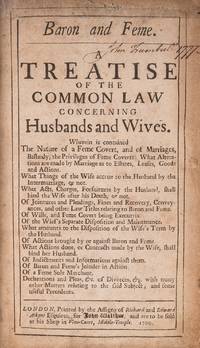
1700ref. 848691700. London 1700. First edition. London 1700. First edition. First Edition of the Earliest English Treatise Devoted Exclusively to the Common Law of Husband and Wife With the Contemporary Signature of John Trumbull Marriage Law. Great Britain. Baron and Feme: A Treatise of the Common Law Concerning Husbands and Wives. London: Printed by the Assigns of Richard and Edward Atkyns Esquires for John Walthoe And are to be Sold in his Shop in Vine-Court Middle-Temple 1700. Octavo. 7" x 4-1/4"; 183 x 110 mm. xxx 380 36 pp. Lacking the advertisement leaves one facing title four at end. Contemporary sheep sympathetically rebacked retaining original spine with raised bands and lettering-piece; boards with blind fillets. Moderate wear corners rubbed; title and front free endpaper rehinged small marginal repair to title. Moderate toning occasional light damp-marking; a few minor marginal defects including a small tear to L4. Ownership inscription of John Trumbull dated 1777 to title and following leaf. Housed in a quarter morocco clamshell case. A very good copy with notable early American legal provenance. $7500. First edition of the earliest English treatise devoted exclusively to the law of husband and wife and one of the principal early attempts to systematize the common-law doctrine of coverture in a single practical work. Issued in expanded editions 1719 1738 it remained a point of reference for eighteenth-century practitioners and compilers. The treatise organizes the law of marriage as a coherent doctrinal field proceeding from formation solemnization and validity through the incidents of coverture to dissolution and separation. Its treatment of the feme covert is comprehensive addressing personal status contractual incapacity property rights and procedural position. In contrast to earlier more diffuse authorities it offers a structured exposition designed for professional use with attention to pleading evidentiary questions and precedent. Of particular legal interest is its detailed account of the interaction between strict coverture doctrine and the equitable and customary devices that qualified it. The discussion of marriage settlements trusts and separate maintenance agreements documents the means by which property could be secured to or for the use of married women notwithstanding their forma. unknown books
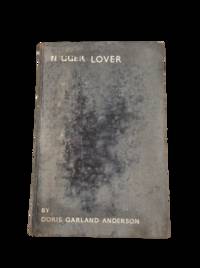
1938ref. 228671938. Anderson Doris Garland. Nier Lover 1938 is an interracial marriage memoir documenting the life of a white English woman married to Garland Anderson one of the earliest Black dramatists to achieve a full-length Broadway production. Published for a British audience in the interwar period the work supports research into African American theater history interracial relationships and transatlantic racial attitudes prior to the modern civil rights movement. The narrative records lived experiences of racial discrimination and social exclusion across Britain Europe Canada and the United States situating personal life within the broader structures of Jim Crow segregation and informal racial hierarchies in the Atlantic world. Anderson Doris Garland. Nier Lover. London: L. N. Fowler & Co. Ltd. 1938. First edition. Octavo. Publisher's dark gray cloth boards lettered in white on spine and upper cover. The text presents a first-person account of marriage to Garland Anderson tracing the couple's movements across multiple countries and documenting encounters with both overt and subtle forms of racial discrimination. Episodes include hotels that accepted them as guests but refused shared accommodations social ostracism within English society and the more rigidly enforced segregation of the United States. The memoir frames these experiences through the lens of Garland Anderson's career as a playwright and lecturer incorporating discussion of his public reception and professional life. The title intentionally provocative contrasts with the narrative's emphasis on mutual respect spiritual alignment and partnership while also reflecting contemporary public hostility toward interracial unions. 8 preliminary leaves 282 pages with frontispiece and additional portrait plates. Publisher's cloth binding. Octavo format. Cloth heavily mottled and rubbed with fading and soiling to both boards; spine sunned with fraying; text block generally clean and sound; overall good condition. Issued during a period when interracial marriage faced legal and social prohibitions in many regions the memoir provides direct evidence of cross-cultural perceptions of race intimacy and Black public life in the 1930s contributing to the study of race relations gender and African American cultural presence in transatlantic contexts. unknown books
1772ref. 823451772. London: T. Spilsbury for J. Ridley 1772. London: T. Spilsbury for J. Ridley 1772. "The Stagnation of Matrimony": A Radical 1772 Proposal to Reform the Marriage Market Marriage. Great Britain. Considerations on the Causes of the Present Stagnation of Matrimony Under the Following Heads. I. The Unreasonable Degree of Influence and Authority which Most Parents Exercise Over Their Children in the Concern of Marriage. II. The High and Elegant Education that is Given to Young Women Beyond the Compass of Their Fortunes and Stations of Life. III. The Debauchery and Extravagance of Young Men. IV. The General Luxurious and Expensive Taste of the Times. All of Which are Evils That Seem to Call for the Attention of Parliament. London: Printed by T. Spilsbury for J. Ridley 1772. iii-vii 1 71 1 pp. Complete. Octavo 8-1/4" x 5-1/4". Stab-stitched pamphlet in plain wrappers. Front wrapper detached small tears and chips to fore-edges of wrappers moderate toning small holes to a few leaves affecting legibility of one word on p. 47. A complete and crisp example of Georgian street literature. $450. Only edition. Only edition. A fascinating and remarkably modern critique of the social and legal barriers to marriage in late 18th-century England. The anonymous author identifies four primary "evils" calling for Parliamentary intervention: parental tyranny over-education male vice and economic luxury a general culture of expensive tastes that makes marriage financially daunting. The author moves beyond mere complaint to offer specific legal remedies including the abolition of the celibacy requirement for fellows at Oxford and Cambridge and a lowering of the age of consent. The work argues for a return to "the simplicity of nature" by allowing young people to follow their affections before they are corrupted by the "pride of life." OCLC and the ESTC locate 10 copies 5 in North America 1 in a law library Library of Congress. English Short-Title Catalogue T68641. unknown books
1883ref. 727291883. London 1883. London 1883. The "Annual Blister" of Victorian Law: A Scarce 1883 Reformist Tract on the Deceased Wife's Sister Controversy Marriage Law Reform Association. A Summary of the Chief Arguments For and Against Marriage With A Deceased Wife's Sister. London: Marriage Law Reform Association 1883. 15 1 pp. Octavo 8-1/4" x 5-1/2". Stab-stitched pamphlet in self wrappers. Light toning negligible edgewear light foxing in a few places. $350. Third and final edition. A scarce reformist tract representing one of the most protracted legal and social battles of the Victorian era. The Marriage Law Reform Association was established in 1851 to overturn Lord Lyndhurst's Marriage Act of 1835 which codified the prohibition of marriage between a widower and his sister-in-law. This restriction was rooted in the theological "one flesh" doctrine of affinity which legally equated a wife's sister with a blood sister. The controversy often dubbed the "annual blister" due to its near-yearly debate in Parliament highlighted a sharp class divide; while the wealthy could travel abroad to marry the working classes-who relied on sisters-in-law for domestic stability-were forced into "legalized concubinage." The debate permeated Victorian culture appearing in works ranging from Gilbert and Sullivan's Iolanthe to the novels of Dinah Craik. This edition captures the height of the Association's campaign which eventually succeeded with the passage of the Deceased Wife's Sister's Marriage Act in 1907. Sweet & Maxwell A Legal Bibliography of the British Commonwealth of Nations Vol. 2 p. 224. unknown books
1880ref. 516961880. London c.1857. London c.1857. Criminal Conversation's Influence on Later Divorce Law Trials. Marriage Law. Crim. Con. Actions and Trials and Other Proceedings Relating to Marriage Before the Passing of the Present Divorce Act. London: N.p c.1880. iv 110 2 pp. Octavo 7-1/2" x 5". Three-quarter calf over marbled boards rebacked retaining portions of original backstrip hinges mended. Some rubbing to extremities offsetting and foxing to endleaves light toning to text. A handsome copy of a scarce title. $100. Only edition. With two cases involving Thomas Erskine as counsel. "Actions for what was formerly known.as criminal conversation were nominally abolished thirty years ago: that they were not actually got rid of as will presently be shewn is evident from the wording of the Divorce Act. It is a remarkable fact however that in spite of the loose wording of the Act such actions have become of such a rare occurrence as to be virtually at an end and what the Act was intended to bring about while failing to do it technically has yet to come to pass. The object of the following pages is to show the nature of the legal proceedings formerly in vogue as necessary before an injured husband could clear himself of an adulterous wife and marry again and a number of interesting cases which attracted a deal of public attention in their day are given from which it may be readily perceived with what facility conspiracy and fraud could be perpetuated.": Preface iii. Not in Sweet & Maxwell or the British Museum Catalogue. unknown books
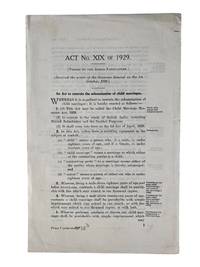
1929ref. 219671929. Government of India An Act to Restrain the Solemnisation of Child Marriages 1929 documents the legal system created to restrict child marriage in British India and supports research into women's rights colonial law childhood and social reform in South Asia. The Act commonly known as the Sarda Act after reformer Har Bilas Sarda reveals how legislation sought to regulate marriage age through statutory definitions penalties and enforcement provisions. It provides primary-source evidence for the study of Indian feminist legal history colonial governance and campaigns against patriarchal marriage customs. Government of India. An Act to Restrain the Solemnisation of Child Marriages. Calcutta: Government of India Central Publication Branch 1929. First edition. Official pamphlet printing of Act No. XIX of 1929 passed by the Indian Legislature and assented to by the Governor General on October 1 1929. The Act defines "child" "child marriage" "contracting party" and "minor" sets age thresholds for boys under eighteen and girls under fourteen and establishes penalties for adult men contracting child marriages as well as for those who solemnize arrange or permit such ceremonies. Its jurisdiction extends across British India including British Baluchistan and the Santhal Parganas with enforcement beginning April 1 1930. The printed price of "1 anna or 1½d" indicates official distribution for public and administrative use. The pamphlet documents a legal enforcement system for marriage reform through statutory age limits criminal penalties and responsibility assigned to adult men parents priests and other facilitators demonstrating the process by which colonial law entered debates over gender childhood and personal status. The timing is significant because Indian social reformers and women's rights advocates used the late colonial legal arena to challenge early marriage and forced domestic subordination. Minor edge creasing; overall very good condition. A concise official printing of a foundational statute in South Asian women's rights law and the legal history of childhood protection. unknown books
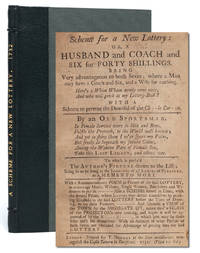
1732ref. 6120London: Printed for T. Dormer 1732. First edition. Modern quarter morocco over cloth with gilt to spine. Measuring 180 x 111mm and collating complete including frontis folding game board and concluding woodcut: 2 62 2. From the collection of stage magician Ricky Jay with his bookplate to upper pastedown. Top margin trimmed close with consistent loss to running headers and occasional loss to page numbers with no other text effected. Pages somewhat toned with minor marginal chips but otherwise unmarked. A scarce satire playing both on the rising popularity of get-rich-quick schemes and on the economics of the marriage market the present is the only example to appear in the auction record. OCLC locates only twelve institutional copies. The present is the only example currently in trade. A Scheme for a New Lottery warns readers against the dangers posed by get-rich-quick schemes targeting large-scale scams like the recently burst South Sea Bubble sometimes called the world's first Ponzi scheme and the pawn-broking swindle of the so-called Charitable Corporation. These scams were appealing to ordinary people at a time when few were "successful in using wealth from trade to found a landed family" Rapp. Mocking both the conmen and the conned A Scheme satirically proposes "Another Lottery which may prove a general benefit to all concern'd; as there is no better Remedy for a Bite from a Mad Dog than the Liver of the Dog that bit." The proposed lottery filled with abstruse rules and convoluted promises ensures that the cycle continues. A Scheme also mocks marriage as a scam in which women could either make a wise match in a rich man or lose it all by marrying down. The lottery provides "Fifty Thousand tickets to be deliver'd to Maids or Widows or any that appear to be such" in the hopes of winning a financially stable husband represented by the tickets drawn. Such a match could be a good one: "A Ware-House Keeper with the Salary of a Hundred Pounds" or "the Governour." It could also by virtue of lottery be a loss: "2 Scotchmen both Pedlars 500 Broken Booksellers" and a range of other ruinous bounders are also listed as prizes. For those who desire an advance attempt the folding game bound in the book invites blindfolded women to stick a pin in the board to claim their prize. The present copy was played gently with pin marks revealing a Blacksmith and a Valet de Chambre among those husbands won The popularity of A Scheme resulted in a reissue the same year with a canceled title page as The Ladies Lottery and falsely attributed to Swift. ESTC N20921. Printed for T. Dormer unknown books
1801ref. 5554London: J. Wright; Philanthropic Reform 1801. First editions. Two pamphlets bound together in modern quarter calf over marbled boards with morocco label to spine. Measuring 203 x 120mm and both collating complete: 4 136; 27 1 blank. Toning throughout both tracts with closed tears to pages 69-70 and 77-80 with no loss of text; contemporary pencil annotations throughout the first tract documenting one reader's responses to the controversial claims. Numbers 2 and 4 in ink to headers of each title suggest these were part of a larger compilation of legal tracts likely the set of four that were offered for sale in the 1923 Walpole Galleries sale which bear matching marks. Each scarce OCLC reports approximately 20 copies of the first title and ESTC locates 3 copies of the second title; they are the only examples currently in trade. Two scarce pamphlets engaging in a longstanding debate about whether how and when divorce should be socially and legally acceptable. These two take up the issue of women's sexual agency and Thoughts on the Propriety specifically espouses the notion that women who have engaged in adultery should not be allowed to divorce an existing spouse in order to marry a man with whom they've been unfaithful. Biblical justifications for this ban are presented throughout; but the hypocrisy woven into the argument makes it clear that its author is manufacturing a problem in order to punish and shame the few women for whom this circumstance even exists. Marriages at the time could only be dissolved through divorce in an Act of Parliament; thus divorces were only available to the titled and the wealthy. Additionally at the time of Thoughts on the Propriety's publication in 1800 no woman had ever successfully petitioned Parliament for divorce and been granted one. This landmark would come in 1801 the year of publication for Nuptiae Sacra when Jane Campbell successfully petitioned to divorce Edward Addison on the grounds of abuse. "Of the 314 divorce Acts issued before 1857 all but five were initiated by men. Of the five women who petitioned for divorce Jane Campbell was the first to successfully unbind herself from her husband" History of Parliament. Whether the author of Thoughts anticipated such a ruling or not it is clear that the issue at stake was not so much women gaining divorces as women more openly at the turn of the century engaging in pre and extra marital sexual relationships or even in some cases paid sex work. This was in fact occurring; and it was the subject of numerous satires erotic works and religious diatribes dealing with cuckoldry and whoredom. The desire to shame and control women who expressed sexual subjecthood and the impulse to position them as the sinning parties rather than the men who equally engaged in the behavior with them is telling and predicts how future divorce laws would unfold. J. Wright; Philanthropic Reform unknown books
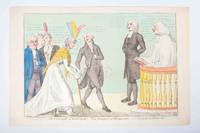
1800ref. 5629London: S. W. Fores 1800. First edition. Illustrated hand-colored broadside measuring 270 x 400mm and printed to verso only. Faint offsetting to recto and faint traces of mounting to corners. In all a Fine example of this visual satire commenting on the phenomenon of younger men seeking marriage with elderly widows for their own financial gain -- and the cultural anxiety surrounding the marital sexuality of such brides. Unrecorded in ESTC and OCLC we have located two examples of the present work at the British Museum and Yale. The present broadside draws together a wide matrix of debates and social anxieties surrounding the economic and sexual status of widows and the financial motivations for marriage among second sons and men of the middle class. Though women were more frequently forced into experiencing marriage as a form of 'honorable prostitution' in which their physical desirability served as their key for accessing wealth and stability under coverture it was increasingly acknowledged that large swaths of young men also suffered under this system. And while widows could escape the system -- shifting from the disempowered femme covert to the more legally independent femme sole on their husbands' deaths -- there was both a social fantasy of reinserting them into the marriage market as a means for regaining control over their money and bodies as well as a social anxiety about their ability to corrupt through the range of knowledge and authority they gained through previous marital experience. Here a young man walks his aging crone down the aisle. Ornately clad and expressing her anticipation for "the comforts of matrimony" she is ridiculed by the ministers at the pulpit who posit that if "matrimony was first ordained.for a remedy against fornication" then "the remedy will be worse than the disease" in this instance. Untroubled the young groom focuses on the land deeds bank notes and jewelry accounts which stuff his pockets -- assets which will legally become his after the ceremony and which serve as his marital comforts. Meanwhile two young women observe from the sidelines one of them planning her future with the groom after his aging bride's eventual demise. "Those jewels will look better on me than on the last owner" she notes as her companion whispers hopefully "you'll let me take a morning ride with you sometimes." A visual commentary on the financial and social issues surrounding marriage under coverture which Daniel Defoe would deride as "matrimonial whoredom." British Museum 1935.0522.8.109. Yale Center for British Art B1974.12.328. S. W. Fores unknown books
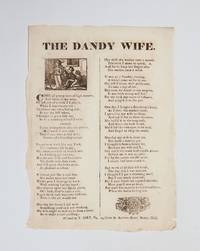
1828ref. 5421London: T. Birt 1828. First edition. Single sheet measuring 250 x 185mm and printed in two columns to recto. Some edgewear to margins not affecting text; a bit of foxing and toning largely confined to margins. A scarce and delicate survivor OCLC documents only one example at the National Library of Scotland. The present is the only example on the market. The Dandy Wife is narrated by a man who aimed "to choose me out a loving wife" at the age of twenty-one but whose experience becomes a warning to "all young men of high renown": "If you want a tidy wife Beware of a boarding school." What unfolds is a satire of how the marriage economy is affected when women have access to knowledge -- intellectual and physical -- and how by meeting a man's superficial expectations a woman can fulfill her own more pressing needs. Thinking that a boarding school girl will have the innocence submissiveness and domestic skill he desires the narrator selects a wife from among their ranks. Thinking only of what he can obtain from such a bargain he is unprepared for what an educated woman brings into his house. The Dandy Wife he describes understands the commodity value of her own beauty and material adornment and that these are her key means for acquiring wealth of her own. "She takes one-half of what I earn In drinking gin and tea; Besides such frills and furbelows My Dandy Wife does wear.Her sleeves upon her dandy gown Oh! Lack they're such a size You'd think they were two balloons that in the air would rise." Aside from staying on par with fashion trends her clothing assists her in avoiding domestic tasks she abhors. She refuses to do laundry more than monthly and through ridiculous cooking failures she rapidly establishes that the kitchen is not a showcase for her skillset. Accustomed to a life of learning she is not trained to conduct domestic business. By the ballad's end it becomes clear that the Dandy Wife was savvier in managing a marriage than her husband was. For not only does her superior intellect help her carve out a more satisfying role but she also has physical knowledge that predates him: "The day that I was married I thought I'd got a charming maid But I was much deceived.For scarce five months we'd married been When she had a darling son. T. Birt unknown books
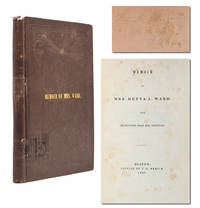
1843ref. 4025Berkeley: T.R. Marvin 1843. First edition. Very Good . Original publisher's cloth binding with gilt to front board. Minor loss of cloth to crown of spine. Faint residue of removed library label to spine and front board. Peach endpapers. Light scattered foxing as is typical of the period. Inscribed on the front endpaper by Ward's husband the compiler: "Reverend Mr. Ellingwood with the respects of J.W. Ward." Bookplate on the front pastedown reveals that the recipient Rev. Ellingwood went on to donate the volume to the Theological Seminary of Bangor Maine. A scarce and important example of a published American elegiac volume produced in this case by an eminent family to mourn the loss of an educated woman. Memoirs is unrecorded by OCLC and has never appeared at auction. In their marriage James Wilson Ward and Hetta Lord Hayes Ward united two prominent Northeastern families. A senator and Congregationalist minister James descended from the founders of Plymouth and had attended Andover and Amherst. Hetta the daughter of a judge and niece of a Dartmouth president was herself a graduate of Miss Grant's Seminary Academy. The present volume released "exclusively for private circulation among the friends of the deceased" is a testament to Hetta's value not as a daughter who married well or a wife who effectively managed a house but as a companion an intellectual and an individual. In this sense it deconstructs the period's expectations of separate spheres or hierarchy between sexes. With an opening letter by Susan Hayes Hetta's mother as well as a copy of the eulogy conducted by her husband the book reveals vast details about who Hetta was as a person. Both describe her as tender and affectionate; but time and again emphasis is placed on her mind. Though Hetta was skillful with a needle as a child according to her mother "her numberless questions interested and surprised me.She acquired a fondness for poetry.She became as much interested in the in the study of the exact sciences as in the works of imagination making herself acquainted with the higher branches of Mathematics Algebra Geometry etc." James similarly eulogizes his wife. What becomes clear is that he is grieving the loss of a companion and equal. "If we have found a friend of distinguished excellence and for years rejoiced with that friend in mutual interchange and warm affections it is natural when death intervenes and separates us from the dear object of our love to contemplate their virtues.First characteristic which I would notice which she possessed in an eminent degree is an ardent love of truth.She possessed great powers of abstraction.She saw with great clearness the point of an argument and was quick to distinguish between sophistry.She loved to trace the workings of the human mind." Not satisfied simply to have their own testaments to Hetta's extraordinary mind the compilers included to the last half of the book a collection of her own poetry and prose. A scarce work in a genre underappreciated in American literature and history. Such coterie publications of intimate mourning were uncommon for the time particularly for a woman. National Cyclopedia of American Biography 148. Very Good . T.R. Marvin unknown books
1878ref. 69170Meadville MS: Boyle & Chapman Printers Memphis 1878 in manuscript. Marriage certificate 11 x 9 ½ inches partially printed in red and green and illustrated at the head from a red wood engraving of a wedding party completed in manuscript and signed by E. C. Adams as clerk of court and by M. McMillan as Justice of the Peace officiating May 25 and 26 1878 with the court's embossed stamp. Entire text enclosed within an ornamental red and green border. Old fold line else very good. (Boyle & Chapman, Printers, Memphis) unknown books
1960ref. 374962New York: Ronald Press 1960. Hardcover. Fine/Fine. First edition. Foreword by Red Grange. Fine in very near fine dustwrapper with a touch of rubbing and a tiny stain and tear. "Football's most complete record book" according to the dustjacket. Scarce especially in this condition. Ronald Press hardcover books
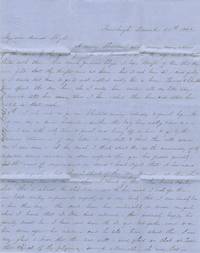
1849ref. BK0018Ferrisburgh Vermont 1849. Autograph letter signed "Anne R. M." to her husband Lloyd Minturn in San Francisco "Upper California." 8 pp.; approximately 1700 words. With stampless cover bearing a black "NEW-YORK / 40" datestamp of January 17 and manuscript routing "per Cherokee. Significant edge wear and central vertical crease; text generally clear and complete. An intimate Christmas letter from Anna Robinson Minturn of Ferrisburgh Vermont to her husband Lloyd then engaged in the hotel and real estate business at Pueblo San José during the California Gold Rush. Writing on the anniversary of his departure Anna describes the four-month-old son Lloyd had never seen questions whether California's speculative "mania" could last and repeatedly urges him to return home. Lloyd Minturn had traveled to California in January 1849 with David Lion Gardiner and other eastern emigrants. By November Gardiner reported that Minturn was "at Pueblo San Jose keeping a hotel and speculating in real estate."1 Anna's references to Lloyd's hotel and stables their rental and the uncertain recovery of his investment relate directly to his California business. He later appears in San Francisco as a member of the Committee of Vigilance of 1851 with his place of business on California Street and his residence at the Mansion House.2 Anna begins writing late on Christmas day imagining a future holiday spent with Lloyd "by thy quiet fire-side in Vermont-with thy wife and darling child with thee." Returning to the letter three days later she reflects on the year since his departure: "Oh how much I think about thee as the anniversary of thy departure comes round . When I think of thee my dearest ask then what a weary dreary time it seems . Our little darling improves so rapidly is so very lovely that I can hardly bear to have thee away." News that another California emigrant Dr. Stone had returned safely made Lloyd's absence still more painful. Although she understood that "the object of thy pilgrimage" at last appeared attainable Anna wondered why the management of his property could not be entrusted to an agent asking why "Mr. Ruckle" cannot "receive the rents & pay the former owner and send thee thy portion of the profits." However she immediately checks her own advice with an observation on marriage and gender: "You men know so much more how these things work than we so that it is rather labor wasted to advise much and I do hate to see a woman trying to rule her husband-don't thee" Anna feared that Lloyd might remain away sacrificing his domestic life only to lose the anticipated reward. Her skepticism extends to the Gold Rush itself: "I do hope though that the man who has taken your property will be able to pay you-that would be so bad to stay away so long-sacrificing so much & lose thy reward entirely-don't thee suppose this mania in California will end much as the land speculation did here seems to me it must. I hope thee won't get drawn in." Much of the letter is devoted to their infant son whose birth Lloyd may initially have learned of from another returning emigrant because of the "shamefully neglected" Pacific mails. At four months the boy weighed eighteen and one-quarter pounds and had "cheeks as hard as little apples." Anna encloses a lock of his hair explaining that she had kissed it before sending it. The contrast between California and the Vermont household runs throughout the letter. Anna describes the snow distant mountains sleighing baked apples and buckwheat cakes while Lloyd remains in a place known to her mainly through contradictory reports and unreliable correspondence. She cites Bayard Taylor's account of portions of California as suitable wheat country while noting that other observers claimed wheat could not be grown there at all remarking on the "contradictory accounts about California" that make it hard to "tell what to believe." Her anxiety was heightened by reports of cholera progressing toward California. She closes by asking Lloyd to protect his health and praying that he might be restored to her "in sound health both body & soul." Anna was a daughter of Rowland Thomas and Rachel Robinson of Rokeby the prominent Ferrisburgh Quaker family whose home later became known for its role in the Underground Railroad. Other letters from Anna to Lloyd during his California absence survive at the Bancroft Library and the Smithsonian.3 Overall a substantial and affecting account of the Gold Rush from the perspective of a wife left behind. 1 David Lion Gardner Letter to Juliana McLachlan Gardiner November 30 1849 David Gardiner Letters BANC MSS 2006/127 box 1.The Bancroft Library University of California Berkeley. 2 Anna Robinson Minturn Letters to Lloyd Minturn 1849-1851 Warshaw Collection of Business Americana Subject Categories: Steamboats box 1 folder 6 J-L Archives Center National Museum of American History Smithsonian Institution Washington DC. 3 Anna R. Minturn "Anna R. Minturn to Mr. Lloyd Minturn Ferrisburgh December 2 1849" California Gold Rush Letters BANC MSS C-B 547 box 5 The Bancroft Library University of California Berkeley. . unknown books
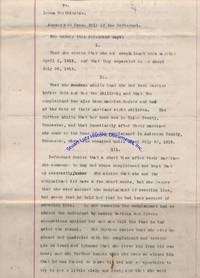
ref. 5492DIVORCE. DS. 5pgs. March 17 1920. Anderson County Tennessee. A typed legal document from the divorce of S. R. Worthington and Leona Worthington. It transcribes Leona Worthingtons answers in cross examination. For answer this defendant says: 1. That she admits that she and the complainant were married April 3 1919 and that they separated on or about July 20 1919Defendant denies that a short time after their marriage she commence to nag and abuse complainant and kept that up constantlyOn one occasion the complainant had so abused the defendant by making various and divers accusations against her and she told him that he had acted the rascal. She further denies that she ever so abused and quarreled with the complainant and treated him so cruel and inhuman that she drove him from his own home; and she further denies that she ever so abused him that he was forced to leave his bed and go up-stairs to try to get a little sleep and rest; and that she went up-stairs and insisted that he come back down and that she then quarreled with him the remainder of the nightShe further denies that she has mistreated the complainant and that she has been so cruel and inhuman in her treatment of him as to make it unsafe for him to live and cohabitate with her and she further denies calling him all sorts of vile names and quarrelling with him until she made his home a very bad placeThat after the complainant made the statement about seeing his lawyer and being advised to do everything he could to aggravate and being advised to do everything he could to aggravate her and cause her to leave the complainant seemed to do everything he could to carry out the advise sic of his lawyer and continually quarrelled sic at the defendant accusing her of staying there with him with the sole purpose of getting his property and made her life so miserable and unhappy that she felt that it was impossible for her to longer live with him and she was forced by his cruel and inhuman treatment of her to leave his home and go back to the home of her son in Union County where she is now living. The couple seems to have quarreled about strange things like milking cows in good clothes and spending too much money on undergarments. Leona Worthington asked for a divorce alimony attorneys fees and her old name back. She signed X and her attorney signed twice for her. A notary and two others also signed. The document is extensively annotated in pencil on the versos of several pages as well as corrected on the recto in the hand of Leona Worthingtons lawyer. It is in very good condition with minor wear. The first page is no longer attached to the staples that holds together the other sheets. hardcover books
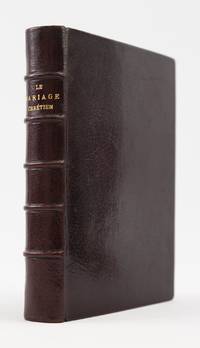
1882ref. ST19567-178Paris: Jules Gervais 1882. Sixth Edition. 160 x 115 mm. 6 1/4 x 4 1/2". 400 pp. Pleasing deep brown morocco by Fonteney stamp-signed on the verso of the front flyleaf raised bands spine lettered in gilt wide turn-ins gilt tooled patterned endleaves all edges gilt. Engraved frontispiece depicting St. Elizabeth by Friedrich Ludy after Friedrich Overbeck; each page with a decorative figural border. Minor foxing to preliminary leaves very slightly foxed elsewhere otherwise a fine copy the text quite clean bright and fresh and the binding unworn and exceptionally lustrous. Decoratively printed and attractively bound this volume on Christian marriage and family life is a delightful example of late 19th century French book production. Its author Félix-Antoine-Philibert Dupanloup 1802-78 was the bishop of Orléans and a proponent of liberal Catholicism in France throughout the 19th century. Alongside teaching and pastoral duties he authored several works on religious matters throughout his career. Initially published in 1869 the present work on "Christian Marriage" went on to become a very popular work remaining in print into the second decade of the 20th century. One wonders if its popularity was as much due to the beauty of the work as its contents: each page is graced with detailed engraved borders laden with scrolling foliage and rich Christian imagery executed with delicacy and panache. This copy is pleasing in its highly polished morocco exterior its lacy inner dentelles and its attractive patterned endleaves. Jules Gervais unknown books
1897ref. 250047Philadelphia: Gebbie Publishing Co 1897. Hardcover. Very Good. Very good book has minor rub of spine edges and corners of cover light fading of cover yellowing of pages foxing of endpapers name of former owner on endpapers gold gilt top foredge rough-cut foredge separation of front and back hinge starting. Gebbie Publishing Co hardcover books
1898ref. 250038Philadelphia: Gebbie Publishing Co 1898. Hardcover. Very Good. Very good book has minor rub of spine edges and corners of cover light fadingof spine and cover slight separation of front hinge yellowing of pages rough-cut pages gold gilt top foredge. Gebbie Publishing Co hardcover books
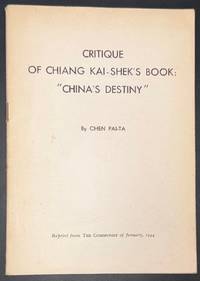
1944ref. 258914New York: The Communist 1944. 35p. staplebound pamphlet minor toning and edgewear otherwise very good. "Reprinted from The Communist of January 1944." Introduction by Earl Browder notes that this document came from the Communist base at Yan'an. The Communist unknown books
1997ref. 170577Chicago and San Francisco: Chinese Art Foundation 1997. Hardbound. VG in like slipcase. Green paper covered pictorial boards with wide green cloth spine. liv 217 pp. with 108 stunning annotated color plates. An essential addition to your Jade reference library. Chinese Art Foundation hardcover books
2006ref. 146761Hong Kong: Christie's 2006. Hardcover. VG. Color illus. paper over boards. Color illus. endpapers. 244 pp. Profusely illustrated in color. Published in conjunction with the auction held November 28 2006 auction code GUIYU QINGDIAO-2322. Text including a foreword by Yang Boda and an essay about jade provided in both English and Chinese. Lots 1351-1456. Christie's hardcover books
1982ref. 226932New York: Abrams 1982. hardcover. fine/near fine. Profusely illustrated in black & white. 317pp. folio black cloth dust wrapper. New York: Harry N. Abrams 1982. Fine in near fine d.w. Abrams unknown books
1754ref. 17008Verona: Per Gio. Battista Saracco 1754. 4to pp. 313. Library stamp on title-page; bound in full vellum a very good copy. This is part of a larger set but this volume concerns matrimonial law succession and other issues concerning the right and responsibilities of women in the Church. Per Gio. Battista Saracco unknown books
1960ref. 45239London: Limited Editions Club 1960. Limited edition. Hardcover. good to near fine. 1/1500. Quarto. xviii 1 271pp 1. Light brown slipcase tan label with black lettering on spine. Binding with black leather label with gilt lettering wrapped around front and back cover near the head and tail of spine. Illustrated frontispiece. This limited edition #87 of 1500 hand numbered and signed by illustrator René ben Sussan illustrated throughout with color gravure reproduction of Ben Sussan's artwork. Slipcase with sunning along bottom edge of back cover and light staining. Binding with light water stains at tail of spine. Top and bottom edges of labels at the spine with some rubbing. Slipcase in very good- binding in very good interior in near fine condition overall. Limited Editions Club hardcover books
2002ref. 270792Paris: Bibliothèque de l'Image / Mariage Frères 2002. Paperback. 92 2p. wraps 9x11 inches profusely illus. very good condition. Text in English and French. Mariage Frères is a French tea company. Bibliothèque de l'Image / Mariage Frères paperback books