5 162 résultats
1824réf. Q93957Paris, chez Treuttel et Würtz 1824 [iv] + 540pp., première édition française (traduit du latin sur l'Edition d'Amsterdam de 1768 "Deliciae sapientiae de amore conjugalis", et publié par un ami de la vérité), 21cm., reliure cart. en bon état (plats marbrés, dos en cuir à cinq nerfs, titre doré au dos), tranches et feuilles de garde marbrées, quelques rousseurs (texte toujours bien lisible), bon état, fort rare, [Cfr. Caillet no. 10462: "Cette traduction de Moet, le Martiniste, est rare ; il fut intimement lié avec Saint-Martin, le Philosophe inconnu, qui le rechercha pour répandre sa doctrine. Cet ouvrage a pour but d'exalter la sainteté du mariage et de signaler les dangers qu'entrainent l'adultère et le libertinage ; il suit dans toutes leurs phases les profanations de l'amour conjugal et montre leurs funestes conséquences"], Q93957
In 16° (cm 5,4 x 10), legatura piena pergamena coeva, pp (16), 635, 19, (2) bianche, impresa silografica al frontespizio, esemplare in buone condizioni, minuscola antica annotazione al front. (il cui inchiostro aveva perforato la carta, senza perdita di testo), ben restaurata con velina. L'A. (1550-1610), gesuita, docente di Teologia Morale a Granada, raccoglie in questo Trattato tutta la normativa relativa al matrimonio, destinata a confessori e direttori spirituali. Data la scabrosità dei soggetti trattati, e approfonditamente e esplicitamente sviscerati, l'opera fece clamore e scandalo (aspramente denigrata da Pascal, divenne spunto di polemiche tra giansenisti e gesuiti) e fu posta all'Index il 4 febbraio 1627; vi restò fino al 1900. La presente edizione riporta ancora tutte le "Approvazioni" degli Inquisitori. De Feller sottolinea che l'A. "avrebbe dovuto essere più riservato nei particolari e nelle decisioni". Tra gli argomenti: in qual modo il seme potè entrare nella Vergine Maria; se sia più peccaminoso congiungersi carnalmente con bestie morte, o vive; come stabilire quale sia il sesso prevalente negli ermafroditi, in modo da determinare se debbano contrarre matrimonio con maschi, o con femmine; ecc.; e innumerevoli minutissimi dettagli relativi ai comportamenti sessuali tra coniugi. Edizione posteriore di tre anni censita in SBN; un esemplare in COPAC. De Feller, tome 11, p 262; Sommervogel, VII, 530-537; Suppl. nn. 2280 e 5266.
1693Bella edizione del 1693 di questa opera di diritto canonico del gesuita e giurista spagnolo Tomas Sanchez (1550-1610) celebre in particolare per quest'opera. L'opera venne pubblicata per la prima volta a Genova nel 1602 e messa all'indice nel 1627 a causa della "Disputatio de debiti coniugali" nella quale si sostiene che l'autorità pontificia nella validità del matrimonio varierebbe in base alla presenza o meno dei figli. L'opera è formata da tre tomi divisi in due volumi ed è completa. Bella legatura in piena pergamena coeva a cinque nervi. Frontespizio in rosso e nero. Vignetta al frontespizio. Antiche firme. Grandi dimensioni. Titolo al taglio inferiore. Collazionata e completa. Copertina in piena pergamena a cinque nervi in buone condizioni generali con lievi usure e parti mancanti ai margini e dorso. Piatto anteriore del secondo volume in parte deformata. Legatura in buone condizioni. All'interno le pagine si presentano in ottime condizioni con fioriture. Qualche lieve gora d'umidità marginale. Bruniture. Alcuni piccoli segni di tarlo dalla carta 99 alla fine dell'ultimo volume. In Folio. Dim. 34x24 cm. Pp. (32)+467+(1)+380, 388+106+(2). Peso Kg. 2,500 Beautiful edition of 1693 of this work of church right by the spanish jesuit and jurist Tomas Sanchez (1550-1610) famous in particular for this work. thw work was published for the first time in Genova in 1602 and put in the index in 1627 because of "Disputatio de debiti coniugali"inn which the author states that authority of church in marriage varies in presence of son. the work is made up of three tomes bound in two volumes and it is complete. Beautiful full parchment cover with five nerfs. Red and black title page. Vignette in the title page. Antique signature in thte title page. Of big size. Collationed and complete. Full parchment coeval cover with five nerfs in good general conditions slightly worn with missing parts in the edges and spine. Front plate of second tome partially deshaped. Binding in good conditions. Inside pages are in very good conditions with foxings. Some slight water stains in the edges. Yellowings. Some little wormings from page 99 until the end of the last volume. In Folio. Dim. 34x24 cm. Pp. (32)+467+(1)+380, 388+106+(2). Weight Kg. 2,500
2003réf. DADAX0826466699Sheffield Academic Press 2003-06-01. hardcover. New. 6.14x0.94x9.21. Buy with confidence. Excellent Customer Service & Return policy. Sheffield Academic Press hardcover
réf. 1386.1aaf1646, 42.5 x 27.5 cm, charte avec belle écriture du 17e s., première ligne calligraphiée, pliée-
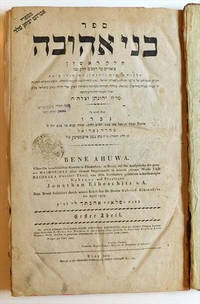
1819réf. 41334Prag Prague: Gedruckt In D. Schollischen Buchdruckerey 1819. Hardback. 1st edition. 4to period boards 4 82 1 25 leaves aproximately 224 pages. In Hebrew with some German on title page. Vinograd: Prague 1165. StCB: 5867 3; Jewish Museum 179. Contents: helek 1. Hilkhot ishut perek 1-10; helek 2. Hilkhot ishut perek 11-25; helek 3. Hilkhot gerushin. Hilkhot yibum va-halitsah. She'elot u-teshuvot. Maftehot. Novellae to Maimonides of the laws pertaining to women i.e. divorce relationships and marriage by Rabbi Jonathan ben Nathan Nata Eybeschutz 1690/95-1764 the talmudist kabbalist and child prodigy. In his youth after the death of his father he studied in Prossnitz under Rabbi Meir Eisenstadt and Rabbi Eliezer ha-Levi Ettinger his uncle and in Vienna under Rabbi Samson Wertheimer. He married the daughter of Rabbi Isaac Spira the av bet din of Bunzlau. After traveling for some time he settled in Prague in 1715 and in time became head of the yeshivah and a famous preacher. After the death of Rabbi David Oppenheim 1736 he was appointed dayan of Prague. Elected rabbi of Metz in 1741 he subsequently became rabbi of the "Three Communities" Altona Hamburg and Wandsbek in 1750. Both in Metz and in Altona he had many disciples and was considered a great preacher. His position in the Three Communities however was undermined when a dispute broke out concerning his suspected leanings toward Shabbateanism. This controversy accompanied Rabbi Eybeschuetz throughout his life and the quarrel had repercussions in every community from Holland to Poland. His main opponent was Rabbi Jacob Emden also a famous talmudist and a potential rival in the candidature to the rabbinate of the Three Communities. The quarrel developed into a great public dispute which divided the rabbis of the day. While most of the German rabbis opposed Rabbi Eybeschuetz his support came from the rabbis of Poland and Moravia. A fruitless attempt at mediation was made by Rabbi Ezekiel Landau rabbi of Prague. Most of Rabbi Eybeschuetz' own community was loyal to him and confidently accepted his refutation of the charges made by his opponent but dissension reached such a pitch that both sides appealed to the authorities in Hamburg and the government of Denmark for a judicial ruling. The king favored Rabbi Eybeschuetz and ordered new elections which resulted in his reappointment. After his reelection as rabbi of the Three Communities some rabbis of Frankfort Amsterdam and Metz challenged him to appear before them to reply to the suspicions raised against him. Rabbi Eybeschuetz refused and when the matter was brought before the Council of the Four Lands in 1753 the council issued a ruling in his favor. In 1760 the debate was rekindled when some Shabbatean elements were discovered among the students of Rabbi Eybeschuetz' yeshiva. At the same time his youngest son Wolf presented himself as a Shabbatean prophet with the result that the yeshiva was closed. See Bibliography of the Hebrew Book 1470-1960 #000109183; EJ; M. A. Perlmutter R. Yehonatan Eybeschuetz ve-Yahaso la-Shabbeta'ut 1947; Mifal ha-Bibliografyah ha-Ivrit Hoveret le-Dugmah 1964 13-24. SUBJECTS: Marriage Jewish law Divorce Jewish law Husband and wife Jewish law Incest -- Religious aspects -- Judaism. Maimonides Moses 1135-1204. Mishneh Torah -- Commentaries. OCLC: 19167576. Some wear usual light age and damp staining wide margins stamps. Binding starting About Very Good Condition. RAB-66-17-BLRKKQQ-'emn. Prag [Prague]: Gedruckt In D. Schollischen Buchdruckerey unknown
Mm 200x265 Due volumi pubblicati tra il 1826 ed il 1827. Legatura coeva in mezza pelle, tasselli ai dorsi con titoli oro impressi, piatti marezzati con angoli in pelle, 384 + 571 pagine con 67 tavole incise in rame (68 in verità perchè il numero 26 del primo tomo è ripetuto per una tavola di contenuto diverso) ripiegate fuori testo, 35 al primo volume, e 32 al secondo. I due volumi sono in buone condizioni con legature ben salde, presentano fioriture in alcune parti del testo ed in alcune tavole. Spedizione in 24 ore dalla conferma dell'ordine.
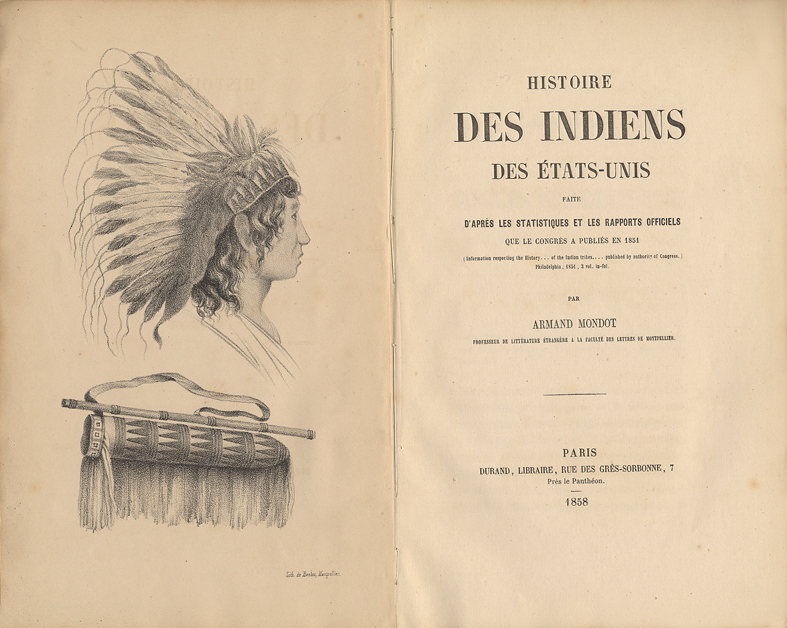
1858réf. 11257Paris, Durand, 1858 ; in-8, broché ; (4), 352 pp., lithographie en frontispice, couverture imprimée.
In folio (cm 21 x 30,5), cartonatura muta coeva, cc 105, (11), vergate nella medesima grafia, assai nitida, e leggibile, in latino; altro fascicolo di mano diversa numerato 20-131, (2). Esemplare in buone condizioni, lievi uniformi bruniture. Postille marginali di altra mano. La prima parte del manoscritto tratta della "quaestio" della donazione dell'imperatore Costantino al Papa, ripercorrendo le varie fasi della vicenda, con inquadramento storico sul periodo, la politica e la vita sociale del tempo che ne fu testimone; inoltre troviemo descritte le leggi di Costantino in favore della religione cristiana; la situazione militare secondo il successore Teodosio; la situazione giuridica in vari settori: matrimonio, ripudio, adulterio; la riforma dei costumi dei cittadini; l'usura; il fisco. Il manoscritto si interrompe bruscamente. E' stato legato insieme altro fascicolo, riguardante lo stesso argomento, sempre chiosato e sottolineato da altra mano.
réf. 32126Paris Chez Janet et Cotelle, Libraires 1820 in 8 (22x14) 2 volumes reliures à la bradel cartonnées rouge de l'époque, XXIII et 864 pages, pagination continue. Nouvelle édition augmentée, revue et corrigée, avec quelques notes de l'auteur et des éditeurs. Bel exemplaire
1905353 - 384, viii [ads] pages. Features: Many nostalgic ads; Seen on the Stage - including photos of Maude Adams, Raymond Hitchcock, Ethel Barrymore, and Bruce McRae; Working directions for Vogue weekly pattern No. 317; Ad for the Surrey Type One Ramber car by Thomas B. Jeffery & Company; Lovely one-page illustrated ad for the Arnold Print Works of New York, featuring their Superfine Organdie and Grecian Voileplus fabrics; Lovely one-page illustrated ad for Rajah and Burlingham fabrics and silks; American Women and Marriage (article); Several one-page illustrations of current fashion; Well-Dressed Man section includes photos of walking coat, waistcoat of suit, fancy white waistcoat, and novel handkerchief; Fabulous Peck & Peck Hosiery ad on back cover features seven wonderful illustrations of contemporary decorated ladies stockings (No. 68 through 74); many current news snippets on a variety of topics. Unmarked with average wear. Please note: large clipping of toque from page 367 affects centerfold illustration on other side of page. Front cover loose but present. Back cover nearly loose. A worthy copy of this charming vintage issue. Book
1732Previous owners' names to front end papers. Browning to end papers. No creasing to covers. Spine strip almost complete but spine and covers very well rubbed. A fairly clean tight copy with rubbing to all corners. Hinges lightly shaken. 36 page Appendix, part in Latin' plus 244pp. Extremely scarce. The first feature is called Some Memoirs of the Life of Robert Feilding Esq, The second is The Case of Barbara Dutchefs of Cleaveland. She could be the wife of Robert Feilding. Frontispiece is a portrait of Richard Feilding Esq. With three more Cases.
1909réf. 002673Paris, Calmann-Lévy, 1909
1784réf. RO80145513LONDRES / NYON. 1770 - 1773 - 1784. In-16. Relié. A restaurer, Couv. légèrement passée, Dos satisfaisant, Intérieur acceptable. 137 + 108 + 31 pages. Ouvrage en cours de reliure, tranches rouges. Une partie du cuir du dos a été conservée.. . . . Classification Dewey : 306.8-Mariage et famille
1688Le 3 incisioni cm 23x32 raffigurano le scene della rappresentazione che si tenne al teatro della Pergola di Firenze, incise da Arnold van Westerhout da Jacopo Chiavistelli
1822réf. PHO-1567Paris, Chez Nepveu,1822, 2 volumes (sur 3) in-16, 2ff.-139pp.,2ff.-206pp., relié demi basane époque , dos lisse avec titre et tomaison , coins usés , frottements, accrocs aux coiffes(T2),petit manque (T3), illustré de 11 gravures , dont certaines dépliantes , représentant des cérémonies de mariages et enterrements ,mœurs et costumes des japonais ,le tome 2 s’occupe des cérémonies funéraires tandis que le tome 3 est consacré aux mémoires et anecdotes des Djogouns, tome 2 et 3 seul, quelques rousseurs.
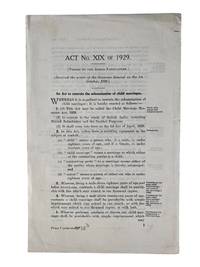
1929réf. 219671929. Government of India An Act to Restrain the Solemnisation of Child Marriages 1929 documents the legal system created to restrict child marriage in British India and supports research into women's rights colonial law childhood and social reform in South Asia. The Act commonly known as the Sarda Act after reformer Har Bilas Sarda reveals how legislation sought to regulate marriage age through statutory definitions penalties and enforcement provisions. It provides primary-source evidence for the study of Indian feminist legal history colonial governance and campaigns against patriarchal marriage customs. Government of India. An Act to Restrain the Solemnisation of Child Marriages. Calcutta: Government of India Central Publication Branch 1929. First edition. Official pamphlet printing of Act No. XIX of 1929 passed by the Indian Legislature and assented to by the Governor General on October 1 1929. The Act defines "child" "child marriage" "contracting party" and "minor" sets age thresholds for boys under eighteen and girls under fourteen and establishes penalties for adult men contracting child marriages as well as for those who solemnize arrange or permit such ceremonies. Its jurisdiction extends across British India including British Baluchistan and the Santhal Parganas with enforcement beginning April 1 1930. The printed price of "1 anna or 1½d" indicates official distribution for public and administrative use. The pamphlet documents a legal enforcement system for marriage reform through statutory age limits criminal penalties and responsibility assigned to adult men parents priests and other facilitators demonstrating the process by which colonial law entered debates over gender childhood and personal status. The timing is significant because Indian social reformers and women's rights advocates used the late colonial legal arena to challenge early marriage and forced domestic subordination. Minor edge creasing; overall very good condition. A concise official printing of a foundational statute in South Asian women's rights law and the legal history of childhood protection. unknown
1929réf. 219671929. Government of India An Act to Restrain the Solemnisation of Child Marriages 1929 documents the legal system created to restrict child marriage in British India and supports research into women's rights colonial law childhood and social reform in South Asia. The Act commonly known as the Sarda Act after reformer Har Bilas Sarda reveals how legislation sought to regulate marriage age through statutory definitions penalties and enforcement provisions. It provides primary-source evidence for the study of Indian feminist legal history colonial governance and campaigns against patriarchal marriage customs. Government of India. An Act to Restrain the Solemnisation of Child Marriages. Calcutta: Government of India Central Publication Branch 1929. First edition. Official pamphlet printing of Act No. XIX of 1929 passed by the Indian Legislature and assented to by the Governor General on October 1 1929. The Act defines "child" "child marriage" "contracting party" and "minor" sets age thresholds for boys under eighteen and girls under fourteen and establishes penalties for adult men contracting child marriages as well as for those who solemnize arrange or permit such ceremonies. Its jurisdiction extends across British India including British Baluchistan and the Santhal Parganas with enforcement beginning April 1 1930. The printed price of "1 anna or 1½d" indicates official distribution for public and administrative use. The pamphlet documents a legal enforcement system for marriage reform through statutory age limits criminal penalties and responsibility assigned to adult men parents priests and other facilitators demonstrating the process by which colonial law entered debates over gender childhood and personal status. The timing is significant because Indian social reformers and women's rights advocates used the late colonial legal arena to challenge early marriage and forced domestic subordination. Minor edge creasing; overall very good condition. A concise official printing of a foundational statute in South Asian women's rights law and the legal history of childhood protection. unknown books
1772réf. 823451772. London: T. Spilsbury for J. Ridley 1772. London: T. Spilsbury for J. Ridley 1772. "The Stagnation of Matrimony": A Radical 1772 Proposal to Reform the Marriage Market Marriage. Great Britain. Considerations on the Causes of the Present Stagnation of Matrimony Under the Following Heads. I. The Unreasonable Degree of Influence and Authority which Most Parents Exercise Over Their Children in the Concern of Marriage. II. The High and Elegant Education that is Given to Young Women Beyond the Compass of Their Fortunes and Stations of Life. III. The Debauchery and Extravagance of Young Men. IV. The General Luxurious and Expensive Taste of the Times. All of Which are Evils That Seem to Call for the Attention of Parliament. London: Printed by T. Spilsbury for J. Ridley 1772. iii-vii 1 71 1 pp. Complete. Octavo 8-1/4" x 5-1/4". Stab-stitched pamphlet in plain wrappers. Front wrapper detached small tears and chips to fore-edges of wrappers moderate toning small holes to a few leaves affecting legibility of one word on p. 47. A complete and crisp example of Georgian street literature. $450. Only edition. Only edition. A fascinating and remarkably modern critique of the social and legal barriers to marriage in late 18th-century England. The anonymous author identifies four primary "evils" calling for Parliamentary intervention: parental tyranny over-education male vice and economic luxury a general culture of expensive tastes that makes marriage financially daunting. The author moves beyond mere complaint to offer specific legal remedies including the abolition of the celibacy requirement for fellows at Oxford and Cambridge and a lowering of the age of consent. The work argues for a return to "the simplicity of nature" by allowing young people to follow their affections before they are corrupted by the "pride of life." OCLC and the ESTC locate 10 copies 5 in North America 1 in a law library Library of Congress. English Short-Title Catalogue T68641. unknown
1772réf. 823451772. London: T. Spilsbury for J. Ridley 1772. London: T. Spilsbury for J. Ridley 1772. "The Stagnation of Matrimony": A Radical 1772 Proposal to Reform the Marriage Market Marriage. Great Britain. Considerations on the Causes of the Present Stagnation of Matrimony Under the Following Heads. I. The Unreasonable Degree of Influence and Authority which Most Parents Exercise Over Their Children in the Concern of Marriage. II. The High and Elegant Education that is Given to Young Women Beyond the Compass of Their Fortunes and Stations of Life. III. The Debauchery and Extravagance of Young Men. IV. The General Luxurious and Expensive Taste of the Times. All of Which are Evils That Seem to Call for the Attention of Parliament. London: Printed by T. Spilsbury for J. Ridley 1772. iii-vii 1 71 1 pp. Complete. Octavo 8-1/4" x 5-1/4". Stab-stitched pamphlet in plain wrappers. Front wrapper detached small tears and chips to fore-edges of wrappers moderate toning small holes to a few leaves affecting legibility of one word on p. 47. A complete and crisp example of Georgian street literature. $450. Only edition. Only edition. A fascinating and remarkably modern critique of the social and legal barriers to marriage in late 18th-century England. The anonymous author identifies four primary "evils" calling for Parliamentary intervention: parental tyranny over-education male vice and economic luxury a general culture of expensive tastes that makes marriage financially daunting. The author moves beyond mere complaint to offer specific legal remedies including the abolition of the celibacy requirement for fellows at Oxford and Cambridge and a lowering of the age of consent. The work argues for a return to "the simplicity of nature" by allowing young people to follow their affections before they are corrupted by the "pride of life." OCLC and the ESTC locate 10 copies 5 in North America 1 in a law library Library of Congress. English Short-Title Catalogue T68641. unknown books
réf. M88Folio ca. 32x195 cm or 12 ¾ x 7 ¾ in. 2 pp. Brown ink on blueish laid paper. Fold marks paper slightly age-toned but overall a very good letter written in a legible hand. Interesting original manuscript letter providing an insight into an early legal dispute over the confirmation of what looks like a common law marriage in the Oregon Territory. Written by a resident of Oregon City who concealed his identity under the letters “R.J.G.” the letter is addressed to “Mr. Harding” – most likely Benjamin Franklin Harding 1823-1899 a notable Oregonian attorney and politician. In 1852 Harding established the “Harding and Grover” law firm in Salem; in 1855-59 served as the Secretary of the Oregon Territory. During the American Civil War Harding took the office of the US Senator from Oregon 1862-65. In the letter the author refuses the claim of an unnamed woman to be his alleged wife apparently common-law and declares that he can prove that she is in fact the wife of another man and that he is going “to defend myself which I shall do regardless of consequences.” In the beginning of the letter the author notes that the “claimant” lived “at Judge Olney’s” who was Cyrus Olney 1815-1870 then the 6th Associate Justice of the Oregon Supreme Court 1853-58. Later Olney served as a delegate to the Oregon Constitutional Convention 1857 and served in the Oregon House of Representatives. Overall an interesting early original letter regarding legal disputes over the confirmation of common-law marriages in the Oregon Territory. The text of the letter: “Mr. Harding Sir On account of your protestations of friendship I think it strange that you did not apprise me of your agency in depositing in … Office that petition. I have said that I was willing the complainant should marry that I never would distrust her that I would not lay a straw in her way. I am informed that she was so informed while living at Judge Olney’s. She has been influenced to make application for a Bill probably on account of such intelligence. Now it is a well founded belief that she would have been married last fall had I not come back when I did and that too without a Bill. She has taken the wrong step to succeed. No lawful marriage exists between us and hence she cannot obtain a Bill from me. I am certainly correct in this view. I consulted the law and lawmakers last fall in reference to this matter as I was determined to take lawful steps and found that I was free from her in every sense of the word. She wishes to marry again I am willing that she should impose upon some other man if she feels safe in so doing and can find one as foolish as I have been. The complainant is not my wife but the wife of one Mr. Walker as I shall prove to the court. Can you not see that she endangers herself you know the penalty I presume. I don’t wish her to suffer this penalty I wish her no harm whatsoever but if this affair goes to court its result may prove fatal to her happiness to her parents and to yours and family. It has proven an unfortunate affair to us all and I presume that neither party wishes any more than a quiet future and freedom from each other. She is not bound to me nor I to her. It would be for her welfare and happiness to immediately withdraw as she has the power of doing her complaint and then here or elsewhere apply for a Bill from Mr. Walker or if she prefers marry without such application. In either event I shall not disturb her. If she obtains a Bill from Walker she will be safe as there is no public record of our marriage nor were witnesses present at the solemnization. If she does not withdraw her Bill she forces me to defend myself which I shall do regardless of consequences. If I did not know that we are free from each other by virtue of the law then I should have long since applied. Take my word for it she cannot obtain a Bill from me by virtue of her relation to Mr. Walker. But if she blindly persists in her present application then I must meet her and answer for my horrid abuse! I have suggested this by advice of one of my legal friends and by virtue of my own feelings toward her. If you have any doubt of the propriety of this course call and see me and others. If the matter stops here you must act promptly for additional costs are making. Respectfully R.J.G.” unknown
2008Audio CD New Release item. Pls. allow a minimum of 4 - 6 weeks as this is hi p from CD Manufacturers.
2003réf. x-0826466699Sheffield Academic Pr 2003. Hardcover. New. 1st edition. 400 pages. 9.25x6.25x1.00 inches. Sheffield Academic Pr hardcover
réf. 22706Palais Bourbon Paris 20 March 1836. One page 8vo bifolium good condition. From the celebrated manuscript collection of Richard Monckton Milnes Lord Houghton. Text: "The Baroness de Feucheres presents her compliments to Mr Wesmacott and has much pleasure in sending a Snuff Box which Capt. Manby said she might venture to offer him. She begs he will consider it merely as a souvenit underlined and by no means as an inducement for him to make any concession in his political opinions." Pinniger and Westmacott also conducted a court case involving the Baroness's large estate reported in detail in the "Annual Register" etc. Palais Bourbon Paris, 20 March 1836. unknown
réf. 40602Paris.Imprimerie Nationale.1853.In-4 cartonné avec caractères dorés.73 p.On ajoute deux poèmes avec dédicace de l'Auteur ( signature peu lisible )à l'occasion de la naissance du Prince Impérial. BE.