3 880 résultats
1991réf. 170896San Rafael CA: Falkirk Cultural Center 1991. First Edition. Softcover. First Edition. Published in conjunction with an exhibition held from May 16 through August 25 1991 at the Falkirk Cultural Center in San Rafael. Near Fine in side-stapled wrappers. Falkirk Cultural Center unknown books
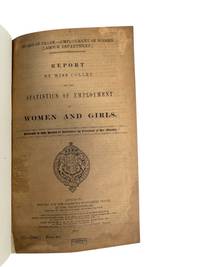
1894réf. 221311894. Women's EmploymentLaborFeminism Collet Clara Elizabeth. Report by Miss Collet on the Statistics of Employment of Women and Girls. London: Her Majesty's Stationery Office 1894. First edition. 153 pages. Rebound with blue cardstock wrappers with blue cloth spine. A foundational document in the history of women's labor rights in the United Kingdom this government-commissioned report by feminist economist and civil servant Clara Collet presents a rigorously detailed statistical study of female employment across various industries and regions in late 19th-century Britain. The report was produced under the auspices of the Board of Trade's Labour Department and presented to both Houses of Parliament by command of Queen Victoria. Collet's work documents an early official recognition of gender disparities in wages labor conditions and occupational distribution. Clara Collet was a pioneering advocate for working-class women. In this report she compiles extensive census and wage data comparing the years 1881 and 1891 with particular focus on textile and manufacturing sectors including cotton wool and worsted mills. The report also explores regional patterns in employment rates of marriage and widowhood and the social consequences of low female wages. Appendices provide granular data segmented by occupation and geography highlighting for instance employment patterns among married women and child laborers. Of note is Collet's contextual analysis of women's roles in both domestic and industrial economies and her subtle but pointed criticism of systemic inequalities in pay and opportunity. Her work prefigures later feminist labor studies by over half a century and has been cited by scholars as foundational to the evolution of state labor policy in Britain. Pages toned with scattered foxing binding stable and professionally renewed; textblock complete. Overall good to very good condition. A landmark primary source in the history of women's labor advocacy and feminist economics and a rare survival in its first edition. unknown books
1890réf. 220271890. Women's Education Three lectures on women's education in Victorian England. Wilson J. M. Three Addresses to Girls at School. London: Percival & Co. 1890. First edition. Original printed brown paper wrappers stitched binding no dust jacket as issued. Delivered between 1887 and 1890 these addresses by Reverend J. M. Wilson-former Head Master of Clifton College and Vicar of Rochdale-offer a pointed reflection on the role of education and religion in shaping the intellectual lives of young women in late Victorian Britain. Each speech was delivered at a girls' high school: the first at Clifton High School 1887 the second at Bath and Clifton 1889 and the third at St. Leonard's School St. Andrews 1890. While framed within the conservative moral expectations of the period Wilson's lectures nonetheless emphasize the legitimacy and value of female academic achievement and make a case for structured standardized education for girls-a relatively progressive position for its time. Notably Wilson defends the Higher Certificate Examination as a measure of "absolute merit" asserting that these certificates serve as proof of both academic competence and institutional rigor. In one significant passage Wilson explains how girls at Clifton High School were permitted to pass examinations in stages-two subjects one year and two the next-unlike boys who were expected to complete all four at once. This practical concession reflects both the social constraints placed on girls and an evolving acknowledgment of their academic seriousness. His emphasis on certificates as both a pedagogical guide for teachers and a tool for public accountability is central to his educational philosophy: "They help to make your work definite and sound: and that if it is slipshod you shall at any rate know that it is slipshod." Though clearly reflective of the gendered assumptions of the time the text offers valuable insight into the advocacy for women's structured schooling during the late 19th century. Front cover moderately soiled with edge wear and a small numeric marking to the lower left corner. Front wrapper and end pages detached. Internal pages clean and unmarked aside from a faint institutional stamp on the title page. Overall fair condition. A scarce record of late Victorian attitudes toward women's education notable for its firsthand account of the evolving role of girls' high schools in Britain. unknown books
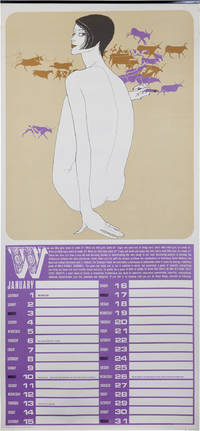
1965réf. 157435San Francisco: Determined Productions 1965. Vintage wall calendar for the year 1966 composed of twelve calendar sheets illustrated with twelve lithographs held together at the top edge with a metal rod. Designed and illustrated by noted fashion artist Betty Brader best known for her work for San Francisco specialty store Joseph Magnin as well as her freelance work for Neiman Marcus in Dallas. Bay Area publisher Determined Productions was founded by Connie Boucher in 1961 largely creating licensed products-including some of the first Peanuts merchandise. The company quickly expanded producing books and ephemera on a variety of topics including astrology the occult and alcohol. With a vibrant feminist overtone the calendar on offer here features illustrations of women from around the world posed in bright and nationally specific garments with text focusing on the way language is often used to discriminate against women. Not found in OCLC. Housed in the original pictorial paper tube. 19 x 14 inches rolled as issued. Calendar sheets Fine. Paper tube Near Fine with light wear at the right end of the tube. Determined Productions unknown books
1895réf. 173991895. Ernst George. The Legal Status Of Married Women in Massachusetts. Boston: Massachusetts Woman Suffrage Association 1895. First Edition. Octavo 5" x 7". Full sheepskin. 81 pages. George Ernst was a Massachusetts lawyer and progressive Republican who spoke at the 1895 Annual Meeting of the Woman's Suffrage Association. In this book he outlines the history of married women's legal rights and responsibilities from the Common Law through judicial decisions and legislative acts in Massachusetts and the United States to the early 1890s. Ernst focuses on the limits to inheritance for wives whose husbands predecease them but fail to make a will. In such a case the maximum amount a wife could inherit would be 50% at most. He ends his book with the question "This is law but is this justice" Covers detached spine worn. Pages clean and textblock tight. Good condition. unknown books
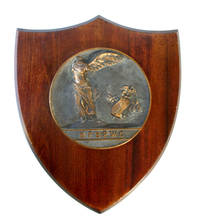
1919réf. 149951919. National Federation of Business and Professional Women's Clubs plaque 1919 commemorates the founding year of a national organization created to coordinate and advance the interests of business and professional women. Established on July 16 1919 after wartime efforts to identify women's professional skills and experience the Federation developed from organizing associated with the Women's War Council and the mobilization of women workers during World War I. Its formation preceded ratification of the Nineteenth Amendment in 1920 and placed questions of women's employment professional advancement and political participation within a national organizational structure. Large bronze embossed seal of the National Federation of Business and Professional Women's Clubs mounted on wood and dated 1919. The Federation was organized at its first national convention in St. Louis in July 1919 under the leadership of Lena Madesin Phillips with Gail Laughlin elected its first national president. Early Federation work included a national survey of business and professional women addressing their status qualifications opportunities and working conditions providing an organized basis for advocacy concerning women's economic and professional life. The plaque dates from the Federation's founding year when women were entering professional occupations in greater numbers while still lacking federally protected voting rights nationwide. The organization continued to advocate on issues affecting working women and to promote professional development leadership and economic opportunity. The bronze seal mounted on wood survives as an organizational artifact from the Federation's establishment in 1919 one year before ratification of the Nineteenth Amendment extended constitutional protection for women's suffrage nationwide. unknown books
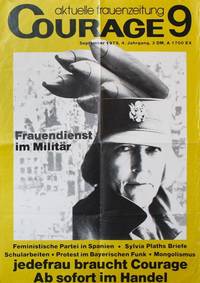
1979réf. 32004Berlin 1979. First Edition. Original photo-montaged advertisement poster 83.5x58.75cm. printed offset in black and yellow on glossy white stock; previous mail folds general wrinkling most heavily along right-hand edge else About Very Good and sound. Advertising poster for the German feminist magazine Courage the image presumably reproducing the cover of the current issue. Contents feature articles on women in the military the feminist movement in Spain and the letters of Sylvia Plath. At bottom of image: "Jedefrau Braucht Courage / Ab sofort im Handel" Every woman needs courage from now on in work. Quite a large poster presumably issued to be displayed at the newsagent. unknown books
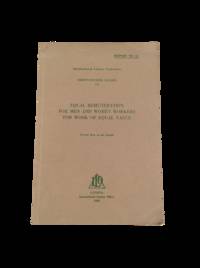
1951réf. 228591951. International Labour Conference. Equal Remuneration for Men and Women Workers for Work of Equal Value 1950 documents the formal development of international labor standards addressing gender-based wage inequality in the immediate postwar period. Issued in advance of the adoption of the Equal Remuneration Convention the report supports research into women's labor history international law and the institutional mechanisms through which gender equity policies were articulated and debated. The publication situates wage discrimination as a matter of economic justice and human rights presenting coordinated efforts by member states and labor delegates to establish enforceable standards for equal pay across national economies. International Labour Conference. Equal Remuneration for Men and Women Workers for Work of Equal Value Report VII 1; Thirty-fourth Session 1951. Geneva: International Labour Office 1950. First edition. Octavo. Original printed wrappers. The report opens with proceedings from the 33rd session of the International Labour Organization outlining debates over gendered wage structures and the economic implications of pay inequality. It includes excerpts from committee reports and plenary discussions alongside a comparative survey of member state legislation and labor practices concerning women's wages. The latter portion presents the full draft convention text proposed for adoption defining "equal remuneration" to include both wages and supplementary benefits as well as an alternative recommendation for countries not prepared to ratify binding measures. The document frames unequal pay as both structural discrimination and a violation of fundamental rights establishing terminology and policy frameworks that would shape subsequent international labor standards. 57 pages. Original printed wrappers. Octavo format. Mild toning to margins faint crease to lower front wrapper light wear at spine ends and small pencil notation at upper corner of title leaf; internally clean and secure; overall very good condition. Produced during a period of expanding international governance through organizations such as the International Labour Organization the report provides direct evidence of early multilateral efforts to codify gender equality in employment offering substantial value for the study of global labor policy and the historical foundations of equal pay legislation. unknown books
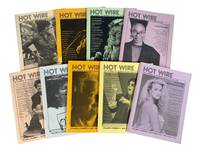
1988réf. 223381988. Armstrong Jr. Toni L. ed. Hot Wire: The Journal of Women's Music and Culture 1988-1994 documents lesbian feminist cultural production through coverage of music performance publishing and community organizing during the late twentieth century. Produced in Chicago the periodical established a platform for lesbian artists activists and writers at a time when independent feminist media sustained networks of communication outside mainstream publishing. The journal includes interviews essays and reports on women's music festivals lesbian performance and feminist enterprises supporting research into LGBTQ history women's liberation and the development of alternative media infrastructures. 1 Hot Wire:Volume 4 Number 2 March 1988. Featuring an interview with Robin Tyler one of the first openly lesbian comedians alongside Cheryl Miller's "Lesbians of Color: Celebrating Common Bonds and Differences." Includes coverage of the 1987 March on Washington "Transistor Sisters: The Girl Groups" by Jorjet Harper and a "Mothers & Daughters" feature. 2 Hot Wire:Volume 6 Number 2 May 1990. Highlights include interviews with Heather Bishop and the legendary keyboardist Laura Post. Barbara Smith and Kitchen Table Women of Color Press are profiled reflecting Hot Wire's ongoing commitment to women-of-color feminism. "Twenty Years of Making Music" by Helen Hooke and "White Courtesys Monogamy and Other Reflections" by Monica Grant offer critical insight into lesbian relationship politics and musical trajectories. 3 Hot Wire:Volume 6 Number 3 September 1990. Includes Holly Near's interview and excerpts from her performance alongside pieces on Michelle Shocked Yasmín Jiwani and Rosetta Reitz. The "I Was There" section captures first-person festival memories while Cathy Andrews reports on "Doing the Festivals." This issue gives special attention to Black lesbian performers and visual artists and reflects the multicultural reach of Hot Wire. 4 Hot Wire:Volume 7 Number 3 September 1991. A deeply insightful issue this volume features Karen Williams the Indigo Girls and Rhiannon & Phamie on performing in women's music spaces. Paula E. Languth's essay "Fade In - Fade Out" continues Hot Wire's tradition of integrating popular culture and feminist critique. Feminist cartoonist Alison Bechdel contributes work anchoring this issue's broader theme of lesbian humor and community satire. 5 Hot Wire:Volume 8 Number 1 January 1992. Lead features include interviews with Margie Adam and Lisa Dietrich alongside Judith Sloan's "Is She or Isn't She.An Outrageous Feminist" and performance reviews from Michigan Womyn's Music Festival. "All Women Radio" and "Singing for Our Lives" foreground the growing importance of radio and choral expression in the lesbian music movement. 6 Hot Wire:Volume 8 Number 2 May 1992. This issue focuses on "Women and Humor" spotlighting comedians Ronnie Gilbert and Dykes to Watch Out For's Alison Bechdel. Julia Willis's "Who Wears The Tux" unpacks gender norms in performance culture. The issue includes a crossword puzzle and a section on lesbian films underscoring the playful and subversive tone that Hot Wire helped cultivate. 7 Hot Wire:Volume 8 Number 3 September 1992. Covering Jamie Anderson and "Big Mamas" by Rosetta Reitz this issue features Cheryl Miller on Black lesbian filmmakers and Laura Post on lesbian guitarists. "Gulf Coast Women's Festival" and "OutWrite '92" offer field reports on lesbian literary and musical organizing. The inclusion of fitness sobriety and motherhood themes reflects a broadening scope of lesbian lifestyle concerns. 8 Hot Wire:Volume 9 Number 2 May 1993. Sherry Hicks discusses "The Queen of Coda Cool" while Laura Love and Seriah Carol offer pieces on mixed-race identity and folk music. "Washington Anthem Revisited" revisits a decade of protest music. Cathy Winter and Gayle Scott anchor a section on "New Artists & Old Favorites" showing the cyclical nature of talent within the lesbian music world. 9 Hot Wire:Volume 10 Number 3 September 1994. Final Issue. Suzanne Westenhoefer is interviewed and a ten-year retrospective looks at all 30 Hot Wire cover girls. Highlights include "Vampire Lovers by Moonlight" "Drumming Circle" by Naomi Pallas and "Women and Children" by Michal Brody. It documents the decline of women's cultural institutions due to funding and shifting community priorities. Published during a period when lesbian feminist media operated through independent print networks Hot Wire documented the growth and challenges of women's music and cultural institutions across the United States. The inclusion of performers writers and organizers reflects the interconnected nature of artistic production and activism while coverage of festivals and presses demonstrates the infrastructure supporting lesbian cultural expression. The final issue addresses the decline of some of these institutions in the 1990s marking a shift in funding and community organization. Minor edge wear and rubbing to covers with occasional sticker residue and light pencil marks; interiors clean and unmarked; overall very good to near fine condition. This archive provides sustained documentation of lesbian feminist publishing and the women's music movement in late twentieth century America. unknown books
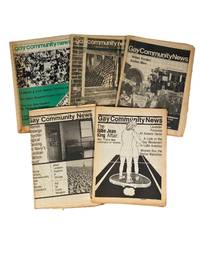
1978réf. 220741978. Gay Community News a major grassroots LGBTQ newspaper published in Boston between 1973 and 1992 documenting lesbian and gay political activism feminist organizing anti-racist solidarity movements and state surveillance during the post-Stonewall era. Produced collectively and distributed nationally through activist and community networks the publication served as one of the most influential independent queer newspapers in the United States during the late 1970s and early 1980s. The archive reflects LGBTQ political and cultural expression within the underground press illustrating how queer activists responded to institutional discrimination media hostility police violence and internal community debates through journalism photography and movement reporting. The issues preserve contemporary coverage of major developments including the White Night Riots anti-lesbian military investigations attacks on queer institutions and lesbian visibility in sports and public life providing important evidence of the political priorities and cultural language of LGBTQ activism before the AIDS crisis transformed queer organizing in the United States. Gay Community News. Boston Massachusetts 1978-1981. Five tabloid-format newspaper issues printed on newsprint each approximately 16-24 pages and illustrated throughout with black-and-white photography activist graphics and bold typographic layouts. 1 Gay Community News. Vol. 5 No. 48. Boston: June 17 1978. Includes a Lesbian & Gay Pride Calendar coverage of the expulsion of two gay seminarians from a Methodist institution reporting on tax-exempt status controversies affecting queer organizations and continuation of a fire safety project focused on LGBTQ households. Front cover features a pride march photograph prominently displaying a "Women Unite" banner. 2 Gay Community News. Vol. 6 No. 8. Boston: September 16 1978. Documents the fifth break-in and ransacking of the newspaper's offices that year alongside reporting on Anita Bryant's canceled Boston appearances and a feature discussing the poetry of Adrienne Rich. 3 Gay Community News. Vol. 6 No. 44. Boston: June 2 1979. Covers the White Night Riots in San Francisco following Dan White's manslaughter conviction in the killings of Harvey Milk and George Moscone accompanied by front-page protest photographs outside City Hall. Additional articles address the Thorpe trial and legal challenges to anti-gay legislation in Oklahoma. 4 Gay Community News. Vol. 7 No. 48. Boston: June 28 1980. Reports on anti-lesbian investigations within the U.S. Navy under the headline "Women Undergo Psychological Testing in Navy's Lesbian 'Witchhunt'" while also covering discrimination cases involving Black lesbians in Chicago and aid efforts supporting Cuban refugees. 5 Gay Community News. Vol. 8 No. 42. Boston: May 16 1981. Features extensive coverage of Billie Jean King's public outing and the media response under the headline "Yes There Are Lesbians in Tennis" alongside articles on Latin American gay activism antiwar protest movements and women participating in the Boston Marathon. The archive captures a critical period in LGBTQ history marked by expanding queer political visibility alongside escalating backlash from religious institutions employers law enforcement and government agencies. Gay Community News distinguished itself from commercial gay publications through its sustained emphasis on feminism anti-racism labor activism antiwar politics and coalition-building across social movements. Coverage of the White Night Riots military anti-lesbian purges attacks on queer institutions and lesbian representation in public culture demonstrates the newspaper's role as both activist platform and documentary record of late twentieth-century LGBTQ organizing. Edge wear creasing moderate toning and occasional closed tears consistent with the fragility of newsprint; interiors remain generally clean and legible throughout. Overall good to very good condition. An important archive of underground queer journalism documenting political struggle lesbian feminist activism and community self-representation during the post-Stonewall decade. unknown books
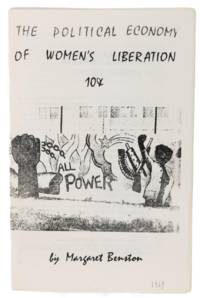
1969réf. 188471969. Benston Margaret. The Political Economy of Women's Liberation. Buffalo NY 1969. First edition pamphlet. 16 pages 9" x 5.5." Margaret Benston was a vocal Leftist Feminist and professor of chemistry computer science and gender studies at Simon Fraser University. This pamphlet contains a manifesto describing how women's labor is exploited by a capitalist framework. She writes that equal access to jobs outside the home is not enough to level the playing field because "as long as work in the home remains a matter of private production and is the responsibility of women they will simply carry a double workload." At the end Benston includes excerpts of Lenin's writing. Very good condition. unknown books
réf. 18017Three Addresses to Girls at School" J.M Wilson. Percival and Co: London 1890. 7" x 5" inches. 74 pages. Soft cover pamphlet. A series of speeches delivered by the vice president of the Clifton High School for Girls in Covent Garden 1890. The speeches were given on "Education" "High School Education for Girls" and "Religion" in 1887 1889 and 1890 respectively. In them Wilson the school's vice president and late head master addresses the female students on the value of their education"You are living in a great age when changes of many kinds are in progress in our political and social and religious ideas. There never was a greater need of trained intelligence clear heads and earnest hearts. And the part that women play is not a subordinate one." Whereas in 1840 60% of British women were illiterate that number dropped dramatically to 40% by 1860 and the momentum for female education picked up considerably through the end of the nineteenth century into the twentieth. Wilson's speeches delivered to high school girls give fascinating insight into both the vision and anxiety bound up in educational reform during the time. "We earnestly desire that women should be highly educated" he writes. "And yet is there not a type of educated woman which we do not wholly admire I am not going to caricature a bluestocking but to point out one or two real dangers. Education is good; but perfect sanity is better still. Sanity is the most excellent of all women's excellences.It is a small matter that you should protest against some small maladjustment or folly; but it is a great matter that you should be perfectly sane and well-balanced. Now education helps sanity." The addresses both promote women's education and caution against radically upending existing social structures. Wilson advises the girls throughout to be gentle humble and sane and celebrates the role educated women play in supporting men in positions of power. Front soft cover detached. Textblock is partially detached. Text block clean and bright. Overall good condition. unknown books
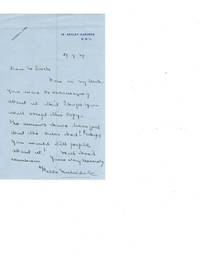
1939réf. 153491939. Feminism and Women's Rights Hilda Martindale. Autograph Letter Signed. Dated April 24 1939. 1 page. 7 x 4.5 in. Black ink on light blue paper. In her hand Martindale writes in thanks of a friend's encouragement and sends a copy of her recent work. In full: "Here is my book. You were so encouraging about it that I hope you will accept this copy. The review have been good but the sales bad! Perhaps you would tell people about it" Martindale was an important advocate for women's employment rights in her day; she made history as one of the first woman factory inspectors in Victorian England and rose to become the Deputy Chief of her department. In 1938 she published a book on the history of women civil servants likely the book she references in the letter and upon her death her estate established a foundation dedicated to assisting British women working in male-dominated fields. Very good. unknown books
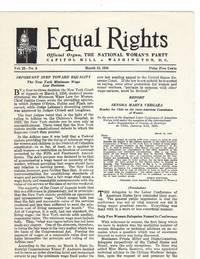
1936réf. 160251936. National Woman's Party. Equal Rights March 15 1936 documents the organization's campaign for legal equality at a time when women's workplace legislation divided American feminists over whether sex-specific protections advanced or restricted women workers. Founded in 1916 by Alice Paul and Lucy Burns during the suffrage campaign the National Woman's Party continued after ratification of the Nineteenth Amendment by advocating the Equal Rights Amendment then commonly associated with the Lucretia Mott Amendment and by opposing laws that imposed legal distinctions based solely on sex. This issue addresses the New York minimum wage controversy international equal-rights efforts and proposed workplace protections for women and children. National Woman's Party. Equal Rights. Vol. 22 No. 6. March 15 1936. 4 pages. 8 1/2 x 11 inches. Official organ of the National Woman's Party. The issue reports on the New York minimum wage case after the New York Court of Appeals struck down the state law regulating minimum wages for women; the United States Supreme Court subsequently affirmed that judgment in Morehead v. New York ex rel. Tipaldo on June 1 1936. It also discusses the Equal Rights Treaty signed at Montevideo by Cuba Ecuador Paraguay and Uruguay part of the National Woman's Party's effort to establish sex equality in international law. Another article addresses workplace hygiene and a resolution requiring employers to provide women with separate quarters for washing changing clothes and general use as well as seats for women and children when the work did not require them to remain standing. Published two years before enactment of the Fair Labor Standards Act of 1938 the issue records a central dispute in interwar women's rights politics: whether legislation written specifically for women offered necessary labor protection or created legal distinctions that could restrict women's employment and undermine demands for equal rights. The National Woman's Party pursued the latter argument while simultaneously campaigning internationally for legal equality between the sexes. The March 1936 issue therefore preserves contemporary evidence of the relationship among the Equal Rights Amendment campaign minimum wage litigation international treaty advocacy and debates over sex-specific workplace regulation. In excellent condition. unknown books
1871réf. 147891871. Mott Lucretia. Autograph Quotation Signed 1871 a concise manuscript statement embodying the ethical and political philosophy that undergirded the nineteenth century women's rights and abolitionist movements. Written entirely in her hand Mott declares "Truth for authority not authority for truth" and signs "Lucretia Mott." The formulation distills a foundational principle of antebellum and Reconstruction era reform: the rejection of inherited legal ecclesiastical and political authority when divorced from moral truth and human equality. By 1871 more than two decades after the 1848 Seneca Falls Convention and the signing of the Declaration of Sentiments Mott stood as an elder stateswoman of American reform her Quaker convictions shaping a lifetime of advocacy for abolition women's legal equality and freedom of conscience. Mott Lucretia. Autograph Quotation Signed. 1871. One card approximately 4¼ x 3 inches. Composed during the post Civil War period when debates over Reconstruction citizenship and suffrage reshaped the constitutional landscape the statement reflects the continued insistence by early feminists that justice must supersede custom majority rule and patriarchal tradition. The maxim's structure directly challenges hierarchical authority aligning with arguments advanced by Mott and her contemporaries that law and governance derive legitimacy only when grounded in universal moral principles. As a signed and dated manuscript expression of this credo the card functions as a compact primary document articulating the intellectual core of American women's rights ideology. Paper clean with strong legibility and a bold well preserved signature and date. Overall condition: very good. unknown books
1899réf. 179371899. 2 Issues of Englishwoman's Review. John Bale Sons and Danielsson Ltd: London July 15th 1899. January 15th 1902. Measures 8.5" x 5.5" inches. 224 pages. Soft covers. Both reviews open with an advertisement for the printer that reads "Office for the employment of women as compositors. Girls trained and employed for the last twenty years. Ladies and gentleman are invited to place their orders for printing where they will be executed by women in a style equal to the best. No slipshod work! No exorbitant prices!" The rest of both reviews is composed of articles news and reviews related to women's suffrage. Some titles include "Experiences Amongst Chinese Women" "The Political Position of Women in Canada." Together the two speak to the level of organization as well as the international focus of the movement as women collaborated across countries and continents reporting on successes and obstacles bolstering support for the cause by keeping readers well informed. Soft covers missing original covers. Clean front and back free endpapers instead. Texblocks tight and clean. Overall good condition. unknown books
réf. Cat352United States 1980. Approximately 170 pieces; see below for full inventory. Conditions vary; generally very good to excellent. An archive of material belonging to Rosemary Gaffney -2024. Gaffney lived in the New York City area with her partner Joyce Vinson; the two were involved in a number of feminist activist organizations including the New York Radical Feminists NYRF the National Organization for Women NOW-NYC and the Women's Liberation Center. Gaffney was a performer involved in filmmaking with Women Make Movies WMM and an employee at Mother Courage for the entire duration that the restaurant was in business from 1972 to 1977. She also collected feminist literature and material from across the country. The collection spans several decades and includes numerous publications event flyers and behind-the-scenes notes from feminist groups. It is highlighted by collections of material related to WMM-particularly the 1976 short Healthcaring: From Our End of the Speculum-women's theater and performance and women's health. The film and performing arts material records the efforts women put in to carve out a space for their own work in creative fields that were then disproportionately composed of men while the women's health material documents some of the early organizing around issues that arose from the similar underrepresentation of women and their issues in healthcare. Interestingly the two topics intersect in the archive particularly in Healthcaring but also in projects like the "Mental Prisoners Liberation" screening at the Kitchen which suggests a connection to the psychiatric survivors movement. These materials are of interest to researchers not just of feminist history but also the history of women in film and the arts; working both in performance and healthcare; and in patient activism. The following description begins with these materials before turning to the remainder of the collection: Other Original and Unpublished Material; NYRF; Women's Strike for Equality; NOW; The Women's Liberation Center; Mother Courage Restaurant; Other Events and Organizations; and Other Publications. Women Make Movies WMM Founded in 1969 by Ariel Dougherty Sheila Paige and Dolores Bargowski Women Make Movies is a non-profit feminist film organization based in New York City. It started as a workshop to teach local women to make films and expanded to include screenings and film distribution. Today WMM distributes films from nearly thirty countries and its films have played at Sundance and Cannes. Though generally not found in OCLC some items offered here may appear in WMM collections at the MoMA and the Academy Film Archive or in the Ariel Dougherty collection at Harvard University. The present collection includes a significant amount of material on Denise Bostrom and Jane Warrenbrand's 1976 short film Healthcaring: From Our End of the Speculum which is listed in its own section. Items presented in alphabetical order. • Blank WMM letterhead 8 ½ x 11 inches. • Copy of a letter from the IRS to WMM. The letter which addresses the group as "Gentlemen" approves its 501c3 status. 8 ½ x 11 inch photocopy. Very good minus. • Grant application materials two pieces. November 1974 materials sent to Youthgrants for creating the film The Women's Movement: The Past Seven Years by Carol Clement Ariel Dougherty and Sheila Paige. Five pages 8 ½ x 11 inches. With large packet of grant-writing material. • Manuscript notes about a film relating to a women's bank in Bethesda. • MENTAL " PRISONERS " LIBERATION / VIDEOTAPES at the kitchen. A flyer for a screening at the avant-garde Chelsea performance space The Kitchen co-sponsored by The Kitchen and WMM. Titles include He Lives Alone dir. Dixie Beckham N.d.; Chelsea Infants of the Martial Arts dir. Jane Warrenbrand N.d.; and Career Women dir. Lisa Methfessel N.d. The flyer reads in part "The Mental 'Patient' Movement / Radical Alternatives / Social Rejection Stigmas" and "Violence and Psychiatry / The Myth of 'Mental Illness' / Poetry and Music" indicating a connection with the psychiatric survivors movement. Sheet measuring 11 x 18 inches folded in half. Some damage to edges. Very good. • MOVIES / international ♀'s day / SATURDAY MARCH 8TH 1975 / after the march. A flyer for two screenings at Washington Square Methodist Church with proceeds going to the International Women's Day Coalition. Titles include "Fear & Domestic Tranquility" and "The Emerging Woman". Double-sided 8 ½ x 11 inch sheet. Excellent. • Photograph of the WMM c. 1970s photocopy. • "the problem" and "a solution". Promotional material for the films Superwoman dir. Anne Sandys Men's Film no director The Women's Martial Arts Center Teaches no director and The Betrayed Daughter dir. Isabel Castellano Carmen Colon and Toni Santiago. Two sheets 8 ½ x 11 inches. Very good. • WMM Newsletter. Fourteen-page newsletter 8 ½ x 11 inches. Excellent. • "women make movies is women making history" 1973. A flyer advertising WMM and several of its films including Domestic Tranquility dir. Harriet Kriegel 1973; Fear dir. Jean Shaw 1973; and The Women's Happy Tine Commune dir. Sheila Paige 1972. Sheet measuring 8 ½ x 13 ¾ inches folded in half. Small fold to one corner else Near Fine. Feminist film conference materials. Several pieces concern a 1975 event the Conference of Feminist Film & Video Organizations in Womanhattan which does not appear to have been documented. • "An Ongoing Manifesto". Single 8 ½ x 11 inch sheet. Very good. • "Conference of Feminist Film & Video Organizations in Womanhattan". Eleven-page stapled conference information packet 8 x ½ x 11 inches. Excellent. • "Policy on Freelance Work" written at the conference. Single 8 ½ x 11 inch sheet. Very good. Healthcaring: From Our End of the Speculum. A documentary short film directed by Denise Bostrom and Jane Warrenbrand the film discusses women's experiences as patients with primarily male practitioners especially in obstetrics and gynecology. • Copy of a letter to Lucille Goodman of Brooklyn 1974. A letter asking for financial support for Healthcaring with a short proposal. Two pages 8 ½ x 11 inches. Very good. • Grant application materials from Healthcaring and an untitled film on street harassment possibly A Film on Street Harassment dir. Sheila Paige 1977. These date to early in Healthcaring's production when it had the earlier title books
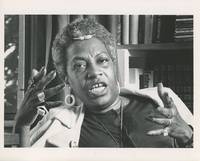
1973réf. List3007United States 1973. Single photograph measuring 8 x 10 inches. Manuscript captions verso reading “Florence Kennedy / Fla / Womens Lib” and “FLORYNCE KENNEDY / WOMEN’S RIGHTS” with stamps “PHOTO BY AKIRA SUWA” and “MAR4-1973”. Near Fine. Florynce Kennedy 1916–2000 was an African American activist lecturer and lawyer. She attended Columbia University as a pre-law student graduating in 1948; she was rejected from Columbia Law School but the decision was reversed when she threatened legal action for racial and gender discrimination. Kennedy went into private practice in 1954; she represented Billie Holliday’s and Charlie Parker’s estates and defended Black Panthers H. Rap Brown and Assata Shakur and radical feminist Valerie Solanas. She founded The Feminist Party which nominated Shirley Chisholm for president sued the Catholic Church lectured on issues of race and gender and organized and participated in numerous protests. Shortly after this photograph was taken in 1973 Kennedy organized the National Black Feminist Organization. The group first met in New York City and its first attendees included Faith Ringgold Ringgold’s daughter Michele Wallace Margaret Sloan-Hunter and other prominent African American feminist activists. In the photograph Kennedy wears a pin reading “DEFEAT THE FETUS FETISHISTS”. Abortion rights were an important cause for Kennedy; the pin is likely related to the October 1973 protests by the Women’s National Abortion Action Coalition against the New York City Archdiocesan “Respect Life Week” where the slogan appeared on many protestors’ signs.1 1 “Respect Life Week Stresses the Unborn” The New York Times October 3 1972 22. unknown books
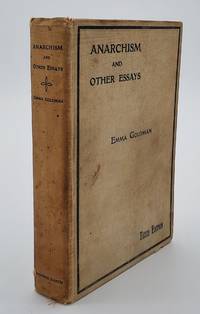
1911réf. 68600New York: Mother Earth Publishing Association 1911. Third edition Second revised edition on title page. Hardcover. Good. SIGNED. 277pp. plus 8pp. of publisher's advertisements at the rear. Duodecimo 19 cm Beige cloth over boards with a black ink stamped title on the backstrip and front board and black ink stamped single-ruled borders on the front board. Reproduced photographic frontispiece portrait of the author by T. Kajiwara. Prominent toning to the spine and a large section of the rear board. Cloth a bit frayed at the edges with the underlying boards at times peeking through. Endpapers split along the hinges. Text block cracked at the title page. Name in pencil on the title page. Very occasional brief markings mostly in the form of hatching in pencil and colored pencil. With two newspaper clippings pertaining to Emma Goldman "Red Emma" laid in. A classic of radical literature. Third edition printed on front cover. Emma Goldman was once viewed as "the most dangerous woman in America" and was a thinker so far ahead of her time that even today her views seem strikingly revolutionary. This collection of essays is a magnificent introduction to her thoughts: ranging from her views on women's suffrage and emancipation patriotism's menace to liberty the psychology of political violence the prison system "a social crime and failure" the hypocrisy of Puritanism and the strategies of dissent. These writings all reflect her fearless joyousness her radical dedication to the idea that life is meant to be a source of delight- and that avoiding the meaningless grind of everyday life must be achieved in any way possible. This copy is inscribed not to a specific person by Emma Goldman on the front free endpaper: "Emma Goldman / Portland August / 1916." Emma Goldman 1869-1940 was born in Kovno now Kaunas Lithuania. She grew up in what is now Kaliningrad Russia and in St. Petersburg. Her formal education was limited but she read widely and in St. Petersburg became involved with a radical student circle. She immigrated to the United States in 1885 first settling in Rochester New York then in New Haven Connecticut where she worked in clothing factories and came into contact with socialist and anarchist groups. Subsequently she moved to New York City where in 1893 she was jailed for inciting a riot when a group of unemployed workers reacted to a fiery speech she had delivered. In 1895 upon her release Goldman began lecturing throughout Europe and the United States and later in 1906 Goldman founded Mother Earth a periodical that she edited until its suppression in 1917. Goldman's naturalization as a U.S. citizen was revoked by a legal stratagem in 1908. Two years later she published Anarchism and Other Essays. An early edition of Goldman's famous essays signed by the much revered revolutionary activist author just under a year before she was sentenced to two years in prison for her opposition to the U.S. involvement in World War I and for agitating against mandatory military service. Mother Earth Publishing Association hardcover books
2004réf. 39905NY:: Villard Books. Fine in Fine dust jacket. 2004. Hardcover. 037550284X . First printing. Fine in a fine dust jacket. . Villard Books, hardcover books
1999réf. 23959NY: New York University Press. Near Fine in Fine dust jacket. 1999. Hardcover. 0814758126 . First American edition. Very near fine in a fine dust jacket. . New York University Press hardcover books
1991réf. 170896San Rafael CA: Falkirk Cultural Center 1991. First Edition. Softcover. First Edition. Published in conjunction with an exhibition held from May 16 through August 25 1991 at the Falkirk Cultural Center in San Rafael. Near Fine in side-stapled wrappers. Falkirk Cultural Center unknown
1894réf. 221311894. Women's EmploymentLaborFeminism Collet Clara Elizabeth. Report by Miss Collet on the Statistics of Employment of Women and Girls. London: Her Majesty's Stationery Office 1894. First edition. 153 pages. Rebound with blue cardstock wrappers with blue cloth spine. A foundational document in the history of women's labor rights in the United Kingdom this government-commissioned report by feminist economist and civil servant Clara Collet presents a rigorously detailed statistical study of female employment across various industries and regions in late 19th-century Britain. The report was produced under the auspices of the Board of Trade's Labour Department and presented to both Houses of Parliament by command of Queen Victoria. Collet's work documents an early official recognition of gender disparities in wages labor conditions and occupational distribution. Clara Collet was a pioneering advocate for working-class women. In this report she compiles extensive census and wage data comparing the years 1881 and 1891 with particular focus on textile and manufacturing sectors including cotton wool and worsted mills. The report also explores regional patterns in employment rates of marriage and widowhood and the social consequences of low female wages. Appendices provide granular data segmented by occupation and geography highlighting for instance employment patterns among married women and child laborers. Of note is Collet's contextual analysis of women's roles in both domestic and industrial economies and her subtle but pointed criticism of systemic inequalities in pay and opportunity. Her work prefigures later feminist labor studies by over half a century and has been cited by scholars as foundational to the evolution of state labor policy in Britain. Pages toned with scattered foxing binding stable and professionally renewed; textblock complete. Overall good to very good condition. A landmark primary source in the history of women's labor advocacy and feminist economics and a rare survival in its first edition. unknown
1890réf. 220271890. Women's Education Three lectures on women's education in Victorian England. Wilson J. M. Three Addresses to Girls at School. London: Percival & Co. 1890. First edition. Original printed brown paper wrappers stitched binding no dust jacket as issued. Delivered between 1887 and 1890 these addresses by Reverend J. M. Wilson-former Head Master of Clifton College and Vicar of Rochdale-offer a pointed reflection on the role of education and religion in shaping the intellectual lives of young women in late Victorian Britain. Each speech was delivered at a girls' high school: the first at Clifton High School 1887 the second at Bath and Clifton 1889 and the third at St. Leonard's School St. Andrews 1890. While framed within the conservative moral expectations of the period Wilson's lectures nonetheless emphasize the legitimacy and value of female academic achievement and make a case for structured standardized education for girls-a relatively progressive position for its time. Notably Wilson defends the Higher Certificate Examination as a measure of "absolute merit" asserting that these certificates serve as proof of both academic competence and institutional rigor. In one significant passage Wilson explains how girls at Clifton High School were permitted to pass examinations in stages-two subjects one year and two the next-unlike boys who were expected to complete all four at once. This practical concession reflects both the social constraints placed on girls and an evolving acknowledgment of their academic seriousness. His emphasis on certificates as both a pedagogical guide for teachers and a tool for public accountability is central to his educational philosophy: "They help to make your work definite and sound: and that if it is slipshod you shall at any rate know that it is slipshod." Though clearly reflective of the gendered assumptions of the time the text offers valuable insight into the advocacy for women's structured schooling during the late 19th century. Front cover moderately soiled with edge wear and a small numeric marking to the lower left corner. Front wrapper and end pages detached. Internal pages clean and unmarked aside from a faint institutional stamp on the title page. Overall fair condition. A scarce record of late Victorian attitudes toward women's education notable for its firsthand account of the evolving role of girls' high schools in Britain. unknown
1965réf. 157435San Francisco: Determined Productions 1965. Vintage wall calendar for the year 1966 composed of twelve calendar sheets illustrated with twelve lithographs held together at the top edge with a metal rod. Designed and illustrated by noted fashion artist Betty Brader best known for her work for San Francisco specialty store Joseph Magnin as well as her freelance work for Neiman Marcus in Dallas. Bay Area publisher Determined Productions was founded by Connie Boucher in 1961 largely creating licensed products-including some of the first Peanuts merchandise. The company quickly expanded producing books and ephemera on a variety of topics including astrology the occult and alcohol. With a vibrant feminist overtone the calendar on offer here features illustrations of women from around the world posed in bright and nationally specific garments with text focusing on the way language is often used to discriminate against women. Not found in OCLC. Housed in the original pictorial paper tube. 19 x 14 inches rolled as issued. Calendar sheets Fine. Paper tube Near Fine with light wear at the right end of the tube. Determined Productions unknown