CHALUMEAU] PLATTNER (Friedrich Carl)MareMagnum

2.027 Ergebnisse
1847XX-652-[2] pages, nombreuses figures dans le texte demi-veau fauve, pièce de titre noire 1847, 1847, in-8, XX-652-[2] pages, nombreuses figures dans le texte, demi-veau fauve, pièce de titre noire, Seconde édition, augmentée, de cet ouvrage rare de chimie analytique appliquée aux champs de la minéralogie et de la métallurgie, paru pour la première fois en 1834. L'auteur y décrit l'emploi et l'usage du chalumeau, dont il reproduit son exemplaire personnel en figure 1. Carl Friedrich Plattner (1800-1858) fut professeur de métallurgie à la Bergakademie de Freiberg. Son traité sur le chalumeau fut traduit dans plusieurs langues. DSB XI, p. 33-34
Best.-Nr. 15053Paris, Gauthier-Villars, 1903-1904 ; in-8 ; bradel demi-percaline ocre foncé, pièce de titre de maroquin rouge à grain long (reliure de l'époque) ; VI, 264 pp., (1) f. d'errata, (1) f. blanc, 138 figures ; (4), 307 pp., 3 cartes hors-texte, 159 figures.
1881Best.-Nr. 4809West Troy: A & A F Spitzli Publishers 1881. First Edition. Original publisher's decorated cloth. Near Fine. 8vo I - 182 2 1 - 70 2 - contents pp.; II - Frontispiece 3 - 5 6 - 118 12 - adverts pp. The text is illus. throughout. Two books bound as one but clearly meant to be issued together. The first book is an extremely useful encyclopaedia of all terms used in or related to the textile trade in the 19th century. There are detailed explanations of manufacturing terms types of cloth and material weaving design etc. Accompanying this is a separately paginated trade catalogue of instruments related to the sciences technical drawing instruments microscopy and items generally used in the design and manufacture of fabrics. It is a very unusual combination of goods. Absent from Romaine. A & A F Spitzli Publishers hardcover books
Best.-Nr. 7138traduits nouvellement en françois suivant la vérité du texte grec, avec un mélange de paragraphes d’éclaircissement es lieux plus obscurs et la clef de cette doctrine par le moyen de la circulation du sang & d’autres nouvelles découvertes de ce siècle en anatomie et chymie. Ouvre nécessaire aux médecins, chirurgiens & apoticaires,& utile à plusieurs autres sortes de personnes,curieuses et sçavantes comme l’avis au lecteur le montre amplement.In 12 plein cuir fauve raciné à nerfs, titre et caissons dorés, tire, XXXIV, 316 pages, tranches jaspées.A Lyon chez Pierre Compagnon & Robert Taillandier 1684.Une pâle mouillure en partie inférieure,sans gravité,pratiquement à tout le volume.Complet du sommaire des sentimens de L. Meyssonnier, extraits des œuvres sur les comètes de 1664 à 1665 dont les effets dureront dix neuf ans,& le moyen de remédier aux maladies qui en peuvent provenir.
1771Best.-Nr. EYL-286Paris, Chez Hérissant, 1771. 3 vol. in 12 de XLVI p., 1 f. (errata, avis au relieur), 432 p. ; 2 ff., 531 p. + une planche dépliante et 2 ff., 474 p., 2 ff. + 8 planches dépliantes (instruments et machines). Veau fauve marbré de l’époque, dos à nerfs ornés de fleurons dorés, menus épidermures sur les dos effaçant en partie les pièces de tomaisons, pièce de titre de maroquin rouge, coiffes sup. avec frottements, quelques feuillets brunis, mouillures claires angulaires sur les planches du tome 3, coins émoussés. Bon exemplaire.
Best.-Nr. 13071In 4 demi -cuir fauve, titre roulette, filets, fers, dorés. Titre et suit de 54 planches gravées, dont deux doubles planches 27 et 42. A. Paris chez H. AGASSE imprimeur libraire r1802An X de la République Française. (Charnière coupée sur 13cm, coiffe inférieure et cuir en pied, manquants) très bon état intérieur. Complet des 52 planches. ,
Best.-Nr. DADAX0070125821New unknown
1854Best.-Nr. PHO-165
1858Best.-Nr. 115827Morel 1858 Paris, A. Morel, 6 volumes, 1858 (noté 1865 sur le premier plat)-1871-1872-1873-1874-1875, demi-chagrin marron à coins, environ 27x17 cm, tranches supérieures dorées, premiers plats d'origine conservés, illustré de nombreuses figures dont 109 planches (il manque la planche 8 du tome 5). Dos insolés, des frottements d'usage sur les reliures et coins un peu émoussés, quelques rousseurs.
1912Best.-Nr. 5142Munich: Deutschen Museums 1912. First Edition. Contemporary cloth. A fine copy. Folio. Frontispiece and 7 plates. Reichenbach was known as an inventor and designer of astronomical instruments and an engineer. He spent some time in England in the early 1790s where he met Boulton Watt and Ramsden. He returned to Germany and was commissioned an officer in the Bavarian army engineering corps. By 1805 he was engaged in the construction of high quality instruments at his own works in Munich where he employed Fraunhofer. This was the beginning of the modern era in German instrument making that resulted in devices of unprecedented power and precision. His workshops became national training centers. German technical excellence in the 19th century is a direct result of Reichenbach's intiative. The book offered here is a scientific biography that covers the development of his instrument designs and engineering projects e.g. his cast iron tube construction of bridges. A superb reference. DSB XI 354 - 355. Deutschen Museums hardcover books
1828Best.-Nr. 1018London: R Taylor 1828. OFFPRINT. Original plain blue wrappers. Very good. 4to 2 - title page 257 - 289 paginated 1 - blank pp. 2 steel engraved plates. This a separately issued offprint retaining the original pagination. Kater was a member of the Royal Engineers. He devised and built a number of geodetic instruments for the accurate determination of the longitude and acceleration of gravity see Turner. But his most important contribution to scientific instrumentation is the device described in this offprint. The collimator permitted the alignment of a telescope attached to a circle in any position of the instrument with negligible error. See Lenzen & Multhauf on Kater's instruments. R Taylor unknown books
1747Best.-Nr. 24065London: T Heath Mathematical Instrument-maker . 1747. First Edition. Full contemporary half leather. Very good; binding rubbed; some rumpling to the extreme fore-edge of the folded plates. 8vo xxiii 1 - errata 1 - 107 1 - blank pp. 6 plates and a folding frontispiece illustrating the contents of the case of instruments. An early book explaining the use of the cased instruments. The author also provides a notable if truncated history of mathematical instruments of all sorts and a handlist of published works on the subject from the 16th century. Uncommon. See Clifton p. 131 for Thomas Heath. T Heath, Mathematical Instrument-maker .... hardcover books
Best.-Nr. DADAX019928878XNew unknown
Best.-Nr. DADAX0415937655New unknown
1827Best.-Nr. 23078London: Printed for Thomas and George Underwood . 1827. First Edition. Contemporary three-quarter leather over binder's cloth. Very good; binding somewhat dry; two spots on the front cover. 8vo xvi 1 - 146 2 - adverts pp. 12 lithographic plates. A renown work for its introduction of new orthopedic devices for simple and complex cases. The book is an outline of the application of Amesbury's inventions and transcriptions of individual procedures from his case book. He also notes in the introduction that the various apparatus he refers to may be obtained at the shop of Mr Grafton in King Street Clifton Directory . p. 117 citing later dates and different addresses. Despite the evident hucksterism the treatise is of value for its awareness and treatment of orthopedic problems and collateral issues e.g. soft tissue trauma accompanying broken bones. In all an informed and remarkably adept treatise. Hirsch I p. 113. Printed for Thomas and George Underwood .... hardcover books
1877Best.-Nr. 19034Paris: Bureaux du Journal 1877 - 1885. First Edition. Contemporary half leather and marbled paper. Very good; some modest chafing; occasional marginal notes. 8vo I - 4 368 pp. 3 plates; II - 3 - 524 12 pp.5 plates; III - 4 3 - 548 2 pp. 11 plates; V - 3 - 516 pp. 22 plates; VI - 4 3 - 646 pp. 17 plates including a mounted full-page albumen print of Pelletan's 'Continental' microscope - a 'class A' instrument of his own design selling for 600 Francs; VII - 4 3 - 666 pp. 6 plates; IX - 4. 1 - 534 pp. 5 plates plate 1 not bound in - as with other located copies. The asterisk indicating confused numbering of the plates but all are present. A run of an important journal in its formative years. The contents pages read like a who's who of nineteenth century microscopists writing on all matter of observations equipment lenses improvements and observations e.g. vol. 9 contains a number of articles and illustrations on penicillin ferments. The text is illustrated throughout. Bureaux du Journal hardcover books
Best.-Nr. DADAX0199240574New unknown
Best.-Nr. DADAX0671218743New unknown
1797Best.-Nr. 11370P. Le Duc, de l'imprimerie de Bertrand-Quinquet 1797 An V br. (papier d'attente). in-8, 61pp., 2 gravures,
1843Best.-Nr. 12856Paris Imprimerie Royale (Impériale) 1843-1847 demi-chagrin havane (couv. conservées). rousseurs in-4, 85pp., 1 pl. et 242pp., (1f.), 7 planches h.t.,
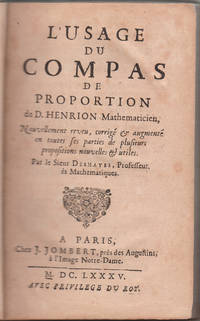
1685Best.-Nr. 4661Paris: J Jombert 1685. Later Revised Edition. Full contemporary calf. Good; rebacked at an early date. 8vo 14 2 - blank leaf 16 290 12 - errata and index pp. an engraved title page and 2 folding plates of the instrument inscribed with Bion's name. It is also worth noting that the instruments illustrated on the plates are different more complex than those of the earlier printings of this book. Henrion's book first 1616 was an explanation of a simple calculating sector based on an original design by Galileo. Henrion took the idea from Gunter. The book offered here however offers a sophisticated device manufactured by Bion. The two plates accompanying the text bear the name of Bion who advertises the fact that the compass as well as other instruments were available through him at his shop on Quay de Horloge; it appears that he began to tout his instruments in the edition of 1681 where they first appear. One of the plates in the book was meant to be removed and serve as a pattern for manufacturing a simple version of the compass. The text consists of examples for various kinds of nautical engineering scientific and some metallurgical calculations. Some are quite complex and manifest a considerable level of skill in manipulating other scales than those scribed on to the limbs of the pattern instrument. Bion was clearly hoping to move his clientele toward purchasing an expensive version of the compass. Henrion's book was an ideal vehicle for advertising this instrument because of the popularity of the text. An interesting example of Bion's marketing strategies for the products of his workshop. DSB VI 271; see Drake on Galileo's sector for a discussion. J Jombert unknown books
1964Best.-Nr. 61504Saginaw MI & Indianapolis IN: Trippensee Planetarium Co. George F. Cram Co. ca. 1964. Planetarium Orrery stands 12.5 in. tall at the top of the central Sun made from yellow plastic mounts on a 7.5 in. diameter moulded plastic base the model extends 22 in. when fully extended with Mercury on opposite side of the Sun from Moon extending out from central Earth. The Earth is a paper-covered 4 in. globe mounted on a gear mechanism mounted with wooden painted Moon mounted on metal rod as is the Venus globe which rotates around the moon all of which are driven by chains when handle underneath the swing arm is moved. Moulded plastic base has iron weight bolted underneath minor closed crack to the outer fore-edge of the base minor rippling to paint finish at base chipping to plastic bushing at base of Earth & Lunar globes still an exceptional piece in beautiful working condition. The Trippensee Planetarium tellurion or “Elementary Planetarium” has been produced for over 90 years and offers a wonderful astronomical mechanism depicting how day night and the seasons are caused by the movement of the Earth on its axis and its orbit around the Sun. It shows solar and lunar eclipses the motion of Venus in relation to the Sun and the rotation. The globe shows the major continents and cities with no internal political divisions except for the continental United States & Alaska shaded in green on the North American continent. The Tellurion or Tellurium was patented by Alexander Laing originally in 1897 as an educational device to be used in schools. He set up operations in Detroit MI and was later bought out by the Trippensee brothers who introduced their own version with a more reliable bicycle-style chain and gear drive and they sold them steadily. In order to further diversify the company they also built the Eddie Rickenbacker automobile for the E-M-F Company until 1927 when the Everitt Company went under. Trippensee brothers moved later to Saginaw Michigan where they occupied a three-story building at the corner of Cass and South Hamilton staying in business until 1999 when they were purchased by Science First. Their Orrery planetariums were made originally from wood and brass then Bakelite and finally plastics. See: Mark Theobald Coachbuiltcom Trippensee Manufacturing Company Rickenbacker Motors. Trippensee Planetarium Co., George F. Cram Co., unknown
1855Best.-Nr. 29821Paris 1855. Image size 156 x 198 sheet size 197 x 238. Printed on china paper and laid down to mounting sheet. Signed by the artist. This humourous scene depicts six musicians plyaing the violin flute double bass trombone and clarinet. A double bass player offers amorous advances to a young lady holding a tray of drinks a dog and cat play in the foreground and there is a general sense of confusion in the music performance. Mount browned. unknown books
1658Best.-Nr. 20068A Lyon, chez Jean Antoine Huguetan, 1658. Fort volume in-8 de [16]-936 (pour 930)-[22] pages, plein vélin souple.
1855Best.-Nr. 29821Paris 1855. Image size 156 x 198 sheet size 197 x 238. Printed on china paper and laid down to mounting sheet. Signed by the artist. This humourous scene depicts six musicians plyaing the violin flute double bass trombone and clarinet. A double bass player offers amorous advances to a young lady holding a tray of drinks a dog and cat play in the foreground and there is a general sense of confusion in the music performance. Mount browned. unknown