48 résultats
1881réf. 38041London: Dulau and Co. Novello and Co 1881. Hardcover. Very Good. Quarto. Full dark green cloth with decorative musical excerpt from Corelli gilt to upper titling and decorative device gilt to spine. xi 484 pp. First Edition. Binding slightly worn rubbed bumped and soiled; spine slightly frayed. Minor internal wear and browning; some signatures very slightly separated. Dulau and Co., Novello and Co hardcover books
1904réf. 38031London New York: The Walter Scott Publishing Co. Ltd. Charles Scribner's Sons 1904. Hardcover. Very Good. Small quarto. Publisher's maroon cloth with decorative blindstamping. xxvii 323 pp. Binding slightly worn rubbed and bumped; minor fraying to head of spine; rear free endpaper creased. Light uniform browning. From the collection of American musicologist and violinist Albert Mell with his signature to upper blank corner of front free endpaper. The Walter Scott Publishing Co., Ltd., Charles Scribner's Sons hardcover books
1933réf. 38049Milano: Ulrico Hoepli 1933. Hardcover. Good. Small octavo. Dark ivory illustrated cloth with titling to spine patterned endpapers. 326 pp. 1 folding plate. With occasional illustrations in text. From the library of American musicologist and violinist Alfred Mell with his signature and date to front free endpaper. Binding slightly worn and soiled. Ulrico Hoepli hardcover books
1834réf. 5227Philadelphia 1834. Not bound. Very good; some old folds. Folio sheet folded as 4 pp.; last page is a blank. The estate inventory of Benjamin Stancliff who was a maker of optical philosophical and mathematical instruments in Philadelphia from the late 18th to early 19th century. The inventory lists the tools supplies and instruments in his estate and what they sold for as well as an accounting for the total. Such inventories are exceptional and rare given the handful of people engaged in this trade. It offers a unique insight into the mode and manner of production and commerce in scientific instruments in colonial America. See Skerritt Catalog of the Charles E. Smart Collection .; NMAH web page for Stancliff in Wash. DC for citations and instruments. unknown books
1890réf. 13043Various places: Various publishers ca 1890. First Editions. Original printed wrappers. There is some occ. chipping and separation of wrappers; otherwise very good. 8vo. All are illustrated. A superb group of late 19th century trade catalogs for German manufacturers of precision instruments for medical laboratories. In the instance of Petzold the firm was also known for its astronomical instruments. They are as follows: 1 W Petzhold - Instrumente und Apparate Physiologische Experimente und Vivisectionen Leipzig 1888 8vo. 20 pp. illustrated.; 2 E Zimmermann - Preis-Verzeichniss uber Apparate zu psychologischen u. physiologischen Experimenten Leipzig 1894 20 pp.; 3 O Moecke inhaber der firma O Hornn - Illustrietes Preis-Verzeichniss chirurgischer Instrumente . Leipzig 1888; 4 W Pfeffer - Ein neuer heizbarer Objecttisch . Leipzig 1890 18 pp. illustrated - WITH separately printed advertisements for the thermostat and object table in proof; 5 F Majer - Physiologische Apparate Leipzig 1888 illustrated - WITH an albumen print of the Hurthle kymographion and three sheets of autograph notes identified as 1897 in a clear hand describing same and its use and adjustment manufactured by Eugen Albrecht of Tubingen Universitats-Mechanikus. A rare group of German instrument makers catalogs. The Moecke has one holding in OCLC at Leipzig; everything else is unlocated. Various publishers unknown books
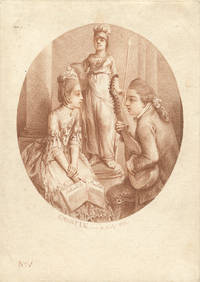
1772réf. 37112London 1772. 235 x 168 mm. On laid paper with "No. V" printed at lower left. A female singer holds an open music book on her lap entitled "Pastorale by Musolini." A Signor Mussolini is recorded as a singer and mandolin player making his first public appearance at Covent Garden on 27 April 1773 "playing a concerto on the double mandolin and royal guitar and accompanying a young gentlewoman in song." Highfill et al. Vol. 10 p. 407. unknown books
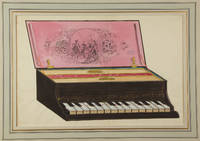
réf. 37111Executed in ink pencil and gouache highlighted in gold. 294 x 443 mm. On wove paper. The drawing depicts a 2-octave piano in a wooden case the interior of the hinged top decorated with a scene of performing musicians. Slightly worn and soiled; creased at central fold. In very good condition overall. Most likely of German or Austrian provenance ca. 1860-80. unknown books
1768réf. 1017Paris: Arts et Metiers 1768. First Edition. Later 19th century bds. Very good; tide marks to corner of the last two plates; some dustiness; untrimmed. Folio 2 1 - 44 pp. 15 highly detailed copper engraved plates. This is a description of a ruling engine that would permit the consistent and accurate division of arcs. The duc de Chaulnes was constantly working on the development of this device throughout the 1760s. By 1768 he had perfected the first ruling engine 5 yrs. prior to Ramsden. The innovation of his design was the elimination of the part played by a skilled craftsman. By mechanical means de Chaulnes was able to produce consistent precise results. The book offered here includes the detailed plates of the device and also incorporates the design for his microscope to read the divisional increments. A major chapter in the history of the construction of accurate astronomical instruments. The work was originally part of the Description des Arts et Metiers v. 13. See Daumas for illustrations and a lengthy entry. Arts et Metiers unknown books
1975réf. 32572Wien: Sammlungskatalog des Museums fur Volkerkunde 1975. Softcover. Very Good. Octavo. Wrappers. xvi 320 pp. plates. From the collection of musicologist Stanley Boorman. Sammlungskatalog des Museums fur Volkerkunde unknown books
1964réf. 37252London: Spring Books 1964. Hardcover. Very Good. Folio. Boards. 37 vi pp. 323 photographic illustrations of rare and historic musical instruments and related items. In dustjacket. Spring Books hardcover books
1970réf. 36969London: Hamlyn 1970. Hardcover. Very Good. Octavo. Boards. 157 pp. Illustrated with 70 plates in color. Hamlyn hardcover books
1970réf. 34051London: Hamlyn 1970. Hardcover. Very Good. Octavo. Boards. 157 pp. Illustrated with 70 plates in color. Hamlyn hardcover books
1895réf. 47419Jena: Carl Zeiss 1895. First Edition. Large slim octavo 27cm.; publisher's brown cloth over blue textured paper upper cover lettered in gilt; 4122pp.; steel-engraved text illus. throughout. Boards a bit rubbed and slightly bowed small spot of glue residue at top fore-edge corner of upper cover original gilt quite dulled though Parisian distributor's gilt-lettered cancel still brilliant contemporary American ownership inscriptions to front endpapers. Overall Very Good internally fine. Quite an attractive and uncommon trade catalog issued by the still-extant microscope manufacturer. This issue not separately catalogued in OCLC COPAC or KVK as of January 2020. Carl Zeiss unknown books
1906réf. SJ13530Berlin Chicago & New York . . . :: Leitz 1906. 1906. 8vo. 118 pp. Illus. index. Dark green gilt-stamped cloth. Near fine. Scarce illustrated catalogue of microscopes and related accessories. Leitz, 1906. hardcover books
1855réf. 29821Paris 1855. Image size 156 x 198 sheet size 197 x 238. Printed on china paper and laid down to mounting sheet. Signed by the artist. This humourous scene depicts six musicians plyaing the violin flute double bass trombone and clarinet. A double bass player offers amorous advances to a young lady holding a tray of drinks a dog and cat play in the foreground and there is a general sense of confusion in the music performance. Mount browned. unknown books
1961réf. 36958London: The Holland Press 1961. 3 volumes. Quarto. 357; 383; 160 ccxix pp. Illustrated. In dustjackets. A facsimile of the original edition published in 1876-1878. The Holland Press unknown books
1985réf. 36955Genève: Minkoff 1985. Softcover. Very Good. Octavo. Wrappers. xxix 357 pp. Illustrated. Facsimile reprint of the edition of 1912. Minkoff unknown books
1984réf. 36938Genève: Minkoff 1984. Softcover. Fine. Small octavo. Wrappers. 52 pp. Facsimile of the edition published in Brussels in 1823. Minkoff unknown books
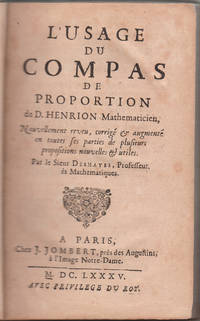
1685réf. 4661Paris: J Jombert 1685. Later Revised Edition. Full contemporary calf. Good; rebacked at an early date. 8vo 14 2 - blank leaf 16 290 12 - errata and index pp. an engraved title page and 2 folding plates of the instrument inscribed with Bion's name. It is also worth noting that the instruments illustrated on the plates are different more complex than those of the earlier printings of this book. Henrion's book first 1616 was an explanation of a simple calculating sector based on an original design by Galileo. Henrion took the idea from Gunter. The book offered here however offers a sophisticated device manufactured by Bion. The two plates accompanying the text bear the name of Bion who advertises the fact that the compass as well as other instruments were available through him at his shop on Quay de Horloge; it appears that he began to tout his instruments in the edition of 1681 where they first appear. One of the plates in the book was meant to be removed and serve as a pattern for manufacturing a simple version of the compass. The text consists of examples for various kinds of nautical engineering scientific and some metallurgical calculations. Some are quite complex and manifest a considerable level of skill in manipulating other scales than those scribed on to the limbs of the pattern instrument. Bion was clearly hoping to move his clientele toward purchasing an expensive version of the compass. Henrion's book was an ideal vehicle for advertising this instrument because of the popularity of the text. An interesting example of Bion's marketing strategies for the products of his workshop. DSB VI 271; see Drake on Galileo's sector for a discussion. J Jombert unknown books
1905réf. 21058ca1920 / ca1905. Original manufacturer's fitted boxes. Near Fine. Two Planimeters in their original velvet and satin lined boxes. The Willis instrument retains its original 8 pp. instructional pamphlet. Planimeters are designed to find the area of a figure profiles plans sections indicator diagrams drawn to any scale on a plane surface by simple mechanical operation. The area is computed by tracing the outline of figure the maximum was a figure of 22 inches in diameter for this size instrument with the tracing point and reading out the result on a graduated measuring wheel; the scale on this device will read out to hundredths of a square inch. It is based on a design by the Swiss mathematician Jacob Amsler in 1856 who licensed it to Keuffel & Esser. The K & E instrument offered here has their catalog identification number 4211. The Willis design uses somewhat different construction and a novel readout design that purports to enhance accuracy because its tracing arm is able to move in a uniform "frictionless" precise manner without regard to the paper or surface quality. The readout can be changed to any of six scales provided with the mechanism. The last patent date cited is 1901 with an instrument serial number 5592. See Zoller Instruments and Methods . SIS Bulletin v. 75 2002 pp. 11-17. unknown books
1877réf. 19034Paris: Bureaux du Journal 1877 - 1885. First Edition. Contemporary half leather and marbled paper. Very good; some modest chafing; occasional marginal notes. 8vo I - 4 368 pp. 3 plates; II - 3 - 524 12 pp.5 plates; III - 4 3 - 548 2 pp. 11 plates; V - 3 - 516 pp. 22 plates; VI - 4 3 - 646 pp. 17 plates including a mounted full-page albumen print of Pelletan's 'Continental' microscope - a 'class A' instrument of his own design selling for 600 Francs; VII - 4 3 - 666 pp. 6 plates; IX - 4. 1 - 534 pp. 5 plates plate 1 not bound in - as with other located copies. The asterisk indicating confused numbering of the plates but all are present. A run of an important journal in its formative years. The contents pages read like a who's who of nineteenth century microscopists writing on all matter of observations equipment lenses improvements and observations e.g. vol. 9 contains a number of articles and illustrations on penicillin ferments. The text is illustrated throughout. Bureaux du Journal hardcover books
1960réf. 88992Leonards-on-Sea: by the Author 1960. First Limited Edition. One of a thousand numbered copies this is no. 184. Inscribed and signed by Elgar on limitation page dated March 1961. 12mo 19cm. Original russet cloth; gilt spine and cover titles; 1271pp; text illustrations including 14 tipped-in original photographic plates. Cloth a bit rubbed and faded; slightly over-opened at half-title page; a previous owner has inserted an additional plate by hand and the original invoice from bookseller Oscar Shapiro is tipped on to front endpaper. Overall a Very Good copy. by the Author unknown books
1539réf. ST20126Pavia: Giovanni Maria Simonetta 1539. FIRST EDITION Second Issue. 210 x 147 mm. 8 1/2 x 5 3/4". 215 leaves. Restrained 19th century crimson morocco by Trautz-Bauzonnet stamp-signed on front turn-in raised bands spine with gilt text wide turn-ins gilt marbled endpapers all edges marbled and gilt. A small leather label with the year affixed to the spine. With two woodcuts depicting the "phagotus" instrument. Title with an attractive pictorial woodcut border. Printed in black and red. Occasional early ink marginalia; early ink ownership inscription to lower margin of colophon: "Hieronymi Pinzoni Cantoris Cremonensis et praepositi." An Armenian alphabet is inscribed in ink on the rear flyleaf dated March 28 1540. Mortimer 20; Adams I 957; Brunet I 229; Graesse I 59. Spine and edges slightly darkened joints a bit rubbed but without any cracking and the wear skillfully retouched. Only scattered very minor stains and soiling--quite a clean copy internally the leaves very fresh. This volume features one of the strangest combinations of a gravely serious treatise and an oddball curiosity: it comprises a landmark study of linguistics as the first European work concerning Syriac and Armenian--along with 36 other languages; and incongruously it also describes and pictures a contemporaneous musical instrument whose design was sufficiently peculiar to limit its interest to just one person the book's dedicatee. Our work originated when Teseo Ambrogio degli Albonesi 1469-1540 a lawyer scholar and canon of the church of Saint John of the Lateran was tasked with the publication of a Syriac manuscript psalter brought by a Maronite contingent to the Fifth Lateran Council. This was not merely a minor exercise in church outreach: 16th century scholars believed Syriac as a derivative of Aramaic to be the language of Christ. While the present work is of great interest because of its Syriac and Armenian content Ambrogio did not limit himself to those tongues: the text includes in particular short studies of Samaritan Arabic Coptic Cyrillic and Ethiopic. Of these some alphabets are provided in print in types specifically designed by Ambrogio and others are supplied in manuscript in spaces left in the text for that purpose. Ambrogio's sample texts range from simple alphabets to biblical passages to a letter purportedly from the Devil! In addition to the serious work done by our volume the text here deviates to include a fascinating musical surprise. Dedicated to the author's uncle Afranio degle Albonesi ca. 1465 - ca. 1540 a fellow church canon and apparently something of an eccentric the work includes an illustrated section on the "phagotus" a musical instrument of Afranio's own invention. Described by composer John Pickard as a "remarkable monstrosity" the phagotus combined features of the bagpipe and the bassoon. It never gained widespread popularity though not for lack of trying on Afranio's part--he once even performed with it for the duke of Ferrara Alfonso d'Este at a banquet in Mantua. Our copy in a pleasing though unassuming binding by one of the foremost 19th century French workshops was owned during its early history by yet another prominent churchman--Girolamo Pinzoni d. 1554 canon of the church of San Leonardo in Cremona. Giovanni Maria Simonetta unknown books
1990réf. 131495TX: Texas Instruments 1990. Softcover. Fine. Fine in wrappers. In wraps softcover. Sealed and 3 hole punched for a binder. Texas Instruments unknown books
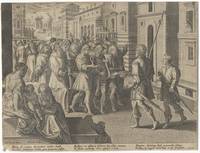
1590réf. 41460Antwerp: Philip Galle 1590. Plate 5: Saul among the Prophets I Samuel x 10-11. The engraving depicts a biblical scene and incorporates an illustration of musical instruments including timbrels harp drums cornet and trumpet with reference in Latin text beneath the image to the musical instruments depicted. 220 x 285 mm. Trimmed to plate mark; edges worn with two small tears; some staining; partially laid down to mounting paper. Plate 9: Solomon taking the Tabernacle into the Temple the Levites singing. 2 Chronicles v 4-6. The engraving incorporates an illustration of trumpets timbrel harp horns drums flute rebec and cymbals with reference in Latin text beneath the image to the musical instruments depicted. 220 x 285 mm with wide margins. Minor wear; upper right blank margin stained; marginal tears and soiling; repairs to verso. Plate 14: Judith's Triumph. The Women of Israel Praising Judith. The engraving depicts a biblical scene and incorporates an illustration of musical instruments including timbrels harp viol drums cornet panpipes and trumpet with reference in Latin text beneath the image to the musical instruments depicted. 220 x 285 mm. Slightly worn; trimmed to within plate mark; laid down to mounting paper. Plate 15: Rededication of the Temple by Simon Maccabaeus. I Maccabaeus Apocrypha xiii 49-51. The engraving depicts a biblical scene and incorporates an illustration of harp timbrels trumpet horn and flute with reference in Latin text below image to the musical instruments depicted. 220 x 285 mm Trimmed to plate mark; laid down to early paper backing. The Encomium Musices Eulogy of Music is an important set of highly detailed late 16th century engravings published in Antwerp ca. 1590 by Philip Galle 1537-1612 best-known as a publisher of Old Master prints; the engraver of this particular plate Collaert was Galle's son-in-law. The suite of engravings is thought by some to commemorate the rededication of Antwerp's churches to Roman Catholicism following the capture of the city by Alexander Farnese in 1585. One of the high points of music iconography. Philip Galle unknown books