BOUGUER (Pierre)Livre Rare Book

2,027 results
1706ref. WOC-969Contenant:Les Propositions & Pratique de Géométrie, un Traité de la Sphère & d'Astronomie, les Tables Ephémérides du mouvement du mouvement du Soleil, celle de sa Déclinaison, de son Ascension droite, de son lever & coucher, de son Amplitude, & plusieurs autres nécessaires en Navigation, nouvellement calculées & reformées, avec des manières de les calculer & prolonger, les constructions & usages des Instruments à prendre les hauteurs des Astres, pour en conclure les latitudes, tant sur Terre, que sur Mer, avec de nouvelles observations & remarques sur les Marées & Table de leur établissement, des variations du Compas de Routes, & les moyens de l'observer, avec des manières de diriger la route d'un Vaisseau sans aiguille aimantée, pendant le jour par le Soleil, & pendant la nuit par les Étoiles, les Règles générales de la Navigation, par les Cartes Marines, par le Quartier de la Réduction, par les Sinus, Tagentes & Secantes, par les Logarithmes, &c, le tout clairement démontré & expliqué, avec détail, qu'il n'a été jusqu'à présent, & divisé par Leçons à la marge, ainsi qu'on les enseigne dans les Écoles Royales de la Marine, établie par Sa Majesté au Croisic, par le Sieur Rouguer, Professeur Royal d'Hydrographie. Nouvellement revu, corrigé & augmenté par l'Auteur de plusieurs manières de naviguer par de nouvelles Echelles, avec des Remarques sur les erreurs qu'on a commises jusqu'à présent dans les Règles composées de longues Routes fausses connues par estimes, & les moyens de les corriger, par une quatrième correction. Ouvrage orné de 11 planches hors-texte, Ephéméride du mouvement du Soleil, table de la déclinaison du Soleil, etc, et du faux-titre. Paris, Chez P. De Heuqueville, Marchand Libraire Juré de l'Université, à la Bible d'Or et Chez l'Auteur, au Croisic, 1706. In-4 (25,5x20cm) reliure d'époque plein veau marbré, dos à nerfs orné, pièce de titre sur maroquin rouge, tranches rouges. 3(ff), 253pp.+ 1(f) d'approbation.
ref. 977le Soudan Oriental.traduit de l’arabe par le docteur PERRON.1845.Ouvrage accompagné de cartes et planches.dédié à son altesse Mohammed-Aly Roi d’Egypte Chez Benjamin Duprat 1845.in 8 chagrin vert à nerfs et à coins.(reliure postérieure)pièce de titre ancienne conservée.Faux-titre (avec timbre école d’artillerie)portrait du Sultan Abou Madian en frontispice dessiné par M.Marchereau professeur de dessin à l’école militaire de Gyzeh.1 feuillet(avec un petit manque réparé en marge supérieure)« à son altesse Mohammed-Aly Vice-Roi d'Egypte et dépendances.Hommage de respect et de connaissance »Perron directeur de l’école de médecine du Kaire.LXXXVIII préface et avant-propos par MM. JOMARD et PERRON au Kaire 1842.491 pages.1 feuillet d’errata.5 planches hors-texte dépliantes sur papier très fort Bien complet des planches IV et V instruments de musique et partition .Planche I Une grande carte dépliante: essai de carte du Dâr-Al-Fôr ou DARFOUR par M. PERRON D.M.P. Kaire 1841 d’après les indications du Scheykh Mohammed El Tounsy(une déchirure réparée)Planche II dépliante fac-similé de la carte du Dâr-Al-Fôr par le Schaykh Mohhhammad al Tounsy.Planche III dépliante figures et plan avec la hutte des concubines,une pliure coupée réparée)Planche IV dépliante,figures,instruments de musique Planche V dépliante musique,partition Chant des Mawgueh.Il manque la page de titre,Très rare.
1688ref. 15606Paris, Etienne Michallet (Imprimerie Estienne Chardon), 1688 ; in-8 ; plein veau havane marbré, dos à nerfs décoré et doré, titre doré, roulette dorée sur les coupes, tranches mouchetées de rouge (reliure de l'époque) ; 138 pp., (1) f. blanc, nombreuses figures dans le texte et 2 planches hors-texte gravées "Figure du Compas de proportion faite par Chapotot".
1769ref. 31219ABLausanne, François Grasset, 1769. 8°. 42, (6) S. Mit einer gefalteten Tafel. Späterer Halbleinenband.
1839ref. 114561839 en ff. 64ff. et 117 ff. (certains sont ecrits recto verso.) 225 x 180mm.
1821ref. 31030Paris Imprimerie de Madame Huzard (née Vallat La Chapelle) 1821 in-4 dérelié, rousseurs
ref. 100002Chez la Veuve Dessaint, de l'Imprimerie de P. Didot l'Aîné, 1792, 3 volumes in-4 de 260x200 mm environ, Tome I. faux-titre, titre, lxvj-478+ Tables Astronomiques de 378 pages avec 5 planches dépliantes - Tome II. faux-titre, titre, 727 pages avec 26 planches dépliantes - Tome III. faux-titre, titre, 737 pages, avec 13 planches dépliantes, pleine basane fauve racinée, dos à 5 nerfs portant titres et tomaisons dorés, ornés de caissons à motifs dorés, coupes dorées tranches finement mouchetées, gardes marbrées. Quelques erreurs de pagination sans manque, des épidermures, petits trous de ver, mors fragiles (tome I en partie fendus), petits défauts de marge, rousseurs mouillures claires et feuillets brunis par endroits, complet du texte et de 44 planches au total (dont une grande carte dépliante de l'éclipse du 1er avril 1764).
First edition, 8vo (200 x 122 mm), iv, 290, [2]pp., with final errata leaf, 19 folding engraved plates, some light offsetting, minor browning from turn-ins, contemporary tree calf, smooth spine ruled in gilt, black leather lettering piece, joints slightly cracked otherwise a fine copy. The work was published anonymously and was long attributed to the English clergyman, the Rev. Francis Kelly Maxwell (1729-1782). However, it has recently been attributed to John Maxwell who was a property manager in Scotland for Sir William Pulteney and an amateur violinist. "In the 'Essay upon Tune' Maxwell presented his discovery to the public, namely, a division of the octave into forty-four distant pitches with the mechanism to enable an organ to produce these pitches."?Kassler. Provenance: Ownership inscription and bookplate of Sir Michael R. Shaw-Stewart, 7th Baronet (1826-1903). Kassler, The Science of Music, pp.760-1.
ref. 83400Ottawa, Lithographed at the Survey Office, 1889, 1 volume in-4 de 265x185 mm environ, 324 pages, demi reliure à coins en cuir noir, dos à 5 nerfs portant titres dorés, orné de filets dorés qui soulignent les nerfs, contient des figures dans le texte et 5 planches hors texte, 1 carte d'envoi de l'auteur. Légères rousseurs sur les pages de garde, petite trace blanche sur le dernier plat, sinon bon état. Un des 50 exemplaires de cette première édition, publiée au sein des Services d'arpentage (Canada), à l'usage des employés de l'équipe. Hommage de l'auteur sous forme de carte. (Nous laissons une enveloppe jointe contenant quelques photographies anciennes sans rapport avec l'ouvrage).
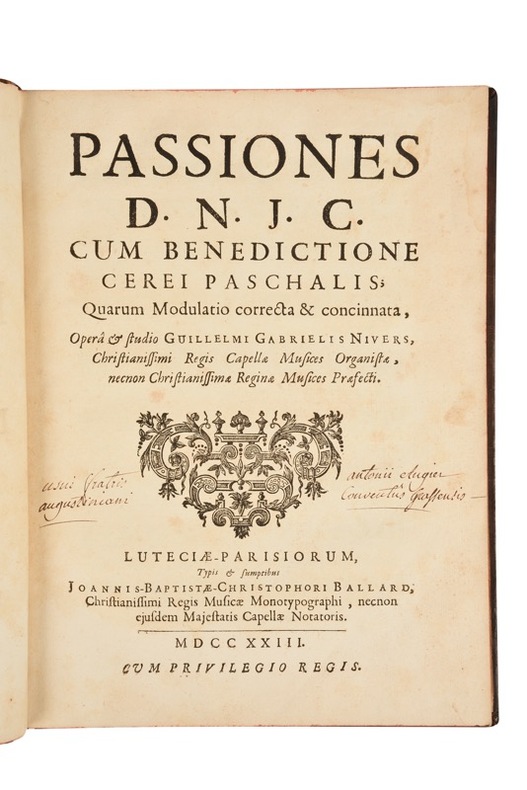
1723ref. 21655Paris, Jean-Baptiste-Christophe Ballard, 1723 ; relié ensuite, du même auteur : Lamentationes Jeremiae prophetae, quarum modulatio correcta et concinnata. (même éditeur et même date).Soit deux ouvrages reliés en un volume in-quarto, reliure de deuil en veau brun, fer des instruments de la Passion poussés à froid au centre des plats, fer à la tête de mort et tibias croisés poussés à froid dans les coins et sur les caissons du dos (reliure de l’époque) ; [4], 122 pp., [1] f. de Privilège ; [2] Titre et Privilège, 22 pp.
1769ref. 15528Lausanne, François Grasset, 1769 ; in-12, broché ; 42 pp., (6) pp. de catalogue des ouvrages de Haller, Boerhaave et Tissot, 1 grande planche dépliante d'instruments gravée par Chovin.
1769ref. 31219ABLausanne, François Grasset, 1769. 8°. 42, (6) S. Mit einer gefalteten Tafel. Späterer Halbleinenband. + Wichtig: Für unsere Kunden in der EU erfolgt der Versand alle 14 Tage verzollt ab Deutschland / Postbank-Konto in Deutschland vorhanden +, A
ref. 183645 tomes in-8, veau marbré, dos à nerfs décoré et doré (reliure de l’époque) ; 24, LXXVI, 515, [11] pp., X planches dépliantes ; 676, [6] pp. pl-XI-XVIII ; 782, [8], pl. XIX-XXXII ; 480 pp., [64] pp., pl. XXXIII-XXXX ; XLVIII, 672 pp., [1] pl. dépliante gravée par Marie Dauvergne.
1774ref. 8122P., Didot, 1774, 3 VOLUMES in 8 reliés en plein veau marbré, dos ornés de fers dorés, tranches rouges (reliures de l'époque), T.1 : 1 PORTRAIT DE PETIT, (5), 104pp., 407pp., T.2 : (1), 8pp., 560pp., T.3 : (1), 8pp., 343pp., 142pp. (SUPPLEMENT par LESNE), 90 PLANCHES DEPLIANTES REPRESENTANT DES INSTRUMENTS DE CHIRURGIE
1582ref. 13078Florence: G Marescotti 1582. First Edition. Modern linen over boards. Good with some erratic spotting and toning; backstrip wanting. Small 4to 53 1 - printer's device & privilege. The book is illustrated throughout. Lupicini was a military engineer who as early as 1552 had been involved in the sieges of Montalcino and Monticchiello. He also worked as a hydraulic engineer for the city of Venice. The book offered here is his explanation of a new astronomical staff devised by him. It could be used for various surveying problems or as a geometrical quadrant and cross-staff. The instrument also included a magnetic compass Breman and the text discusses its application to ballistics and cartography. This is the only printing of the treatise. Adams L-1723; Breman pp. 212 - 213; Riccardi II 59; H-L #2741; Sphaera Mundi #35. G Marescotti hardcover books
ref. 578P., Jombert, 1752, un volume in 4 relié en plein veau marbré, dos orné de fers dorés, tranches rouges (reliure de l'époque),(habiles restaurations aux coiffes et aux coins, 2 noms partiellement grattés sur la page de titre), UN FRONTISPICE, UN PORTRAIT, (4), 448pp.., (6), 37 PLANCHES dépliantes
1768ref. 8518A Paris, l'Auteur... chez Mr. Levinville, luthier ; gravé par Mme Vendôme, imprimé par Montuhai, sans date (circa 1768) ; in-folio ; plein vélin vert, grande pièce de titre de maroquin grenat entourée d'un large décor doré sur le premier plat (reliure de l'époque) ; (2) ff. (titre-frontispice, titre, dédicace au duc de Chartres, planche représentant une mandoline), 67 pp., imprimé sur vergé fort. Ouvrage entièrement gravé.
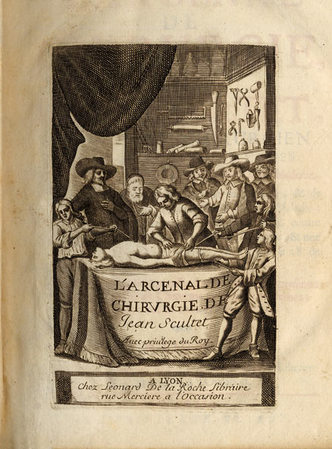
1712ref. 9402Lyon, Léonard De La Roche, 1712 ; in-4 ; plein veau havane, dos à nerfs richement décoré et doré, pièce de titre grenat, tranches mouchetées rouges (reliure de l'époque) ; (16) y compris le frontispice gravé, titre en rouge et noir, Dédicace aux médecins et chirurgiens de Lyon, table, 369, (3), 138, (22) pp. de tables ; 46 planches numérotées plus 4 non chiffrées soit 50 planches gravées hors-texte au total, certaines dépliantes, représentant de très nombreux outils et appareils, des opérations et 3 planches de monstres.
1624In-folio, 57 ll., 1bl.; engraved title and 51 full-page engraved plates, giving geodetic and cosmographic instruments and measurements; woodcut ornate initials and tailpieces, large Aldus anchor woodcut device at the end. Bound in contemporary cartonnage (reliure d'attente), with weak hinges; occasional light foxing, light dampstain at the bottom of the last leaves. Despite the title the work includes 50 full-page engravings, of which the last 7 are a supplement by Scala and are especially devoted to architecture and perspective.
1890ref. 13043Various places: Various publishers ca 1890. First Editions. Original printed wrappers. There is some occ. chipping and separation of wrappers; otherwise very good. 8vo. All are illustrated. A superb group of late 19th century trade catalogs for German manufacturers of precision instruments for medical laboratories. In the instance of Petzold the firm was also known for its astronomical instruments. They are as follows: 1 W Petzhold - Instrumente und Apparate Physiologische Experimente und Vivisectionen Leipzig 1888 8vo. 20 pp. illustrated.; 2 E Zimmermann - Preis-Verzeichniss uber Apparate zu psychologischen u. physiologischen Experimenten Leipzig 1894 20 pp.; 3 O Moecke inhaber der firma O Hornn - Illustrietes Preis-Verzeichniss chirurgischer Instrumente . Leipzig 1888; 4 W Pfeffer - Ein neuer heizbarer Objecttisch . Leipzig 1890 18 pp. illustrated - WITH separately printed advertisements for the thermostat and object table in proof; 5 F Majer - Physiologische Apparate Leipzig 1888 illustrated - WITH an albumen print of the Hurthle kymographion and three sheets of autograph notes identified as 1897 in a clear hand describing same and its use and adjustment manufactured by Eugen Albrecht of Tubingen Universitats-Mechanikus. A rare group of German instrument makers catalogs. The Moecke has one holding in OCLC at Leipzig; everything else is unlocated. Various publishers unknown books
1790In-4°; 2 parti in 2 volumi rilegati in mezza pelle coeva con tassello e titolo in oro al dorso (del primo vol. lievemente difettosa); tagli spruzzati. Pp. 321, (1), 3 tavole f.t. a piena pagina incise su rame (una raffigura il vulcano Pambamarca nella zona di Quito in Ecuador), 2 grandi tavole ripiegate con tabelle; Pp. 400, 4 tavole a piena pagina incise su rame di cui una raffigura il, vulcano di Pichincha vicino Quito, e l’altra il vulcano Chimborazo sempre in Ecuador; 2 grandi tavole ripiegate con tabelle. Al verso dei frontespizi piccoli timbri di possesso. Interessante e poco nota opera di fisica sperimentale e sienze naturali del gesuita spagnolo Francesco Perez (1720-1807 Bologna), matematico e missionario in Ecuador, Quito, fino alla espulsione dei gesuiti dai domini spagnoli (1767); in Italia si dedicò alla scrittura di opere scientifiche che vennero pubblicate dopo la soppressione della Compagnia nel 1773. Il suo nome è legato anche all’invenzione di strumenti scientifici, tra cui uno per misurare gli angoli. Oggetto del trattato il Barometro, “istrumento in grado eminente per condurre l’intelletto alla cognizione dell’elemento dell’aria”, e il Termometro, strumenti dei quali si ricordano gli inventori, i metodi costruttivi, le evoluzioni tecniche; si esaminano le differenze tra aria e atmosfera, “l’elasticità” della materia eterea, l’atmosfera equinoziale dell’America, specialmente delle montagne e vulcani dell’Ecuador (Caraburo, Oyambaro, Pichincha Pambamarca ecc.) dove l’atmosfera fu misurata con l’aerometro, come ampiamente si descrive nella seconda parte. Un capitolo, in fine, è dedicato all’atmosfera europea.
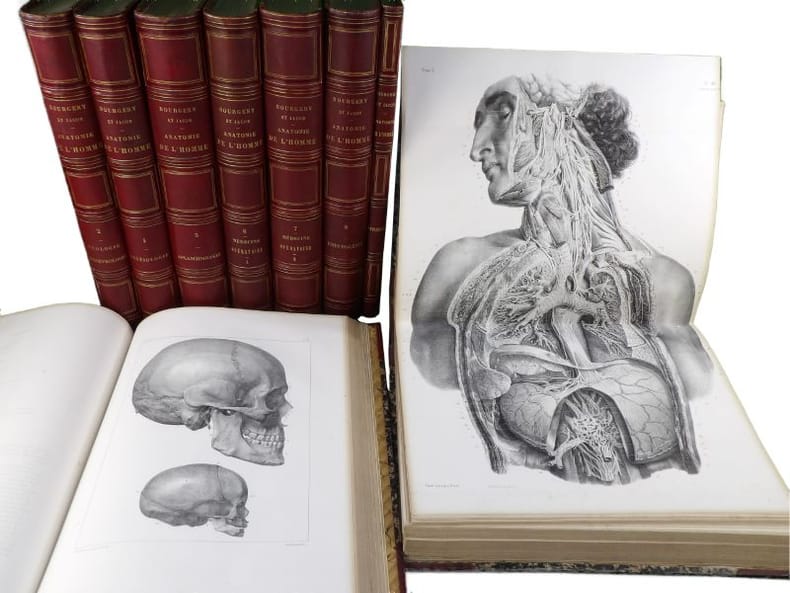
1866ref. 2789Paris, L. Guérin, 1866-1871. 9 Volumes in-folio + 1 Supplément. COMPLET. In-folio - 44 x 34 cm. Reliure de l'époque en demi-chagrin rouge à coins, dos à 4 nerfs orné de caissons à filets dorés. Ouvrage orné de 750 planches lithographiées en noir d'après nature par Jacob (726 gravures + 24 gravures in Supplément). Rehauts de couleur bleu et rouge pour différencier veines et artères sur quelques planches. Cette collection se divise ainsi : Tome 1 : Anatomie descriptive et physiologique. Appareil de relation. Organes de la locomotion. Ostéologie. Syndesmologie. 191 pages + 59 planches (N°1-59) ; Tome 2 : Appareil de locomotion. Myologie. Aponévrologie. 141 pages + 100 planches (N°60-159) ; Tome 3 : Appareil de relation. Névrologie ou organes de l'innervation. 341 pages + 115 planches [100 planches (N°1-100) + 15 bis] ; Tome 4 : Appareil de nutrition. Angéiologie. 162 pages + 98 planches [91 planches (N°1-91) + 7 bis] ; Tome 5 : Appareil de nutrition. Splanchnologie. 342 pages + 96 planches [76 planches (N°1-76) + 20 bis] ; Tome 6 : Sclérotomie. Ophtalmologie. Ténotomie (1e partie). 280 pages + 93 planches [91 planches + 2 bis] ; Tome 7 : Sclérotomie. Ophtalmologie. Ténotomie (2e partie). 356 pages + 98 planches [77 planches + 5 bis + 16 lettrées de A à P] ; Tome 8 : Embryogénie. 335 pages + 67 planches [60 planches (N°1-60) + 7 bissées] ; Suppléments, par le Dr Duchaussoy : 108 pages + 24 planches (1 déchirure restaurée page 31 sans manque de texte, 1 petit manque en marge dans la page de texte de la planche 19, sans conséquence pour le texte). Claude Bernard collabora à cette somme médicale à partir de 1845, en présentant des pièces anatomiques.
1834ref. 5227Philadelphia 1834. Not bound. Very good; some old folds. Folio sheet folded as 4 pp.; last page is a blank. The estate inventory of Benjamin Stancliff who was a maker of optical philosophical and mathematical instruments in Philadelphia from the late 18th to early 19th century. The inventory lists the tools supplies and instruments in his estate and what they sold for as well as an accounting for the total. Such inventories are exceptional and rare given the handful of people engaged in this trade. It offers a unique insight into the mode and manner of production and commerce in scientific instruments in colonial America. See Skerritt Catalog of the Charles E. Smart Collection .; NMAH web page for Stancliff in Wash. DC for citations and instruments. unknown books
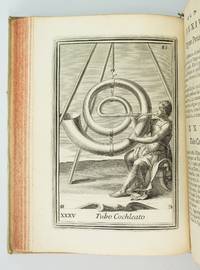
1722ref. ST21075Rome: Giorgio Plancho and Gettatore de' Caratteri 1722. FIRST EDITION. 250 x 180 mm. 9 7/8 x 7 1/4". 8 p.l. 170 pp. Contemporary stiff vellum raised bands burgundy morocco label lettered in gilt all edges sprinkled. Engraved title page frontispiece and 151 PLATES DEPICTING MUSICAL INSTRUMENTS. Front pastedown with bookplates of John Smith Esquire Arthur & Charlotte Vershbow Cia Fornaroli and David R. Godine. Cicognara 1596 citing 148 plates; Brunet I 1086 citing 136 plates; Graesse I 480. A long thin red ruled line to upper cover a few small cuts at edge of front board O1 with insignificant hole trivial loss of text a few light stains isolated faint browning to plates but quite AN EXCELLENT COPY--the leaves extremely fresh and clean and the binding entirely sound and perfectly inoffensive. This is an excellent copy of a sumptuously illustrated Baroque compendium of musical instruments which has been owned by three eminent collectors. A student of Athanasias Kircher the Jesuit scholar Filippo Bonanni also Buonanni 1638-1723 produced works on wide-ranging subjects including anatomy shell-collecting and porcelain lacquer. "Gabinetto Armonico" attempts to catalogue all known musical instruments including a broad range of horns as well as other wind percussion stringed and keyboard instruments not infrequently exotic in appearance and operation from all regions including Florida and the world of Islam. Many of the instruments included here were held in the collection of the Jesuit Collegio Romano where Bonanni was teaching at the time he composed the book; other information was gleaned from various authors and ethnographical reports. The book is organized based on the use for which the music is intended e.g. for festivals funerals battle worship hunting and even navigation. The very attractive illustrations by Flemish-born painter and publisher Arnold van Westerhout 1651-1725 depict the instruments in the hands of their players in their native costumes and environs. While some of the depictions of the ancient and foreign musicians are fanciful the majority of these engravings provide genuine invaluable information on music and musical instruments up to the early 18th century. The musicians are as interesting as the instruments dressed in keeping with the original homeland of the instrument ranging from King David with his harp to fashionable rococo ladies at the keyboards of spinet and cimbalo. Our copy is from the library of Italian ballerina Cia Fornaroli 1888-1954 and her husband Walter Toscanini 1898-1971 a bookseller and choreographer. The couple whose distinguished careers were split between New York and Italy assembled a large collection of works documenting the history of dance in Italy from the Renaissance until the 20th century. The bulk of their library now resides in the Jerome Robbins Dance Division of the New York Public Library for the Performing Arts. Our next notable owners were Arthur 1922-2012 and Charlotte Vershbow 1924-2000 who together built a large collection of prints illuminated manuscripts and printed books. Their collection sold at Christie's New York in a series of four auctions in 2013 the present volume was lot 771. Most recently our copy belonged to American publisher David R. Godine who trained as a printer at Leonard Baskin's Gehenna Press before founding his own publishing firm in 1970. His interest in the art of the book led him to build an extensive library of early printed books with a particular focus on antiquarian illustrated works. Two portions of his collection sold for more than $950000 at Bonham's New York in May 2026. The book is not particularly rare at auction but copies in desirable condition even without the distinguished provenance seen here command substantial prices. Giorgio Plancho and Gettatore de' Caratteri unknown books
1722ref. ST21075Rome: Giorgio Plancho and Gettatore de' Caratteri 1722. FIRST EDITION. 250 x 180 mm. 9 7/8 x 7 1/4". 8 p.l. 170 pp. Contemporary stiff vellum raised bands burgundy morocco label lettered in gilt all edges sprinkled. Engraved title page frontispiece and 151 PLATES DEPICTING MUSICAL INSTRUMENTS. Front pastedown with bookplates of John Smith Esquire Arthur & Charlotte Vershbow Cia Fornaroli and David R. Godine. Cicognara 1596 citing 148 plates; Brunet I 1086 citing 136 plates; Graesse I 480. A long thin red ruled line to upper cover a few small cuts at edge of front board O1 with insignificant hole trivial loss of text a few light stains isolated faint browning to plates but quite AN EXCELLENT COPY--the leaves extremely fresh and clean and the binding entirely sound and perfectly inoffensive. This is an excellent copy of a sumptuously illustrated Baroque compendium of musical instruments which has been owned by three eminent collectors. A student of Athanasias Kircher the Jesuit scholar Filippo Bonanni also Buonanni 1638-1723 produced works on wide-ranging subjects including anatomy shell-collecting and porcelain lacquer. "Gabinetto Armonico" attempts to catalogue all known musical instruments including a broad range of horns as well as other wind percussion stringed and keyboard instruments not infrequently exotic in appearance and operation from all regions including Florida and the world of Islam. Many of the instruments included here were held in the collection of the Jesuit Collegio Romano where Bonanni was teaching at the time he composed the book; other information was gleaned from various authors and ethnographical reports. The book is organized based on the use for which the music is intended e.g. for festivals funerals battle worship hunting and even navigation. The very attractive illustrations by Flemish-born painter and publisher Arnold van Westerhout 1651-1725 depict the instruments in the hands of their players in their native costumes and environs. While some of the depictions of the ancient and foreign musicians are fanciful the majority of these engravings provide genuine invaluable information on music and musical instruments up to the early 18th century. The musicians are as interesting as the instruments dressed in keeping with the original homeland of the instrument ranging from King David with his harp to fashionable rococo ladies at the keyboards of spinet and cimbalo. Our copy is from the library of Italian ballerina Cia Fornaroli 1888-1954 and her husband Walter Toscanini 1898-1971 a bookseller and choreographer. The couple whose distinguished careers were split between New York and Italy assembled a large collection of works documenting the history of dance in Italy from the Renaissance until the 20th century. The bulk of their library now resides in the Jerome Robbins Dance Division of the New York Public Library for the Performing Arts. Our next notable owners were Arthur 1922-2012 and Charlotte Vershbow 1924-2000 who together built a large collection of prints illuminated manuscripts and printed books. Their collection sold at Christie's New York in a series of four auctions in 2013 the present volume was lot 771. Most recently our copy belonged to American publisher David R. Godine who trained as a printer at Leonard Baskin's Gehenna Press before founding his own publishing firm in 1970. His interest in the art of the book led him to build an extensive library of early printed books with a particular focus on antiquarian illustrated works. Two portions of his collection sold for more than $950000 at Bonham's New York in May 2026. The book is not particularly rare at auction but copies in desirable condition even without the distinguished provenance seen here command substantial prices. Giorgio Plancho and Gettatore de' Caratteri unknown