8 postcards bagBiblio.com
Julia KristevaLivre Rare Book
HISTOIRES D'AMOUR.
ref. PSY042C591983 / 358 pages. Broché. Editions Denoël

Librairie du Levant · Bayonne, France€25.00
590 results
1955ref. 2080502106906618Not Available 1955. Soft Cover. Fine. The book is in fine condition. Not Available paperback
ref. 2080502106906621Not Available N.A. Soft Cover. Fine. The book is in fine condition. Not Available paperback
2000ref. Q-1901123553Dixie Postcards & Souvenir Sal 2000. Paperback. New. In shrink wrap. Looks like an interesting title! Dixie Postcards & Souvenir Sal paperback
ref. PSY042C591983 / 358 pages. Broché. Editions Denoël
1991ref. PSY090C1141991 / 175 pages. Broché. Editions PUF.
ref. PSY008C1141975 / 233 pages. broché Editions Seuil Collection l'Univers Historique
ref. 2080502106911324Not Available N.A. Soft Cover. Fine. The book is in fine condition. Not Available paperback
ref. 2080502106909941Not Available N.A. Soft Cover. Fine. The book is in fine condition. Not Available paperback
Madrid, Alianza Editorial, 1973. Cubierta de Daniel Gil. Colección El Libro de Bolsillo nº 427. 208p. 8º. Rústica editorial ilustrada. Muy buen ejemplar. Primera edición en la colección.
1980No marks or inscriptions. No creasing to covers or to spine. A very clean very tight copy with bright unmarked boards and no bumping to corners. 95pp. Heilbronn in Germany in old postcards. All text in German.
1983Oblong 4to., First Edition, with numerous full-page photographs in the text; pictorial grey cloth, upper board and backstrip lettered in black, a near fine copy.
2017New English Original bdg. HC. 4to. (30 x 30 cm). In English and Turkish. 323 p., color and b/w ills. Haremeyn: Hajj. Journey to holiness.= Haremeyn: Hac. Mukaddese yolculuk.
ref. 2080502106908898Not Available N.A. Soft Cover. Fine. The book is in fine condition. Not Available paperback
2014New New English Original bdg. Dust wrapper. 4to. (29 x 29 cm). Bilingual in English and Turkish. B/w and color ills. 306 p. "Persevering against wars, disasters, and epidemics for more than 13 centuries, the Hajj is the only ritual that has continued without interruption in the history of humanity. There have been absolutely no changes in its religious character, yet the scope of the changes made to its physical structure in the last century is much greater than the total of the changes implemented throughout the 13 centuries in question. And by using postcards, this book aims to help visualize what the Hajj was like before all these changes. This book will allow you to witness the past of the sublime and multifaceted act of worship through the medium of the postcards. We humbly hope to succeed in opening up new horizons in the minds and hearts of those interested in this topic, and especially those who have performed their pilgrimage or have yet to perform it. Contents Part I and Part VI .departure and arrival of the pilgrims, people seeing them off and welcoming them. Apart from giving us an idea about the different forms of this journey in the past, postcards also tell us how great a number of lands and peoples were affected around the time of pilgrimage every year. Part II .ceremonies from Istanbul, Damascus and Egypt. Part III is dedicated to Hejaz, Jeddah and Yanbu. These postcards may give us clues about the daily life in the Hejaz in those years, and how the pilgrims traveled and found accommodations. Parts IV and V .the holy cities of Mecca and Medina .sights from the two holy cities, Masjid al-Haram and Masjid al-Nabawi. These postcards provide an opportunity to compare the present state of these two cities with their near past in terms of architecture and town planning. Part VII. The Ottoman State launched the Hamidiye Hejaz Railroad project at the beginning of the 20th century. This was the greatest project undertaken after the Industrial Revolution for the comfort and safety of the tens of thousands of pilgrims undertaking the Hajj journey
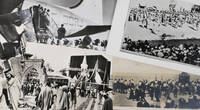
1950ref. ABC_487261950. Kept in a clear plastic sleeve. Various sizes. Four postcards and one press photograph. Collection of four postcards and one press photograph all relating to hajj. Every image shows a different aspect of the pilgrimage. The photograph shows a group of Moroccan men awaiting their turn to board the plane to Mecca and the postcards show the covered Kaaba both from further away and from up close and the arrival of the holy carpet in Alexandria. The final postcard depicts the public execution of two men.The postcard of the holy carpet has been used and has a black stamp on the front and a message and an address on the back the left margin has been cut slightly affecting the image and the handwritten text the corners of the photographs are somewhat creased. Otherwise in good condition. unknown
2013As New English Paperback. Pbo. Mint. Oblong large demy 8vo. (16 x 22 cm). In English. Fully color and b/w ills. 96 p. Hagia Sophia in old picture postcard.
ref. 67122Berlin, Ferdinand Osertag Verlag,, 1923 Original hardcover binding,(1) 50 pages (1), 27x20cm. illustrated with 20 b/w illustrations (woodcuts) *fine condition.
ref. 2080502106903679Not Available N.A. Soft Cover. Fine. The book is in fine condition. Not Available paperback
1978ref. A02-01In-8° livre de poche Collection PBP (Petite Bibliothèque Payot), Paris 4e trimestre. 1978, 256 pp. – dont 6 pages de catalogue PBP. Important Index bibliographique et références psychiatriques en fin de chapitre «La théorie psychanalytique du délire». Relié paperback couverture souple. Titre assez rare aujourd'hui, absent du site La Chasse aux livres en octobre 2022. Très bon état avec quelques soulignés.
1990No marks or inscriptions and no creasing to cards. A set of 30 postcards in fine unused condition. They are attached to the book and can be removed and used for messages by post or for display puposes. 32pp.
ref. 46840Minerva Press.1993.In-4,couv.souple ill.en couleurs.375 p.Nombreuses reproductions en noir.Dédicace de l'Auteur. TBE.En langue anglaise.
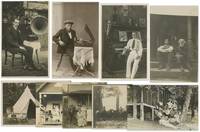
1910ref. List3897United States 1910. Nine real photo postcards most standard postcard size several postally used with divided backs. Images include families and groups gathered on porches and in yards with phonographs or gramophones lakeside and camp scenes with record players an interior scene showing a man posed beside a piano and phonograph and several portraits of men with tabletop and horn machines. Some wear silvering soiling and handling; generally very good. A group of real photo postcards documenting the domestic and social use of gramophones and phonographs in the early twentieth century. The cards date from the period in which recorded sound was moving from novelty to common household entertainment. Victor introduced the internal-horn Victrola in 1906 and by the following decade phonographs had become recognizable features of parlors porches camps and other informal leisure settings. The commercial growth of the industry was rapid: Victor's 1904 Red Seal recording of Enrico Caruso singing "Vesti la giubba" is generally described as the first million-selling record while less expensive records and machines helped bring recorded music into a broader range of American homes.1 The group shows the machines among families vacationers young men porch groups and domestic interiors centering the new technology in social gatherings during the period. 1 Marc Hogan "How Much Is Music Really Worth" Pitchfork April 16 2015 accessed July 21 2026 https://web.archive.org/web/20150501155808/https://pitchfork.com/features/articles/9628-how-much-is-music-really-worth/. . unknown books
1910ref. List3897United States 1910. Nine real photo postcards most standard postcard size several postally used with divided backs. Images include families and groups gathered on porches and in yards with phonographs or gramophones lakeside and camp scenes with record players an interior scene showing a man posed beside a piano and phonograph and several portraits of men with tabletop and horn machines. Some wear silvering soiling and handling; generally very good. A group of real photo postcards documenting the domestic and social use of gramophones and phonographs in the early twentieth century. The cards date from the period in which recorded sound was moving from novelty to common household entertainment. Victor introduced the internal-horn Victrola in 1906 and by the following decade phonographs had become recognizable features of parlors porches camps and other informal leisure settings. The commercial growth of the industry was rapid: Victor's 1904 Red Seal recording of Enrico Caruso singing "Vesti la giubba" is generally described as the first million-selling record while less expensive records and machines helped bring recorded music into a broader range of American homes.1 The group shows the machines among families vacationers young men porch groups and domestic interiors centering the new technology in social gatherings during the period. 1 Marc Hogan "How Much Is Music Really Worth" Pitchfork April 16 2015 accessed July 21 2026 https://web.archive.org/web/20150501155808/https://pitchfork.com/features/articles/9628-how-much-is-music-really-worth/. . unknown
ref. 70944Six are unused but one of those has traces of mounting verso. Some rubbing but a very good lot. For nine postcards unknown books
ref. 41053501A group of 47 period color Hong Kong postcards some hand colored lithograhs &c. Shows harbor various streets Peak tram opium smokers rickshaws &c. unknown