212 results
1866ref. 1307Newburgh 1866. Framed manuscript Sheets with inserted short typescript. 5 x 8 inches. 6pp. Browned folds small hole at top of one page no loss preserved under glass; front plate cracked. Charter of a new lodge from 1866 which contains the names of many leading businessmen of Newburgh New York. Brother John L. Westervelt presented an original petition to Newburgh Lodge 309 asking if a new lodge could be organized in Newburgh “believing that the best interest of Masonry would be best subserved thereby.” A charter was granted to Hudson River Lodge 607 on June 8 1866. Forty-six signatures are appended to the document. Many are designated “true” and a few are designated “non affiliated”. David A. Scott was voted master; G. Frederick Wiltsie senior warden; Samuel Stanton junior warden and John Alsdorf as first secretary. John L. Westervelt 1826-after 1880 the petitioner was a silversmith whose specialty was repairing and replating Gorham objects. He married Catherine Gorham of New York. “After the Lodge had been declared open the Master arose and on behalf of Bro. John L. Westervelt presented to the Lodge a full set of solid silver jewels for the use of the offices. The following resolution was then offered and adopted unanimously: Resolved That the thanks of this Lodge be and are hereby tendered to Brother John L. Westervelt for the very beautiful set of jewels which he has so generously presented to the Lodge.” History of Hudson River Lodge. Charles Estabrook 1823-1900 bookstore owner and librarian at Newburgh Free Library signed as did Chancy M. Leonard mayor of Newburgh who died in 1874. Another jeweler and silversmith Thomas W. Purdy ca. 1830-after 1880 also signed. David A. Scott 1825-1890 lawyer court judge and first master was also a signatory. Charles H. Halstead. History of Hudson River Lodge. 1896 . unknown books
1931Fine English Paperback. Pbo. Fine++. Roy. 8vo. (23 x 16 cm). articles in Turkish, French and German. 19 issues full set published in 4 years (1931-1935). When Kemal Atatürk closed all of masonic lodges in Turkish Republic, this periodical's publishing has ended. Extremely rare.
1844ref. 373390Boston: Published by Oliver Ditson 1844. Presentation copy inscribed on the front endpaper by G. Peverelli to R. F. Gladstone. 105pp. 8vo. Nineteenth century navy morocco covers elaborately bordered in gilt with a Masonic design upper cover lettered in gilt marbled endpapers gilt edges. Presentation copy inscribed on the front endpaper by G. Peverelli to R. F. Gladstone. 105pp. 8vo. Published by Oliver Ditson unknown
1844ref. 373390Boston: Published by Oliver Ditson 1844. Presentation copy inscribed on the front endpaper by G. Peverelli to R. F. Gladstone. 105pp. 8vo. Nineteenth century navy morocco covers elaborately bordered in gilt with a Masonic design upper cover lettered in gilt marbled endpapers gilt edges. Presentation copy inscribed on the front endpaper by G. Peverelli to R. F. Gladstone. 105pp. 8vo. Published by Oliver Ditson unknown books
1910Very Good Turkish, Ottoman (1500-1928) Original 1/3 black leather bdg. raised bands to gilded spine 'Usak Askerî Kulübü, the title of the book, and ornamental designs in the compartments. Crescent and star embossing on front board, Imperial Ottoman sign on the backboard. A fine binding. Marbled endpapers in western style. Light wear on spine, fading on boards, ex-owner's inscription on the colophon, and some notes and seal by Usak Askerî Klübü. Sealed by "Ittihat ve Terakki Cemiyeti Usak Kazasi Kulüp Heyeti Idaresi: Uhuvvet - Hürriyet - Musavat" [i.e. Union and Progress Society Usak City Club Directorate: Brotherhood - Freedom - Equality]. Signed and inscribed by Ahmed Saib as 'Usak Askeri Klübü'ne hediye-i acîzânemdir. Vatanimizi kanimiz ile muhafaza ediniz'. Seal is produced in 'July 20, 1908'. Ahmed Saib was born in 1859 in Dagestan. After completing his education in military schools in the Russian Empire, he entered the service of the Ottoman Empire with the rank of captain. He was in the Sultan Abdulhamid II's Hassa Cavalry Regiment and under the aide of Gazi Ahmed Muhtar Pasha, the Extraordinary Commissioner of Egypt. Later, he left his military service and published the newspaper Sancak (1899-1907), which spread the ideas of Ottoman liberals against the tyranny of the sultan since 1899 in Egypt, in the city of Cairo, and included articles on the constitutional struggle and the political structure of the period. Murad V was the 33rd Sultan of the Ottoman Empire who reigned from 30 May to 31 August 1876. The question of Sultan Murad V's enthronement in 1876 was a very strategic move for the Young Turks in its period. Only three copies in OCLC: 427392804.; Özege 19913. First and Only Edition. Extremely rare.
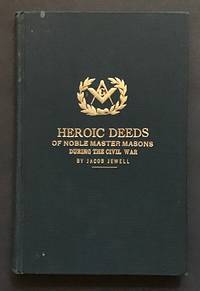
1916ref. 34332Pueblo CO: The Franklin Press. 1916. First Edition; First Printing. Hardcover. This volume written by Jewella Civil War soldier had started the process of becoming a Mason but was interrupted two weeks later by joining the Union army in 1862. After serving in the winter of 1865/66 he became Master Mason. The book contains the stories of soldiers who when captured by the Confederates or the Federal Army once they were known to be a Mason were treated as brothers and well cared for. Cleary Jewell had solicited these stories as they are mostly signed by the former soldier/Mason who experienced these considerations. The book also contains a brief autobiography of Jewell as well as some thoughts on Masonry war and related subjects. The Masonry scholar Michael A Halleran wrote in the journal "Heredom" suggesting the Masonry affiliation aided prisoners on both sides of the conflict. Jewell's book is considered one of the earliest works addressing the Freemasonry's role in the Civil War though Halleran does criticize it for being "anecdotal." See volume 15 2007 of "Heredom." The book is near fine with a few small spots on the front board. Extremely scarce.; Small 8vo 7½" - 8" tall; 127 pp . The Franklin Press hardcover
1916ref. 34332Pueblo CO: The Franklin Press. 1916. First Edition; First Printing. Hardcover. This volume written by Jewella Civil War soldier had started the process of becoming a Mason but was interrupted two weeks later by joining the Union army in 1862. After serving in the winter of 1865/66 he became Master Mason. The book contains the stories of soldiers who when captured by the Confederates or the Federal Army once they were known to be a Mason were treated as brothers and well cared for. Cleary Jewell had solicited these stories as they are mostly signed by the former soldier/Mason who experienced these considerations. The book also contains a brief autobiography of Jewell as well as some thoughts on Masonry war and related subjects. The Masonry scholar Michael A Halleran wrote in the journal "Heredom" suggesting the Masonry affiliation aided prisoners on both sides of the conflict. Jewell's book is considered one of the earliest works addressing the Freemasonry's role in the Civil War though Halleran does criticize it for being "anecdotal." See volume 15 2007 of "Heredom." The book is near fine with a few small spots on the front board. Extremely scarce.; Small 8vo 7½" - 8" tall; 127 pp . The Franklin Press hardcover books
1805ref. 373696Massachusetts 1805. Signed by Thomas at center on the pedestal. Countersigned by Grand Secretary John Procter. 17-1/2x13 inches. Fading to the manuscript light soiling and foxing. Signed by Thomas at center on the pedestal. Countersigned by Grand Secretary John Procter. 17-1/2x13 inches. Isaiah Thomas served as grand master of Massachusetts from 1803 to 1805 with the present certificate dated A.L. 5805 i.e. Anno Lucius being the Gregorian year plus 4000. The allegorical certificate engraved by Hawksworth shows the figures of Wisdom Athena wearing a helmet Strength Hercules wearing a lion skin and holding crossed keys and Beauty Venus trailing a rose vine surrounding a lettered tablet all upon a large pedestal with Masonic symbols at the base and with an all seeing eye above. The certificate was issued to Nathaniel Wade likely Col. Nathaniel Wade 1749-1826 who led a company of Minute Men who responded to the Lexington Alarm and served in the Continental Army or his son Nathaniel Wade Jr. 1778-1843. unknown
1805ref. 373696Massachusetts 1805. Signed by Thomas at center on the pedestal. Countersigned by Grand Secretary John Procter. 17-1/2x13 inches. Fading to the manuscript light soiling and foxing. Signed by Thomas at center on the pedestal. Countersigned by Grand Secretary John Procter. 17-1/2x13 inches. Isaiah Thomas served as grand master of Massachusetts from 1803 to 1805 with the present certificate dated A.L. 5805 i.e. Anno Lucius being the Gregorian year plus 4000. The allegorical certificate engraved by Hawksworth shows the figures of Wisdom Athena wearing a helmet Strength Hercules wearing a lion skin and holding crossed keys and Beauty Venus trailing a rose vine surrounding a lettered tablet all upon a large pedestal with Masonic symbols at the base and with an all seeing eye above. The certificate was issued to Nathaniel Wade likely Col. Nathaniel Wade 1749-1826 who led a company of Minute Men who responded to the Lexington Alarm and served in the Continental Army or his son Nathaniel Wade Jr. 1778-1843. unknown books
1783In -4°, pp. VIII, 182, (4). Piena pergamena con titolo al dorso. Prima edizione. Contraddittorio e inquieto studioso, Odazi (Atri, 1741 - Napoli, 1794) è considerato fra gli economisti napoletani di maggior rilievo nella seconda metà del Settecento. Allievo del Genovesi, la cui cattedra gli sarebbe stata affidata nel 1781, massone, partecipò se pure con indolenza al fermento politico che avrebbe portato nel 1799 alla guerra civile e poi alla Repubblica napoletana. Ma, imprigionato nel ’94, si era ucciso in carcere, in circostanze mai chiarite. In questo suo “dotto studio” O. invoca “contro l’opinione del Galiani, la libertà dei prezzi, col notevole intento di giovare agli umili e, di riverbero, alla prosperità nazionale” (R. di Castiglione, “La massoneria nelle due Sicilie”, Gangemi, 2006, p. 115). A restless and complex scholar, Odazi was considered one of the major neapolitan economists of the second half of XVIII century. A mason, pupil of Genovesi, whose chair he obtained in 1781, he took part in politic stirs that brong in 1799 to civil war in Naples and the to the “Repubblica”. But he was imprisoned and died in jail, probably suicide, in ’94. In this learned work O. claims, against Galiani opinion, the freedom of prices, meaning to benefit the humble classes.
1902[20], 644 pages. Index. Twenty-six black and white photographic plates. Leather binding. "Comprising a history of Egypt, with a comprehensive and authentic account of the antiquity of masonry resulting from many years of personal investigation and exhaustive research in India, Persia, Syria and the Valley of the Nile." - title page. After first receiving the Light in India, the author was moved to "investigate, to the fullest extent, the meaning and purport of the numerous hieroglyphic inscriptions, symbols and characters found upon the ancient tombs and temples, so that the Masonic Fraternity might understand, appreciate and apply the teachings of the hierophants and sages of bygone days." - Preface. Chapters: Alexandria - the Antiquity of Masonry; Ruined Temples - Masonry and Masonic Symbols; Ancient Cities - Soirian Myth - Karma; the Nile - Origin of the Name Free Mason - Scottish Rite Philosophy; Ancient Mysteries - Scottish Rite philosophy; Suez Canal - The Druses, Their Manners and Customs; Agriculture - Irrigation - Lotus - Papyrus; The Supreme Architect of the Universe; Mosques - Tombs - Massacre of Mamelukes - Heliopolis; Esoteric Teaching of the Scottish Rite - Brain and Thought; Pyramids - Sphinx - Tombs; Solomon - Death of Hiram - Cross - Swastica; Mummification - Transmigration - Re-incarnation; Sixteen Saviours - Lost Knowledge; The Golden Fleece - Roman Eagle - Masonic Apron - What it Teaches; Pyramids of Sakkarah - Lisht - Medum - The Fayum - Labyrinth; Sun Worship - Zodiac - Masonic Allegories; A Voyage up the Nile - Description of Tombs and Temples - Pro Doric Columns; Ineffable degrees - Thoughts on Ecclesiastes - I.N.R.I. - Voyaging up the Nile - examining Tombs and Temples - Paintings - Sculptures; Masonic teachings - Hindu beggar - Roman Catholicism; Thebes - Colossi - Der-El-Bahari - Luxor - Karnak; Ceremonies - Initiation - Blue Lodge - Transmigration - Mystery Language; The Gawazee - exploring Temples and tombs - Philae and its ruins - Nubia; Jewish Traditions and customs - Cable tow - Ceremonies of ancient Initiation - book of the Law; Circumsision - upon what the Ancient Craftsmen were obligated - the lost word. All edges gilt. Protected frontis portrait of author. Ornately embossed boards. Raised bands to spine. Partially rubbed gilt lettering and decoration upon back strip. Marbled endpapers. Hinges intact internally, open or opening externally. Front board partially detached. Somewhat above-average wear to boards. Unmarked. A worthy original copy of this monumental work. 12" x 9.5" x 2.5". 11 pounds. Book
1872ref. 9402N.p.: Privately Printed 1872. First edition. 8vo 20x14cm 3 98pp with 50pp consisting of 13 separately printed Pike poems and "In Memoriam Albert Pike" from 1898 bound in at rear. Lengthy presentation inscription from Pike to Capt. Fayette Hewitt and dated in 1872 Washington on separate leaf in front; and opposite a lengthy presentation inscription from Hewitt to a J.H. Johnson in 1896 Frankfort KY memorializing his friendship with Pike and gifting the book. Additionally Pike has briefly inscribed 2 of the poems bound in at rear to Hewitt one dated in 1870. Bound for Hewitt in full gilt-ruled black morocco binding spine and turn-ins tooled in gilt gilt lettering on spine marbled endpapers g.e. Spine ends joints and corners rubbed. Few of the poems at rear with light transmittal folds. Tremendous presentation copy of this privately printed collection of mythological poems from the Confederate General and architect of the Southern Scottish Rite Albert Pike 1809-1891. This copy presented to his close friend and subordinate Captain Fayette Hewitt 1831-1909 who served under Pike during the Civil War including the period of Pike's treaty negotiations in Indian Territory. Contemporary accounts from Pike on Hewitt illustrate the foundations of their relationship: "He daily deserved praise and won the love and admiration of all who knew him. He became as dear to me as my own sons. Brave courteous amiable unassuming obliging and kind to every one firm in the performance of duty—a nobler gentleman or better soldier never lived." This association is further deepened by the volume itself which Pike inscribed to “Capt. Fayette Hewitt” and which Hewitt preserved for over two decades before presenting it onward in 1896. Expanded with a substantial group of privately circulated poems including one inscribed in 1870 the volume documents a longstanding association between the two men later reinforced by Hewitt’s memorial presentation. L. Boyden in his Bibliography of the Writings of Albert Pike 1921 records many of these bound-in poems as separately issued printings spanning from 1859 through the early 1870s with titles including "Cruiskeen Lan" "The Light of Days Long Past" "After the Midnight Cometh Morn" "The Fine Arkansas Gentleman" and others. In all this volume represents a singular object at the intersection of the Civil War Southern fraternal culture and the personal legacy of Albert Pike preserved through his wartime friend and subordinate Fayette Hewitt. . Privately Printed unknown