704 136 résultats
1792réf. D21095Paris 1792. Ephemera. Near Fine. June 22 1792; Bifolium. Nice clean example. unknown books
1619réf. D21093Paris 1619. Ephemera. Very Good. Pamphlet. 6 pp. Marbled wraps trimmed. Text concludes with "Marie.juin 1619" Marie de Medicis - mother of King Lous XIII. Leaves stained. Scare item. unknown books
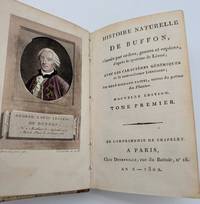
1803réf. 71345Paris: De L'Imprimerie de Crapelet 1803. Nouvelle Édition. Leather Bound. Very Good. Twenty-fourmo 13.5 cm Contemporary 3/4 brown leather with speckled paper over boards. Pale red and green gilt stamped leather spine labels. Six gilt ruled compartments on the spines. Illustrated plates the majority with tissue-guards. This specific set has a frontispiece portrait of Buffon 781 illustrated plates and 5 folding tables the exact number of plates found in each volume is available upon request. Text in French. Extremities very lightly rubbed and soiled. A couple of boards with small red stains. Spines sporadically mottled. Occasional minor chipping to spine ends and a handful of spine labels with loss. Underlying boards peeking through at corners. Endpapers have a previous owner's red ink stamps a small faint ink stamp in black and minute contemporary numerical notations. Stitching visible in gutters here and there. Pp. 125-130 volume 12 are partially detached. Pp. 29-32 volume 44 and pp. 93-96 volume 77 are completely detached but present. Skillful repair to fore-edge margin of p. 169 volume 59. Pages bound out of sequence in volume 59 between p. 136 and p. 185. Periodic printing errors occur in the set's pagination. In a handful of plates the sky in the background appears stained and there is a bit of red staining to plate at p. 258 in volume 70. Two reptile illustrations in volume 42 are a trifle trimmed at the head. Additional Collation Notes: Curiously volumes 56-65 are the only volumes in which the plates are numbered. In volume 58 I believe plate 15 is mislabeled as 13 and it is found between plates 23 and 24. The books are very structurally sound and the pages are strikingly clean and bright. Contents: Théorie de la Terre. Époques de la Nature; Discours Généraux; Quadrupèdes; Oiseaux; Histoire Naturelle des Minéraux; Histoire Naturelle des Poissons; Histoire Naturelle des Reptiles; Histoire Naturelle des Insectes; Histoire Naturelle des Coquilles; Histoire Naturelle des Vers; Histoire Naturelle des Crustacés; Histoire Naturelle des Végétaux. An edition published posthumously of Buffon's most famous work. Buffon's Histoire Naturelle was continued in part by others after his death. It was translated into various languages and read throughout Europe. French naturalist George-Louis Leclerc de Buffon 1707-1788 Comte de Buffon is viewed as the most influential biologist of the 18th century epitomizing the revolutionary changes the Enlightenment brought to the study of nature. The title of Count was bestowed on him by Louis XV in recognition of his accomplishments rather than by birth. He is most famous for Histoire Naturelle a comprehensive work on natural history first begun in 1749. De Buffon began his studies at the College of Godrans in Dijon where he was only an average student. Originally his father wanted him to have a legal career however in 1728 he went to Angers where he studied medicine botany and mathematics. In 1739 he was appointed keeper of the Jardin du Roi the royal botanical garden now the Jardin des Plantes and of the accompanying museum. There he was tasked with creating a catalog of the royal collections in natural history which he transformed into an undertaking to produce a record of the whole of nature. This became his monumental work Histoire Naturelle Générale et Particulière which was the first modern effort to methodically present all existing knowledge in the subjects of natural history geology and anthropology in one publication. Buffon's ideas challenged traditional biological classification and introduced theories of evolutionary thought roughly one hundred years before Darwin. Comte de Buffon is also remembered for his argument that the world had a lengthy history rather than being only a few thousand years old as the naturalists of the 1600s believed. In addition he felt that scientific writing should be energetic and graceful in style thereby allowing his work to be accessible to a wide audience in Europe and beyond. Buffon's work articulated that species were different throughout the world that the planet was much older than the Bible suggested and that plant and animal species were related in intricate ways. Buffon's bold way of looking at the world laid the groundwork for later revolutionary thinkers who are responsible for much of what we know about the natural world. An attractive set of a pivotal work of the Enlightenment richly illustrated with numerous hand-colored plates. De L'Imprimerie de Crapelet unknown books
1880réf. 81061Chicago IL.: O. L. Baskin & Co. Historical Publishers. Very Good. 1880. 1/2 Leather. This book is hard-bound in 1/2 leather with brown cloth covers with gilt stamping on the upper cover and spine. The covers show light scuffing edge-wear and light rubbing to the corners and spine-ends. The binding is solid. The contents are bright and clean with portrait illustrations and with a fold-out outline map at the front. Very nice condition. . O. L. Baskin & Co., Historical Publishers hardcover books
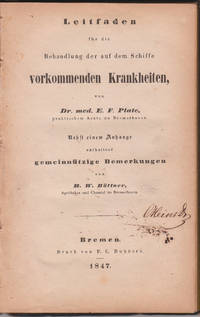
1847réf. 12043Bremen: F C Dubbers 1847. First Edition. Contemporary marbled boards. Very good. 8vo viii 1 - 126 pp. A succinct and rare manual for ship-board medical treatment written by a 'practical' physician that is accompanied by a supplement or appendix listing the medicines contained in the medical kit and finally a brief section on herbs and their use in cooking. Indicating the prevalence of ailments aboard ship the text is divided into sections dealing with fever inflammation nervous ailments gastric ailments infectious disease esp. typhus. Wounds etc. are briefly covered. Emphasis is on true illness. It is remarkable that this book was written by an apprenticed 'physician' who considers each ailment from practical experience rather than a clincal perspective. Such manuals do appear in English; they are usually brief. This German language manual is unusual since there was little voyaging originating in Germany at this time - coastal trips being the norm and therefore not out of range of quick medical assistance if needed. Therefore its detailed text outlining symptoms and treatment and the list of medicines are beyond what is encountered in the English language pamphlets of the period. Unlocated. F C Dubbers hardcover books
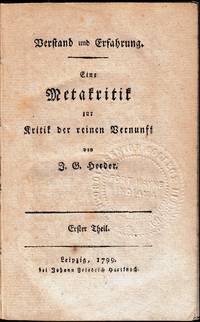
1799réf. 6513Leipzig: J F Hartknoch 1799. First Edition. Original paste paper boards. Good; inst. blind stamp on each title; small accession label on verso of title to vol. 2 and modest number and name stamp on the endpapers; some abrasion to the spines. 8vo; I - xxxii 3 - 479 1 - blank pp.; II - xii 3 - 402 pp. An important critique of Kant. It is anecdotal that Goethe is supposed to have requested that the book be suppressed. Apart from Goethe the book provoked a good deal of response. Adickes #2269; Goedeke IV/1 733. J F Hartknoch hardcover books
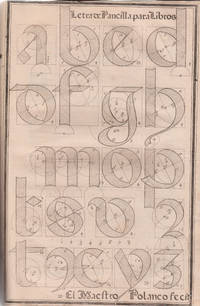
1719réf. 5206Madrid: M R de Murga 1719. First Edition second state - plates numbered. Contemporary limp vellum. Good; old ink stain to p. 74 has resulted in the loss of a few letters; some margins close but complete; binding worn; text block beginning to split. 4to. There is an engraved title frontis. with four saints engraved portrait and 39 engraved plates. A sought after book in which the author departs from usual forms of calligraphic art and presents it as a geometrical science. It is the first Spanish writing manual listed in the Hofer catalog. Harvard has two copies both defective. The copy offered here is according to Palau Hofer and others complete with the maximum number of plates. Palau suggests that early issues of the book may have fewer plates. The author was an orphan born in 1663 raised by the schoolmaster of his native town Mostoles. He was to become famous as a creative and inventive and favored member of the court as well as a didactic writer on art a mathematician architect and instructor of fencing. An impressive work with plates illustrating the laying out of dials and the mathematical basis for various letter forms. This resulted in a lengthy and detailed text that is most uncommon for this kind of book. The engraving throughout is elaborate and elegant. Only one plate is signed by the engraver Juan Bernabe Palomino; Cotarelo assigns all the engraving to him. The state results from the fact that the plates are numbered consecutively - Harvard has a defective copy without the numbering. What is of special interest is the crucial significance see Corbeto of such books and especially Aznar de Polanco on the early development of punchcutting in Spain during the formative mid-eighteenth century. The in depth analysis of the ' letra grifa ' - a cursive type - is directly attributed to Aznar de Polanco. Hofer Coll. # 137; Palau # 21133; Cotarelo y Mori I pp. 134 - '40; see Corbeto The Library v. 10 #3 esp. pp. 286 - 289. [M R de Murga] hardcover books
1904réf. 6658Frankfurt: J Baer & Co. 1904. First Edition. Original grey bevelled publisher's cloth. Very good with some minor dust smudges to the binding. 4to. 12 3 - 464 pp. 5 numbered plates and illustrations some full page throughout. A formal history and Festschrift to celebrate the centenary of the school in Frankfurt. There are several lengthy essays that comprise the text. The most interesting study 145 pages with plates is by I Kracauer on the architectural and design history of the buildings and appointments interior and exterior of the "Judengasse" in Frankfurt from its inception. This is the first published historical study. J Baer & Co. hardcover books
1826réf. 6603Philadelphia: For the Author 1826. First Edition. Disbound. Very good. 8vo. Godman was the author of the three volume American Natural History that started to be published in 1826. This was an original treatise and a valuable contribution to science at the time. The pamphlet offered here is a response to criticism and accusation of plagiarism by Richard Harlan. DAB VII 350 -`51; Tucher #824. S & S #24699. For the Author unknown books
1664réf. 1056Hafniae: P Haubold 1667/1664. First Edition. Full contemporary stiff vellum. A very good copy somewhat age browned. 8vo I - 8 568 24 - index & errata pp.; II - 8 248 8 248 pp. Two works of Bartholin bound as one. 1 This is volume 4 of Bartholin's collected medical correspondence each collection is issued separately. The subject matter covered in the text is staggering in the range of topics there is a subject index listing the correspondent. This volume contains Bartholin's exchange with Steno on the structure of the muscles of the heart accompanied by a text illus. The Krivatsy entry listing all four volumes as one work appears to be an error since they were issued separately as noted in Parkinson and Wellcome. 2 Bartholin's observations on parturition. Appended is a selection of Vesling's correspondence on obstetrics. The Vesling has its own title page but is integral with the Bartholin tract. This Vesling addenda is often missing. Both the Osler and Waller copies are lacking this portion of the text. Krivatsky #830 & #805; Parkinson #193; Wellcome II 108. P Haubold hardcover books
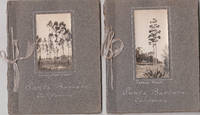
1910réf. 6664Santa Barbara : not published ca. 1910. Unique. Grey paper stitched with silk cord. Near fine. 8vo. There are two albums with a total of 16 mounted gelatin sliver prints of trees meas. appx. 110 x 65 mm. Two small artfully crafted hand made albums of photographs of trees that grow in the Santa Barbara area. Each photograph is tipped on to the album sheet with a neat hand inked identification beneath. not published unknown books
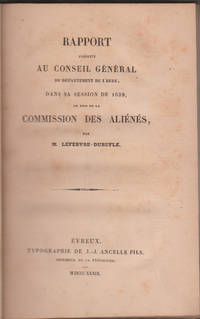
1839réf. 8009Evreux: JJ Ancelle 1839. First Edition. contemp. half leather. Good copy; spotting throughout. 8vo. There are four fldg. litho. plates of asylums. An important insight into provincial concerns of public health in France. The work offered here is a commission report to the provincial gov't. of the county in where Evreux is located. The commission was charged with the responsibility of examining the plans and proposals for the erection of an asylum. There are a number of statistical indices and appendices. The commission examined construction designs in France and the UK. JJ Ancelle hardcover books
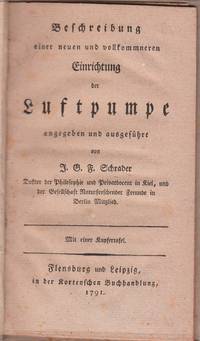
1791réf. 1799Flensburg und Leipzig: Korten 1791. First Edition. Later plain wrappers. Very good. . 8vo 24 pp. folding plate. Schrader was a physics prof. at Kiel who was noted for his work in optics. He laments the difficulties inherent in attaining high vacuums and maintaining them. One solution he offers is a newly designed valve to aid mechanical vacuum pumps reach and then maintain higher levels. An interesting invention and solution to a vexing experimental problem. Poggendorff II 840. Korten unknown books
1852réf. List2521London 1852. Five groups of documents measuring 13 x 8 inches various paginations see full description below. Fine condition. A scarce set of primary source documents relating to the protection of British territory in the Caribbean in particular along the Mosquito Coast during the period of varied interests in the area in the period following the Anglo-Spanish agreement on the slave trade. Consisting of a series of secretarial copies of reports delivered to Peter McQuhae Commodore of H.M.S. Imauam stationed in Jamaica these dispatches offer an overview of the issues confronting the British Navy in Jamaica during the period and in the Caribbean more broadly. Most of the documents refer to issues with Cuba the most interesting perhaps being a letter warning of an impending filibustering expedition against Cuba by a pro-slavery faction in the American South. The group consists of five groups of bound documents some bound out of order and likely bound later. Contents are as follows: 1. Addington A.M. Four Page Report Concerning Placing a Ship of War at Grey Town to Discourage Invasions on the Mosquito Coast March 13 1851. Henry Addington writes McQuhae to recommend stationing a warship at Grey Town: ".it would be sufficient that a Ship of War should from time to time look in grey Town without remaining there at any time long enough to endanger the health of the crew. to provide for the case which is possiblee tho' not at all likely that during the interval between the visits of a Ship of War some expedition of Nicaraguan or some of the North Americans returning from California might take advantage of the comparatively unprotected state of the lace to take possession of it and that the cruiser on its return to Grey Town might find the place so occupied Lord Palmerston concieves taht in such an event it would seem to be inconsistent with the Honor of this Country that a British Ship of War should acquiesce in such an aggression and it would be right that the intruder should be expelled if the Commander of the Ship of War should find as he probably would that he had the means of doing so without much difficulty and that in case he should repel the intruders and re-establish the authorities of the Mosquito Government demanding the liberation of any British or Mosquito subjects who might have been made Prisoners and holding hostages for their relief if they should have been removed up into the interior of the Country. It It is to be hoped however that all questions of dispute in regard to Grey Town will beoon be settled because Her Majesty's government has through Her Majesty's Minister at Washington proposed to the Government of the United States that an arrangement should be made by which the Sovereignty of Grey Town. should be transferred to the State of Costa Rica. Lord Palmerston desires me to add that there are at present at Washington a plenipotentiaries both from Nicaragua and Costa Rica for the purpose of conducting this negotiation." 2. Addington G.M. Single Page Letter in Secretarial Hand Warning of Incoming Ships to Cuba Carrying Enslaved Individuals January 24 1852. Addington writes to McQuhae about two incoming vessels carrying enslaved Africans passing on information received at Rio De janeiro by another British vessel: "I am directed by Earl GraH.M. Minister at Rio reporting that he had recieved information that two Slavers had sailed from Havana to. the coast of Africa. with the intention of returning with Cargoes of slaves which are to be landed at the Entrade de Cuchillo in Cuba." 3. Seymour G.F. et al. Four Reports Bound Together on Varied Subjects including the Case of the Creole British Fishing Rights in Spanish Waters off of Cuba and Porto Rico and the Case of a Detained British Vessel in Cuba 1852. A series of four reports addressed to McQuhae on various subject as follows: A. Report dated May 17 1852 from Seymour discussing the case of the Creole detained in 1851: ".enclosing copies of a letter from the Under Secretary of State for Foreign Affairs approving of the course I had pursued with regard to the Creole and of a despatch from the Earl of Malmesbury to Her Majesty's Minister at Madrid relative to the rights of British Subjects to fish on the coast of Cuba." B. Letter from Augustus Stafford Apriul 23 1852 discussing the Creole mostly discussing the enclosure of varied reports on the subjects but with little specific information. C. Addington A.M. April 21 1852 letter discussing the Creole case and the enclosure of documents. D. Earl of Malmesbury April 14 1852 letter discussing the Creole case in more detail: " The Right thus claimed rests on this universally admitted precept of international Law "dominium finitur ubi finitur armorum vis" which in modern practice has been construed to mean "about one marine league from the mainland" and H.M.'s Govt are clearly justified in demanding that the Spanish authorities shall be ordered not to meddle or interfere with British fishermen outside that three mile boundary." 4. Earl of Malmesbury et al. Series of Three Secretarial Copies of Reports Concerning Impending Filibuster Raids on Cuba Giving Instructions for Assisting Spanish Forces. A very interesting series of reports detailing the planned response to pending "Piratical Attacks" showing the extent to which British forces were prepared for an American filibuster attack on the island and the degree to which they intended on assisting the Spanish forces. As follows: A. Seymour G.F. Secretarial Copy of Letter Written on May 5 1852 from Cumberland at Bermuda relaying the transmission of a full report of instructions to the British forces regarding an impending filibuster raid: " I hereby enclose for your guidance. orders. relative to the assistance which is to be afforded by Her Majesty's Ships on the application of the Captain General of Cuba in the Transport of Troops in the event of a Piratical attack being again made on that island by which you will govern your conduct." B. Earl of Malmesbury. Secretarial Copy of a Letter Dated April 10 1862 discussing piratical attacks: ".that in the event of a Piratical Attach being made upon that island. HM's ships might assist in conveying troops to any poiunt of the Coast of Cuba at which the invading Party might effect a landing." C. Honley P. Secretarial Copy of an Undated Letter c. 1852 regarding piratical attacks: "Her Majesty's ships might assist in coveying Troops to any point off the Coast of Cubat at which the invading Party might effect a landing. you should be instructed until further ORders that if the Captain General of Cuba should require your assistance for the transport of troops in the manner pointed out in your abovementioned dispatch you should comply with that demand." 5. Crampton Sir John. Copy of a Letter in Secretarial Hand Relaying the Impending Danger of a Pro-Slavery Filibuster Mission from Florida May 17 1852. A fascinating letter relaying information received from M. Calderon de la Barca concerning an impending filibuster mission against Cuba led by a Dr. Wren part of an organization called "The Lone Star Association:" ".it would appear that the government of the United States has also received an intimation that something of the sort is on foot for the President informed M. Calderon that orders had already been sent to the U.S. Authorities at the different Ports of the Union to be prepared to take vigorous measures for the repression of any such attempts. an expedition is in fact meditated by certain parties in the South and that it is intended that it should leave some Port of Florida. The real object of this expedition however as as I am told not Cuba. but San Domingo for the purpose of acting as auxiliaries to the Dominicans against the Haytians. it is by no means impossible that its ultimate aim would be Cuba. the persons I am given to understand engaged in the expedition are a Dr. Wren who is president of a society called "The Lone Star State Association." The letter is worthy of further study - we find references to a Dr. Wren in newspaper articles from the period but were unable to pinpoint his identity or the history of his organization. An article from a Loudon Tennessee newspaper describes Dr. Wren as a "representative of New Orleans societies" and described a meeting in Loudon in 1852 trying to recruit for the overthrow of the Spanish colonial government of Cuba through an invasion. unknown books
réf. B104636-1Paris 1972. No. 1: all published. 8pp. including introduction by Goldschmidt. 20 signed and numbered contributions hors texte including original gouaches drawings collages and prints in various media etching woodcut screenprint lithography; some hand-colored by Jean-Bernard Arkitu Édouard Berreur Gérard-Philippe Broutin Françoise Canal Jean-Paul Curtay Myriam Darrell Jean-Pierre Gillard Micheline Hachette François Poyet Roland Sabatier Jacques Spacagna Jacqueline Tarkieltaub Antoine Grimaud and Patrick Poulain; an original photocopy by Pierre Jouvet two texts by Isidore Isou and Alain de Latour and a superb mixed-media assemblage by Maurice Lemaître. Lrg. 4to. Publishers chartreuse silk box and chemise hand-painted in gold on the front cover and spine. Contents loose as issued. Edition limited to 50 hand-numbered copies signed in the justification by the editors. Conceived as the first of a series of Lettrist portfolios only this inaugural volume of Jerimadeth appeared. A fine copy. Paris, 1972. books
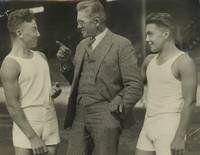
1928réf. List3877San Francisco / Cleveland / New York: Newspaper Enterprise Association 1928. Press photograph measuring approximately 6 ½ x 8 ½ inches. Glossy silver gelatin photograph showing two young Karuk runners Mad Bull and Flying Cloud in athletic uniforms posed with University of Oregon track coach Bill Hayward. Verso with Stouffer & Schermer Photo Supply stamp of San Francisco N.E.A. reference stamp and typed press caption. Some handling wear caption slip affixed to verso; very good. A 1928 press photograph of Karuk runners Mad Bull and Flying Cloud preparing for the second Redwood Highway "Indian Marathon" a short-lived but nationally publicized ultramarathon staged to promote the Redwood Highway and the newly branded "Redwood Empire" route between San Francisco and Grants Pass Oregon. The caption states that Mad Bull identified in period spelling as a "Karook Indian" had won the previous year's race over the 480-mile course between San Francisco and Grants Pass; and that he and his fellow tribal member Flying Cloud had traveled to Eugene Oregon to receive advice from Bill Hayward longtime University of Oregon track coach and member of the American Olympic coaching staff. The race itself was a highway-booster spectacle organized by civic groups in San Francisco Grants Pass and towns along the route. The first race held in 1927 began at San Francisco City Hall crossed the bay to Sausalito and continued north through Santa Rosa Willits Garberville Eureka Crescent City Cave Junction and finally Grants Pass. Runners were required to proceed on foot but could sleep or rest when they chose and were accompanied by support cars carrying food shoes clothing and supplies. The field was limited to Native runners a decision organizers believed would attract greater publicity for the road and the region. Mad Bull and Flying Cloud were the central figures in the event's first two years. The Oregon Encyclopedia identifies Mad Bull as John Southard and Flying Cloud as Henry Thomas both Karuk men whose publicity names were assigned because their given names appeared too ordinary for the promotional campaign.1 In 1927 Southard won the race in seven days twelve hours and thirty-four minutes taking the $1000 first prize while Thomas finished second and received $500. In 1928 the year of this photograph Flying Cloud / Henry Thomas won the race beating Mad Bull's 1927 time by roughly thirteen hours; Mad Bull withdrew near Crescent City. 1 Wayne Morrow "Indian Redwood Marathon Redwood Empire Run" Oregon Encyclopedia March 17 2022 accessed July 20 2026 https://www.oregonencyclopedia.org/articles/indian_redwood_marathon_redwood_empire_run_/. . Newspaper Enterprise Association unknown books
1988réf. 2343979Greece New York: The Greece History Museum Historical Society of Greece N.Y 1988. Stapled Binding. Near Fine. Plastic covers. 1988 Stapled Binding. Unpaginated. A history of Greece New York with black-and-white illustrations. The Greece History Museum, Historical Society of Greece, N.Y unknown books
2002réf. 2334223Paris: Histoire & Collections 2002. Magazine. Near Fine. An exceptional copy. 2002 Magazine. 82 pp. A French-language magazine for hobbyists of tank miniatures with English captions. Histoire & Collections unknown books
1866réf. 28199Springfield Mass.: Gurdon Bill. Fair. 1866. Third Printing. Hardcover. A later printing in fair condition that is very fragile to handle. The fabric of the book has begun to dissipate while the pages have almost completely separated from the hinge. The stitching is exposed on the spine ; ; 4to; 629 pages . Gurdon Bill hardcover books
1892réf. 28112New York: Charles Scribner's Sons. Fine. 1892. Hardcover. A fine copy the book is very tight and was taken very good care of ther is just some discoloration of the tan fabric. There is also a signature and date on the front free endpaper from a previous owner; ; 8vo; 280 pages . Charles Scribner's Sons hardcover books
1951réf. 28167New York: E. P. Dutton & Company Inc. Near Fine. 1951. First Edition; First Printing. Hardcover. This first printing of the first edition is in nearly fine condition due to the bent board edges and shelf wear on the spine. There is some slight discoloration to the pages but otherwise a solid first edition. The author's signature is featured directly on the dedication page ; ; B&W Photographs; 8vo; 400 pages; Signed by Author . E. P. Dutton & Company, Inc. hardcover books
1887réf. 28200New York: The Century Co. Fair. 1887. Hardcover. A four volume edition in fair condition with general wear and tear from life on the shelf; ; Vol. 1/4/2026; 4to . The Century Co. hardcover books
1928réf. 28201Garden City New York: Doubleday Doran and Company Inc. Near Fine in Poor dust jacket. 1928. Second Printing. Hardcover. A second printing in near fine condition with some tanning uncut pages and some obvious shelf wear. Volume is housed in a poor dust jacket that is very torn and fragile ; ; 8vo; 377 pages . Doubleday, Doran and Company, Inc. hardcover books
1919réf. 28159New York: Charles Scribners. Near Fine. 1919. First Edition; First Printing. Hardcover. A nearly fine first printing of the first edition with some slight rubbing to the boards and a cocked spine ; ; 8vo; 240 pages . Charles Scribners hardcover books
1911réf. 28205Boston And New York: Houghton Mifflin Company. Fine. 1911. Second Printing. Hardcover. A three volume set in fine condition there is rubbing to the outer corners and the pages are uncut. This set has been very well cared for and has little worn shelf life ; Welles was the Secretary of the American Navy under Abraham Lincoln and President Johnson. His diaries offer insight for the historical collector; Vol. 1/3/2026; 8vo . Houghton Mifflin Company hardcover books