668 997 résultats
1903réf. 84424Raleigh NC: Rev. M.L. Latta 1903 but 1924. Revised and Expanded Edition. Octavo 23.5cm; dark green cloth titled in gilt on spine with titles stamped in gilt on front cover within a brown double-ruled border; viii31-600pp with a portrait frontispiece of Frederick Douglass and five inserted plates of illustrations halftones; text is complete despite the eccentric pagination. Darkening to spine some wear to extremities and softening to corners bit of dust-soil to covers with rear hinge cracked but holding and a 1" tear to lower front hinge; contents clean; Very Good. "An ex-slave in North Carolina who later attended Shaw University and then was for many years a schoolteacher writes primarily of his workas head of Latta University in West Raleigh North Carolina an institution he founded in 1892. He also tells of his experiences in the Raleigh area and alludes to his visit to England and France" BRIGNANO 224. While the copyright page gives no indication this edition was published after 1903 Brignano notes a revised and considerably expanded edition published by Latta in 1924 mentioning events in his life after 1903 and printing long essays by Carter G. Woodson and Frederick E. Drinker adding another 229 pages of content. Uncommon in commerce; OCLC shows 9 holdings for the 1924 edition. Not in Blockson. 84424. Rev. M.L. Latta unknown books
1976réf. 82310New York: Oxford University Press Inc 1976. First Edition. First Printing. Octavo 23.5cm; brown cloth-covered board with titling stamped in gilt on spine; dustjacket; xvi23-5377pp. Small 1.5" scratch to upper front pastedown else Fine. Dustjacket unclipped priced $19.95 with some rubbing at flap folds and creasing and closed tears along extremities; Very Good. With over one hundred sources including letters fugitive slave narratives songs legal cases and petitions "the collection paints a portrait of slavery as it evolved from 1620 to the eve of the Civil War.Ms. Rose does not feature celebrated writers on slavery but presents ordinary people reading unselfconsciously their own opinions and events as they saw them" from front flap. 82310. Oxford University Press, Inc unknown books
2005réf. 82647New York: Basic Books / Civitas Books 2005. First Edition. First Printing. Octavo 24cm; beige and navy blue paper-covered boards with titles stamped in gilt on spine; dustjacket; xxiv3528pp; illus. Signed by Myrlie Evers-Williams on the half-title page. Base of spine a bit pushed light wear to lower board edges with a few faint scuffs to rear cover; contents clean; Near Fine. Dustjacket is unclipped priced $26.00 with light wear to extremities; Near Fine. Autobiography of civil rights activist Medgar Evers 1925-1963 the NAACP's first field secretary in Mississippi. Told through previously unpublished writings and photos edited by his widow and African American scholar Dr. Manning Marable. 82647. Basic Books / Civitas Books unknown books
1990réf. 82644New York: Farrar Straus and Giroux 1990. First Edition. First Printing. Octavo 23.5cm; blue paper-covered boards and navy blue cloth backstrip with titles stamped in gilt on spine; pictorial endpapers; dustjacket; xvi4311pp; illus. Inscribed by the author on the half-title page: "To Lucky / Her father had the right idea! / J.L. Chestnut Jr. / August 7 1990." Spine ends gently nudged else a clean very Near Fine copy. Dustjacket is unclipped priced $22.95 with light surface wear and some corresponding faint creasing to spine ends; Near Fine. Autobiography of J.L. Chestnut Jr. 1930-2008 the first Black attorney in Selma Alabama chronicling the history of the Voting Rights Movement in Selma the 1965 March to Montgomery Bloody Sunday and his examination of the realities of power and politics in the South. 82644. Farrar, Straus and Giroux unknown books
1985réf. 82642Tuscalooosa: University of Alabama Press 1985. First Edition. First Printing. Octavo 24cm; dark grey cloth with titles stamped in gilt on spine; dustjacket; xx34-3604pp; illus. Inscribed by the author on the front endpaper "To Sam Pointer / Virginia Foster Durr" and signed directly beneath by editor Hollinger F. Barnard and author Studs Terkel who wrote the foreword. Fine in a Near Fine dustjacket with a hint of sunning to spine and some trivial wear to extremities. Autobiography of Virginia Foster Durr 1903-1999 a white civil rights activist and lobbyist from Alabama and a close friend to both Rosa Parks and Eleanor Roosevelt. It charts the life of "a woman whose childhood in the early years of the century had frequent visits to her grandmother's plantation whose social concern became active in old Birmingham during the Great Depression whose political consciousness was forged in the New Deal days of Washington D.C. and whose later years were spent in the vanguard of the New South's civil rights struggle" from front flap. 82642. University of Alabama Press unknown books
1991réf. 82645New York: Charles Scribner's Sons 1991. First Edition. First Printing. Octavo 24cm; tan paper-covered boards and navy blue cloth backstrip with titles stamped in silver on spine; dustjacket; xii3551pp; illus. Inscribed by the author on the front endpaper: "2/22/96 / To the Rosens / Many thanks for your generous support of my work / Morris Dees." Upper right corner of front board gently tapped though still sharp else a clean Near Fine copy. Dustjacket is unclipped priced $24.95 with light wear gentle sunning to spine and a faint wrinkle to upper spine panel; Near Fine. Memoir by noted civil rights lawyer and Southern Poverty Law Center co-founder Morris Dees scourge of the KKK and other hate groups who among his many accomplishments successfully sued and bankrupted the United Klans of America in 1981 after the lynching of Michael Donald in Alabama. 82645. Charles Scribner's Sons unknown books
2013réf. 82643Lexington: University Press of Kentucky 2013. First Edition. First Printing cloth issue. Octavo 23.5cm; grey cloth with titles stamped in gilt on spine; dustjacket; x3539pp; illus. Generically inscribed by the author on the half-title page: "Brooklyn represent! / Brian Purnell." Fine in a very Near Fine dustjacket with some trivial external wear. A study of the Brooklyn chapter of CORE founded in the summer of 1960 that "immediately became a leader in the fight against northern forms of Jim Crow racism.Brian Purnell explores the chapter's efforts to shape the northern civil rights debate around issues of economic justice and social equality. He documents their nonviolent protests which helped establish CORE's reputation as one of the most dynamic civil rights organizations of the era" from front flap. 82643. University Press of Kentucky unknown books
1987réf. 82648New York: William Morrow and Company 1987. First Edition. First Printing. Octavo 24cm; beige paper-covered boards and dark grey cloth backstrip with titles stamped in gilt on spine; dustjacket; 78-592pp; illus. Inscribed by the author on the half-title page: "Max Kennedy / "We'll never turn back" / Mary King." Old splash marks affecting upper half of front pastedown faint foxing to text edges though contents are clean; Very Good. Dustjacket is unclipped priced $22.95 with light surface wear some rubbing to extremities faint foxing on verso and a few tiny splash marks to front flap; Very Good. Memoir by King b.1940 a white civil rights activist drafted into the movement by Ella Baker recounting her involvement with SNCC the 1964 murder of three of her fellow workers in Mississippi and her association with Julian Bond Marion Barry Andrew Young Martin Luther King Jr. and others. 82648. William Morrow and Company unknown books
1962réf. 82523Chapel Hill: University of North Carolina Press 1962. Second Printing. Octavo 21cm; grey cloth with titles stamped in gilt on spine; dustjacket; xvi2044pp. Inscribed by the author on the front endpaper: "To the Johnsons / with warmest regards / Merrill Proudfoot." Light wear to extremities some fading to spine ends internally clean; Very Good to Near Fine. Dustjacket is unclipped priced $5.00 edgeworn with a chip at upper spine panel costing a few letters in the author's name and a few tiny nicks tears and attendant creases; Very Good. First-hand day-by-day observations on the 1960 lunch-counter desegregation demonstrations in Knoxville Tennessee. Proudfoot was a white Presbyterian clergyman on the faculty of the predominantly black Knoxville College and became one of the leaders of the movement; the book is arranged chronologically and based upon his daily diary entries. Includes a foreword by former North Carolina Senator Frank P. Graham. 82523. University of North Carolina Press unknown books
1999réf. 82665Montgomery: Black Belt Press 1999. First Edition. First printing. Quarto; pictorial glossy card wrappers softcover as issued; 543pp; illus. Mild corner-creasing and wear to covers; internally clean complete and unmarked; Very Good. Anthology of writings from participants in the Civil Rights struggles of the Sixties; contributors include Julian Bond Guy and Candie Carawan Bob Dylan Myrlie Evers John Lewis Bob Moses Pete Seeger and many others. Published in partnership with the Cultural Center for Social Change. Black Belt Press unknown books
2015réf. 82702Lexington KY: University Press of Kentucky 2015. First Edition. First Printing. Octavo 23.5cm; light grey cloth with titles stamped in gilt on spine; dustjacket; xiv4959pp. Inscribed by three contributors - Sherrilyn Bevel Gail Schechter and Pam Smith - opposite the title page. Security decal on p.11 faint finger-soil to right edge of textblock; Near Fine in a Near Fine dustjacket showing some minimal wear. Laid into this copy is a promotional flyer for a lecture and signing event at the Evanston Public Library on September 21 2016. An in-depth study of the Chicago Freedom Movement and the men and women who used nonviolent strategies to bring about change. "Essays by eminent scholars activists and other prominent figures provide an alternative assessment of the Chicago Freedom Movement's impact on race relations and social justice both in the city and across the nation" from rear flap. 82702. University Press of Kentucky unknown books
2002réf. 82695New York: New York University Press 2002. First Edition. First Printing wrappered issue. Quarto 27.25cm; original pictorial card wrappers; xviii1473pp; illus. Trivial wear to extremities with a patch of sticker residue at lower left corner of rear wrapper just over the ISBN number; Near Fine. Collection of 118 linocuts representing the case of the nine African-American "Scottsboro Boys" who were accused in 1931 of raping two white women on a train. New York University Press unknown books
1979réf. 82703Hicksville NY: Exposition Press 1979. First Edition. First Printing. Octavo 23.5cm; maroon boards titled in gilt on spine and front cover; dustjacket; xxii23-248pp. Inscribed by the author on the front endpaper: "For John Mary Hellman / With admiration from several perspectives including the chicken and in solidarity / John R. Salter Jr." Light rubbing to spine ends and lower corner tips else a clean Near Fine copy. Dustjacket is unclipped priced $10.00 shelfworn with a hint of sunning to spine a vertical crease to rear panel and several small nicks tears and attendant creases; Very Good or better. The publisher's 8.5" x 14" publicity sheet is folded and laid in. A chronicle of the Jackson Movement "the first massive nonviolent direct-action protest in Mississippi which culminated in the tragic murder of Medgar Evers on June 12 1963. Beginning with a mere handful of dedicated courageous people the Jackson Movement took shape in the increasingly perilous atmosphere of Mississippi in 1962-63 first as an effective consumer boycott then as a massive upsurge involving thousands of black Mississippians and their too few non-black allies" from the front flap. Exposition Press unknown books
1991réf. 82609New York: Charles Scribner's Sons 1991. First Edition. First Printing with solicitation letter from the Southern Poverty Law Center SPLC. Octavo 24cm; navy blue cloth backstrip over tan paper-covered boards with titling stamped in silver on spine; dustjacket; xii3551pp; 8pp. black and white photograph halftones inserted. Generic SPLC sticker bearing Dee's printed signature mounted to front endpaper. Small ink dot to right edge of textblock else Fine. Dustwrapper unclipped priced $24.95 with creases at spine panel and trivial surface wear; Near Fine. Memoir by noted civil rights lawyer and Southern Poverty Law Center co-founder Morris Dees scourge of the KKK and other hate groups who among his many accomplishments successfully sued and bankrupted the United Klans of America in 1981 after the lynching of Michael Donald in Alabama. "Morris gives behind-the-scenes accounts of the most significant case ever undertaken by the Center -- Beulah Mae Donald v. United Klans of America. In 1981 a young black man named Michael Donald was found hung from a tree in Mobile Alabama. After the criminal trial in which a Klan member Henry Hays was convicted of murdering Michael Donald the Center filed a lawsuit on behalf of his bereaved mother seeking $10 million in damages from the Klan" from SPLC letter. 82609. Charles Scribner's Sons unknown books
réf. 82944N.p. n.d. ca. 1921. Published without imprint; no statement of edition or printing. Narrow octavo; staple-bound self wrappers 15pp. Very Good. Reprints documents relating to the settlement of the violent Alabama coal strike of 1920 including the original agreement from the UMWA to cede arbitration to Governor Thomas E. Kilby of Alabama; the report of the Governor's fact-finding committee; and the final award of the arbitrator. Scarce document; six copies noted in OCLC no examples traced in commerce. unknown books
1971réf. 82491New York & Cleveland: The World Publishing Company 1971. First Edition. First Printing. Octavo 21.5cm; white cloth with titles stamped in blue on spine; pictorial endpapers; dustjacket; ivv-xii196pp. Signed by the author opposite the title page. Subtle tanning to text edges some foxing to cloth and upper edge of textblock though internally clean; Very Good. Dustjacket is price-clipped with some trivial external wear and a corresponding faint trace of foxing to verso; Near Fine. Memoir of Charles Evers 1922-2020 former mayor of Fayette Mississippi and brother of murdered civil rights leader Medgar Evers. Edited and with an introduction by Grace Halsell. BLOCKSON 2787. 82491. The World Publishing Company unknown books
1970réf. 83469Atlanta: Southern Regional Council 1970. First Edition. First printing. Octavo 26cm. Staple-bound pictorial wrappers; 44pp; illus. Clean Near Fine copy. Issued as no. 2 in the S.R.C. Leadership series. Somewhat uncommon SRC pamphlet adapted from a feature story describing the northward migration of southern Black families focused on the Gibson family of Williamsburg County S.C. The book takes its title from the colloquial name for trains carrying rural laborers out of the south and into northern cities. A book-length version expanded from the current pamphlet was issued later the same year. Walls d.2008 was an award-winning feature reporter for the Charlotte Observer through the 1960s. Southern Regional Council unknown books
1969réf. 82488New York: The Dial Press 1969. First Edition. First Printing a review copy with the publisher's typed slip laid in. Octavo 21.75cm; red-orange cloth with titles stamped in black on spine; pictorial endpapers; dustjacket; xii1451pp; illus. Gentle sunning to upper board edges else a clean Near Fine copy. Dustjacket is unclipped priced $3.95 gently spine-sunned with a few small tears to extremities and some rubbing and neat splitting along the rear flap fold; Very Good. Political autobiography of the fifth chairman of the Student Nonviolent Coordinating Committee SNCC charting his journey from the Negro "colonialized" America to Black America - as much a personal history as it is the record of his radicalization. Scarce as a review copy. BLOCKSON 2710. 82488. The Dial Press unknown books
1971réf. 82500New York: Random House 1971. First Edition. First Printing. Octavo 21.5cm; black cloth with titles stamped in copper on spine; dustjacket; xvi23-364pp. Faint forward lean trivial thumb-soil to right edge of textblock; Near Fine. Dustjacket is unclipped priced $8.95 with the usual gentle sunning to the spine lettering modest surface wear and a few faint creases; Very Good. A collection of individual testimonies written by sixteen of the Blank Panther members who were part of 21 defendants accused of plotting to bomb public buildings and later acquitted of the charges in 1969. Written while in jail these straightforward and powerful accounts relate the lives oppression and beliefs of sixteen imprisoned Black Panthers. 82500. Random House unknown books
1974réf. 82490New York: Harper & Row Publishers 1974. First Edition. First Printing. Octavo 24cm; red cloth titled in black and yellow on spine; dustjacket; xiv2382pp. Inscribed by the author on the half-title page: "For Harriet / Who lives in me almost as if she were a part of myself / Love always / Gregory." A bit of softening to spine ends corners gently bumped though still sharp with some dust-soil to upper edge of textblock; Very Good. Dustjacket is unclipped priced $8.95 shelfworn and dust-soiled with a few small tears and attendant creases and a faint shallow dampstain along the upper edge of the front panel; Very Good. Biography of revolutionary black activist George Jackson by his close friend and the editor of Jackson's prison memoir Soledad Brother 1970. Armstrong describes himself as the "guy.that gave Jackson something he wanted more than anything else an existence outside of prison. His book was the closest he ever got to escape.there was something we shared which overrode all our differences. Our mutual desperation made us brothers." Jackson was murdered by prison guards at San Quentin in 1971. BLOCKSON 2742. 82490. Harper & Row, Publishers unknown books
1994réf. 82624New York: Pocket Books 1994. First Edition. First Printing. Octavo 24cm; beige paper-covered boards and burgundy cloth backstrip with titles stamped in silver on spine; dustjacket; xxiv312pp; illus. Inscribed by the author on the front endpaper in the year of publication: "6/94 / To: Robert / Your energy determination are a reflection of the Holy Spirit / Best wishes / Melba Beals." Fine in a Near Fine dustjacket unclipped priced $22.00 with some sunning to spine. Memoir by one of the "Little Rock Nine" published around the 40th anniversary of the Brown v. Board of Education ruling. "Beals commemorates the milestone decision in this first-person account of her ordeal at the center of the violent confrontation that helped shape the civil rights movement. Beals takes us from the lynch mob that greeted the terrified fifteen-year-old to a celebrity homecoming with her eight compatriots thirty years later on October 23 1987 hosted by Arkansas Governor Bill Clinton." from front flap. 82624. Pocket Books unknown books
2002réf. 64017Los Angeles: Greybull Press 2002. First Edition. First Printing trade issue one of 4000 copies. Quarto 31cm; black cloth with titles embossed on spine; dustjacket; 144pp; illus. Signed by Kathleen Cleaver on the title page dated July 30 2010. Base of spine gently nudged crown gently bumped else Near Fine in a lightly rubbed Near Fine dustjacket. Greybull Press unknown books
réf. 81481Paris: 1927. Original silver-gelatin photographic print 7" x 6". Mounted on thin board 13" x 9-3/4" signed "A. Feny" on mount below image see note. Dated in the subject's hand "17/8/27 - Paris" and inscribed: "To the Beloved couple Grover & Nettie hoping you will continue having success and making friends" signed in full. Some abrasion to the mount especially at corners; small flaw to image at upper left corner still Very Good or better. A lovely jazz-age portrait of Henry Georges Walter playing his trumpet probably in a Paris nightclub around 1927. Walter b.1902 was born in Alabama and studied music in the renowned Harlem studio of Isabel Talafierro-Spiller but seems to have spent most of his performing career in Europe. A brief notice in the Baltimore Afro-American for Oct. 19 1929 advises that Walter "will return to America in October. after being eleven years in Europe;" he was at this time performing with Opal Cooper's "International Five" a popular Paris quintet which also included Samuel Richardson Harvey White and Charlie Lewis. Little else is known of Walter; the 1930 U.S. Census finds him living as a lodger on 151st Street in Harlem with the occupation of "musician" but we find no further record of him after this. The photograph is titled "A Fény" with an address in Hungarian at left: "Váczi U Vaci Utca 11/B." The title which translates to "The Light" is possibly a reference to the influential Hungarian photographic journal of the same name published in Budapest from 1906-1912. We have been unable to satisfactorily identify the photographer. unknown books
réf. 81483Chicago: Richard Gordon c. 1984. Original silver-gelatin print on matte photographic paper. Image area 8" x 12" on 11" x 14" sheet. Titled in ink in lower left margin; signed in ink lower right beneath image. Fine unfaded print in a hinged gallery mat. A lovely profile portrait of Parks in conversation with American folk singer and activist Judy Collins. Likely from the 1984 Candace Award ceremony held at the Metropolitan Museum of Art. The Candace Award was a prize given to African-American women of distinction by The National Coalition of 100 Black Women over a ten-year period between 1982 and 1996; the 1984 prize was shared between five women all pioneers in the American civil rights struggle of the 1950s-60s. Photographer Richard Gordon 1945-2012 became well-known for his studies of New York shop windows in the 1960s; he published half a dozen monographs and his works are widely held including at SFMoMA the Art Institute of Chicago and the Corcoran among many others. unknown books
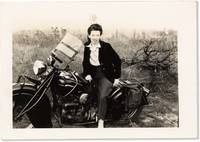
réf. 81167St. Louis: Ozark M.C. 1927-1942. A rich archive of original source documents for one of the earliest motorcycle clubs in the Midwest with clear precursors to the "Outlaw" clubs of the post-WW2 era. Includes minute books for the Club's primary years of activity; founding documents including draft Constitution and By-Laws; membership rolls; correspondence; printed and promotional ephemera and photographs complete inventory in note below. Condition generally Good or better with expected aging to some documents and a few in fragile condition. The archive has been removed from the decomposing ring binders in which it was originally housed and organized into manila file-folders respecting where possible the as-found order of contents. The original binders have been retained and are included with the archive. The entirety comprises sixteen file folders housed in two hinged Hollinger boxes occupying about half a linear foot. INVENTORY: BOX 1: Folder 1. By-Laws and Constitution. Ten items including five drafts in mimeograph with extensive holograph edits; one apparently final draft in typescript on lined paper; related documents including roster of charter members with addresses; suggestions for effective Presidency; directory of other regional motorcycle clubs. Folder 2. Minutes June 15 1928 - October 18th 1929. Continuous; 32 leaves used plus 12 blank Folder 3. Minutes Jan 8 1937 - December 24th 1937. 24 leaves fully used recto & verso Folder 4. Minutes Jan 7 1938 - December 30th 1938. 21 leaves fully used recto & verso Folder 5. Minutes Jan 6 1939 - March 1 1940. 26 leaves most used recto & verso plus about 20 blank leaves as found. Entry for March 1 1949 is annotated possibly at a later date: "This is last meeting." Folder 6. Membership Forms 1935 - 1939. 33 numbered completed forms plus two unnumbered completed in holograph with name date of application record of membership vote and signatures. This presumably comprises a complete list of all Club members from 1935-1939. Folder 7. Miscellaneous correpondence 1930 - 1942. Twelve pieces on various subjects including political statements apparently by Michael Verderber not related to Club activities. Envelopes laid in as found. Folder 8. Printed and promotional items. Six pieces produced by the Club and by others. Folder 9. Midwest Motorcycle Association. Two pieces documenting an attempt by Ozark M.C. members to start a rival association to the American Motorcycle Association. Folder 10. Races Meets and Competitions 1932 - 1939. Sixteen pieces including correspondence race forms sanctioning certificates and related materials relating to competitions and Club meets. Folder 11. American Motorcycle Association 1930 - 1941. Eight items including correspondence bulletins and blank forms from the American Motorcycle Association the main sanctioning body for motorcycle clubs across the U.S. Folder 12. Ephemera including event tickets pit passes business cards club receipt book for 1936. Nine unique items some present in multiples. Folder 13. Photographs. Thirty-nine vintage silver-gelatin photographs most measuring 3" x 5" or the reverse; a few smaller; also twenty-three original negatives some but not all replicating the prints above. Folder 14. Photographs. Three larger format vintage silver-gelatin photographs two measuring ca. 8" x 10"; the third 5" x 7" on card mount this image fully cracked through image at lower third; verso of board held together with masking tape. Folder 15. Michael Verderber personal. Two items relating to 1943 registration certificate for Verderber's Indian Model "4" motorcycle. Folder 16. Fragments and extraneous envelopes as found. BOX 2: Remnants of 3 original binders from which the archive was removed. ------------------------------------- The original Ozark Motorcycle Club was founded in 1927 by a group of twenty St. Louis cycling enthusiasts including Mike Verderber who appears to have been the original keeper of these documents Louis Ahrens first President Fred Tremozini Vice President Hank Eiler and sixteen others. It is unclear when the group began holding formal meetings; extant minutes for this iteration of the club begin with June 15 1928 and end without warning or explanation on Oct 18 1929 leaving about twenty blank leaves in the minute book. As this last recorded meeting was held just six days before the stock market crash the cause for this cessation of club activities may be conjectured. We can find no public mention of the Club in its pre-Depression phase; the minute book included here would appear to be the only record of its existence. The Club was reconstituted on August 16 1935 in the depths of the Great Depression by Verderber and about twenty others. Included here are multiple drafts both in manuscript and mimeograph for the new Club's Constitution and By-Laws which specify that members shall be "White Male Riders and Owners of Motorcycles" emphasis in the original but "may bring their wives or such persons as they see fit to club-affairs." The earliest minutes appear to be missing but the archive's record of meetings is complete from January 1937 to March 1 1940 which appears to have been the Club's last official meeting so marked in the minute book though other evidence included in the archive suggests that the club persisted for at least a few more years perhaps more as a social group than a functioning organization. For the first two years meetings focus mostly on club events including meets tours and rallies. The availability of beer at meetings is a topic that arises with some frequency as does the matter of the American Motorcycle Association for which at least a few members express strong antipathies see our note regarding Outlaw motorcycle clubs below; at one point it appears that a club faction even attempts to launch their own regional association the Midwest Motorcycle Association to challenge the AMA's supremacy in the promotion of meets "gypsy tours" and hill climb events. Eventually the Ozark M.C. appears to have made the decision to affiliate with the A.M.A. though we mysteriouly do not find any vote for this decision in the meeting minutes just correspondence from the AMA sanctioning club events but it clearly cost the club some members: by 1938 membership had dwindled from 22 riders to no more than a dozen. In later years beginning especially around mid-1939 meetings address with increasing urgency the Club's dwindling membership and futile attempts to collect dues from the many members in arears. By early 1940 it seems the eight remaining members can agree on very little; the minutes grow sparse and by March of that year the Club appears defunct. This winding narrative is supported by the archive's many other documents including correspondence which includes several lengthy letters from club president Verderber to prominent public figures including Franklin Delano Roosevelt publicity materials and especially photographs which are remarkable: all are vernacular nearly all captioned with names and dates taken during biker events throughout the midwest evoking the rough-and-tumble nature of early cycling events and the decidedly proletarian milieu in which they took place. "Outlaw" culture was still a few years away from being fully articulated by clubs such as The Outlaws The Boozefighters The Bandidos and others; but its roots are most definitely to be found among these risk-taking beer-drinking blue-collar riders of the Great Depression. The roots of Outlaw motorcycling in America have been widely documented typically traced to the years directly after the Second World War when returnig G.I.'s out of work and deprived of the close bonds they'd formed in battle found an outlet in the rough and occasionally dangerous world of open-road cycling. "Outlaw" Clubs - those that refused to affiliate with the American Motorcycle Association a commercial trade organization founded in 1924 - developed a mostly undeserved reputation for antisocial and sometimes violent behavior cemented in the public imagination by the 1953 Marlon Brando film The Wild One and its many imitators. But as is clear from the evidence in this archive an independent and contrarian spirit prevailed even in the pre-War years and we suspect it was members of Depression-era clubs such as this one who were most active in forming the post-war Outlaw clubs. In fact Verderber in one telling line from a long letter to his girlfriend included here describes himself as an "outlaw" rider - then thinking better of it crosses the word out and replaces it with "independent." By war's end such reticence would be a thing of the past; independent bikers would begin wearing the "outlaw" label proudly and defiantly. And though the use of the term "outlaw" before the war is hardly unnown - the Outlaws M.C. of Chicago were using it as early as 1935 - documentation of these pre-War motorcycle clubs is nearly non-existent making the current archive an invaluable resource for both the study of working-class culture in the midwest and one of the earliest instantiations of a uniquely American subculture. unknown books