1185 risultati
rif. 14757Three plates engraved by Robert Havell and son printed by Edward Egerton-Williams in colours and finished by hand each with printer's blindstamp. From an edition limited to 110 copies printed from the original printing plates in 1988 employing the same techniques as used in 1823. This fine edition was published as a collaborative effort between the State Library of New South Wales and the renowned fine art publishers Alecto Editions. "By 1820 Sydney was a town of 12000 inhabitants about a third of whom were convicts. It had grown dramatically during the administration of Lachlan Macquarie who was appointed governor of New South Wales in 1810. Unlike previous governors Macquarie was not content merely to oversee a penal colony. His vigorous building programme changed forever the appearance of Sydney while his policy of accepting emancipated convicts as respected citizens demonstrated a social attitude strangely out of step with the times. Both these policies earned him criticism. In 1819 alarmed by Macquarie's extravagant public works the British Government commissioned a lawyer and civil servant J.T.Bigge to investigate. The attacks by his critics were met head on by Macquarrie's supporters in New South Wales. Books pamphlets and paintings luded the governor's undoubted achievements. Almost certainly Major Taylor's drawings were used in if not commissioned for this cause. The engraved views of the Panorama present a flattering image of the Australian seat of government and by extension of Macquarie's term there.Taylor arranged the engraving and printing of the of the three sheet Panorama. upon his return to England in July 1822.Havell appears to have worked from Taylor's. large watercolours but amended them with additional details. and decorative elements.It is most fortuitous that the copper plates.have survived. There is no other example of such a case for 19th century Australian engravings. unknown books
1896282 pages. Handsome bright gilt decoration upon front board. Gilt lettering upon backstrip clearly legible excepting a chip affecting three characters. Loss from top of backstrip. Prior owner's signature inside front board else unmarked. Narrow opening along back hinge. Average external wear. Additional photos available upon request. Book
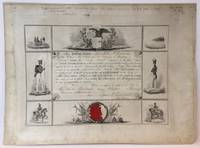
rif. 58705A collection of 11 items from the first organizational years of the National Guard unit which protected New York City in the early 19th century. The group consists of three brass cylinders each containing rolled manuscript documents related to the regiment; an oval metal box containing a pair of epaulettes from the 7th; a wallet style polished black leather military bag with a gilt emblem of the 7th National Guards on the front flap; and a partially printed document completed in manuscript acknowledging the service of a member of the regiment. New York 1816-1847. What became known as New York's Seventh Regiment was originally organized in April 1806 as a response to the threats from the British search and seizure policies in New York harbor. The regiment consisted of four companies comprising many of the merchants and tradesmen in the city. During the War of 1812 the unit by then designated the 2nd Battalion 11th Artillery manned the guns of the forts guarding New York harbor. After the war a military-weary New York saw a fall-off of interest in drilling and training by militias. The appointment in 1820 of Col. James Benedict to lead the Eleventh brought a renewed interest in organized training discipline and field exercises attention to uniforms and equipment and regular attendance at meetings. His order regarding the wearing of pantaloons over boots is reflected in one of the documents present here. By 1824 the Eleventh had been renamed "The National Guards" in honor of the Marquis de Lafayette and by 1826 it was redesignated "The Twenty-Seventh Regiment of the New York State Artillery." In addition to official parades and escorting of dignitaries the national Guards were used to maintain order in the city during public executions in the 1820s and were called out to help quell riots in the 1830s. A reorganization of all the militia units resulted in its new official designation as the Seventh Regiment in 1847. All of the material is in very good condition aside from some scuffing to the metal box. Each of the brass cylinders has an engraved label and the end of each one unscrews to reveal the rolled document inside. The metal box has a faint blind-stamp on the lid identifying it as having been produced by J.H. McLenney & Co. 141 Grand St. New York. The leather wallet is stamped in blind on the back "Ridabock & Co. New York." McKenney & Co. and its successor Ridabock & Co. were manufacturers and dealers in military goods. #6445. Itemized list of the collection: a The first cylinder engraved label reading "Roll of Honorary Members 1st Co. 7th Regt." The document inside dated June 23 1816 206 x 25 cm. consisting of 6 pages tipped together end-to-end records the "Bye laws for the Regulation of Capt. James Benedict's Company in the Eleventh Regiment NY State Artillery" including the establishment of a monthly meeting time regulations regarding attendance new members arms & equipment etc. It is signed by the three members of the Committee of Revisal Gilbert Hopkins Irad Hawley and Richard E. Purdy as well as approximately 77 members of the company. Damage to the lower corner of the document has resulted in the loss of several signatures; some chipping along the right margin of the scroll occasionally affecting a word or two. b The second cylinder engraved label reading "Roll of Company. 7th Regt. N.G.S.N.Y." Rolled inside are two separate documents. The first dated May 18 1821 90 x 20 cm. consisting of 3 pages tipped together end-to-end is a document signed by the members of the company commanded by Capt. Gilbert Hopkins 11th Regt 1st Brigade pledging to abide by a decision regarding the wearing of pantaloons over instead of under Boots on Parade signed by 67 members of the company. The second document is undated 22 x 20 cm. a single leaf approves an alteration to the by-laws regarding dunning members for non-attendance signed by 20 members. c The third cylinder engraved label reading "Roll of the first Company National Guards New York State Artillery" ownership name partially rubbed out but research shows it reads "Captain J.S. Cocks". The manuscript document records another revision of the by-laws this one from October 1826. Printed in block letters at the head of the document 184 x 23 cm. consisting of 5 pages tipped together end-to-end is the title "TWENTY-SEVENTH REGIMENT / NEW YORK STATE ARTILLERY / PRO PATRIA ET GLORIA / NATIONAL GUARDS." The text includes several modifications to various articles of the by-laws and is signed by the members of the Committee of Revisal Smith Spelman Thos. Jaycox and Thos. H. Locke along with 48 other members of the regiment. Some chipping to the margins of the document not affecting text; one long tear carefully repaired on verso touching some letters but all still legible. The ink from the block lettering has burned through the paper in spots. John Samuel Cocks 1813-1868 whose name is etched on the cylinder was elected captain of the First Company of the 7th Regiment in 1838 and resigned in 1845. During the Civil War he served as a Colonel with the 40th New York Infantry Mozart Regiment. A Successful New York businessman and member of the New York state legislature he died in Brooklyn in 1868. d The black metal box containing the epaulettes is moderately scuffed. There is a small metal handle on the lid and a clasp. The epaulettes rest on an oval post mounted inside the box. Each is braided and has a brass crescent on the shoulder dulled and a round emblem of red cloth with a contrasting black & gray striped cloth "7" affixed to it a gold button embossed with an eagle and two bars. The epaulettes show some wear particularly on the undersides where a metal plate denotes left and right shoulder pad with modest fraying to the edges. e The leather wallet has high polish; the ornamental lettering "NG7" on the front flap is bright the small leather loop clasp is worn but intact. f A partially printed document image size 21 x 31 cm. on a larger sheet 30 x 40 cm. completed in manuscript and dated October 14 1846. The text is surrounded by eight vignette illustrations six of men in uniform on horseback in ranks one of an eagle perched on a shield and the last of swords and cannons with a red wax seal over the middle partially chipped away. The document acknowledges the seven years service of John A. Hadden in Company 6 National Guard 27th Regiment and declares him to be exempt for the rest of his life from both jury service and further military service. Signed by two members of the regiment Andrew H. Brenner and Cyrus H. Loutrel. A few creases in the surface of the document which is a little soiled and has some later ink notes by Hadden in the upper margin. unknown
rif. 58705A collection of 11 items from the first organizational years of the National Guard unit which protected New York City in the early 19th century. The group consists of three brass cylinders each containing rolled manuscript documents related to the regiment; an oval metal box containing a pair of epaulettes from the 7th; a wallet style polished black leather military bag with a gilt emblem of the 7th National Guards on the front flap; and a partially printed document completed in manuscript acknowledging the service of a member of the regiment. New York 1816-1847. What became known as New York's Seventh Regiment was originally organized in April 1806 as a response to the threats from the British search and seizure policies in New York harbor. The regiment consisted of four companies comprising many of the merchants and tradesmen in the city. During the War of 1812 the unit by then designated the 2nd Battalion 11th Artillery manned the guns of the forts guarding New York harbor. After the war a military-weary New York saw a fall-off of interest in drilling and training by militias. The appointment in 1820 of Col. James Benedict to lead the Eleventh brought a renewed interest in organized training discipline and field exercises attention to uniforms and equipment and regular attendance at meetings. His order regarding the wearing of pantaloons over boots is reflected in one of the documents present here. By 1824 the Eleventh had been renamed "The National Guards" in honor of the Marquis de Lafayette and by 1826 it was redesignated "The Twenty-Seventh Regiment of the New York State Artillery." In addition to official parades and escorting of dignitaries the national Guards were used to maintain order in the city during public executions in the 1820s and were called out to help quell riots in the 1830s. A reorganization of all the militia units resulted in its new official designation as the Seventh Regiment in 1847. All of the material is in very good condition aside from some scuffing to the metal box. Each of the brass cylinders has an engraved label and the end of each one unscrews to reveal the rolled document inside. The metal box has a faint blind-stamp on the lid identifying it as having been produced by J.H. McLenney & Co. 141 Grand St. New York. The leather wallet is stamped in blind on the back "Ridabock & Co. New York." McKenney & Co. and its successor Ridabock & Co. were manufacturers and dealers in military goods. #6445. Itemized list of the collection: a The first cylinder engraved label reading "Roll of Honorary Members 1st Co. 7th Regt." The document inside dated June 23 1816 206 x 25 cm. consisting of 6 pages tipped together end-to-end records the "Bye laws for the Regulation of Capt. James Benedict's Company in the Eleventh Regiment NY State Artillery" including the establishment of a monthly meeting time regulations regarding attendance new members arms & equipment etc. It is signed by the three members of the Committee of Revisal Gilbert Hopkins Irad Hawley and Richard E. Purdy as well as approximately 77 members of the company. Damage to the lower corner of the document has resulted in the loss of several signatures; some chipping along the right margin of the scroll occasionally affecting a word or two. b The second cylinder engraved label reading "Roll of Company. 7th Regt. N.G.S.N.Y." Rolled inside are two separate documents. The first dated May 18 1821 90 x 20 cm. consisting of 3 pages tipped together end-to-end is a document signed by the members of the company commanded by Capt. Gilbert Hopkins 11th Regt 1st Brigade pledging to abide by a decision regarding the wearing of pantaloons over instead of under Boots on Parade signed by 67 members of the company. The second document is undated 22 x 20 cm. a single leaf approves an alteration to the by-laws regarding dunning members for non-attendance signed by 20 members. c The third cylinder engraved label reading "Roll of the first Company National Guards New York State Artillery" ownership name partially rubbed out but research shows it reads "Captain J.S. Cocks". The manuscript document records another revision of the by-laws this one from October 1826. Printed in block letters at the head of the document 184 x 23 cm. consisting of 5 pages tipped together end-to-end is the title "TWENTY-SEVENTH REGIMENT / NEW YORK STATE ARTILLERY / PRO PATRIA ET GLORIA / NATIONAL GUARDS." The text includes several modifications to various articles of the by-laws and is signed by the members of the Committee of Revisal Smith Spelman Thos. Jaycox and Thos. H. Locke along with 48 other members of the regiment. Some chipping to the margins of the document not affecting text; one long tear carefully repaired on verso touching some letters but all still legible. The ink from the block lettering has burned through the paper in spots. John Samuel Cocks 1813-1868 whose name is etched on the cylinder was elected captain of the First Company of the 7th Regiment in 1838 and resigned in 1845. During the Civil War he served as a Colonel with the 40th New York Infantry Mozart Regiment. A Successful New York businessman and member of the New York state legislature he died in Brooklyn in 1868. d The black metal box containing the epaulettes is moderately scuffed. There is a small metal handle on the lid and a clasp. The epaulettes rest on an oval post mounted inside the box. Each is braided and has a brass crescent on the shoulder dulled and a round emblem of red cloth with a contrasting black & gray striped cloth "7" affixed to it a gold button embossed with an eagle and two bars. The epaulettes show some wear particularly on the undersides where a metal plate denotes left and right shoulder pad with modest fraying to the edges. e The leather wallet has high polish; the ornamental lettering "NG7" on the front flap is bright the small leather loop clasp is worn but intact. f A partially printed document image size 21 x 31 cm. on a larger sheet 30 x 40 cm. completed in manuscript and dated October 14 1846. The text is surrounded by eight vignette illustrations six of men in uniform on horseback in ranks one of an eagle perched on a shield and the last of swords and cannons with a red wax seal over the middle partially chipped away. The document acknowledges the seven years service of John A. Hadden in Company 6 National Guard 27th Regiment and declares him to be exempt for the rest of his life from both jury service and further military service. Signed by two members of the regiment Andrew H. Brenner and Cyrus H. Loutrel. A few creases in the surface of the document which is a little soiled and has some later ink notes by Hadden in the upper margin. unknown books
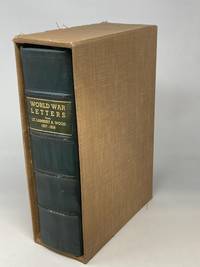
1918rif. 88062Self-Published 1918. Manuscript. Very Good Plus. Half-bound dark green morocco over light brown woven linen. A large sturdy hand-crafted book with sewn signatures 11 3/4 in. x 8 in. x 3 in. housed within a sturdy wooden slipcase covered with woven linen matching the cover of the book itself. Letters envelopes official documents etc. are displayed behind within clear plastic "jackets" each mounted to individual pages of thick card stock. The large tipped in photo shows some spotty residue and the slipcase shows a bit of edgewear. The archive consists of 77 detailed letters written by Lieutenant Wood 9th Infantry Regiment 2nd Division was killed in action southeast of Soissons France on July 18 1918 while in command of his machine gun platoon on a flank movement against an enemy group which was enfiltrating the advancing infantry line. This copy includes a tipped-in photograph of Lambert Wood opposite the title page and a tipped-in handwritten presentation slip written and signed by his mother Northwest author Elizabeth Lambert Wood "With the compliments of soldier-author's mother. Elizabeth Lambert Wood". A collection of remarkable letters written by Lambert Alexander Wood 1895-1918 who served with the Machine Gun Company 9th Infantry Regiment 2nd Division reflecting an extraordinarily deep and philosophical grasp of both the lofty purpose justification and horrors of war "I am fighting for our very civilization" with none of the details left out "I have seen men die smiling." or "I haven't been out of my clothes for 30 days." . Roughly half of this notable 77-letter archive are addressed to both parents with some addressed individually to "Mother" "Father" "Dad" and the other half -- 36 letters -- addressed to M.S. his sweetheart. Woven throughout so many of the letters is Wood's profound and unstoppable sense of duty and responsibility and consistent view of himself as a crucial component of a much larger grand effort than merely his individual self -- one utterly dependent upon his steady and ferocious all-in participation. Further as an officer he felt his comportment had to be visibly far and above that required of the ordinary soldier . On a number of occasions he mentioned to M.S. that he deprived himself of sleep and duly awarded leave because he felt compelled to set an example; yet their seems to be no trace of egoism or grandstanding; Lambert Wood was fighting the good fight the real fight and coming to realize and mentioning that it was the brave two-fisted men who would win this very tough war. In his devoted sweet letters to M.S. he explains both the logistics of his various responsibilities and placements -- instructor in gas warfare for example -- and seldom neglectsto delve deeper into the reasons behind war as if in explaining it to his beloved and perhaps to himself. The young man was clearly a highly articulate writer who is able to clearly convey the American sense of righteousness against a loathesome enemy. Somewhat alarmingly reading through the letters one sees this soldier-leader's growing -- it must be called "joy" for he himself terms it so in this and other synonymous words in KILLING the enemy the cold and dispassionate"otherizing" which steadily grows to supplant his still youthful and natural 23-year-old nnocence and permits the taking of human life behind a script of justification. Reading through this archive one follows the horrific yet fascinating path through the eyes of an educated privileged young man from Portland Oregon as he gradually transforms into a focused and efficient killing machine a capable and effective instructor and leader of other men who had no choice but becoming the same if they were to survive. Their unit was the first in the actual trenches. Lambert Alexander Wood was the son of Dr. William Lee Wood a physician and Elizabeth Lambert Wood a Northwest author best known for her adventure stories for boys. His grandfather was J.H. Lambert Oregon pioneer horticulturist and originator of the Lambert Cherry. He grew up in Portland Oregon. While attending Williams College in Massachusetts Wood enrolled in the volunteer pre-enlistment training program in Plattsburgh New York as part of the "Preparedness" movement before actual U.S. involvement in World War I sailing for France in March of 1917. Note: Two books that contain excerpts from these letters were published and are included with the purchase of this letter-archive: The first entitled "His Job: Letters Written By A 22 Year-Old Lieutenant In The World War To His Parents And Others In Oregon" was published in 1936 by the Metropolitan Press of Portland OR. The second book is entitled "Certain Brief Conclusions: From Selected Letters Of Lambert Wood" which was issued by publishers Binfords & Mort Portland OR in 1939 and also printed by the Metropolitan Press in Portland OR. Self-Published unknown
1809rif. 000867cSCOTLAND IRELAND ENGLAND DUBLIN EDINBURGH UK. Good. 1809. On offer is a remarkable original 1809 - 1833 handwritten manuscript book once used by the British Army's 94th Regiment of Foot. This book contains all manner of writings relevant to the running and goings-on of the Regiment by the Officers. The book is rather eclectic containing standing orders regimental orders different charts and forms for payroll and other reportage for example on the conditions of the Dublin Garrison orders of the day direct communications between officers public requests for leave advancement of funds settling of accounts etc. public apologies for poor behavior copies of letters sent to superiors up to and including the Duke of York Commander of all His Majesty's Forces and many other of Britain's peerage and there are even personal reminiscences notes of reference for departing soldiers plus much much more. Most of the entries of personal notes and those for Day Book purposes are signed by all manner of officers and peerage; Colonels Captains Lords and many reference specific orders by the Supreme Commander of the Army or even the King. Most fascinating are the 'Memorialist' messages of certain officers writing in the 3rd person touting themselves while seeking favor. 164 pp of history and methodology of this noted British Army regiment contained in this entirely handwritten book. Most of the entries are circa 1809 - 1827 but the oldest entry in the book is dated Edinburgh Castle 1833 and is addressed to what appears to be 'My Dear Beaver' while the correspondent signs in initials F.M. late of St. Lucia. He makes reference to Mr. Beaver as the clergyman that baptized his 3 children. Also of note: on the very last page written upside down are a quote a note and an invitation dated Fort Charlotte 1825 to His Excellency Major General Blackwell by Mr. and Mrs. Murray. Many clues for the astute researcher will assuredly unveil many of the writers in this fascinating piece of British militaria. Save for the front cover being nearly detached and some loosened endpapers this book would be G. Truly one of the most exceptional pieces of manuscript militaria we have ever encountered.; English; 4to - over 9¾" - 12" tall; KEYWORDS: HISTORY OF MILITARY MILITARIA BRITISH ARMY 94TH REGIMENT SCOTLAND IRELAND DUBLIN GARRISON MAP MANUSCRIPT DOCUMENT LETTER AUTOGRAPH DIARY JOURNAL LOG KEEPSAKE WRITER HAND WRITTEN DOCUMENTS SIGNED LETTERS MANUSCRIPTS HISTORICAL HOLOGRAPH WRITERS DIARIES JOURNALS LOGS AUTOGRAPHS PERSONAL MEMOIR MEMORIAL PERSONAL HISTORY antiquité contrat vélin document manuscrit papier Antike Brief Pergament Dokument Manuskript Papier oggetto d'antiquariato atto velina documento manoscritto carta antigüedad hecho vitela documento manuscrito Papel . unknown
1811rif. 54628E-172: Longman Hurst Rees Orme and Brown. Very Good. 1811. First Edition; First Printing. Hardcover. Leather. 4to. Printed in London for Longman Hurst Rees Orme and Brown Paternoster-Row. 1811. 436 pgs. Fine folding engraved map "of the Interior of Louisiana with a part of New Mexico" and full-page map of ". The Mississippi River from its source to the Mouth of the Missouri." Bound by in full calf leather. Spine has been rebacked with contemporary leather spine and gilt titled spine label. Boards are scuffed and worn with wear present to the edges of the boards. Small name present to the reverse of the front board. Both maps present however the first map has a small piece missing and has been rebacked with linen. Foxing present. Text is free of marks. Binding tight and solid. The first U. S. Government exploration of the American southwest. In 1805 Wilkinson ordered Pike to find the source of the Mississippi River so Pike traveled into the northern Louisiana Territory newly purchased from France. In 1806 Pike led an expedition to the southwestern borders of the land acquired by the United States through the Louisiana Purchase. One of the most important inland travel narratives giving an account of the South-west including the author's description of his earlier journey to explore the headwaters of the Mississippi. The two maps are among the first of the area executed by a government expedition. After Pike returned from this first expedition General Wilkinson almost immediately ordered him to mount a second expedition this time to explore map and find the headwaters of the Arkansas and Red rivers. Additional objectives of this exploratory expedition into the southwestern part of the Louisiana Territory were to evaluate natural resources and establish friendly relations with Native Americans. Beginning July 15 1806 Pike led what became known as the "Pike Expedition". General Wilkinson's son James served as one of his lieutenants although it now seems that Wilkinson planned that the Spanish who controlled Mexico would capture him and his men. Over 100 years later France released official records showing General Wilkinson received personal trade concessions and thus could be labeled a spy for Spain at the time. Sabin 62837; Howes P373 e-172; 8vo 8" - 9" tall . Longman, Hurst, Rees, Orme, and Brown hardcover
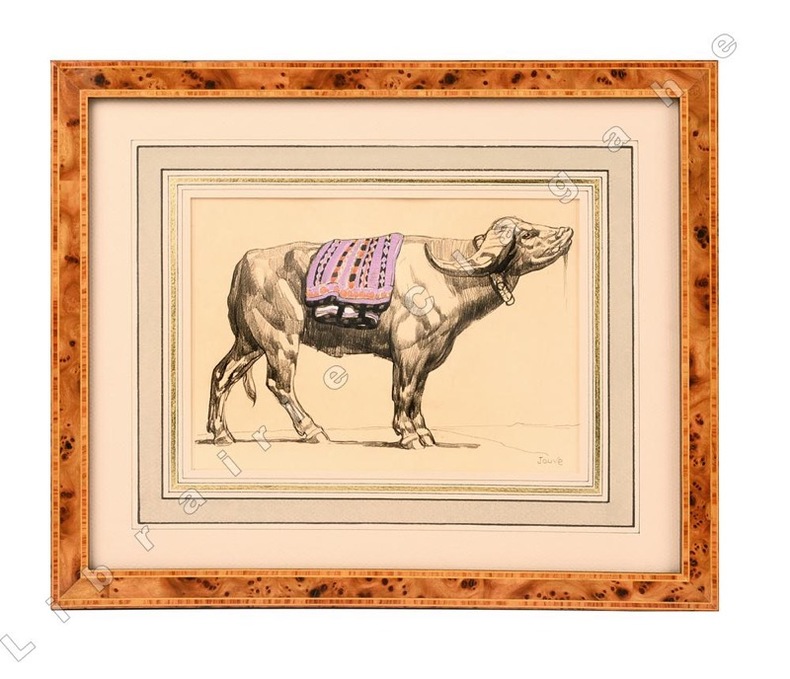
1852rif. 21442Dessin original au crayon gras, gouache et aquarelle sur papier japon impérial (185 x 217 mm ; recadré 151 x 212), signé au crayon dans le coin inférieur droit ; passe-partout à large encadrement bicolore beige et vert et large filet doré, encadrement de loupe. Format total 295 x 355 mm. Au dos, partie de dessin au crayon et fusin, découpée.
1862rif. 72838np: np 1862. Civil War letter archive comprising 78 chronologically arranged letters the majority from Corporal Christopher C. Mead of the 12th New Jersey Regiment to his wife Hannah dated November 12 1862 to May 29 1864. Two letters comprise correspondence between Christopher and Hannah in March and April 1864; Hannah authored two additional letters in May 1864. Three letters are incomplete. Most bear penciled numbers on the front apparently added by a previous handler. The correspondence is generally legible though some letters have faded more than others; overall the paper is in good condition. The archive also includes three undated and unsigned letter fragments; an unsigned letter dated June 18 1863; a September 16 1862 letter addressed to "Uncle Christopher" concerning family matters accompanied by a note reading "Mrs. Hannah Mead Woodstown Salem Co. New Jersey Please forward"; and a four-page indenture dated 1811 and signed by James Mead. The most striking letters are Corporal Mead's fist hand account at the Battle at Gettysburg with vivid description of Picket's charge written on July 6th. Shortly after Pickett's Charge at Gettysburg Mead. an active participant in the battle. writes his wife Hannah: ".The next day was the severest of the fighting. Skirmishing was kept up until about noon when the rebels opened with about 80 pieces of artillery upon us which was kept up for about 3 hours when they succeeded in silencing one of our batteries; the artillery fight which was about a half mile apart ours being on a hill theirs masked in the woods the ground between us was lower than either of the artillery positions. After they had succeeded in silencing in silencing the battery they began to pour out of the woods in 3 lines of battle and a line of skirmishers in advance of them. In all 18 reg's strong approaching our front they made a splendid approach with their colors flying in the breeze. I was about the center of our line at the point of which they were approaching and had a fair view of them although they had silenced our battery. Thanks be to God of our Nation we had more in reserve for them. Well charged with great and canister shot which was opened upon them with terrible effect. But as their ranks were terribly thinned by the artillery fire yet they closed up quickly their ranks and marched on like brave determined men to accomplish their purposes. On they came driving our skirmishing line before them like so many frightened sheep. Although they fought well until they saw there was no chance then they fell back quickly as they possibly could; and as soon as the rebs came in range of our guns of our line of battle which laid behind piles of rails and stones four deep we opened on them and they fell like grain before the reaper which nearly annihilated them and all that came as far as our line of battle came as prisoners and of the 18 stand of colors they so nobly brought out only one seen to go back." Letter from Gettysburg recounts the Battle of Pickett's Charge. During Pickets Charge Mead writes "But as their ranks were terribly thinned by the artillery fire yet they closed up quickly their ranks and marched on like brave determined men to accomplish their purposes. On they came driving our skirmishing line before them like so many frightened sheep. Although they fought well until they saw there was no chance then they fell back quickly as they possibly could; and as soon as the rebs came in range of our guns of our line of battle which laid behind piles of rails and stones four deep we opened on them and they fell like grain before the reaper which nearly annihilated them and all that came as far as our line of battle came as prisoners and of the 18 stand of colors they so nobly brought out only one seen to go back." From Longacre page 135 "Several minutes under the storm of Federal bullets reduced Lowrances and Lane's brigades to bloody fragments. A handful managed to reach the wall before they went down riddled with balls. Their comrades at last convinced of the futility of it all began to flee. Many fell dead the moment they turned their backs to the enemy. Others hugged the ground in the hope of surviving the hail of lead long enough to surrender." Pickett's Charge July 3 1863 also known as the Pickett-Pettigrew-Trimble Assault was a major Confederate infantry attack against Union positions under Major General George G. Meade on the final day of the Battle of Gettysburg. Ordered by General Robert E. Lee and directed by Lieutenant General James Longstreet approximately 12500 Confederate soldiers advanced nearly three-quarters of a mile across open ground toward the center of the Union line on Cemetery Ridge. Preceded by a heavy artillery bombardment the assault was met by intense Union artillery and rifle fire and was repulsed with more than 50 percent Confederate casualties. The failed attack effectively ended Lee's invasion of Pennsylvania and forced the Confederate Army's retreat to Virginia. Popularly named for Major General George Pickett whose division formed the center of the assault the charge is often regarded as a major turning point of the Civil War and is associated with the "high-water mark of the Confederacy" referring to the farthest point reached by Confederate forces. Mead writes from Hanover County Virginia late May 1864. Soon after he fought in the Battle of Cold Harbor May 31 - June 12 1864 where Mead was killed. Battle of Cold Harbor May 31-June 12 1864 was a major engagement of the Union Army's Overland Campaign against Richmond. At the crossroads of Cold Harbor roughly ten miles northeast of Richmond General Ulysses S. Grant's Army of the Potomac launched repeated assaults against entrenched Confederate forces under General Robert E. Lee culminating in a devastating attack on June 3. The Union assaults failed to break the Confederate defenses and resulted in more than 17000 casualties. Grant subsequently disengaged crossed the James River and moved toward Petersburg a vital railroad and manufacturing center that guarded the approaches to Richmond. Although Cold Harbor was a costly Union defeat Grant's continued advance ultimately placed Confederate forces under sustained pressure around Richmond and Petersburg. np unknown
1862rif. 72838np: np 1862. Civil War letter archive comprising 78 chronologically arranged letters the majority from Corporal Christopher C. Mead of the 12th New Jersey Regiment to his wife Hannah dated November 12 1862 to May 29 1864. Two letters comprise correspondence between Christopher and Hannah in March and April 1864; Hannah authored two additional letters in May 1864. Three letters are incomplete. Most bear penciled numbers on the front apparently added by a previous handler. The correspondence is generally legible though some letters have faded more than others; overall the paper is in good condition. The archive also includes three undated and unsigned letter fragments; an unsigned letter dated June 18 1863; a September 16 1862 letter addressed to "Uncle Christopher" concerning family matters accompanied by a note reading "Mrs. Hannah Mead Woodstown Salem Co. New Jersey Please forward"; and a four-page indenture dated 1811 and signed by James Mead. The most striking letters are Corporal Mead's fist hand account at the Battle at Gettysburg with vivid description of Picket's charge written on July 6th. Shortly after Pickett's Charge at Gettysburg Mead. an active participant in the battle. writes his wife Hannah: ".The next day was the severest of the fighting. Skirmishing was kept up until about noon when the rebels opened with about 80 pieces of artillery upon us which was kept up for about 3 hours when they succeeded in silencing one of our batteries; the artillery fight which was about a half mile apart ours being on a hill theirs masked in the woods the ground between us was lower than either of the artillery positions. After they had succeeded in silencing in silencing the battery they began to pour out of the woods in 3 lines of battle and a line of skirmishers in advance of them. In all 18 reg's strong approaching our front they made a splendid approach with their colors flying in the breeze. I was about the center of our line at the point of which they were approaching and had a fair view of them although they had silenced our battery. Thanks be to God of our Nation we had more in reserve for them. Well charged with great and canister shot which was opened upon them with terrible effect. But as their ranks were terribly thinned by the artillery fire yet they closed up quickly their ranks and marched on like brave determined men to accomplish their purposes. On they came driving our skirmishing line before them like so many frightened sheep. Although they fought well until they saw there was no chance then they fell back quickly as they possibly could; and as soon as the rebs came in range of our guns of our line of battle which laid behind piles of rails and stones four deep we opened on them and they fell like grain before the reaper which nearly annihilated them and all that came as far as our line of battle came as prisoners and of the 18 stand of colors they so nobly brought out only one seen to go back." Letter from Gettysburg recounts the Battle of Pickett's Charge. During Pickets Charge Mead writes "But as their ranks were terribly thinned by the artillery fire yet they closed up quickly their ranks and marched on like brave determined men to accomplish their purposes. On they came driving our skirmishing line before them like so many frightened sheep. Although they fought well until they saw there was no chance then they fell back quickly as they possibly could; and as soon as the rebs came in range of our guns of our line of battle which laid behind piles of rails and stones four deep we opened on them and they fell like grain before the reaper which nearly annihilated them and all that came as far as our line of battle came as prisoners and of the 18 stand of colors they so nobly brought out only one seen to go back." From Longacre page 135 "Several minutes under the storm of Federal bullets reduced Lowrances and Lane's brigades to bloody fragments. A handful managed to reach the wall before they went down riddled with balls. Their comrades at last convinced of the futility of it all began to flee. Many fell dead the moment they turned their backs to the enemy. Others hugged the ground in the hope of surviving the hail of lead long enough to surrender." Pickett's Charge July 3 1863 also known as the Pickett-Pettigrew-Trimble Assault was a major Confederate infantry attack against Union positions under Major General George G. Meade on the final day of the Battle of Gettysburg. Ordered by General Robert E. Lee and directed by Lieutenant General James Longstreet approximately 12500 Confederate soldiers advanced nearly three-quarters of a mile across open ground toward the center of the Union line on Cemetery Ridge. Preceded by a heavy artillery bombardment the assault was met by intense Union artillery and rifle fire and was repulsed with more than 50 percent Confederate casualties. The failed attack effectively ended Lee's invasion of Pennsylvania and forced the Confederate Army's retreat to Virginia. Popularly named for Major General George Pickett whose division formed the center of the assault the charge is often regarded as a major turning point of the Civil War and is associated with the "high-water mark of the Confederacy" referring to the farthest point reached by Confederate forces. Mead writes from Hanover County Virginia late May 1864. Soon after he fought in the Battle of Cold Harbor May 31 - June 12 1864 where Mead was killed. Battle of Cold Harbor May 31-June 12 1864 was a major engagement of the Union Army's Overland Campaign against Richmond. At the crossroads of Cold Harbor roughly ten miles northeast of Richmond General Ulysses S. Grant's Army of the Potomac launched repeated assaults against entrenched Confederate forces under General Robert E. Lee culminating in a devastating attack on June 3. The Union assaults failed to break the Confederate defenses and resulted in more than 17000 casualties. Grant subsequently disengaged crossed the James River and moved toward Petersburg a vital railroad and manufacturing center that guarded the approaches to Richmond. Although Cold Harbor was a costly Union defeat Grant's continued advance ultimately placed Confederate forces under sustained pressure around Richmond and Petersburg. np unknown books