1,404 results
1811ref. 54628E-172: Longman Hurst Rees Orme and Brown. Very Good. 1811. First Edition; First Printing. Hardcover. Leather. 4to. Printed in London for Longman Hurst Rees Orme and Brown Paternoster-Row. 1811. 436 pgs. Fine folding engraved map "of the Interior of Louisiana with a part of New Mexico" and full-page map of ". The Mississippi River from its source to the Mouth of the Missouri." Bound by in full calf leather. Spine has been rebacked with contemporary leather spine and gilt titled spine label. Boards are scuffed and worn with wear present to the edges of the boards. Small name present to the reverse of the front board. Both maps present however the first map has a small piece missing and has been rebacked with linen. Foxing present. Text is free of marks. Binding tight and solid. The first U. S. Government exploration of the American southwest. In 1805 Wilkinson ordered Pike to find the source of the Mississippi River so Pike traveled into the northern Louisiana Territory newly purchased from France. In 1806 Pike led an expedition to the southwestern borders of the land acquired by the United States through the Louisiana Purchase. One of the most important inland travel narratives giving an account of the South-west including the author's description of his earlier journey to explore the headwaters of the Mississippi. The two maps are among the first of the area executed by a government expedition. After Pike returned from this first expedition General Wilkinson almost immediately ordered him to mount a second expedition this time to explore map and find the headwaters of the Arkansas and Red rivers. Additional objectives of this exploratory expedition into the southwestern part of the Louisiana Territory were to evaluate natural resources and establish friendly relations with Native Americans. Beginning July 15 1806 Pike led what became known as the "Pike Expedition". General Wilkinson's son James served as one of his lieutenants although it now seems that Wilkinson planned that the Spanish who controlled Mexico would capture him and his men. Over 100 years later France released official records showing General Wilkinson received personal trade concessions and thus could be labeled a spy for Spain at the time. Sabin 62837; Howes P373 e-172; 8vo 8" - 9" tall . Longman, Hurst, Rees, Orme, and Brown hardcover
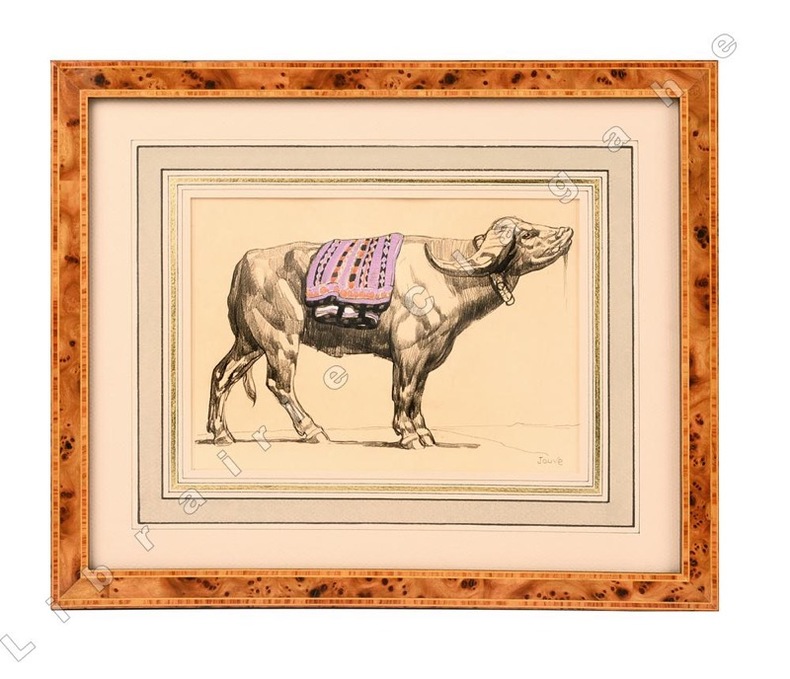
1852ref. 21442Dessin original au crayon gras, gouache et aquarelle sur papier japon impérial (185 x 217 mm ; recadré 151 x 212), signé au crayon dans le coin inférieur droit ; passe-partout à large encadrement bicolore beige et vert et large filet doré, encadrement de loupe. Format total 295 x 355 mm. Au dos, partie de dessin au crayon et fusin, découpée.
1862ref. 72838np: np 1862. Civil War letter archive comprising 78 chronologically arranged letters the majority from Corporal Christopher C. Mead of the 12th New Jersey Regiment to his wife Hannah dated November 12 1862 to May 29 1864. Two letters comprise correspondence between Christopher and Hannah in March and April 1864; Hannah authored two additional letters in May 1864. Three letters are incomplete. Most bear penciled numbers on the front apparently added by a previous handler. The correspondence is generally legible though some letters have faded more than others; overall the paper is in good condition. The archive also includes three undated and unsigned letter fragments; an unsigned letter dated June 18 1863; a September 16 1862 letter addressed to "Uncle Christopher" concerning family matters accompanied by a note reading "Mrs. Hannah Mead Woodstown Salem Co. New Jersey Please forward"; and a four-page indenture dated 1811 and signed by James Mead. The most striking letters are Corporal Mead's fist hand account at the Battle at Gettysburg with vivid description of Picket's charge written on July 6th. Shortly after Pickett's Charge at Gettysburg Mead. an active participant in the battle. writes his wife Hannah: ".The next day was the severest of the fighting. Skirmishing was kept up until about noon when the rebels opened with about 80 pieces of artillery upon us which was kept up for about 3 hours when they succeeded in silencing one of our batteries; the artillery fight which was about a half mile apart ours being on a hill theirs masked in the woods the ground between us was lower than either of the artillery positions. After they had succeeded in silencing in silencing the battery they began to pour out of the woods in 3 lines of battle and a line of skirmishers in advance of them. In all 18 reg's strong approaching our front they made a splendid approach with their colors flying in the breeze. I was about the center of our line at the point of which they were approaching and had a fair view of them although they had silenced our battery. Thanks be to God of our Nation we had more in reserve for them. Well charged with great and canister shot which was opened upon them with terrible effect. But as their ranks were terribly thinned by the artillery fire yet they closed up quickly their ranks and marched on like brave determined men to accomplish their purposes. On they came driving our skirmishing line before them like so many frightened sheep. Although they fought well until they saw there was no chance then they fell back quickly as they possibly could; and as soon as the rebs came in range of our guns of our line of battle which laid behind piles of rails and stones four deep we opened on them and they fell like grain before the reaper which nearly annihilated them and all that came as far as our line of battle came as prisoners and of the 18 stand of colors they so nobly brought out only one seen to go back." Letter from Gettysburg recounts the Battle of Pickett's Charge. During Pickets Charge Mead writes "But as their ranks were terribly thinned by the artillery fire yet they closed up quickly their ranks and marched on like brave determined men to accomplish their purposes. On they came driving our skirmishing line before them like so many frightened sheep. Although they fought well until they saw there was no chance then they fell back quickly as they possibly could; and as soon as the rebs came in range of our guns of our line of battle which laid behind piles of rails and stones four deep we opened on them and they fell like grain before the reaper which nearly annihilated them and all that came as far as our line of battle came as prisoners and of the 18 stand of colors they so nobly brought out only one seen to go back." From Longacre page 135 "Several minutes under the storm of Federal bullets reduced Lowrances and Lane's brigades to bloody fragments. A handful managed to reach the wall before they went down riddled with balls. Their comrades at last convinced of the futility of it all began to flee. Many fell dead the moment they turned their backs to the enemy. Others hugged the ground in the hope of surviving the hail of lead long enough to surrender." Pickett's Charge July 3 1863 also known as the Pickett-Pettigrew-Trimble Assault was a major Confederate infantry attack against Union positions under Major General George G. Meade on the final day of the Battle of Gettysburg. Ordered by General Robert E. Lee and directed by Lieutenant General James Longstreet approximately 12500 Confederate soldiers advanced nearly three-quarters of a mile across open ground toward the center of the Union line on Cemetery Ridge. Preceded by a heavy artillery bombardment the assault was met by intense Union artillery and rifle fire and was repulsed with more than 50 percent Confederate casualties. The failed attack effectively ended Lee's invasion of Pennsylvania and forced the Confederate Army's retreat to Virginia. Popularly named for Major General George Pickett whose division formed the center of the assault the charge is often regarded as a major turning point of the Civil War and is associated with the "high-water mark of the Confederacy" referring to the farthest point reached by Confederate forces. Mead writes from Hanover County Virginia late May 1864. Soon after he fought in the Battle of Cold Harbor May 31 - June 12 1864 where Mead was killed. Battle of Cold Harbor May 31-June 12 1864 was a major engagement of the Union Army's Overland Campaign against Richmond. At the crossroads of Cold Harbor roughly ten miles northeast of Richmond General Ulysses S. Grant's Army of the Potomac launched repeated assaults against entrenched Confederate forces under General Robert E. Lee culminating in a devastating attack on June 3. The Union assaults failed to break the Confederate defenses and resulted in more than 17000 casualties. Grant subsequently disengaged crossed the James River and moved toward Petersburg a vital railroad and manufacturing center that guarded the approaches to Richmond. Although Cold Harbor was a costly Union defeat Grant's continued advance ultimately placed Confederate forces under sustained pressure around Richmond and Petersburg. np unknown
1862ref. 72838np: np 1862. Civil War letter archive comprising 78 chronologically arranged letters the majority from Corporal Christopher C. Mead of the 12th New Jersey Regiment to his wife Hannah dated November 12 1862 to May 29 1864. Two letters comprise correspondence between Christopher and Hannah in March and April 1864; Hannah authored two additional letters in May 1864. Three letters are incomplete. Most bear penciled numbers on the front apparently added by a previous handler. The correspondence is generally legible though some letters have faded more than others; overall the paper is in good condition. The archive also includes three undated and unsigned letter fragments; an unsigned letter dated June 18 1863; a September 16 1862 letter addressed to "Uncle Christopher" concerning family matters accompanied by a note reading "Mrs. Hannah Mead Woodstown Salem Co. New Jersey Please forward"; and a four-page indenture dated 1811 and signed by James Mead. The most striking letters are Corporal Mead's fist hand account at the Battle at Gettysburg with vivid description of Picket's charge written on July 6th. Shortly after Pickett's Charge at Gettysburg Mead. an active participant in the battle. writes his wife Hannah: ".The next day was the severest of the fighting. Skirmishing was kept up until about noon when the rebels opened with about 80 pieces of artillery upon us which was kept up for about 3 hours when they succeeded in silencing one of our batteries; the artillery fight which was about a half mile apart ours being on a hill theirs masked in the woods the ground between us was lower than either of the artillery positions. After they had succeeded in silencing in silencing the battery they began to pour out of the woods in 3 lines of battle and a line of skirmishers in advance of them. In all 18 reg's strong approaching our front they made a splendid approach with their colors flying in the breeze. I was about the center of our line at the point of which they were approaching and had a fair view of them although they had silenced our battery. Thanks be to God of our Nation we had more in reserve for them. Well charged with great and canister shot which was opened upon them with terrible effect. But as their ranks were terribly thinned by the artillery fire yet they closed up quickly their ranks and marched on like brave determined men to accomplish their purposes. On they came driving our skirmishing line before them like so many frightened sheep. Although they fought well until they saw there was no chance then they fell back quickly as they possibly could; and as soon as the rebs came in range of our guns of our line of battle which laid behind piles of rails and stones four deep we opened on them and they fell like grain before the reaper which nearly annihilated them and all that came as far as our line of battle came as prisoners and of the 18 stand of colors they so nobly brought out only one seen to go back." Letter from Gettysburg recounts the Battle of Pickett's Charge. During Pickets Charge Mead writes "But as their ranks were terribly thinned by the artillery fire yet they closed up quickly their ranks and marched on like brave determined men to accomplish their purposes. On they came driving our skirmishing line before them like so many frightened sheep. Although they fought well until they saw there was no chance then they fell back quickly as they possibly could; and as soon as the rebs came in range of our guns of our line of battle which laid behind piles of rails and stones four deep we opened on them and they fell like grain before the reaper which nearly annihilated them and all that came as far as our line of battle came as prisoners and of the 18 stand of colors they so nobly brought out only one seen to go back." From Longacre page 135 "Several minutes under the storm of Federal bullets reduced Lowrances and Lane's brigades to bloody fragments. A handful managed to reach the wall before they went down riddled with balls. Their comrades at last convinced of the futility of it all began to flee. Many fell dead the moment they turned their backs to the enemy. Others hugged the ground in the hope of surviving the hail of lead long enough to surrender." Pickett's Charge July 3 1863 also known as the Pickett-Pettigrew-Trimble Assault was a major Confederate infantry attack against Union positions under Major General George G. Meade on the final day of the Battle of Gettysburg. Ordered by General Robert E. Lee and directed by Lieutenant General James Longstreet approximately 12500 Confederate soldiers advanced nearly three-quarters of a mile across open ground toward the center of the Union line on Cemetery Ridge. Preceded by a heavy artillery bombardment the assault was met by intense Union artillery and rifle fire and was repulsed with more than 50 percent Confederate casualties. The failed attack effectively ended Lee's invasion of Pennsylvania and forced the Confederate Army's retreat to Virginia. Popularly named for Major General George Pickett whose division formed the center of the assault the charge is often regarded as a major turning point of the Civil War and is associated with the "high-water mark of the Confederacy" referring to the farthest point reached by Confederate forces. Mead writes from Hanover County Virginia late May 1864. Soon after he fought in the Battle of Cold Harbor May 31 - June 12 1864 where Mead was killed. Battle of Cold Harbor May 31-June 12 1864 was a major engagement of the Union Army's Overland Campaign against Richmond. At the crossroads of Cold Harbor roughly ten miles northeast of Richmond General Ulysses S. Grant's Army of the Potomac launched repeated assaults against entrenched Confederate forces under General Robert E. Lee culminating in a devastating attack on June 3. The Union assaults failed to break the Confederate defenses and resulted in more than 17000 casualties. Grant subsequently disengaged crossed the James River and moved toward Petersburg a vital railroad and manufacturing center that guarded the approaches to Richmond. Although Cold Harbor was a costly Union defeat Grant's continued advance ultimately placed Confederate forces under sustained pressure around Richmond and Petersburg. np unknown books