1 317 résultats
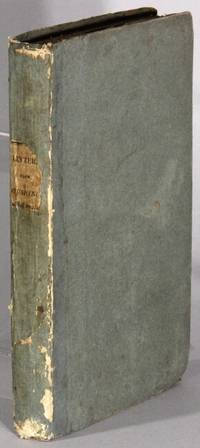
réf. 685038vo. One-page approximately 25 words in part: "Make up your statement & we will settle for your men." Conner began the war as a captain in the Hampton Legion then commanded the 22nd NC Infantry from Seven Pines through the Battle of the Wilderness before taking command of Kershaw's Brigade; he was seriously wounded at Cedar Creek necessitating a leg amputation. Following the war Conner resumed his law practice and served as South Carolina Attorney General 1876-1877. Published posthumously in 1933 his book Letters of General James Conner C.S.A. is rare and much sought. Verso with ink calculations else very good. unknown books
réf. 685044to. One-page approximately 35 words in part: "In re Annie J. Laurens & W. J. Ball we prefer that the Representatives . be made parties to the proceedings"; with docketing verso. Conner began the war as a captain in the Hampton Legion then commanded the 22nd NC Infantry from Seven Pines through the Battle of the Wilderness before taking command of Kershaw's Brigade; he was seriously wounded at Cedar Creek necessitating a leg amputation. Following the war Conner resumed his law practice and served as South Carolina Attorney General 1876-1877. Published posthumously in 1933 his book Letters of General James Conner C.S.A. is rare and much sought. Light stain at central fold old fold lines. Very good. unknown books
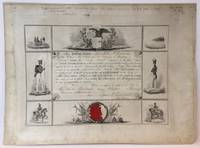
réf. 58705A collection of 11 items from the first organizational years of the National Guard unit which protected New York City in the early 19th century. The group consists of three brass cylinders each containing rolled manuscript documents related to the regiment; an oval metal box containing a pair of epaulettes from the 7th; a wallet style polished black leather military bag with a gilt emblem of the 7th National Guards on the front flap; and a partially printed document completed in manuscript acknowledging the service of a member of the regiment. New York 1816-1847. What became known as New York's Seventh Regiment was originally organized in April 1806 as a response to the threats from the British search and seizure policies in New York harbor. The regiment consisted of four companies comprising many of the merchants and tradesmen in the city. During the War of 1812 the unit by then designated the 2nd Battalion 11th Artillery manned the guns of the forts guarding New York harbor. After the war a military-weary New York saw a fall-off of interest in drilling and training by militias. The appointment in 1820 of Col. James Benedict to lead the Eleventh brought a renewed interest in organized training discipline and field exercises attention to uniforms and equipment and regular attendance at meetings. His order regarding the wearing of pantaloons over boots is reflected in one of the documents present here. By 1824 the Eleventh had been renamed "The National Guards" in honor of the Marquis de Lafayette and by 1826 it was redesignated "The Twenty-Seventh Regiment of the New York State Artillery." In addition to official parades and escorting of dignitaries the national Guards were used to maintain order in the city during public executions in the 1820s and were called out to help quell riots in the 1830s. A reorganization of all the militia units resulted in its new official designation as the Seventh Regiment in 1847. All of the material is in very good condition aside from some scuffing to the metal box. Each of the brass cylinders has an engraved label and the end of each one unscrews to reveal the rolled document inside. The metal box has a faint blind-stamp on the lid identifying it as having been produced by J.H. McLenney & Co. 141 Grand St. New York. The leather wallet is stamped in blind on the back "Ridabock & Co. New York." McKenney & Co. and its successor Ridabock & Co. were manufacturers and dealers in military goods. #6445. Itemized list of the collection: a The first cylinder engraved label reading "Roll of Honorary Members 1st Co. 7th Regt." The document inside dated June 23 1816 206 x 25 cm. consisting of 6 pages tipped together end-to-end records the "Bye laws for the Regulation of Capt. James Benedict's Company in the Eleventh Regiment NY State Artillery" including the establishment of a monthly meeting time regulations regarding attendance new members arms & equipment etc. It is signed by the three members of the Committee of Revisal Gilbert Hopkins Irad Hawley and Richard E. Purdy as well as approximately 77 members of the company. Damage to the lower corner of the document has resulted in the loss of several signatures; some chipping along the right margin of the scroll occasionally affecting a word or two. b The second cylinder engraved label reading "Roll of Company. 7th Regt. N.G.S.N.Y." Rolled inside are two separate documents. The first dated May 18 1821 90 x 20 cm. consisting of 3 pages tipped together end-to-end is a document signed by the members of the company commanded by Capt. Gilbert Hopkins 11th Regt 1st Brigade pledging to abide by a decision regarding the wearing of pantaloons over instead of under Boots on Parade signed by 67 members of the company. The second document is undated 22 x 20 cm. a single leaf approves an alteration to the by-laws regarding dunning members for non-attendance signed by 20 members. c The third cylinder engraved label reading "Roll of the first Company National Guards New York State Artillery" ownership name partially rubbed out but research shows it reads "Captain J.S. Cocks". The manuscript document records another revision of the by-laws this one from October 1826. Printed in block letters at the head of the document 184 x 23 cm. consisting of 5 pages tipped together end-to-end is the title "TWENTY-SEVENTH REGIMENT / NEW YORK STATE ARTILLERY / PRO PATRIA ET GLORIA / NATIONAL GUARDS." The text includes several modifications to various articles of the by-laws and is signed by the members of the Committee of Revisal Smith Spelman Thos. Jaycox and Thos. H. Locke along with 48 other members of the regiment. Some chipping to the margins of the document not affecting text; one long tear carefully repaired on verso touching some letters but all still legible. The ink from the block lettering has burned through the paper in spots. John Samuel Cocks 1813-1868 whose name is etched on the cylinder was elected captain of the First Company of the 7th Regiment in 1838 and resigned in 1845. During the Civil War he served as a Colonel with the 40th New York Infantry Mozart Regiment. A Successful New York businessman and member of the New York state legislature he died in Brooklyn in 1868. d The black metal box containing the epaulettes is moderately scuffed. There is a small metal handle on the lid and a clasp. The epaulettes rest on an oval post mounted inside the box. Each is braided and has a brass crescent on the shoulder dulled and a round emblem of red cloth with a contrasting black & gray striped cloth "7" affixed to it a gold button embossed with an eagle and two bars. The epaulettes show some wear particularly on the undersides where a metal plate denotes left and right shoulder pad with modest fraying to the edges. e The leather wallet has high polish; the ornamental lettering "NG7" on the front flap is bright the small leather loop clasp is worn but intact. f A partially printed document image size 21 x 31 cm. on a larger sheet 30 x 40 cm. completed in manuscript and dated October 14 1846. The text is surrounded by eight vignette illustrations six of men in uniform on horseback in ranks one of an eagle perched on a shield and the last of swords and cannons with a red wax seal over the middle partially chipped away. The document acknowledges the seven years service of John A. Hadden in Company 6 National Guard 27th Regiment and declares him to be exempt for the rest of his life from both jury service and further military service. Signed by two members of the regiment Andrew H. Brenner and Cyrus H. Loutrel. A few creases in the surface of the document which is a little soiled and has some later ink notes by Hadden in the upper margin. unknown books
1848réf. vot498Tampa Florida: University of Tampa Press Seminole Wars Historic Foundation 2000. A Reproduction of the 1848 Edition. Seminole Wars Historic Foundation Contribution Number Two. Octavo softbound stiff illus. slick brown wrappers xxx pp 557 pp 40 pp. Near Fine with sunned spine. From lower cover: The Origin Progress and Conclusion of the Florida War first published in 1848 just six years after the conflict ended is an outstanding account of the Second Seminole War that lasted from 1835 to 1842. Nearly one hundred and fifty years after first publication this book is still outstanding. University of Tampa Press, Seminole Wars Historic Foundation, (2000). A Reproduction of the 1848 Edition. Seminole Wars Histo paperback books
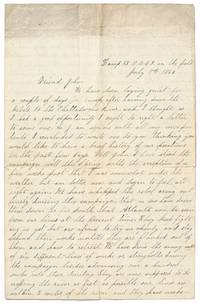
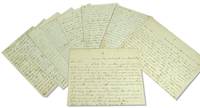
1864réf. 438776Atlanta Georgia 1864. Very Good. Autograph Letter Signed. Folio. 4pp. Partial splitting at the edges of one vertical and two horizontal folds about very good. A detailed and historically important long letter written in the field by Union soldier Harvey Rodgers just two weeks before he was killed at the Battle of Atlanta on July 22 1864. Rodgers was mustered into service in 1861 as a Corporal in the 54th Regiment Ohio Volunteer Infantry Zouaves Company A commanded by 1st Lt. Judson McCoy referred to as "Jud" in the letter. In the letter written to his "Friend John" on four easily legible folio pages Rodgers describes Confederate and Union Army maneuvers and skirmishes immediately after the Battle of Kennesaw Mountain fought from June 19 - July 2 1864 during the lead-up to the Battle of Atlanta which began on July 21st: ". Well John I have stood the campaign well this Spring . We have whipped the rebel army out finely . that is we have drove them so far South that Atlanta can be seen from our lines . I suppose you have heard about our making a charge on the 27th June . I do not wish to be in anymore such places . we lay in camp until the 2nd of July when our Division moved . very near due south of the Kennesaw mountain. That night Jud with our Company was on picket. We heard the cars very plain but did not think they the rebel army were evacuating the mountain and falling back . Next morning . We did not move forward until two o'clock when we advanced our lines two miles finding a small force of Cavalry in our front which we routed by charging them. The Regt. lost 1 killed 14 wounded ." He describes a second skirmish on July 4th at which his Company fought in support of the Union army's 16th Corps to advance Union lines and continues: ". On the 5th we were moved back again and brought further around on the right where we now lay. Our front lines are two miles further on. The rebels have a line of works between them and the Chattahoochee river . I expect we will have a pretty hard time before we get there and a hard time to cross the river ." The Battle of Atlanta commenced on July 21 1864. Both Harvey Rodgers and Union Maj. Gen. James B. McPherson were killed during the battle on July 22nd. Rodgers' letter thus ends poignantly: "Well John my time is fast rolling around now and I begin to think I will soon get home again. Only two months and 8 days more . Still in that short time there are many dangers to undergo. I may be called on to go into several more charges. Perhaps of some one not to come out alive . There has not more than half a dozen days passed since the 10th of May but what we have been under the sound of artillery. The troops appear to be pretty well worn out and wish for the campaign to close yet they all want to get into Atlanta first ." A compelling and ultimately heartbreaking eye witness account of General Sherman's Atlanta campaign during the summer of 1864. Longer quoted extracts from the letter are available. unknown books
1862réf. es2009Providece: Sidney S. Rider 1862. Octavo burgundy cloth hardcover gilt letters 260 pp. Cracked hinges wear to covers; interior clean & tight. Sidney S. Rider, 1862. hardcover books
réf. qms1594U. S. Naval Academy n.d. ca. 1919. 10 1/2 inches x 7 inches. illustrated heavy cardstock folding card with printed tissue wrapper. Small name card & photograph laid-in W. Burgess Broadhurst Midshipman United States Navy. Small signed photograph of Sender glued to interior of card; otherwise Fine in a chipped tissue wrapper in original torn envelope. Small typed card explaining history of piece laid-in. unknown books
1862réf. 72838np: np 1862. Civil War letter archive comprising 78 chronologically arranged letters the majority from Corporal Christopher C. Mead of the 12th New Jersey Regiment to his wife Hannah dated November 12 1862 to May 29 1864. Two letters comprise correspondence between Christopher and Hannah in March and April 1864; Hannah authored two additional letters in May 1864. Three letters are incomplete. Most bear penciled numbers on the front apparently added by a previous handler. The correspondence is generally legible though some letters have faded more than others; overall the paper is in good condition. The archive also includes three undated and unsigned letter fragments; an unsigned letter dated June 18 1863; a September 16 1862 letter addressed to "Uncle Christopher" concerning family matters accompanied by a note reading "Mrs. Hannah Mead Woodstown Salem Co. New Jersey Please forward"; and a four-page indenture dated 1811 and signed by James Mead. The most striking letters are Corporal Mead's fist hand account at the Battle at Gettysburg with vivid description of Picket's charge written on July 6th. Shortly after Pickett's Charge at Gettysburg Mead. an active participant in the battle. writes his wife Hannah: ".The next day was the severest of the fighting. Skirmishing was kept up until about noon when the rebels opened with about 80 pieces of artillery upon us which was kept up for about 3 hours when they succeeded in silencing one of our batteries; the artillery fight which was about a half mile apart ours being on a hill theirs masked in the woods the ground between us was lower than either of the artillery positions. After they had succeeded in silencing in silencing the battery they began to pour out of the woods in 3 lines of battle and a line of skirmishers in advance of them. In all 18 reg's strong approaching our front they made a splendid approach with their colors flying in the breeze. I was about the center of our line at the point of which they were approaching and had a fair view of them although they had silenced our battery. Thanks be to God of our Nation we had more in reserve for them. Well charged with great and canister shot which was opened upon them with terrible effect. But as their ranks were terribly thinned by the artillery fire yet they closed up quickly their ranks and marched on like brave determined men to accomplish their purposes. On they came driving our skirmishing line before them like so many frightened sheep. Although they fought well until they saw there was no chance then they fell back quickly as they possibly could; and as soon as the rebs came in range of our guns of our line of battle which laid behind piles of rails and stones four deep we opened on them and they fell like grain before the reaper which nearly annihilated them and all that came as far as our line of battle came as prisoners and of the 18 stand of colors they so nobly brought out only one seen to go back." Letter from Gettysburg recounts the Battle of Pickett's Charge. During Pickets Charge Mead writes "But as their ranks were terribly thinned by the artillery fire yet they closed up quickly their ranks and marched on like brave determined men to accomplish their purposes. On they came driving our skirmishing line before them like so many frightened sheep. Although they fought well until they saw there was no chance then they fell back quickly as they possibly could; and as soon as the rebs came in range of our guns of our line of battle which laid behind piles of rails and stones four deep we opened on them and they fell like grain before the reaper which nearly annihilated them and all that came as far as our line of battle came as prisoners and of the 18 stand of colors they so nobly brought out only one seen to go back." From Longacre page 135 "Several minutes under the storm of Federal bullets reduced Lowrances and Lane's brigades to bloody fragments. A handful managed to reach the wall before they went down riddled with balls. Their comrades at last convinced of the futility of it all began to flee. Many fell dead the moment they turned their backs to the enemy. Others hugged the ground in the hope of surviving the hail of lead long enough to surrender." Pickett's Charge July 3 1863 also known as the Pickett-Pettigrew-Trimble Assault was a major Confederate infantry attack against Union positions under Major General George G. Meade on the final day of the Battle of Gettysburg. Ordered by General Robert E. Lee and directed by Lieutenant General James Longstreet approximately 12500 Confederate soldiers advanced nearly three-quarters of a mile across open ground toward the center of the Union line on Cemetery Ridge. Preceded by a heavy artillery bombardment the assault was met by intense Union artillery and rifle fire and was repulsed with more than 50 percent Confederate casualties. The failed attack effectively ended Lee's invasion of Pennsylvania and forced the Confederate Army's retreat to Virginia. Popularly named for Major General George Pickett whose division formed the center of the assault the charge is often regarded as a major turning point of the Civil War and is associated with the "high-water mark of the Confederacy" referring to the farthest point reached by Confederate forces. Mead writes from Hanover County Virginia late May 1864. Soon after he fought in the Battle of Cold Harbor May 31 - June 12 1864 where Mead was killed. Battle of Cold Harbor May 31-June 12 1864 was a major engagement of the Union Army's Overland Campaign against Richmond. At the crossroads of Cold Harbor roughly ten miles northeast of Richmond General Ulysses S. Grant's Army of the Potomac launched repeated assaults against entrenched Confederate forces under General Robert E. Lee culminating in a devastating attack on June 3. The Union assaults failed to break the Confederate defenses and resulted in more than 17000 casualties. Grant subsequently disengaged crossed the James River and moved toward Petersburg a vital railroad and manufacturing center that guarded the approaches to Richmond. Although Cold Harbor was a costly Union defeat Grant's continued advance ultimately placed Confederate forces under sustained pressure around Richmond and Petersburg. np unknown books
1866réf. 378788Vicksburg Mississippi 1866. 8pp. comprised of two bifolium. 4to. Old folds tape repairs few short tears and nicks. 8pp. comprised of two bifolium. 4to. The 5th Regiment Heavy Artillery was organized from the 1st Mississippi Heavy Artillery African Descent. It was designated the 4th Heavy Artillery March 11 1864 and 5th Heavy Artillery April 26 1864. They were attached to 1st Division USCT Vicksburg Miss. through February 1865. It served garrison duty at Vicksburg Miss. until May 1866. Their expeditions included from Vicksburg to Rodney and Fayette September 29-October 3 1864; and expedition from Vicksburg to Yazoo City November 23-December 4 1864. The regiment was officially mustered out May 20 1866. unknown books
1900réf. 304367New York 1900. 2 pp. illuminated manuscript on vellum signed by Captain Morton B. Steele and Benj. H. Plattt Secretary. Reversed calf. Fine. 2 pp. illuminated manuscript on vellum signed by Captain Morton B. Steele and Benj. H. Plattt Secretary. "At a meeting of Company F Seventh Regiment N.C. N.Y. held April fifth nineteen hundred it was unanimously Resolved that the officers and members of the Sixth Company tender their sincere thanks to Edward Kemp. Esq. for the delightful entertainments which they owe to his kind and generous thoughtfulness ." The Seventh Regiment Armory is now more commonly called the Park Avenue Armory. unknown books
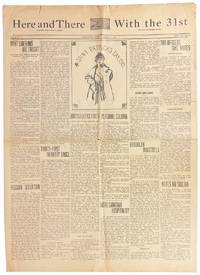
1919réf. 47912Vladivostok Siberia: 31st Infantry Regiment 1919. Very Good -. Vladivostok Siberia: 31st Infantry Regiment 1919. First Edition. Oversized tabloid 59.5cm; 6pp. Folds chips and a few splits along edges; paper toned and a bit brittle; Good to Very Good. Quite scarce publication from the 31st Infantry Regiment published "Every Once In A While" "Wherever We Happen To Be." This issue was published during the Russian Civil War and the United States' failed Siberian Intervention. The paper itself is full of local and international news and leads with an article "What Siberians Are Taught: One Paper Says America Treats the Russians in the Same Way as Negroes." We find three holdings in OCLC at the Hoover Institution Montana State and U.S. Army War College. 31st Infantry Regiment unknown books
1946réf. SKU1037749England: Privately Printed 1946. Hardcover. Good/Good. Dust jacket is wrapped- jacket has minor wear with a chip to the rear bottom corner. Bound in green leather. Clean has a good binding no marks or notations. All foldouts are in very good condition. Front endpapers are mapped Normandy. 275 pages. Privately Printed hardcover books
1809réf. 66435London: printed for Richard Phillips Bridge Street Blackfriars 1809. First edition 8vo pp. 2 ii 288 16 Phillips catalog; folding frontispiece map 2 other folding maps; original blue paper-covered boards printed paper label on spine; front endpapers and frontispiece dampstained spine worn with small chips out label chipped with loss of one letter; a good sound and but for the initial dampstains clean copy. On the front pastedown is armorial bookplate for Robert Montgomery / Convoy. Wikipedia notes that "The Walcheren Campaign was an unsuccessful British expedition to the Netherlands in 1809 intended to open another front in the Austrian Empire's struggle with France during the War of the Fifth Coalition. printed for Richard Phillips, Bridge Street, Blackfriars unknown books
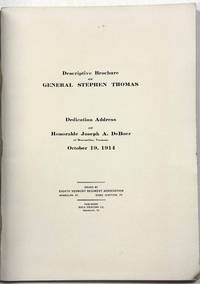
1914réf. 41864Randolph VT: Buck Printing Co. 1914. 32 4 pp. Original staples original printed wrappers. Printed on glossy paper with frontispiece photo illustration of General Stephen Thomas tissue guard other full-page photo illustrations. Very Good. The heroism of this Vermont Regiment during the Civil War. Buck Printing Co. unknown books
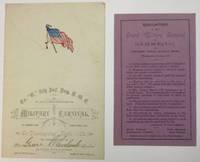
1885réf. 37814Santa Rosa 1885. Engraved invitation top flap with color illustration of American flag. Bottom half in several elegant type styles and fonts. "Grover Cleveland" in manuscript. Mild wear Very Good. offered with REGULATIONS OF THE GRAND MILITARY CARNIVAL OF CO. E. 5TH INF. REG. N.G.C. AT ARMORY RINK SANTA ROSA THANKSGIVING EVENING 1885. Small broadside 3-1/2" x 5-3/4" on purple paper listing rules 1-9 with ticket prices Floor Tickets $2; Spectators' Tickets $1. Very Good. The elegant Invitation is from the National Guard Corps on Thanksgiving 1885. Whether President Cleveland made the trip from Washington to Santa Rosa is doubtful. Regulations required guests to be "masked and in costume." Moreover "Sharp weapons must be secured to the scabbard. Firearms examined by the committee. unknown books
réf. 96173Very Good. These two orders are printed on the rectos of two adjoined leaves as folded. Versos are blank. Modest browning and wear. 31 cm. A General Court Martial had been convened on Sept. 6 at which John D. Jaques Surgeon of the First Regiment was convicted and adjudged to be cashiered. Jaques appealed to the commander who disapproved to some portion of the conviction whereupon General Steddiford revived the court and ordered it to re-assemble and review its proceedings. We don't know why Jaques was being court martialed why the review was ordered or the ultimate resolution of the proceedings against Jaques. unknown books
réf. 88028Very Good. Two vertical creases where folded. Oblong 22cm. Thompson then serving as a white officer in an African American regiment spent most of his Army career in the American Southwest and also served with U.S Forces in the Philippines. He retired as a Brigadier General in 1905. unknown books
1866réf. 44820New York 1866. First edition. Very good minor tears along folds light soiling. 1 sheet. 9 x 14.5 inches. "Report of Recruiting Committee" completed and signed July 5th 1866 by Alex Morrison Henry J. Mansfield and by representatives of the Recruiting Committee on August 7th 1866. "The 9th Regiment was first formed on June 24 1799 as the "6th Regiment of Infantry N.Y.N.G.The 9th Regiment participated at intervals in the War of 1812. On May 29 1850 the unit became known as the "9th Regiment New York State Militia" and due to the large percentage of Irish soldiers within the regiment it was given the nickname "the Irish Ninth.".Between 1861 and 1864 the 9th Regiment saw combat during the Civil War and fought under the name of the "83rd New York Volunteer Infantry Regiment.". It was attached to the Army of the Potomac and participated in dozens of actions from 1861 to 1864 including the battles of Antietam Fredericksburg Chancellorsville Gettysburg the Wilderness Spotsylvania Court House and Cold Harbor to name some of the more famous engagements" See New York State National Guard 9th Regiment Collection MS 3085 New-York Historical Society. unknown books
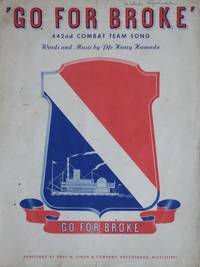
1944réf. List2436Hattiesburg: Earl M. Finch 1944. Sheet music measuring 12 x 9 inches 4 pp. Signature of a Nabuko Hayashida on front cover. Slight tears at fold some toning two small pinholes very good overall quite attractive. Very Good. In Hawaii in May 1942 a battalion of Nisei volunteers was assembled for service in World War Two despite earlier failures of efforts to recruit Japanese-Americans due to the Army’s labeling of Nisei recruits as 4-C enemy aliens. Designated as the 100th Infantry Battalion they were deployed to North Africa in June 1943 integrating with the 34th Division in active combat. Their subsequent deployment to Italy in September 1943 exposed them to intense warfare earning them the moniker of the "Purple Heart Battalion" due to their notably high casualty rate. In January 1943 the U.S. War Department officially declared the establishment of the segregated 442nd Regimental Combat Team RCT which was comprised of Nisei volunteers originating from Hawaii and the mainland. The culmination of this initiative transpired in June 1944 when the 442nd RCT merged forces with the 100th Infantry Battalion in Europe subsequently absorbing the latter into its structure. The notable achievements of Nisei soldiers in combat operations prompted the reinstatement of the draft in January 1944 specifically targeting Nisei detainees to augment the ranks of the 442nd. Over time the 442nd RCT expanded to encompass the 2nd 3rd and 100th Battalions; the 522nd Field Artillery Battalion; the 232nd Engineering Company; the 206th Army Band; Anti-Tank Company; Cannon Company; and Service Company. Offered here is a very scarce piece of sheet music entitled “Go For Broke” which was written by the Hawaiian musician Harry Hamada reflecting the slogan of the 442nd and performed by Shelby and others during the war as part of efforts to boost morale. Hamada would feature in the 1951 movie “Go For Broke” as Masami alongside several other veterans of the 442nd. This publication of “Go For Broke” is from 1944 seven years before the movie’s release. The piece is dedicated to Colonel C.W. Pence. Hamada was a Hawaiian musician who performed with a band called the Shelby Hawaiians or the Shelby Serenaders. They performed as early as 1943. The Hattiesburg Mississippi merchant Earl M. Finch who ran an Army and Navy store close to Camp Shelby befriended Hamada and other members of the 442nd and acted as a sponsor for the group and eventually published this version despite his business being a dry goods merchant house and not a publishing house. The group with the support of Finch performed throughout the country to lift morale. At some point Hamada penned this composition likely in 1944 as we find no reference to it in 1943 articles and Finch published it - Hamada’s composition would become the theme song of the 442nd and Hamada would perform at the Halloran General Hospital in New York and the Walter Reed Hospital in Washington D.C. in 1944 likely performing this composition. Another composition called “Go For Broke” exists as well and it is unclear to what degree Hamada’s work caught on among the regiment. We find two records of Finch’s published version of the composition one listed as part of an online remembrance of the 442nd by the Smithsonian Institution https://americanhistory.si.edu/explore/stories/day-remembrance-70-years-after-executive-order-9066 which appears to have been on loan from the National Japanese American Historical Society and another copy held at Stanford though not listed in OCLC. Finch’s story is also interesting and is the subject of a remembrance on a 100th Battalion History page online https://www.100thbattalion.org/history/stories/earl-finch/. We find no copies listed in OCLC. Overall a very scarce piece of Japanese-American wartime history. Earl M. Finch unknown books
1890réf. 1410180Chicago: The Craig Press 1890. Hardcover. Octavo 129 pages. In Fair minus condition. Spine is red with gold print. Boards in red cloth gold print mitred edges; tattering to spine caps and corners blemishes toning shelf wear cocked spine. Text block has cracked hinges front flyleaf loose intermittent spine breaks light age toning to paper. Illustrated: b&w frontispiece and plates photographs with tissue guards. NOTE: Shelved in Netdesk Column Z. 1410180. FP New Rockville Stock. The Craig Press hardcover books
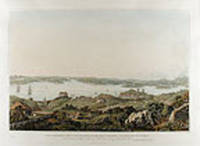
réf. 14757Three plates engraved by Robert Havell and son printed by Edward Egerton-Williams in colours and finished by hand each with printer's blindstamp. From an edition limited to 110 copies printed from the original printing plates in 1988 employing the same techniques as used in 1823. This fine edition was published as a collaborative effort between the State Library of New South Wales and the renowned fine art publishers Alecto Editions. "By 1820 Sydney was a town of 12000 inhabitants about a third of whom were convicts. It had grown dramatically during the administration of Lachlan Macquarie who was appointed governor of New South Wales in 1810. Unlike previous governors Macquarie was not content merely to oversee a penal colony. His vigorous building programme changed forever the appearance of Sydney while his policy of accepting emancipated convicts as respected citizens demonstrated a social attitude strangely out of step with the times. Both these policies earned him criticism. In 1819 alarmed by Macquarie's extravagant public works the British Government commissioned a lawyer and civil servant J.T.Bigge to investigate. The attacks by his critics were met head on by Macquarrie's supporters in New South Wales. Books pamphlets and paintings luded the governor's undoubted achievements. Almost certainly Major Taylor's drawings were used in if not commissioned for this cause. The engraved views of the Panorama present a flattering image of the Australian seat of government and by extension of Macquarie's term there.Taylor arranged the engraving and printing of the of the three sheet Panorama. upon his return to England in July 1822.Havell appears to have worked from Taylor's. large watercolours but amended them with additional details. and decorative elements.It is most fortuitous that the copper plates.have survived. There is no other example of such a case for 19th century Australian engravings. unknown books
1992réf. 198460Gilroy Ca; various US cities: alumni" associations 1992. Substanial packet of newsletters survivor directories job opportunities aviation museum brochures reunion association cards and printouts a holograph note with a color family snapshot a licenceplate-sized logo on thick plastic offers of memorial coins many items in original envelopes addressed by hand. Backbone of collection are nos. 1-14 of "Newsletter Kingsmen" published out of Gilroy each ten or twelve pages corner-stapled. The Kingsmen were a helicopter unit in Vietnam. Also of research significance two issues of "Behind the Lines The Journal of U. S. Military Special Operations" these very professional and meaty premier issue Nov-Dec '92 and subsequent number. Recipient lived in this period in Rocklin Ca. One scrap of poetry "So my mind acting like a bomb I realize I'm not home from Nam;" otherwise veteran's stories what-we're-doing-now etc. Items are in very good to fine condition packet is easily an inch thick. alumni" associations unknown books
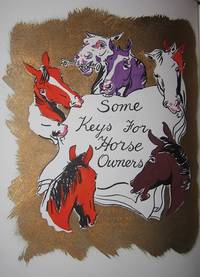
1928réf. 003636London: Country Life Ltd 1928. First Limited Edition. Full Pictorial Pigskin. Near Fine. No. 65 of 150 Edition de Luxe limitation signed by author and the illustrator using his pseudonym. 4to. 11.5 by 9.5 inches 29 by 24 cm. 240 6 pp. The illustrations through the body of the work are sprightly colorful fun and perfect exemplars of a twenties to thirties highball sophisticated aesthetic -- a sporting extension of the sleek look associated with thirties screwball comedies and musicals! The book makes riding and all its mishaps seem like one endless lark a party in which nothing really bad could possibly intrude. This is the kind of work that everyone will have a favorite image but few can not but admire the frontis of horses' heads awash with a gilt border. Much of the illustration by the way appears as if it were applied directly by hand and this slapdash manuscript quality greatly adds to the charm of the production. The pigskin binding has a film of soiling but remains attractive especially with its inked title and inkwell and feather quill pen imagery. With also a letter from the publisher. Country Life Ltd unknown books
réf. 14891A fine pair of plates engraved by Robert Havell and son printed by Edward Egerton-Williams in colours and finished by hand each in very good condition "The Town of Sydney" with a slightly greyer paper tone. From an edition limited to 110 copies printed from the original printing plates in 1988 employing the same techniques as used in 1823. This fine edition was published as a collaborative effort between the State Library of New South Wales and the renowned fine art publishers Alecto Editions. "By 1820 Sydney was a town of 12000 inhabitants about a third of whom were convicts. It had grown dramatically during the administration of Lachlan Macquarie who was appointed governor of New South Wales in 1810. Unlike previous governors Macquarie was not content merely to oversee a penal colony. His vigorous building programme changed forever the appearance of Sydney while his policy of accepting emancipated convicts as respected citizens demonstrated a social attitude strangely out of step with the times. Both these policies earned him criticism. In 1819 alarmed by Macquarie's extravagant public works the British Government commissioned a lawyer and civil servant J.T.Bigge to investigate. The attacks by his critics were met head on by Macquarrie's supporters in New South Wales. Books pamphlets and paintings lauded the governor's undoubted achievements. Almost certainly Major Taylor's drawings were used in if not commissioned for this cause. The engraved views of the Panorama present a flattering image of the Australian seat of government and by extension of Macquarie's term there.Taylor arranged the engraving and printing of the of the three sheet Panorama. upon his return to England in July 1822.Havell appears to have worked from Taylor's. large watercolours but amended them with additional details. and decorative elements.It is most fortuitous that the copper plates.have survived. There is no other example of such a case for 19th century Australian engravings. unknown books
réf. 14758London: Alecto Editions and the State Library of New South Wales 1988. Originally engraved by Robert Havell and son printed by Edward Egerton-Williams in colours and finished by hand with printer's blindstamp. "By 1820 Sydney was a town of 12000 inhabitants about a third of whom were convicts. It had grown dramatically during the administration of Lachlan Macquarie who was appointed governor of New South Wales in 1810. Unlike previous governors Macquarie was not content merely to oversee a penal colony. His vigorous building programme changed forever the appearance of Sydney while his policy of accepting emancipated convicts as respected citizens demonstrated a social attitude strangely out of step with the times. Both these policies earned him criticism. In 1819 alarmed by Macquarie's extravagant public works the British Government commissioned a lawyer and civil servant J.T.Bigge to investigate. The attacks by his critics were met head on by Macquarrie's supporters in New South Wales. Books pamphlets and paintings luded the governor's undoubted achievements. Almost certainly Major Taylor's drawings were used in if not commissioned for this cause. The engraved view presents a flattering image of the Australian seat of government and by extension of Macquarie's term there.Taylor arranged the engraving and printing of the of the three sheet Panorama. upon his return to England in July 1822.Havell appears to have worked from Taylor's. large watercolours but amended them with additional details. and decorative elements.It is most fortuitous that the copper plates.have survived. There is no other example of such a case for 19th century Australian engravings. Alecto Editions and the State Library of New South Wales unknown books