Regiment, Members Of the,Biblio.com

1317 risultati
rif. 41646158-nnew. unknown
2020rif. 1-333792154Xhansebooks 2020. Paperback. New. 692 pages. 8.50x6.56x1.56 inches. hansebooks paperback
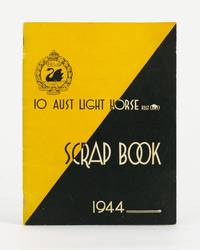
1944rif. 146426Perth: The Regiment 1944. First Edition. Paperback. Very Good. Perth The Regiment 1944. Quarto 36 pages with numerous illustrations mainly from photographs but with some cartoons by the editor plus text on the inside front cover. Two-colour pictorial wrappers in the regiment's yellow and black colours; covers slightly creased and marked with minimal surface loss to silverfish confined mainly to the plain rear one; a very good copy. A few pages are devoted to the regiment's WW1 precursor the 10th Light Horse. A rarity; not in the standard bibliographies. The Regiment paperback
2010rif. DADAX1165870789Kessinger Publishing 2010-09-10. hardcover. New. 6.00x1.31x9.00. Buy with confidence. Excellent Customer Service & Return policy. Kessinger Publishing hardcover
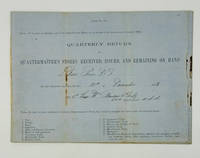
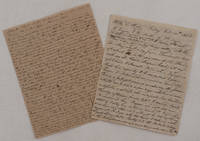
rif. MA46Folio bifolium ca. 375x22 cm or 14 ½ x 8 ½ in. 3 pp. Printed form completed in manuscript. Brown ink on creamy lined wove paper; several titles underscored in red. Foldmarks several minor holes on folds several minor tears on extremities but overall a very good document written in a legible hand. Fort Rice D.akota T.erritory 31 December 1878. Oblong Folio ca. 20x275 cm or 7 ¾ x 10 ¾ in. 14 leaves fastened with a thread 2 blank. T.p. 10 1 pp. Printed form completed in manuscript. Brown ink on blueish lined wove paper; several titles underscored in red. Foldmarks all leaves with long narrow holes apparently caused by fire on one of the folds affecting the text on at least six leaves minor losses on the blank margins of the first four leaves not affecting the text otherwise a very good document written in a legible hand. Historically significant collection of two original documents recording the expenses for personnel and supplies in the U.S. Army’s stations in the Dakota Territory - Standing Rock Cantonment since 1878 – Fort Yates and Fort Rice on the Upper Missouri River south of Mandan Morton Co. – shortly before and after the Great Sioux Black Hills War of 1876. Both documents were compiled and signed by a U.S. Army career officer and Civil War veteran Lieutenant William Badger. A son of William Badger Sr. the Governor of New Hampshire in 1834-36 he graduated from Dartmouth College in 1848 and worked with several New Hampshire companies Union Manufacturing Co. in Gilmanton Tilton Manufacturing Co. in Tilton &c. During the American Civil War he served in the 4th and later the 9th New Hampshire Volunteer Regiments. In 1866 Badger Jr. was commissioned as a lieutenant in the 6th U.S. Infantry and served with them until his retirement in 1889 See: Babcock E. A War History of the Sixth U.S. Infantry from 1798 to 1903… Kansas City 1903 pp. 107 115 129. During the height of the Sioux Wars in the 1870s Badger served as a quartermaster in several U.S. military posts in the Dakota Territory including Fort Buford and Fort Abraham Lincoln – in the latter when Lt.-Col. George Armstrong Custer’s 1839-1876 7th Cavalry Regiment was stationed there preceding the Battle of the Little Bighorn Fort Life in ‘70’s Recalled// The Fargo Forum. Fargo N.D. 28 July 1929 p. 9. William Badger and Custer were acquainted and the former’s son William Cogswell Badger 1857-1897 then a 19-year-old man “accompanied Lieut. Col. George A. Custer on his expedition into the Black Hills to discover the truth of the rumor of fabulous amounts of gold in the summer of 1874” William C. Badger Pioneer N.D. Man is Dead at Toledo// The Bismarck Tribune January 20 1937 p. 2. In the 1880s William Badger served in Fort Leavenworth Kansas See more about his biography in: Jameson E.O. The Cogswells in America. Boston 184 pp. 207-208; see more. The earlier document was compiled in the Standing Rock Cantonment of the U.S. Army which was renamed Fort Yates in 1878 and is now the headquarters of the federally recognized Standing Rock Sioux Tribe. The “Abstract of Expenditures at the Standing Rock Cantonment” is dated December 1875 about half a year before the Battle of the Little Bighorn which resulted in an overwhelming defeat of the U.S. forces and the death of George Custer. The document lists the vouchers paid to “Citizen Employees” an “Interpreter” and for “Extra Duty Mess” for the total amount of $160168. The second document is a 10-page “Quarterly Return of Quartermaster’s Stores Received Issued and Remaining on Hand at Fort Rice in the Quarter ending on the 31st of December 1878.” Badger records the movement of supplies in over a dozen categories: fuel soft wood forage oats corn hay stationery various paper envelopes ink wax pens quills pencils office tape erasers paper folders rubber bands sandboxes letter press & many others barrack & office furniture clock cooking and heating stoves field desks iron safe ice box lockers pans for frying and baking tables tea kettles &c. means of transportation ambulances army wagons blankets saddle brooms a “ferry boat” horses mules jockey sticks “yawl boat” “bob sledges” &c.; veterinary blacksmiths’ carpenters’ masons’ and bricklayers’ saddlers’ tools miscellaneous tools brass sundial hay forks and scales lifting jack paint brushes rubber fire buckets scythes wood saws &c. machinery belting assistant circular saws gumming machines horse medicines and “stores for expenditure” bolts bridle leather cotton twine harness rings horse shoes nails nuts oars rope rivets tar coal wax black & many others. Overall an important collection of original documents providing a compelling insight into the everyday life of the U.S. military posts in the Dakota Territory shortly before and after the Great Sioux War of 1876. An archive of original William Badger’s documents created during his service as a quartermaster in the 6th Infantry in the Dakota Territory is deposited in the special collections of the State Historical Society of North Dakota see more. hardcover
2009rif. 129422Brisbane: A. Green 2009. Hardcover. Fine. Brisbane A. Green 2009 facsimile edition/ 1921. Octavo 344 pages plus 3 maps 2 folding 61 pages of plates containing 86 plates in all and 7 folding maps in an endpocket. Quarter cloth and papered boards with the battalion's colour printed on the front cover; corner-tips of the last few leaves slightly curled; essentially a fine copy. Number 9 of only 400 copies. Dornbusch 399; Fielding and O'Neill page 233; Trigellis-Smith 280 all referring to the original edition. A. Green hardcover
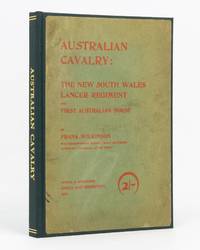
1901rif. 129531Sydney: Angus and Robertson 1901. First Edition. Hardcover. Fair. Sydney Angus and Robertson 1901. Quarto x 64 pages with an illustration plus 8 plates but lacking the colour frontispiece called for by Dornbusch. Modern binder's cloth with the front panel of the original green wrapper printed in red mounted on the front board; text block tide-marked near the head of the spine with the plates a little stained; some discolouration and foxing heavy in places; minor signs of age and use; a decent copy of an absolute rarity. This history of these two cavalry units from their foundation through to the end of the Boer War is 'undoubtedly a regimental record but it is something more - it is an attempt to explain and to some extent combat the unreasoning prejudice which has grown up as a result of the South African campaign against the cavalry arm of the service. On this point Mr. Wilkinson says:- "It is my purpose to show not only that cavalry regiments like the New South Wales Lancers have done equal yeoman service to the Empire in the South African struggle with their comrades in the other branches of the service but that they have done infinitely more as the pioneers of the cavalry movement in Australia to enhance the value of our defence force and to shew the world of what fighting stuff our men are made"' from a review in the 'Daily Telegraph' 12 October 1901. The last 18 pages contain numerous appendices including nominal and casualty rolls. Dornbusch 126; Fielding and O'Neill page 126. Angus and Robertson hardcover
rif. 131661Very Good. A single leaf octavo printed recto only slightly marked with a marginal crease to a top corner; two light horizontal creases where folded for posting; in very good condition. The invitation headed '9th L.H.O.C.A.' 9th Light Horse Old Comrades Association invites members to give a hearty welcome to the old commanding officer Colonel William Henry Scott 1881-1960 who 'will be in Adelaide for a few days this month on a visit to his son'. The date for the event is not given but we suggest some time in the 1920s as Scott 'rose to brigadier in 1929' 'Australian Dictionary of Biography'. Darley writes presumably as president of the association that 'it will be quite informal come along in your working clothes or anyhow you like and you need not get your hair cut for the occasion. If you clean your boots be sure to use NUGGET. Refreshments liquid only will be provided'. The ADB provides the answer to the unasked question: 'Scott contributed items to the "Bulletin" under the pseudonym of "Nugget" an ironic nickname considering his great height'. Dornbusch 384; Fielding and O'Neill page 233; Trigellis-Smith 279. unknown
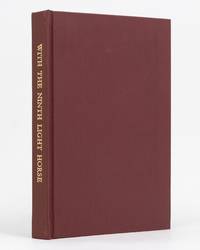
1942rif. 129472Brisbane: William Brooks and Co 1942. First Edition. Hardcover. Fair/Fair. Brisbane William Brooks and Co. 1942. Octavo xvi 186 pages with an illustration and 4 maps plus 67 pages of plates containing 108 plates in all; the regimental colour patch is printed in three colours on the title page. Maroon sand-grain cloth lettered in gilt on the spine and front cover; cloth a little stained and rubbed with two small worm holes to the spine and front cover with some short tracks visible on the front pastedown; edges marked; binding a little shaken and cracked between some gatherings; trifling remnants of the original tipped-in plain opaque paper dustwrapper on the leading edges of the pastedowns as often; minimal adhesive residue to one page from an old insert; paper a little tanned; some scattered foxing; overall a decent copy. This is a rare item with provenance from two light horsemen. An inscription on the front free endpaper reads: 'Originally owned by the late 868 Corporal Jack Ledlie but given to me by his widow Olive. Clive Kynaston. 512 - 12th ALH'. A second inscription in the same hand at the head of one of the contents pages indicates that he later presented the book to '2/14 QMI' Queensland Mounted Infantry. The author was Signal Sergeant of the Regiment. Dornbusch 393; Fielding and O'Neill page 233; Trigellis-Smith 282. William Brooks and Co hardcover
rif. 129496No Place: No Publisher. Hardcover. Fine. No Place No Publisher circa 1990s undated xerographic facsimile edition/ 1980s facsimile/ 1924. Octavo viii 206 pages plus 28 pages of plates. Binder's cloth lettered in gilt on the spine; small ownership label to the front pastedown; a fine copy. A xerographic facsimile read photocopy produced from a copy of the Burridge facsimile edition circa 1980s. See Dornbusch 384; Fielding and O'Neill page 233; Trigellis-Smith 279. No Publisher hardcover
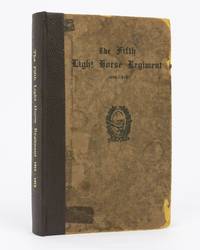
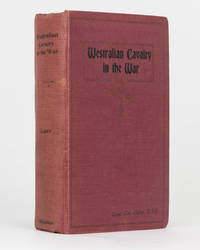
1926rif. 129485Sydney: The Motor Press of Australia Limited 1926. First Edition. Hardcover. Sydney The Motor Press of Australia Limited 1926. Octavo 232 pages with a facsimile letter plus 3 plates portraits of the Commanding Officers and 7 folding maps on 4 leaves in an end-pocket. Printed papered boards later rebacked in brown cloth lettered in gilt; original boards marked stained and worn at the extremities with a heavy bump to the leading edge of both covers; new endpapers and rear endpocket; edges foxed with scattered foxing throughout; small light tidemark to the top margin of the plates and a few leaves; folding maps tidemarked and worn with some chipped edges stabilized with archival tape; signs of age and use but overall a presentable copy of a very rare book. The retained original front flyleaf carries the contemporary ownership details of 'Staff Sergt U J Cunneen Late 5 L.H. 295' June 1926; two other family members have added their details later and one of them has put a relevant annotation on an early page. 'Saddler/Sergeant Urban James Cunneen' appears in the nominal roll see page 176. Dornbusch 404; Fielding and O'Neill page 232; Trigellis-Smith 276. The Motor Press of Australia Limited hardcover
rif. 99394Paris Plon 1916. 8° 48 S. m. zahlr. Abb. Geheft. Tadell. Text. franz. 010 Paris, Plon, 1916 unknown
rif. M53HMS Thalia “18 leagues to the North of St. Jago” 20 October 1805 and Colombo Fort 21 June completed 2 September 1806. Both Octavos ca. 23x18 cm and 25x20 cm. Each 3 ½ pp. Both addressed and sealed on the last pages. Brown ink on watermarked laid and white paper. Fold marks both letters with minor holes on the 4th pages after opening affecting several words; second letter with tears and minor holes on folds but overall very good letters. Two extensive letters giving an interesting firsthand account of the early British rule in Sri Lanka the British occupied former Dutch possessions on the island only ten years earlier in 1795. The first letter describes Cleather’s voyage to Ceylon from England on board HMS Thalia with the notes on the heat of the gun room‚ the frigate’s captain Walker Santiago Island Cape Verde where they got fresh supplies and water social life on board the ship et al. “I sleep every night in the most tantalizing situation you can possibly imagine Rayner having strung my cot in the after gun room in the midst of <…> chests of dollars to the amount of 40.000 £ which they are taking out for the Company there is 400.000 £ standing more below.” The second letter completed almost a year later gives an inside look into the life of British military and civil society on Ceylon shortly after the end of the First Kandyan War 1803-1805. Cleather praises the Colombo garrison’s chaplain Reverend W.H. Heywood in whose house he started writing the letter notes that he has dined with the “Chief Secy. Mr. Arbuthnot the 2nd personage in the Island” and mentions “innumerable” balls and suppers to which “I am constantly invited.” His regiment “is stationed about ten miles from the Fort <…> I have a small house but very comfortable near the parade & not far from a pretty little Cot.tage of Heywoods where he generally resides – for this I pay two guineas a month nothing here.” Cleather mentions that the Regiment which consists of sepoys trains a lot because it is expected to be reviewed shortly; notes on his relation with his colleague officers – Lieut.-Col. T.W. Kerr who “has an unfortunate disposition to talk scandal” Fort Adjutant Mr. Stewart officers wives and daughters and others. “I do not much … the heat and have never had a day’s illness since I landed in the Island. I had no duty for two or three months at first being laid up with hurts in my legs. This is common enough & is thought nothing of it is long since over…” Captain W.H. Cleather of the first Ceylon Regiment was educated at Exeter College Oxford and arrived in Ceylon in 1805. Through his sister Mary Littlehales to whom the letters are addressed he was a brother-in-law of Vice-Admiral Bendall Robert Littlehales 1765-1847 a participant of the Napoleonic Wars and Captain Edward Littlehales 1805-1888 a commander of HMS Dolphin on the coast of West Africa during the suppression of the slave trade in the 1840s. During his career in the British Ceylon he served in different Ceylon Regiments was the Fort adjutant at Galle Jaffna and Colombo. He took part in military actions during the Uva Rebellion 1817-1818 and for many years served as Deputy Judge Advocate in Ceylon. hardcover
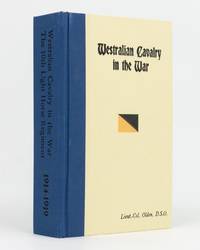
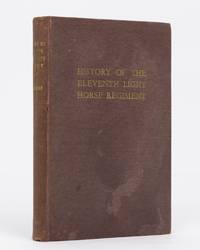
1921rif. 122313Melbourne: Alexander McCubbin 1921. First Edition. Hardcover. Very Good. Melbourne Alexander McCubbin 1921. Octavo 343 1 colophon pages plus 3 maps 2 folding 86 plates and 7 folding maps in a rear endpocket. Decorated cloth a little stained on the rear cover and lightly stained and sunned on the spine; endpapers offset; trifling signs of age and use; a very good copy internally excellent. The two-page foreword by Lieutenant-General Sir Harry Chauvel describes the author thus: 'Lieut.-Colonel Olden is well qualified to undertake the work as joining the Regiment on its inception he served with it throughout the War and though twice wounded was never long away from duty. He temporarily commanded it during the absence wounded of Colonel Todd on more than one occasion notably during the 2nd Battle of Gaza and finally succeeded to the command after the death of Colonel Todd'. He was awarded the DSO. Dornbusch 399; Fielding and O'Neill page 233; Trigellis-Smith 280. Alexander McCubbin hardcover
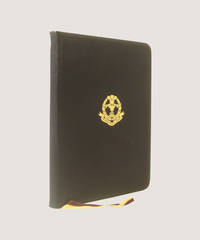
1922rif. 4654Aldershot; Gale & Polden for the Regiment 1922. 1922. Hard Cover. Quarto. xii 92 pp. Frontispiece of the Memorial at Mill Hill Barracks plus plates of its Unveiling ceremony and of the Tablet in St Paul's Church at Mill Hill. Navy blue leatherette over cushioned boards; gilt crest to upper board gilt dentelles; all edges gilt; deep blue silk moire end-papers. Two-tone yellow and brown silk placemarker. Spine very lightly rubbed at head. Scattered light foxing otherwise a clean copy; no annotation or inscriptions. Very good. A scarce honour roll containing the names of the men who served as part of the Middlesex Regiment in the First World War. An essential document for an historian of the regiment. Aldershot; Gale & Polden, for the Regiment, [1922]. hardcover
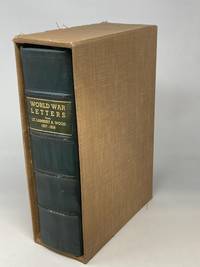
1918rif. 88062Self-Published 1918. Manuscript. Very Good Plus. Half-bound dark green morocco over light brown woven linen. A large sturdy hand-crafted book with sewn signatures 11 3/4 in. x 8 in. x 3 in. housed within a sturdy wooden slipcase covered with woven linen matching the cover of the book itself. Letters envelopes official documents etc. are displayed behind within clear plastic "jackets" each mounted to individual pages of thick card stock. The large tipped in photo shows some spotty residue and the slipcase shows a bit of edgewear. The archive consists of 77 detailed letters written by Lieutenant Wood 9th Infantry Regiment 2nd Division was killed in action southeast of Soissons France on July 18 1918 while in command of his machine gun platoon on a flank movement against an enemy group which was enfiltrating the advancing infantry line. This copy includes a tipped-in photograph of Lambert Wood opposite the title page and a tipped-in handwritten presentation slip written and signed by his mother Northwest author Elizabeth Lambert Wood "With the compliments of soldier-author's mother. Elizabeth Lambert Wood". A collection of remarkable letters written by Lambert Alexander Wood 1895-1918 who served with the Machine Gun Company 9th Infantry Regiment 2nd Division reflecting an extraordinarily deep and philosophical grasp of both the lofty purpose justification and horrors of war "I am fighting for our very civilization" with none of the details left out "I have seen men die smiling." or "I haven't been out of my clothes for 30 days." . Roughly half of this notable 77-letter archive are addressed to both parents with some addressed individually to "Mother" "Father" "Dad" and the other half -- 36 letters -- addressed to M.S. his sweetheart. Woven throughout so many of the letters is Wood's profound and unstoppable sense of duty and responsibility and consistent view of himself as a crucial component of a much larger grand effort than merely his individual self -- one utterly dependent upon his steady and ferocious all-in participation. Further as an officer he felt his comportment had to be visibly far and above that required of the ordinary soldier . On a number of occasions he mentioned to M.S. that he deprived himself of sleep and duly awarded leave because he felt compelled to set an example; yet their seems to be no trace of egoism or grandstanding; Lambert Wood was fighting the good fight the real fight and coming to realize and mentioning that it was the brave two-fisted men who would win this very tough war. In his devoted sweet letters to M.S. he explains both the logistics of his various responsibilities and placements -- instructor in gas warfare for example -- and seldom neglectsto delve deeper into the reasons behind war as if in explaining it to his beloved and perhaps to himself. The young man was clearly a highly articulate writer who is able to clearly convey the American sense of righteousness against a loathesome enemy. Somewhat alarmingly reading through the letters one sees this soldier-leader's growing -- it must be called "joy" for he himself terms it so in this and other synonymous words in KILLING the enemy the cold and dispassionate"otherizing" which steadily grows to supplant his still youthful and natural 23-year-old nnocence and permits the taking of human life behind a script of justification. Reading through this archive one follows the horrific yet fascinating path through the eyes of an educated privileged young man from Portland Oregon as he gradually transforms into a focused and efficient killing machine a capable and effective instructor and leader of other men who had no choice but becoming the same if they were to survive. Their unit was the first in the actual trenches. Lambert Alexander Wood was the son of Dr. William Lee Wood a physician and Elizabeth Lambert Wood a Northwest author best known for her adventure stories for boys. His grandfather was J.H. Lambert Oregon pioneer horticulturist and originator of the Lambert Cherry. He grew up in Portland Oregon. While attending Williams College in Massachusetts Wood enrolled in the volunteer pre-enlistment training program in Plattsburgh New York as part of the "Preparedness" movement before actual U.S. involvement in World War I sailing for France in March of 1917. Note: Two books that contain excerpts from these letters were published and are included with the purchase of this letter-archive: The first entitled "His Job: Letters Written By A 22 Year-Old Lieutenant In The World War To His Parents And Others In Oregon" was published in 1936 by the Metropolitan Press of Portland OR. The second book is entitled "Certain Brief Conclusions: From Selected Letters Of Lambert Wood" which was issued by publishers Binfords & Mort Portland OR in 1939 and also printed by the Metropolitan Press in Portland OR. Self-Published unknown
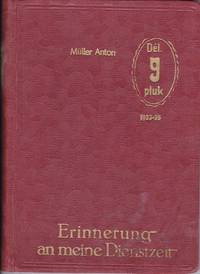
1933rif. 9101C1933. Tschechoslowakei. 1933-35. ca. 205 x 15 cm. ca. 80 S. Original-Leinen mit goldgeprägtem Deckeltitel. Einband leicht berieben Deckel etwas gebogen. Innen zahlreiche private ganzseitige Einträge und Illustrationen. Altersentsprechend guter Zustand. Das Album zur Dienstzeit eines Soldaten besteht aus deutschsprachigen Einträgen von Kameraden zum Zwecke der Erinnerung an die gemeinsame Dienstzeit und aus Einträgen des Albumeigners selbst. Diese Einträge sind teils tagebuchartig teils sind es eher Verse zur Selbsterbauung. Die Einträge sind datiert und stammen meist aus 1934-1935. Die Soldaten waren scheinbar in ihrem Wehrdienst und wurden geschult die Naivität der Einträge scheint keine Berührung mit irgendeinem Kampfeinsatz zu kennen. Genannt sind Orte wie Nitra Zilina und Malazky welche allesamt in der heutigen Slowakei liegen und damals der Tschechoslowakei in den Jahren zwischen 1918 und 1938 zugehörten. Die Einträge sind alle in deutscher Sprache verfasst oft auch eher etwas holprig. Es scheint sich um das Album eines Deutschböhmers und Sudetendeutschen zu handeln der im Rahmen seiner tschechoslowakischen Soldatenzeit an diese Orte versetzt wurde. In mehreren Einträgen werden auch die Sehnsucht nach der Heimat und das Deutschsein zum Ausdruck gebracht. Ein längerer Eintrag des Albumbesitzers etwa zur Mitte des Albums trägt den Titel "Ein Deutscher Spruch!". Der mehrstrophige Text lautet: "Wenn alles reist wenn alles bricht du Deutsches Herz versage nicht. Versage nicht du Deutsches Land vergiss nicht unsere Bruderhand. / Versage nicht du Deutsches Herz versage nicht in Leid u. Schmerz. Denn einmal kommt die Zeit wo mann uns Deutschen doch befreit. / Halte Deiner Heimat heiligerscholle Deutsch soll sie bleiben komme was wolle komme was wolle Freud oder Leid Deutsch soll sie bleiben in Ewigkeit!" Es sieht so aus als hätte dieser Soldat das Jahr 1938 und den Einmarsch der Wehrmacht am 1.10.1938 kaum erwarten können. Interessante historische Archivalie privater Hand aus der Tschechoslowakei vor 1938! =================== LIEBE KUNDEN ICH MACHE MEINE DIESJÄHRIGE HERBSTAKTION MIT 30% AUF DEN GESAMTEN BESTAND. DIE AKTION LÄUFT BIS EINSCHLIESSLICH SONNTAG 25. OKTOBER. WICHTIG: DER 30%-RABATT WIRD ERST NACH IHRER BESTELLUNG ABGEZOGEN SIE ERHALTEN EINE EMAIL MIT DEN AKTUALISIERTEN ZAHLUNGSINFOS VON MIR. ICH FREUE MICH WIE IMMER AUF IHR INTERESSE AN MEINEN SELTENEN BÜCHERN ARCHIVALIEN UND UNIKATEN. ==================== unknown
2010rif. DADAX1165258676Kessinger Publishing 2010-09-10. paperback. New. 6.00x0.20x9.00. Buy with confidence. Excellent Customer Service & Return policy. Kessinger Publishing paperback
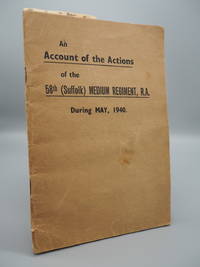
1940rif. C148336Poole: J. Looker 1940. Paperback . Very Good. Slim paperback. Slight creasing with slight rubbing at tearing at spine otherwise very good. Owner name to inside front cover. J. Looker, paperback
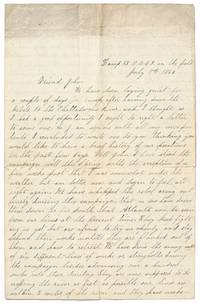
1864rif. 438776Atlanta Georgia 1864. Very Good. Autograph Letter Signed. Folio. 4pp. Partial splitting at the edges of one vertical and two horizontal folds about very good. A detailed and historically important long letter written in the field by Union soldier Harvey Rodgers just two weeks before he was killed at the Battle of Atlanta on July 22 1864. Rodgers was mustered into service in 1861 as a Corporal in the 54th Regiment Ohio Volunteer Infantry Zouaves Company A commanded by 1st Lt. Judson McCoy referred to as "Jud" in the letter. In the letter written to his "Friend John" on four easily legible folio pages Rodgers describes Confederate and Union Army maneuvers and skirmishes immediately after the Battle of Kennesaw Mountain fought from June 19 - July 2 1864 during the lead-up to the Battle of Atlanta which began on July 21st: ". Well John I have stood the campaign well this Spring . We have whipped the rebel army out finely . that is we have drove them so far South that Atlanta can be seen from our lines . I suppose you have heard about our making a charge on the 27th June . I do not wish to be in anymore such places . we lay in camp until the 2nd of July when our Division moved . very near due south of the Kennesaw mountain. That night Jud with our Company was on picket. We heard the cars very plain but did not think they the rebel army were evacuating the mountain and falling back . Next morning . We did not move forward until two o'clock when we advanced our lines two miles finding a small force of Cavalry in our front which we routed by charging them. The Regt. lost 1 killed 14 wounded ." He describes a second skirmish on July 4th at which his Company fought in support of the Union army's 16th Corps to advance Union lines and continues: ". On the 5th we were moved back again and brought further around on the right where we now lay. Our front lines are two miles further on. The rebels have a line of works between them and the Chattahoochee river . I expect we will have a pretty hard time before we get there and a hard time to cross the river ." The Battle of Atlanta commenced on July 21 1864. Both Harvey Rodgers and Union Maj. Gen. James B. McPherson were killed during the battle on July 22nd. Rodgers' letter thus ends poignantly: "Well John my time is fast rolling around now and I begin to think I will soon get home again. Only two months and 8 days more . Still in that short time there are many dangers to undergo. I may be called on to go into several more charges. Perhaps of some one not to come out alive . There has not more than half a dozen days passed since the 10th of May but what we have been under the sound of artillery. The troops appear to be pretty well worn out and wish for the campaign to close yet they all want to get into Atlanta first ." A compelling and ultimately heartbreaking eye witness account of General Sherman's Atlanta campaign during the summer of 1864. Longer quoted extracts from the letter are available. unknown
2007rif. DADAX0548276463Kessinger Publishing 2007-07-25. hardcover. New. 6.00x0.63x9.00. Buy with confidence. Excellent Customer Service & Return policy. Kessinger Publishing hardcover
rif. 64610730The Naval & Military Press . Papeback. New. pp. 378 The Naval & Military Press unknown
1862rif. es2009Providece: Sidney S. Rider 1862. Octavo burgundy cloth hardcover gilt letters 260 pp. Cracked hinges wear to covers; interior clean & tight. Sidney S. Rider, 1862. hardcover
2007rif. DADAX1783316322Naval & Military Press 2020-07-10. paperback. New. 6.00x0.84x9.00. Buy with confidence. Excellent Customer Service & Return policy. Naval & Military Press paperback
2007rif. DADAX1783316551Naval & Military Press 2020-07-10. hardcover. New. 6.00x1.00x9.00. Buy with confidence. Excellent Customer Service & Return policy. Naval & Military Press hardcover