MICHOLLET, Capitaine C. - VALETTE D'OSIA, Colonel (Préface)Livre Rare Book

1 185 résultats
1947réf. 1240501947 Société d'édition savoyarde, Thonon-les-Bains - 1947 - In-12, broché, couverture illustrée - 208 pages - Nombreuses reproductions photographiques et illustrations hors-texte en N&B - Carte dépliante in-fine
1864réf. 58358Various places including Methuen Lawrence Andover Boston and Lowell Massachusetts 1864-1865. modern calf antique with original gilt-lettered label "Company Clothing" laid down on front panel. Folio. Two pages list "Price of Clothing Camp & Garrison Equipage Year 1864." Following are 204 pages one to a soldier listing name company place and date of enlistment articles of clothing issued value itemized date of clothing issue and signature of soldier and witness. In some cases date of discharge desertion or demise is also noted. A "colored" under cook is also listed along with the soldiers. hardcover
1877réf. 8187Imprimeur C. Annoot-Braeckman 13,5 x 19,5 Gand 1877 Plaquette brochée, 87 pp. Planche dépliante in fine. Publication de la Revue Belge d'art et de sciences militaires. Couverture très piquée, mais bon intérieur, pages non coupées.(Home33)
1877réf. 8187Imprimeur C. Annoot-Braeckman 13,5 x 19,5 Gand 1877 Plaquette brochée, 87 pp. Planche dépliante in fine. Publication de la Revue Belge d'art et de sciences militaires. Couverture très piquée, mais bon intérieur, pages non coupées.(Home33)
réf. GF15424Manuscrit sur papier (18,5 x 29 cm) avec cachet de cire rouge signé, situé et daté : "à Montechevou au Comté de Montbéliard le 20 février 1678"
1775réf. 157951775 quelques trous d'usure, trace de pliage. certificat avec encadrements et armes de France, cachet de cire rouge, visa de la Gendarmerie de Saint- Pourçain. Metz 21 septembre 1775
1784réf. 5638Sarlouis, le 18 mars 1784. 1784 1 feuillet in-folio oblong ( 212 x 286 mm) imprimé à l'encre noire et completé à la main à l'encre brune, cachet de cire rouge du régiment et cachet humide rouge estompé; et au dos est rédigé et signé par l'intendant du régiment, le détail reçu par ce soldat. (salissures, traces de plis, défauts d'usage.)
réf. 13842(Document) Belley, 1850. 31.5 x 21.5 cm - feuillet simple imprimé sur les deux faces rempli manuellement pour le Sergent Dupominier Antoine, caporal de voltigeur... Trace de pliure sur le document et légères rousseurs.
réf. 11555Letter 'dated Cape Town May 10th 1797' on paper also with watermarked date '1797'. 2pp. 4to. Good on lightly-aged laid paper. Bower begins by stating that he is sending 'a Copy of a Letter which I have received from Dr Carm Smyth James Carmichael Smyth 1742-1821 of the Middlesex Hospital'. Smyth's son the future Sir James Carmichael-Smyth is 'a very fine handsome young man Lieut in the Engineers come out a Passanger sic in the same ship with us'. Bower and Smyth 'wisely went into the Boat which was lashed to the Stern Gallery to fish sharks which were following the ship - the Boat suddenly canted round in the slings upon which poor Smyth went plump into the sea'. Bower 'happened to catch hold of the Boat & by the dictate of instinct & fear together scrambled up again & got into the Stern Gallery'. The slings being 'foul' an attempt to lower the boat failed and 'poor Smyth was nearly exhausted when I jumpt from the great Cabin window & kept him up till we were both Pickt up'. Bower continues: 'I will thank you to tell his Dad that I think myself well rewarded for my Ducking by the satisfaction I derive from his Letter'. Dr Smyth has sent Bower 'a very fine field Glass' and Bower asks his father to 'tell Sandy to call on Dr Smyth if he goes to London he is a man of considerable eminence in his profession'. The doctor has 'exerted himself on my account for my promotion in the Army' and 'if he can serve either Graham or Sandy' Bower will think himself 'Greatly overpaid'. The Gentleman's Magazine of February 1800 pp.181-182 gives an unusually long entry on Captain Bower's death at 'the isle of Perrim on the Red Sea' praising his character and accomplishments. Letter 'dated Cape Town May 10th 1797', on paper also with watermarked date '1797'. unknown
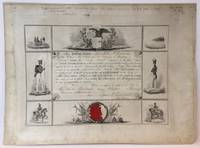
réf. 58705A collection of 11 items from the first organizational years of the National Guard unit which protected New York City in the early 19th century. The group consists of three brass cylinders each containing rolled manuscript documents related to the regiment; an oval metal box containing a pair of epaulettes from the 7th; a wallet style polished black leather military bag with a gilt emblem of the 7th National Guards on the front flap; and a partially printed document completed in manuscript acknowledging the service of a member of the regiment. New York 1816-1847. What became known as New York's Seventh Regiment was originally organized in April 1806 as a response to the threats from the British search and seizure policies in New York harbor. The regiment consisted of four companies comprising many of the merchants and tradesmen in the city. During the War of 1812 the unit by then designated the 2nd Battalion 11th Artillery manned the guns of the forts guarding New York harbor. After the war a military-weary New York saw a fall-off of interest in drilling and training by militias. The appointment in 1820 of Col. James Benedict to lead the Eleventh brought a renewed interest in organized training discipline and field exercises attention to uniforms and equipment and regular attendance at meetings. His order regarding the wearing of pantaloons over boots is reflected in one of the documents present here. By 1824 the Eleventh had been renamed "The National Guards" in honor of the Marquis de Lafayette and by 1826 it was redesignated "The Twenty-Seventh Regiment of the New York State Artillery." In addition to official parades and escorting of dignitaries the national Guards were used to maintain order in the city during public executions in the 1820s and were called out to help quell riots in the 1830s. A reorganization of all the militia units resulted in its new official designation as the Seventh Regiment in 1847. All of the material is in very good condition aside from some scuffing to the metal box. Each of the brass cylinders has an engraved label and the end of each one unscrews to reveal the rolled document inside. The metal box has a faint blind-stamp on the lid identifying it as having been produced by J.H. McLenney & Co. 141 Grand St. New York. The leather wallet is stamped in blind on the back "Ridabock & Co. New York." McKenney & Co. and its successor Ridabock & Co. were manufacturers and dealers in military goods. #6445. Itemized list of the collection: a The first cylinder engraved label reading "Roll of Honorary Members 1st Co. 7th Regt." The document inside dated June 23 1816 206 x 25 cm. consisting of 6 pages tipped together end-to-end records the "Bye laws for the Regulation of Capt. James Benedict's Company in the Eleventh Regiment NY State Artillery" including the establishment of a monthly meeting time regulations regarding attendance new members arms & equipment etc. It is signed by the three members of the Committee of Revisal Gilbert Hopkins Irad Hawley and Richard E. Purdy as well as approximately 77 members of the company. Damage to the lower corner of the document has resulted in the loss of several signatures; some chipping along the right margin of the scroll occasionally affecting a word or two. b The second cylinder engraved label reading "Roll of Company. 7th Regt. N.G.S.N.Y." Rolled inside are two separate documents. The first dated May 18 1821 90 x 20 cm. consisting of 3 pages tipped together end-to-end is a document signed by the members of the company commanded by Capt. Gilbert Hopkins 11th Regt 1st Brigade pledging to abide by a decision regarding the wearing of pantaloons over instead of under Boots on Parade signed by 67 members of the company. The second document is undated 22 x 20 cm. a single leaf approves an alteration to the by-laws regarding dunning members for non-attendance signed by 20 members. c The third cylinder engraved label reading "Roll of the first Company National Guards New York State Artillery" ownership name partially rubbed out but research shows it reads "Captain J.S. Cocks". The manuscript document records another revision of the by-laws this one from October 1826. Printed in block letters at the head of the document 184 x 23 cm. consisting of 5 pages tipped together end-to-end is the title "TWENTY-SEVENTH REGIMENT / NEW YORK STATE ARTILLERY / PRO PATRIA ET GLORIA / NATIONAL GUARDS." The text includes several modifications to various articles of the by-laws and is signed by the members of the Committee of Revisal Smith Spelman Thos. Jaycox and Thos. H. Locke along with 48 other members of the regiment. Some chipping to the margins of the document not affecting text; one long tear carefully repaired on verso touching some letters but all still legible. The ink from the block lettering has burned through the paper in spots. John Samuel Cocks 1813-1868 whose name is etched on the cylinder was elected captain of the First Company of the 7th Regiment in 1838 and resigned in 1845. During the Civil War he served as a Colonel with the 40th New York Infantry Mozart Regiment. A Successful New York businessman and member of the New York state legislature he died in Brooklyn in 1868. d The black metal box containing the epaulettes is moderately scuffed. There is a small metal handle on the lid and a clasp. The epaulettes rest on an oval post mounted inside the box. Each is braided and has a brass crescent on the shoulder dulled and a round emblem of red cloth with a contrasting black & gray striped cloth "7" affixed to it a gold button embossed with an eagle and two bars. The epaulettes show some wear particularly on the undersides where a metal plate denotes left and right shoulder pad with modest fraying to the edges. e The leather wallet has high polish; the ornamental lettering "NG7" on the front flap is bright the small leather loop clasp is worn but intact. f A partially printed document image size 21 x 31 cm. on a larger sheet 30 x 40 cm. completed in manuscript and dated October 14 1846. The text is surrounded by eight vignette illustrations six of men in uniform on horseback in ranks one of an eagle perched on a shield and the last of swords and cannons with a red wax seal over the middle partially chipped away. The document acknowledges the seven years service of John A. Hadden in Company 6 National Guard 27th Regiment and declares him to be exempt for the rest of his life from both jury service and further military service. Signed by two members of the regiment Andrew H. Brenner and Cyrus H. Loutrel. A few creases in the surface of the document which is a little soiled and has some later ink notes by Hadden in the upper margin. unknown
réf. 58705A collection of 11 items from the first organizational years of the National Guard unit which protected New York City in the early 19th century. The group consists of three brass cylinders each containing rolled manuscript documents related to the regiment; an oval metal box containing a pair of epaulettes from the 7th; a wallet style polished black leather military bag with a gilt emblem of the 7th National Guards on the front flap; and a partially printed document completed in manuscript acknowledging the service of a member of the regiment. New York 1816-1847. What became known as New York's Seventh Regiment was originally organized in April 1806 as a response to the threats from the British search and seizure policies in New York harbor. The regiment consisted of four companies comprising many of the merchants and tradesmen in the city. During the War of 1812 the unit by then designated the 2nd Battalion 11th Artillery manned the guns of the forts guarding New York harbor. After the war a military-weary New York saw a fall-off of interest in drilling and training by militias. The appointment in 1820 of Col. James Benedict to lead the Eleventh brought a renewed interest in organized training discipline and field exercises attention to uniforms and equipment and regular attendance at meetings. His order regarding the wearing of pantaloons over boots is reflected in one of the documents present here. By 1824 the Eleventh had been renamed "The National Guards" in honor of the Marquis de Lafayette and by 1826 it was redesignated "The Twenty-Seventh Regiment of the New York State Artillery." In addition to official parades and escorting of dignitaries the national Guards were used to maintain order in the city during public executions in the 1820s and were called out to help quell riots in the 1830s. A reorganization of all the militia units resulted in its new official designation as the Seventh Regiment in 1847. All of the material is in very good condition aside from some scuffing to the metal box. Each of the brass cylinders has an engraved label and the end of each one unscrews to reveal the rolled document inside. The metal box has a faint blind-stamp on the lid identifying it as having been produced by J.H. McLenney & Co. 141 Grand St. New York. The leather wallet is stamped in blind on the back "Ridabock & Co. New York." McKenney & Co. and its successor Ridabock & Co. were manufacturers and dealers in military goods. #6445. Itemized list of the collection: a The first cylinder engraved label reading "Roll of Honorary Members 1st Co. 7th Regt." The document inside dated June 23 1816 206 x 25 cm. consisting of 6 pages tipped together end-to-end records the "Bye laws for the Regulation of Capt. James Benedict's Company in the Eleventh Regiment NY State Artillery" including the establishment of a monthly meeting time regulations regarding attendance new members arms & equipment etc. It is signed by the three members of the Committee of Revisal Gilbert Hopkins Irad Hawley and Richard E. Purdy as well as approximately 77 members of the company. Damage to the lower corner of the document has resulted in the loss of several signatures; some chipping along the right margin of the scroll occasionally affecting a word or two. b The second cylinder engraved label reading "Roll of Company. 7th Regt. N.G.S.N.Y." Rolled inside are two separate documents. The first dated May 18 1821 90 x 20 cm. consisting of 3 pages tipped together end-to-end is a document signed by the members of the company commanded by Capt. Gilbert Hopkins 11th Regt 1st Brigade pledging to abide by a decision regarding the wearing of pantaloons over instead of under Boots on Parade signed by 67 members of the company. The second document is undated 22 x 20 cm. a single leaf approves an alteration to the by-laws regarding dunning members for non-attendance signed by 20 members. c The third cylinder engraved label reading "Roll of the first Company National Guards New York State Artillery" ownership name partially rubbed out but research shows it reads "Captain J.S. Cocks". The manuscript document records another revision of the by-laws this one from October 1826. Printed in block letters at the head of the document 184 x 23 cm. consisting of 5 pages tipped together end-to-end is the title "TWENTY-SEVENTH REGIMENT / NEW YORK STATE ARTILLERY / PRO PATRIA ET GLORIA / NATIONAL GUARDS." The text includes several modifications to various articles of the by-laws and is signed by the members of the Committee of Revisal Smith Spelman Thos. Jaycox and Thos. H. Locke along with 48 other members of the regiment. Some chipping to the margins of the document not affecting text; one long tear carefully repaired on verso touching some letters but all still legible. The ink from the block lettering has burned through the paper in spots. John Samuel Cocks 1813-1868 whose name is etched on the cylinder was elected captain of the First Company of the 7th Regiment in 1838 and resigned in 1845. During the Civil War he served as a Colonel with the 40th New York Infantry Mozart Regiment. A Successful New York businessman and member of the New York state legislature he died in Brooklyn in 1868. d The black metal box containing the epaulettes is moderately scuffed. There is a small metal handle on the lid and a clasp. The epaulettes rest on an oval post mounted inside the box. Each is braided and has a brass crescent on the shoulder dulled and a round emblem of red cloth with a contrasting black & gray striped cloth "7" affixed to it a gold button embossed with an eagle and two bars. The epaulettes show some wear particularly on the undersides where a metal plate denotes left and right shoulder pad with modest fraying to the edges. e The leather wallet has high polish; the ornamental lettering "NG7" on the front flap is bright the small leather loop clasp is worn but intact. f A partially printed document image size 21 x 31 cm. on a larger sheet 30 x 40 cm. completed in manuscript and dated October 14 1846. The text is surrounded by eight vignette illustrations six of men in uniform on horseback in ranks one of an eagle perched on a shield and the last of swords and cannons with a red wax seal over the middle partially chipped away. The document acknowledges the seven years service of John A. Hadden in Company 6 National Guard 27th Regiment and declares him to be exempt for the rest of his life from both jury service and further military service. Signed by two members of the regiment Andrew H. Brenner and Cyrus H. Loutrel. A few creases in the surface of the document which is a little soiled and has some later ink notes by Hadden in the upper margin. unknown books
réf. 2504ministère de la guerre paris imprimerie nationale 1906 in 16 cartonnage éditeur 268 pages
réf. 8933Letter One: 'Camp Sebastopol. January 24th. 1856.' Letter Two: 'Camp 49 Regt Sebastopol. March 31st.'. Letter One: 12mo 4 pp. Bifolium. 75 lines of text. Clear and complete. Good on lightly-aged paper. Expresses regret at 'Morten Edens melancholy death so young & so clever as he was'. 'There is great talk of Peace. We hardly know if to believe it - few will be sorry should the news prove to be true as I think most of us have had enough fighting. Apparently refers to his sweetheart under a cypher. She has not written to him but 'London gaieties have little time for correspondence'. 'The weather here is something awful - cold & wet fogs & sleet. The place is a sea of mud up to your knees without exaggeration.' His father has sent him food and clothing. The officers are 'getting up a school for the men as the weather is too bad for drill' but 'there is no scarcity of work' with the roads requiring constant repair and 'the Minie Rifle Instruction' going on daily. 'There was a good deal of firing on Sunday night down by the Tchernaya - and we rather expected an attack however it all ended in Smoke.' The docks which he considers 'the most splendidly finished' he has ever seen 'built up of that beautiful red & blue granite' have 'all been blown up'. Letter Two: 12mo 4 pp. Bifolium. 67 lines of text. Clear and complete. Fair on aged paper with 6 cm vertical closed tear through both leaves. Containing an interesting description of 'Spring horse races' which took place 'in the Valley of the Tchernaya' as a result of an armistice. The allied armies crowded the banks on one side of the river and on the other 'the Russians let loose for the occasion'. There was much bartering - 'Knifes sic Pipes Tobacco Money and various other articles . thrown across the river attached to a stone or enveloped in mud. The river is not more than 2 or 3 yards wide at some places so that we could have plenty of conversation with our Enemies without breaking the "General order". The French were allowed by their Chiefs to cross and they appeared to get on capitally with the Russian Officers'. The French fired 101 guns in a general salute to the heir to their emperor and the British returned the salute with the same number. Regarding the outcome of 'the conferences' hears that 'you people in England are very pugilistic and are determined to have war if you can'. Considers that the British Army 'was never in better condition for a campaign' and thinks it 'a pitty to stop just now'. Gibson was still alive in 1864 when he married Georgina Eliza daughter of William Clarke. Note: "The 49th was at the battles of Alma Inkerman and Sevastopol during which three Victoria Crosses were awarded to members of the Regiment." Letter One: 'Camp Sebastopol. January 24th. 1856.' Letter Two: 'Camp 49 Regt Sebastopol. March 31st.' hardcover
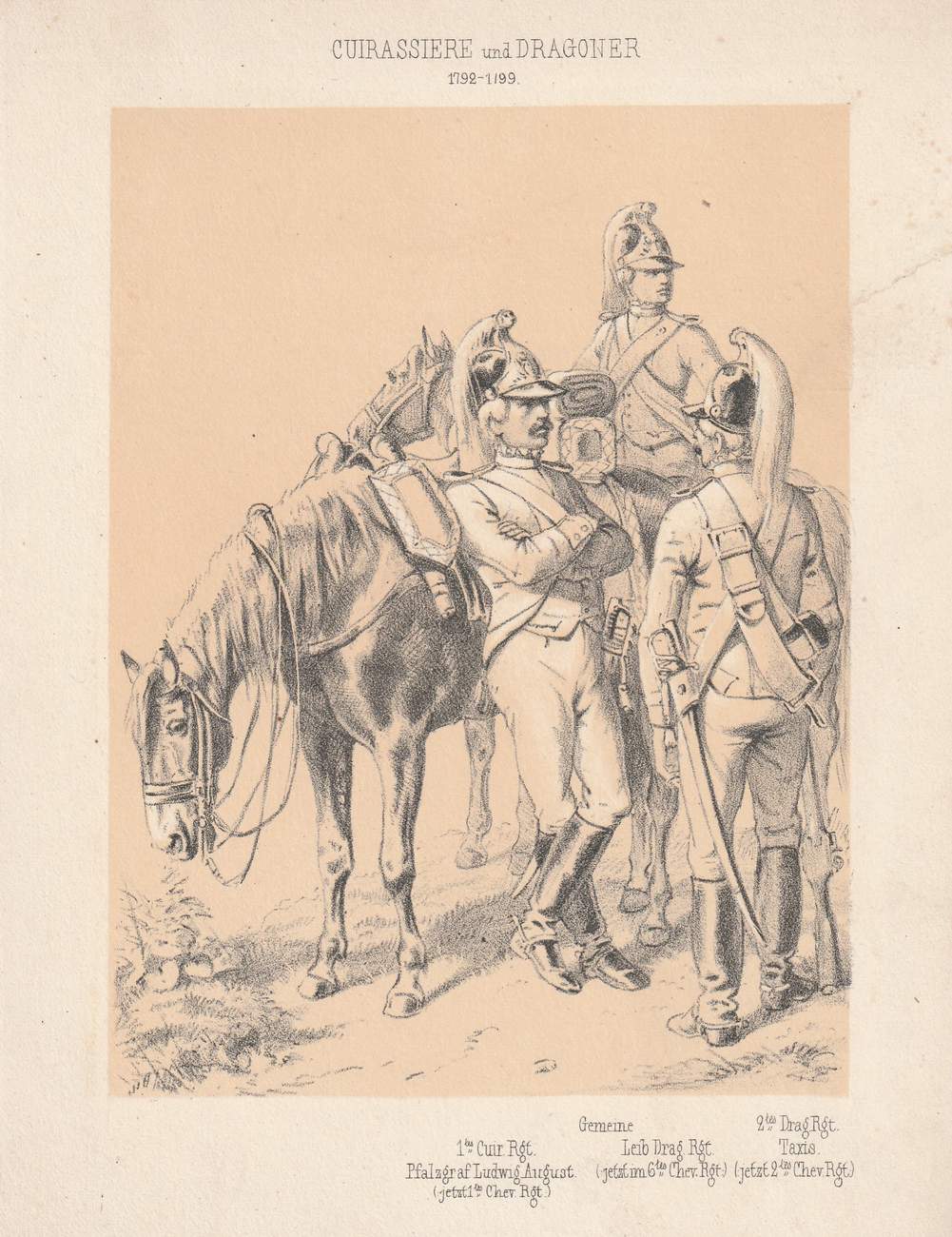
1860réf. 68295Ohne Ort, um 1860. Blatt ca. 21 x 16 cm. 1 Blatt, verso weiß.
1936réf. 93139ABWiesbaden, Matthias-Grünewald-Verl., 1936. Gr.-8°. Mit 50 Abb. a. Taf., 32 Kartenskizz. i. Text, 1 Übersichtskarte u. 7 Karten a. 1 mehrf. gefalt. Tafel. 14, 536, 1 S. Roter OLwd. m. goldgeprägt. Rt. u. goldgeprägt. Deckelillustr. - Unbedeutend fleckig, gutes Ex.
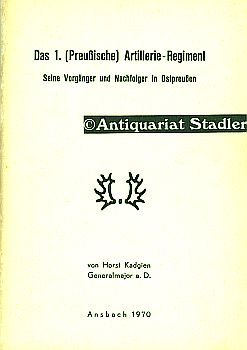
1970réf. 21506Ansbach 1970. Mit Fasim.abb. 69 S. OBrosch geheftet. 21x15 cm.
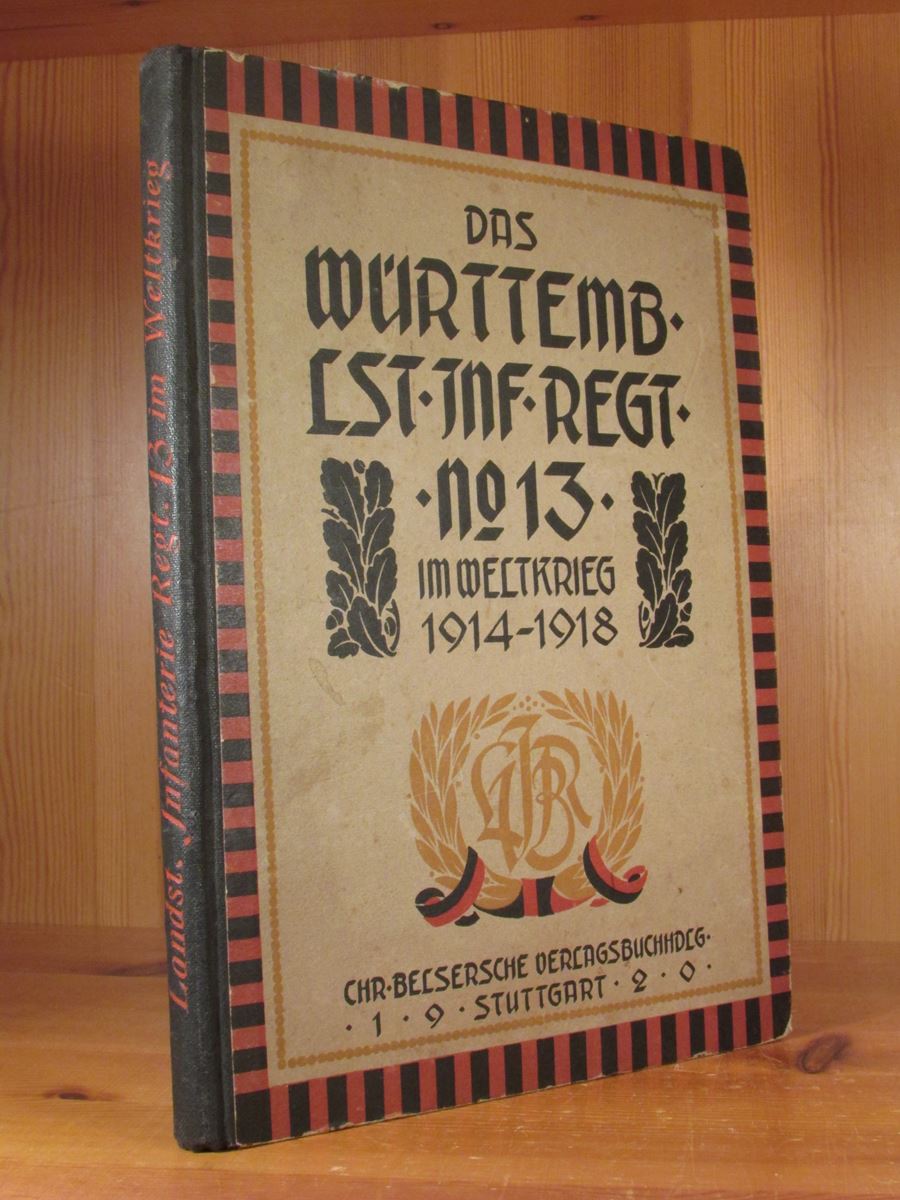
1920réf. SB-22703Stuttgart, Chr. Belser, 1920. VII, 96 S. Illustrierter Original-Halbleinenband im Format 26 x 19 cm. Mit 82 Abbildungen und 8 beiliegenden Skizzen im Anhang.
1929réf. KM113Berlin, Verlag Tradition Wilhelm Kolk 1929. OLn. mit goldgepr. Deckelvignette. IX, 280 S. sowie zahreiche Tafeln mit photograph. Abbildungen und 2 lose in Lasche beil. gefaltete Bl. mit 4 Karten. 8°. Rücken verblichen. Gelenke gelockert bzw. angebrochen. Titelblatt mit verblichenen Notaten.
1920réf. 97717ABKallmünz, Verl. d. Oberpfälzischen Landbuchhandlung, (um 1920). Gr.-8°. Mit zahlr. Abb. u. Ktn.-Skizz. 197 S. Grauer OPbd. m. Rückenschild. - Gutes Ex.
1930réf. 24207Hannover 1930. Goldgepr. blauer OLn. (dekorativ). 596 und IX S. und ein Blatt Inhaltsverz. Mit zahlr., meist photograph. Abb. sowie einigen Tafeln. Lose beil. 7 S. Anhang und ein Informationsblatt der Schriftleitung. 8°. Verblichener Stempel auf Titelblatt. Gut erhaltenes Exemplar.
1930réf. 93224ABOsnabrück, Verlag Carl Prelle, 1930. Gr.-8°. Mit 21 Skizzen und 111 Abb. auf Tafeln, Buchschmuck v. Fr. Carl Erdmann. 15, 350 S. OLwd. m. gr. Deckeltitel. - Stellenweise etwas fleckig, sehr wenige hs. Anmerkungen i. Tinte, gutes Ex.
1930réf. 99820ABOsnabrück, Verlag Carl Prelle, 1930. Gr.-8°. Mit 21 Skizzen und 111 Abb. auf Tafeln, Buchschmuck v. Fr. Carl Erdmann. 15, 350 S. OLwd. m. gr. Deckeltitel. - Gutes Ex.
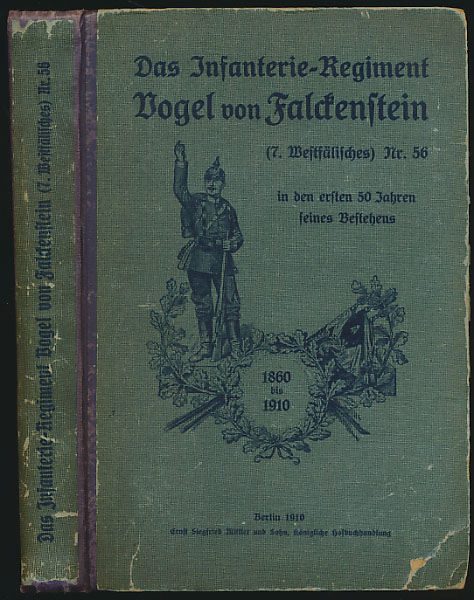
1910réf. 5224EBBerlin, Ernst Siegfried Mittler und Sohn, 1910. 8°. 22,5 cm. X, 456 Seiten, 2 Faltkarten. Original-Halbleinenband.
1935réf. KM109Görlitz, Bokämper 1935. OLn. mit goldgepr. Deckelvignette und RTitel. 560 S. mit zahlr. Textabb. sowie zahlreichen Tafeln mit photograph. Abbildungen und 3 lose in Lasche beil. Faltkarten. Gr-8°. Einband an den Kanten u. Ecken etwas bestoßen u. berieben. Innengelenke gebrochen. Lezte Blätter im Rand in den Rändern perforiert (Kein Textverlust).
1926réf. 39365Bayerisches Kriegsarchiv, München, 1926. EA, XVI, 704 (2) Seiten, 4°, 27 x 19 cm, Leder