HITLER, AdolfBiblio.com
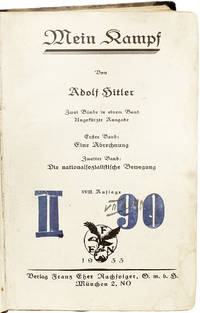
1933réf. 002253Munich: Verlag Franz Eher Nachfolger GmbH 1933 1933. FROM THE DACHAU PRISONER CONCENTRATION CAMP LIBRARY. 1 vol. 175 x 115 mm 7 x 4-1/2 inches including the Inseraten-Anhang advertising supplement at end halftone portrait frontispiece printed in sepia facsimile signature complete. Bound in crude half black cloth mottled boards art-laid endpapers all edges trimmed and plain undoubtedly BOUND BY THE PRISONERS' BINDERY AT DACHAU dated 6 May 1936 on a Kontroll-Zettel control-slip tipped in. Worn scattered light foxing half-title lost a few short tears carefully mended without loss. Reference: 1 Cf Printing and the mind of man 1967 1983 415n. 2 For the prisoners' library at Dachau see Torsten Seela 'Die Lagerbucherei im KZ Dachau' Dachauer Hefte Dachau vii 1991 34-46 and his Bucher und Bibliotheken in nationalsozialistischen Konzentrationslagern: Das gedruckte Wort im antifaschistischen Widerstand der Hftlinge 1992. Provenance: 1 BUCHEREI DES KONZENTRATIONSLAGERS DACHAU Library of Dachau concentration camp with their manuscript Kontroll-Zettel control slip tipped on the upper free endpaper printed lending-rules mounted on the frontispiece recto purple stamp Konzentrationslager Dachau Gefangenenlager in about margins. 2 Liberating soldier 1945; by descent to his widow 3 "a woman in New England"; sold 2006 AN EVIL BOOK SNATCHED FROM THE VERY HEART OF EVIL. This copy belonged originally to the prisoners' library 'Lagerbucherei' at Dachau. Now almost forgotten this unlikely library was installed in Barracks 10 along with the infirmary and a sort of canteen. It was conceived as early as October 1933 by an imprisoned publisher Heinrich Bergmann who somehow obtained permission from the commandant Theodor Eicke to set up a lending-library for 'privileged' prisoners. For his part Eicke supplied some books predictable Nazi fare including presumably the present volume. To these were added some tractates and Jesuit relations seconded from a nearby Roman Catholic library and later literature history geography polonica &c from various sources. Perhaps the library appealed to Eicke's sense of Dachau as a 'model' camp or perhaps it was just a bit of practical penology controlling the many by meting out 'privileges' to the few. In any case the prisoners' library became a center of subversive activity within the camp particularly under its later librarians Kurt Schumacher and Viktor Matejka and by 1945 the library held some 15000 volumes: Some of these were carted off into the old town of Dachau where a former prisoner named Albert Zeitler set up a small lending-library in Augsburgerstrasse and the rest were simply scattered among surviving prisoners or mostly lost. Today these books are so rare on the market that the leading historian of concentration-camp libraries has never heard of one. Munich: Verlag Franz Eher Nachfolger GmbH, 1933 hardcover