6 684 résultats
1938réf. LFA-126728063Un journal de10 pages, format 430 x 610 mm, illustré, bon état, rare
19601st edition, later paper wrappers, 8vo. 808 + xx columns, illustrations throughout. In Hebrew, with an English title page and introduction. We consider it important and necessary to represent a review of our Memorial-Book to the children and friends of the Goniondz Society who do not read Yiddish or Hebrew. Let all of them get an idea about the Hometown of their parents and relatives and together with them hold dear the memory of the small Jewish community, that went to martyrdom during the black period of the bestial Nazi rule. 6, 000, 000 Jews perished during the 2nd World War in Eastern and Central Europe. Many bigger and smaller towns were immortalized in memorial books. They stand out like living symbols, spiritual monuments for the coming generations. Our beloved Goniondz has surely earned such a monument. The Jewish Goniondz was very lively and interesting. The small Jewish population was very active, established many parties and clubs and gave to the world outstanding intellectuals in many fields, both Jewish and general. Citizens of Goniondz are spread out all over the world. The majority of them live in the United States and in Israel, where they have established many societies and cooperatives in the socio-philanthropic field, giving financial and moral support to needy townspeople. The Memorial-Book portrays to a great extent the manysided life of Goniondz before its destruction. (from book) SUBJECT(S) : Jews -- Poland -- Gonia? Dz. Holocaust, Jewish (1939-1945) . Ethnic relations. OCLC: 18096280, OCLC lists 29 copies worldwide. Cover is missing, outside pages have some wear and discoloration, internally very good, Good Condition overall. (YIZ-20-2)
19831st English Language edition. 4to. Original wrappers, xxxix + 663 pages. Illustrations throughout. In English. The book by Serge Klarsfeld, contains vital statistics of some 76, 000 Jews deported from France. Together with his wife Beate, the Paris-based Serge Klarsfeld has published lists of Jews deported from France and Belgium over the last decades. He was the leading Nazi hunter in France . France was one of the more liberal nations in opening its doors to Jewish refugees from Poland, Romania, and Germany. Some 350, 000 Jews were living in France when the Germans invaded the country in June 1940. More than half of them were refugees from Germany who had arrived during the 1930s. Many were French citizens whose families had lived in France for centuries and who were fully assimilated. Others had come to France, often from Eastern Europe, to seek a better life and escape from antisemitism. Approximately 76, 000 Jews were deported from France between 1942 and 1944. Most went to Auschwitz-Birkenau, where the vast majority were exterminated on arrival. Klarsfeld's book is a most startling document. Nearly the size of the Manhattan (NYC) telephone directory, it lists nearly 76, 000 names of Jews deported to Eastern Europe or killed in France. Names are listed in alphabetical order, according to each of the 80 convoys. Family name, first name, birth date, place of birth, and nationality are recorded for every person. Klarsfeld also provides a detailed history of each convoy. (Jewishgen 2018) SUBJECT(S) : Jews -- Persecutions -- France. Holocaust, Jewish (1939-1945) -- Registers of dead -- France. World War, -- Deportations from France. Ethnic relations. Genealogy. Translation of: Le mémorial de la déportation des juifs de France. OCLC: 9685134. Small tear to margin of cover, otheriwse Very Good Condition Overall. (YIZ-16-20) xx
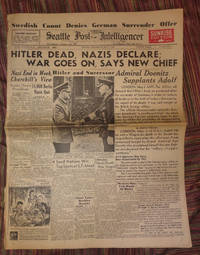
1945réf. 45969Seattle Washington: Seattle Post-Intelligencer. Very Good. First Edition. Newspaper. Seattle Post-Intelligencer; Oblong folio; 16 pages; Seattle Post-Intelligencer. Vol. CXXVIII No. 61. Entire issue two sections 16 pages. One horizontal fold as issued. This is an- 81 year-old newspaper in its natural state not removed from a volume etc. The pages are toned but not brittle; a few leaves in the second section are separated but present. The Front page displays a large b/w image in half-tones depicting Adolf Hitler shaking hands with his eventual successor: Admiral Doenitz. A smaller banner headline at the top of the page reads: "Swedish Count Denies German Surrender Offer." . 1945. Seattle Post-Intelligencer unknown
19611st edition, original cloth, 4to, xix+ 288+ (2) pages. On title page: Brzezin memorial book. Illustrations throughout. Yiddish, with English introduction. There once was a town of Jewish tailors Brzezin. From early dawn until late at night one could hear the music of the Singer sewing machines. It was the music of hard work, of intense anxiety, of a hard life, but also of noisy youth, semi-intellectuals, observant Jews, Hasidim who lived and had aspirations in the small Jewish town Brzezin. The Nazi savages extinguished this life forever, transformed it into ashes. Only a few Jews from the tailoring town Brzezin, by some miracle, remain, scattered over the entire world, individuals who were witnesses to the German cannibalism. May these words, frail in print, but inscribed not with ink but with blood, be a modest contribution to the matseve [gravestone] for my native town, Brzezin. Brzezin was one of the oldest and most popular Jewish communities in Poland. When this community was established, it carried the name Krakowek [Little Krakow]. At that time, the community extended from the Strykower highway to beyond the Jewish besoylem [cemetery] to the surrounding hills. The Polish noblewoman, Anna Lasocka, had brought the first weavers from afar into this community. Then the community developed even further and began to broaden its borders. At that time, the town already carried the name Brzezin. Jewish tailors came to Brzezin from many places, and after several generations, the town developed its own type of tailoring industry, by which it was known all over the world. A cottage industry was the main occupation here. As early as 1772, Brzezin was famous for its mass production in tailoring. Until 1914 the great Czarist Russia was flooded with the inexpensive products of Brzeziner tailors. In the years between the two world wars, the export of Brzezin industry was spread over many lands in Europe and into other parts of the world. In this, the great Jewish magaziners [owners of clothing enterprises] exporters such as Frankensztejn, Tuszynski, Sulkowicz, and others played a great role. The Jews in Brzezin did not only work, they also participated actively in the socio-political and cultural life of the town, had their representatives on the town council in town hall, and had their religious and secular educational, cultural, and social organizations. Materially, it was a life of Jewish poverty, but spiritually, socially, and culturally, it was rich. (translated from book) SUBJECT(S) : Holocaust, Jewish (1939-1945) -- Poland -- Brzeziny (Lo´dz´) ; Jews. OCLC: 19306453. Light wear on cover, some wear on spine. Good Condition Overall. (YIZ-16-6A)
19511st edition, original wrappers, 8vo. 64 pages, portraits throughout. In Yiddish with English title page. Book 3 part 1 of History of the Jews in Bialystok. SUBJECT (S) : Jews -- Poland -- Bialystok. OCLC: 970935047, OCLC lists 17 copies worldwide. Ex library with usual marks, light wear on spine and cover, Good Condition overall. (YIZ-18-12A)
19721st edition, original cloth with dust jacket, 4to, 11 pages + 754, 170 columns. Illustrations throughout. In Hebrew, with an English section. This is the story of a vanished world, the shtetel of Antopol. The material for this presentation was gathered painstakingly over a long period of time by a relatively small group of dedicated people who wished to preserve its memory and heritage for the descendants of its martyred. More than a history, this story is very personal because our parents, grandparents and great-great grandparents going back many generations came from this community. This is also a place whose many sons and daughters in years past left to seek a new and free life. Many achieved success and prominence all over the world - the United States, South Africa, Argentina, and other areas of the globe. We are the fortunate descendants of these hardy forebears and pioneers. It is hard to imagine that only a few decades ago there existed a vibrant, living community called Antopol, with its men, women and children; its market place, stores, schools. Beth medroshim (Houses of Prayer) , orphanages, Gmilas Hasodim (free loan society for the needy) , newspaper stands - all so familiar and so dear to memory. This little town was typical of hundreds of similar smaller and larger communities. And, like Atlantis, or some past people recounted in a saga, it suddenly vanished in the most bloody massacre in all of history. But this presentation is for the living - to convey to us, the she'erit or last remnant of descendants, something of the heritage, spirit and, record of the life of this community which many of us know only in an abstract and detached way. The task is too great, and our resources too limited to write the whole story. This little volume, condensed and translated into English, is both a record and a personal memorial to a profoundly meaningful and warmly nostalgic past. (foreword from the English version of this book) SUBJECT(S) : Jews -- Belarus -- Antopal. Holocaust, Jewish (1939-1945) . Ethnic relations. OCLC: 19155706. Dust jacket has some tearing and damp stains, cover corners are dented, some wear on bottom of spine, page edges slightly yellowed, internally very good. Good Condition overall. (YIZ-17-7A) xx
1939réf. 86081London: Hutchinson 1939. 1st edition. Very Good. quarto. orig. dec. cloth 584pp. b/w plates maps index With more than two hundred exclusive and specially selected illustrations. Unexpurgated illustrated edition originally published in 18 parts. This bound in publisherÕs cloth. Very scarce Hutchinson hardcover
réf. 2946Lightly rubbed else fine. Photographic Card Depicting Adolf Hitler at the 1935 Seventh Nazi Party Congress at Nuremberg circa 1936. Measures 6.5 x 2.5 inches. Stamped with Nazi emblem to verso. . unknown
2009réf. LFA-126742966Revue de 80 pages, format 210 x 300 mm, illustrée, brochée couverture couleurs, bon état
2005réf. LFA-126742969Revue de 82 pages, format 210 x 295 mm, illustrée, brochée couverture couleurs, bon état
1936réf. 42908London: Friends of Europe 1936. 1st edition. Original Printed Paper Wrappers 8vo 21 3 pages. 22 cm. In English. Translated extracts with commentary from Hitler’s Mein Kampf. Part of the series Friends of Europe" publications no. 38. Holocaust-era publication of Antisemitic propaganda with a critical explanation by the Anti-fascist Friends of Europe with opens with a five-page Foreword by the Duchess of Atholl M.P. the first female Scottish Member of Parliament. She gives the publishing and distribution history of Mein Kampf which she calls the “Nazi Bible” up to 1936 and suggests reasons why its contents have stayed relatively unknown by non-German speakers. In particular she is critical of the 'severe expurgation' of the October 1933 English version entitled My Struggle. The remainder of the work highlight quotes from 1936 edition of Mein Kampf where Hitler lays out his views on foreign policy; these are grouped for the reader under the followingn categories: German Arms and Methods; A Pan-German Policy; The Conquest of Territories - Old and New; Alliances Essential for the Overthrow of France; Views on Peace and Pacifism. “Editions in English of Mein Kampf have had a chequered history” writes the journalist Donald Watt. “The first the famous 'bowdlerised' version of 1934 was never intended to be such. The translator was the husband of Blanche 'Baffy' Dugdale Arthur Balfour's daughter a determined opponent of appeasement and one of the foremost Gentile Zionists in Britain. Captain Dugdale shortened the book but an odious Nazi Dr Hans Thost then the London correspondent of the Nazi Volkischer Beobachter insisted on further abridgement. The destruction in the Blitz of the files of the publisher Hurst and Blackett means that we can no longer tell who was responsible for which omission. Not that it mattered much. The Foreign Office circulated its own translation of the most ominous sections. And Kathleen Duchess of Atholl with Foreign Office help published them as a Friends Of Europe pamphlet in 1936” in The Guardian London Feb. 13 1992 In their 1980 work Hitler's Mein Kampf in Britain and America: A Publishing History 1930–39 James and Patience Barnes note that the series of pamphlets published by the Friends of Europe included four which consisted of excerpts from Mein Kampf. The first dealt with biographical information and the other three contained quotations on race religion and foreign policy. The latter pamphlet was originally "extracted and translated" by Rennie Smith however the pamphlet's "guiding spirit" quickly became the Duchess of Atholl. She contacted the Foreign Office and was given the excerpts that had been prepared by Weizmann. Further inquiries from her convinced the British foreign ministry to compose an in-house translation of some of the passages. The 11-page document Central Germany 7 May 1936 – Confidential – A Translation of Some of the More Important Passages of Hitler's Mein Kampf 1925 edition was circulated among the British diplomatic corps and a private copy was also sent to the Duchess of Atholl who may or may not have used it in what was ultimately her translation of Mein Kampf in the Friends of Europe pamphlet Barnes James J.and Barnes Patience P. 1980 Hitler's Mein Kampf in Britain and America: A Publishing History 1930–39 Cambridge UK: Cambridge University Press. pp. 28–32 36–37 The objects of the Friends of Europe are: “1. To encourage effective co-operation for the prevention of war and the establishment of peace. 2. To provide accurate information about Nazi Germany for use throughout Great Britain the British Empire the USA Europe and wherever the English tongue is known” all part of a goal of getting to the public "reliable information on the racial ideas the religious struggle the new militarism new education and foreign policy in Nazi Germany." The USHMM keeps their copy in their Rare Book Room." SUBJECTS: Diplomatic relations. Politics and government. Nationalsozialistische Deutsche Arbeiter-Partei. Germany -- Politics and government -- 1933-1945. Germany -- Foreign relations -- Allemagne -- Politique et gouvernement -- Relations exte´rieures. OCLC: 13085478. Our colleague offers their copy for over $1000. Old vertical fold Very Good Condition. B HOLO2-141-35-XX-ACC-'mme. London: Friends of Europe unknown
réf. 109448sd Non daté - In-4, broché - Couverture illustrée - 44 pages, sans pagination - Très nombreuses reproductions photographiques en N&B
1939réf. 113609Partitions sur la Seconde guerre mondiale Braun 1939 approx.
1933Napoli, 1933, febbraio 6, copertina illustrata a colori in fascicolo originale completo di pp. 16 de “Il Mattino illustrato”
1939Roma, Novissima, 1938, 8vo br. originale, pp. 152
Foto e didascalia ne 'La Domenica del Corriere' del 12/2/1933.
1942Roma, (1942) 8vo br. pp. 38
1944Il Tempo, quotidiano di un solo foglio del 22/7/1944
1938Napoli, 1938, settembre 26, copertina illustrata a colori in fascicolo originale completo di pp. 16 de “Il Mattino illustrato”
Milano, anni '60, fasc. n. 2/6 complet. ill. da fot. in nero. Manca il solo 1° n. di questo supplemento di 'Gente'.
19421942. First Edition. Paper Wrappers, 8vo, 61 pages. Includes eight photographic illustrations, including three full-page photomontages by Polish avant-garde artist Teresa Zarnower, and original pictorial wrappers with two additional photomontages by Zarnower. Text in Polish. Published by the heavily Jewish Polish Labor Group in New York. The Destruction of Warsaw. Light wear to covers, with light crease through part of front cover and unobtrusive 4 digit number in pen at top near spine. Touch of wear to top of spine, Otherwise Very Good Condition, far better than generally seen of this rare and important Holocaust related avant-gard photography title. (HOLO2-117-61)
1914Later cloth with original paper cover mounted on front. 8vo. 94 pages. 24 cm. In German. Series: Ergänzungshefte zur Neuen Zeit, Nr. 20. Title translates to English as, Race and Judaism. SUBJECT (S) : Race. Jews. Jewish question. Zionism. Rassismus. Antisemitismus. Politique internationale. Juifs. Avant 1914. Politique internationale. Racisme. Avant 1914. Allemagne. Juifs. Avant 1914. Pages are slightly darkened, but all text is clear. Ex-libris with usual markings. Otherwise a nice and clean copy. Very good condition. (HOLO2-61-17A)
19351st edition. Original illustrated wrappers. 4to. 60 and 76 pages, 28 cm. In Hebrew and English. Title translates to Polish Jews. Poylishe Iden ran from 1933-1944 and was published by the American Federation for Polish Jews. The federation was established in 1908 to assist the newly arrived Polish Jews of New York. They also coordinated relief efforts on behalf of Polish Jewry. (YIVO, 2018) . This issue highlights the groups political activity, relief activities, and more. SUBJECTS: Jews -- Poland -- Periodicals. Fraternal organizations -- Periodicals. OCLC lists 11 copies worldwide (OCLC: 145390394) . Some edge wear to wrappers, but pages clean. Overall Very Good Condition. (YID-30-35)
19411st Edition. Original CCloth. 4to. 36 Sermons (about 250 pages) ; 28 cm. In English. Holocaust-era collection of sermons, includes The Courage to Carry On. Typed and bound manuscript. Newman was a Reform rabbi and a leader of the Zioninst Revisionists in the United States (Goodman, EJ) He played a pivotal role in the creation of Brandeis University. SUBJECT(S) : American Jewish Sermons. Ex-library with Jewish Institutional Stamp and Usual Markings. Cover is worn, with some water damage. One page folded, but inside pages are largely clear and very readable. Good condition. (AMRN-9-21a)