POLIAKOV LEON.Livre Rare Book
Hitler ABiblio.com
Brief an Marechal sept 1939
1939réf. 849971939. unknown

Buchhandlung Antiquariat Sawhney · Allemagne105,00 €
6 527 résultats
1979réf. R150202362CALMANN LEVY. 1979. In-8. Broché. Bon état, Couv. convenable, Dos satisfaisant, Intérieur frais. 397 pages. . . . Classification Dewey : 943.086-IIIe Riech. Hitler, 1933-1845
ISBN : 2702102921. CALMANN LEVY. 1979. In-8 Carré. Broché. Bon état. Couv. convenable. Dos satisfaisant. Intérieur frais. 397 pages
réf. 43683, A.W. Bruna , 2008 Gebonden, hardcover met stofwikkel, 439pp., 22x15cm., ills. in z/w., als nieuw. ISBN 9789022994511.
1939réf. 849971939. unknown
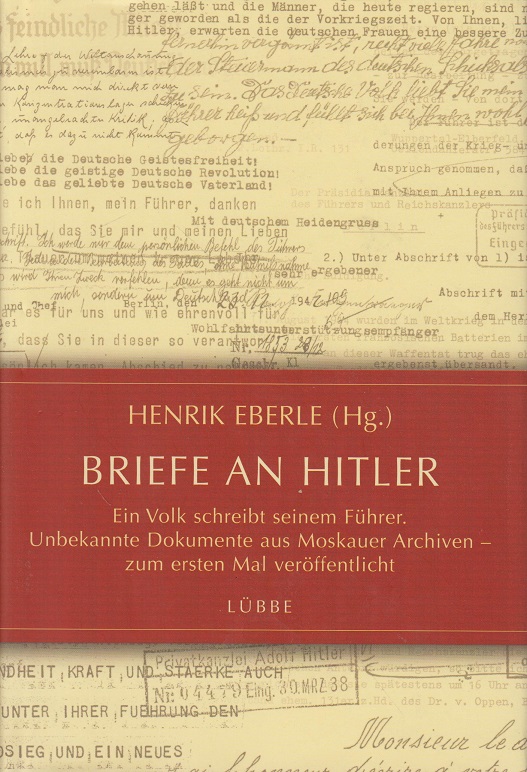
2007réf. 1189732Bergisch Gladbach : Lübbe, 2007. 476, [16] S. : Ill. ; 22 cm gebundener Originalpappband mit Umschlag
2007réf. 107496Bergisch Gladbach, Lübbe, 2007. 476 S. Gr.-8°, Hardcover/Pappeinband mit OU
1996Hardcover, 8vo, 303 pages, illustrated. In German. Edition: 1. Aufl. SUBJECT (S) : Stalin, Iosif V. Molotov, Vjaceslav M. Briefsammlung 1925-1936. Literaturverz. Bibliography on pages 267-268. Other Titles: Pisma I. V. Stalina V. M. Molotovu. ; Deutsch. Light wear to edges of dustjacket. Very good condition. (Holo2-73-1)
1997réf. R160216543Goethe institut de Lyon. 1997. In-4. Broché. Bon état, Couv. convenable, Dos satisfaisant, Intérieur frais. 24 pages agrafées - quelques illustrations en noir et blanc dans le texte.. . . . Classification Dewey : 943.086-IIIe Riech. Hitler, 1933-1945
2007Hardcover, 270 pages, illustrated, 4to, 28 cm. SUBJECT (S) : Jews -- Hungary -- Biography. Jewish youth -- Hungary -- Biography. Zionism -- Hungary -- History -- 20th century. World War, 1939-1945 -- Jewish resistance -- Hungary. Jews, Hungarian -- Israel -- Biography. Holocaust survivors -- Israel -- Biography. Ondergrondse organisaties. Joden. Zionisten. Hongarije. Note(s) : "Copyright (c) The Society for the Research of the History of the Zionist Yorth Movement in Hungary. "-Title page verso. Includes bibliography (p. 261-264) and index. Wear to corners and binding. Otherwise, good condition. (Holo2-16-23)
2007Hardcover, 270 pages, illustrated, 4to, 28 cm. SUBJECT (S) : Jews -- Hungary -- Biography. Jewish youth -- Hungary -- Biography. Zionism -- Hungary -- History -- 20th century. World War, 1939-1945 -- Jewish resistance -- Hungary. Jews, Hungarian -- Israel -- Biography. Holocaust survivors -- Israel -- Biography. Ondergrondse organisaties. Joden. Zionisten. Hongarije. Note(s) : "Copyright (c) The Society for the Research of the History of the Zionist Yorth Movement in Hungary. "-Title page verso. Includes bibliography (p. 261-264) and index. Very good condition. (Holo2-16-23A)
1946Original illustrated cover, Large 8vo; 133 pages; In Polish. To the Victims of the Brigade of Death. Wolff # I: 1354. Weliczker was in the Sonderkommando. "Leon Weliczker Wells was born in Lvov, Poland, on March 10, 1925. Wells was a prisoner in the Janowska concentration camp outside Lvov during World War II. He escaped from the camp in an uprising in 1943 and was hidden in the basement of the Kalwinski family on the outskirts of Lvov. Wells kept a written record of his experiences as a member of the "Death Brigade," and these memoirs were published in Poland after the war and reissued in the United States as The Janowska Road. In 1946 Wells left Poland for the American Zone in Germany, and while in Munich he helped organize the Jewish Historical Commission there. This group gathered documents on the Holocaust which became part of the original collection of the Yad Vashem archive in Israel. Wells gave testimony at both the Nuremberg trials and the Eichmann trial....Wells published Who Speaks for the Vanquished? in 1987. In this work Wells investigated the "non-response" of American Jewish leaders of theplight of Jews in Nazi Europe. He contended that Zionist organizations in America failed to respond in a significant way to save the Jews of Europe because they were focusing their time, influence, and money on preparations for a Jewish state in Palestine" (Yale 2002).Repair to spine. Cover wrappers are edgeworn and chipped without any significant damage to illustration. Pages are browning. Overall Fair Condition. (H-17-1)
1979réf. R300284159Calmann-Lévy. 1979. In-8. Broché. Etat d'usage, Coins frottés, Dos satisfaisant, Intérieur acceptable. 397 pages. 2e plat plié. Quelques rousseurs sur les tranches.. . . . Classification Dewey : 943.086-IIIe Riech. Hitler, 1933-1945
1960Original Paper Wrappers. 21 pages. Illus. 20 cm. In German. Title translates to English as, Buchenwald: A Guide Through the Memorial. Includes maps, significant dates. SUBJECT (S) : Buchenwald (Concentration camp) . Wrappers worn but solid. Internal pages are tanned, but not fragile. Good Condition. (HOLO2-93-17)
1937Volume 3, Number 9. December 30, 1937. Wrappers; 16mo. 35 pages. Also includes "The Ludlow Resolution" by General William C. Rivers and Major George Fielding Eliot, and "After the Town Meeting" by Edward Hodnett. A transcript of a broadcast from the League for Political Education's Town Hall in cooperation with the National Broadcasting Company. Debates and debating -- Periodicals. Radio addresses, debates, etc. -- Periodicals. Social problems -- Periodicals. Title Subject: America's town meeting of the air -- Periodicals. Pages brown; lower right-hand corner bent; small piece of back page gone. Good condition. (H-31-4)
1956Paper Wrappers, 8vo, 164 pages. 23 cm. In German. "mit einer Einfuhrung von H. G. Van Dam, mit Gesetz zur Aenderung des BEG (Mantelgesetz) ...Verordnung zur Durchführung des [sect. ] 31d des Gesetzes zur Regelung der Wiedergutmachung nationalsozialistischen Unrechts für Angehörige des öffentlichen Dienstes vom 6. Juli 1956." Inscribed by the author in year of publication to Moses Leavitt, chairman of the Claims Conference negotiating delegation at the Hague. Subject(s) : World War, 1939-1945 --Claims --Germany (West) . Very Good Condition. (h2-3-13)
1990réf. 238585Koblenz, Eigenverlag, 1990. Broschiert
19998vo; pp. 157; illustrazioni in b/n nel testo; legatura editoriale cartonata con titolo al dorso; sovraccoperta figurata. In ottimo stato. Prima edizione.
1957Publishers cloth. 8vo. 252 pages. 22 cm. First edition. With 18 black and white plates. Subtitle: On the work of Sue Ryder on behalf of displaced persons in Germany. With plates, including portraits. A biography and history of the relief work done by Sue Ryder for Displaced Persons and Holocaust Suvivors. Born in Yorkshire in 1924, Sue Ryder served with the Special Operations Executive (SOE) during the Second World War. Established by Winston Churchill in 1940, the SOE promoted and coordinated resistance activity in German occupied Europe. Her life's mission became clear after World War II. During the post-war reconstruction in Europe, she worked as a volunteer amongst displaced and stateless refugees. During this time she opened her first home, St Christopher's in Germany. It was designed as a haven for refugees, many of whom were survivors of concentration camps. On her return to England, she established the Sue Ryder Foundation with the aim to provide care where it is needed most. Sue Ryder was married for many years to war hero and fellow charity founder the late Leonard Cheshire VC, who died in 1992. Lady Ryder was made a life peer in 1978 and was a Companion of the Order of St Michael and St George in 1975. She also received the Order of the British Empire (OBE) in 1957. (Sue Ryder Foundation) Subjects: Refugees. Britain. Biographies. Ryder. Social issues. Refugees. Organizations S. I. R. World War 1939-1945. German camps and prisons. Britain. Biographies. Ryder. Social issues. Refugees. Organizations S. I. R..World War 1939-1945. German camps and prisons. Outer edges lightly soiled, light wear to cloth. Without jacket. Very good condition. (HOLO2-100-15) XX
19611st edition, original cloth, 4to, xix+ 288+ (2) pages. On title page: Brzezin memorial book. Illustrations throughout. Yiddish, with English introduction. There once was a town of Jewish tailors Brzezin. From early dawn until late at night one could hear the music of the Singer sewing machines. It was the music of hard work, of intense anxiety, of a hard life, but also of noisy youth, semi-intellectuals, observant Jews, Hasidim who lived and had aspirations in the small Jewish town Brzezin. The Nazi savages extinguished this life forever, transformed it into ashes. Only a few Jews from the tailoring town Brzezin, by some miracle, remain, scattered over the entire world, individuals who were witnesses to the German cannibalism. May these words, frail in print, but inscribed not with ink but with blood, be a modest contribution to the matseve [gravestone] for my native town, Brzezin. Brzezin was one of the oldest and most popular Jewish communities in Poland. When this community was established, it carried the name Krakowek [Little Krakow]. At that time, the community extended from the Strykower highway to beyond the Jewish besoylem [cemetery] to the surrounding hills. The Polish noblewoman, Anna Lasocka, had brought the first weavers from afar into this community. Then the community developed even further and began to broaden its borders. At that time, the town already carried the name Brzezin. Jewish tailors came to Brzezin from many places, and after several generations, the town developed its own type of tailoring industry, by which it was known all over the world. A cottage industry was the main occupation here. As early as 1772, Brzezin was famous for its mass production in tailoring. Until 1914 the great Czarist Russia was flooded with the inexpensive products of Brzeziner tailors. In the years between the two world wars, the export of Brzezin industry was spread over many lands in Europe and into other parts of the world. In this, the great Jewish magaziners [owners of clothing enterprises] exporters such as Frankensztejn, Tuszynski, Sulkowicz, and others played a great role. The Jews in Brzezin did not only work, they also participated actively in the socio-political and cultural life of the town, had their representatives on the town council in town hall, and had their religious and secular educational, cultural, and social organizations. Materially, it was a life of Jewish poverty, but spiritually, socially, and culturally, it was rich. (translated from book) SUBJECT(S) : Holocaust, Jewish (1939-1945) -- Poland -- Brzeziny (Lo´dz´) ; Jews. OCLC: 19306453. Light wear on cover, some wear on spine. Good Condition Overall. (YIZ-16-6A)
19611st edition, original cloth, 4to, xix+ 288+ (2) pages. Illustrations throughout. Yiddish, with English introduction. There once was a town of Jewish tailors Brzezin. From early dawn until late at night one could hear the music of the Singer sewing machines. It was the music of hard work, of intense anxiety, of a hard life, but also of noisy youth, semi-intellectuals, observant Jews, Hasidim who lived and had aspirations in the small Jewish town Brzezin. The Nazi savages extinguished this life forever, transformed it into ashes. Only a few Jews from the tailoring town Brzezin, by some miracle, remain, scattered over the entire world, individuals who were witnesses to the German cannibalism. May these words, frail in print, but inscribed not with ink but with blood, be a modest contribution to the matseve [gravestone] for my native town, Brzezin. Brzezin was one of the oldest and most popular Jewish communities in Poland. When this community was established, it carried the name Krakowek [Little Krakow]. At that time, the community extended from the Strykower highway to beyond the Jewish besoylem [cemetery] to the surrounding hills. The Polish noblewoman, Anna Lasocka, had brought the first weavers from afar into this community. Then the community developed even further and began to broaden its borders. At that time, the town already carried the name Brzezin. Jewish tailors came to Brzezin from many places, and after several generations, the town developed its own type of tailoring industry, by which it was known all over the world. A cottage industry was the main occupation here. As early as 1772, Brzezin was famous for its mass production in tailoring. Until 1914 the great Czarist Russia was flooded with the inexpensive products of Brzeziner tailors. In the years between the two world wars, the export of Brzezin industry was spread over many lands in Europe and into other parts of the world. In this, the great Jewish magaziners [owners of clothing enterprises] exporters such as Frankensztejn, Tuszynski, Sulkowicz, and others played a great role. The Jews in Brzezin did not only work, they also participated actively in the socio-political and cultural life of the town, had their representatives on the town council in town hall, and had their religious and secular educational, cultural, and social organizations. Materially, it was a life of Jewish poverty, but spiritually, socially, and culturally, it was rich. (translated from book) SUBJECT(S) : Holocaust, Jewish (1939-1945) -- Poland -- Brzeziny (Lo´dz´) ; Jews. OCLC: 19306453. Light wear on cover, Good Condition Overall. (YIZ-16-6)
1969Later Cloth. 8vo. 292 pages. 21 cm. First Portuguese edition. Translated from the Russian, this documentary in the form of a novel details the massacre at Babi Yar, a large ravine outside the city of Kiev where 100, 000 Jews, Gypsies, and Communists were mass murdered in 1941. Subjects: Babi Yar Massacre, Ukraine, 1941 - Fiction. War stories. Russian fiction - Translations into Portuguese. Historical fiction. Soviet Union - History - German occupation, 1941-1944 - Fiction. OCLC lists four copies worldwide (Biblio Senado Federal; Gratz Col; Univ Pittsburgh; Boston Pub Libr) . Previous owners signature on endpage; otherwise clean and fresh. Good + condition. (HOLO2-99-19)
1961réf. 3054184Tübingen, Wunderlich, 1961. 387 S. Mit Abbildungen. Lwd.
2008réf. R240120096ARMAND COLIN. 2008. In-8. Broché. Bon état, Couv. convenable, Dos satisfaisant, Intérieur frais. 155 pages - quelques photos noir et blanc hors texte - annotations/soulignements au crayon dans le texte. . . . Classification Dewey : 943.086-IIIe Riech. Hitler, 1933-1845
réf. 5944413e année - N° 20-21 - 1er décembre 1936 - Revue bimensuelle publiée par le C.C. du Parti Communiste Français (S.F.I.C) - Imp. Centrale, 5, rue Erard, Paris (12e) - bimensuel - in-8 broché Sommaire : Front Populaire avant tout ! (Jacques Duclos) - Triomphe du socialisme et de la Démocratie (J. Staline) - La duperie tragique (Florimond Bonte) - Quelques problèmes du rapprochement franco-allemand (André Seigneur) - Le IIIe Reich et l'Espagne (S. Erckner) - Le Front Populaire vit ! (Fernand Fontenay) - Pour l'union de la Jeunesse laborieuse (Léonce Granjon) - Réponses au Cardinal Liénart (Arthur Ramette, Mar. Desrumeaux, Joseph Hentges) - Le pacifisme de Hitler (xxx) - Où en est l'application du Programme du Front Populaire (xxx) - ...
réf. 5949413e année - N° 7 - 15 Avril 1936 - Revue bimensuelle publiée par le C.C. du Parti Communiste Français (S.F.I.C) - Imp. Centrale, 5, rue Erard, Paris (12e) - bimensuel - in-8 broché - 1 hors-texte Sommaire : A Ernst Thaelmann pour son 50e anniversaireC'est de la France qu'il faut parler (Jacques Duclos) - La défense du franc (Georges Politzer) - De La Rocque copie Hitler (Jean Seinforin) - L'acte d'accusation contre Thaelmann (Emile Belfort) - La vie de Fritz Heckert (Wilhelm Pieck) - Interview avec M. Chastenet - ...