335 results
ref. MA05F-00385U. S. Government Printing Office. Collectible - Good. Washington D.C.: U. S. Government Printing Office 1946. Sm 4to. v9pp. Illustrations maps. Good book. strategic bombing Japan aircraft engines Inquire if you need further information. U. S. Government Printing Office unknown
1946ref. 5955Washington DC: Government Printing Office GPO 1946. First Edition. Paperback. Very good. Very Good in original blue paper wraps light browning to covers minor erased markings to front cover. vi 46 pp ii 2 fold-outs. Maps are intact and unmarked. Government Printing Office [GPO] paperback
ref. MA05F-00384U. S. Government Printing Office. Collectible - Good. Washington D.C.: U. S. Government Printing Office 1947. Sm 4to. v67pp. Photos folded illustrations maps. Good book. strategic bombing Japan aircraft Inquire if you need further information. U. S. Government Printing Office unknown
1945Contents: Nash car color ad inside front cover; Commercial Solvents Corp. ad with great Iwo Jima beach landing photo; Chrysler *Fluid Drive* color ad; Only Stalin of first trio is left but Attlee carries on where Churchill left off; Very graphic 6-photo sequence of a 'Jap' being burned to death by a flame-thrower; British Labor landslide stirs the world - the winning issue was not Churchill but new homes and jobs for Britons; Photo of a masked 'squeeler' identifying Gestapo agents hiding in the ranks of the Wehrmacht in Norway; Nice color ad for Martin aircraft; Photo of Dutch people tearing up trolly blocks for desperately needed fuel; Trial of Marshal Petain in France; Amazing coverage of B-25 Mitchell bomber striking the Empire State building - the diagram looks just like what the world witnessed September 11th, 2001; The Big Playhouse - Michigan's cushy prison at Jackson; Japan on the ropes - strikes at Kure naval base cover harbor with blazing ships - B-29s blast forewarned cities; Photo of American troops from Europe massing in Manila; *Super* color centerfold featuring a 1942 yellow Buick convertible; photo of leaflet dropped on Jap cities prior to bombing (with article); Photo of Canadian General Crerar who's army has been dissolved; Kaiser lines up Graham-Paige in march toward reconversion - with Frazer's selling genius added to Western Steel facilities, Combine's one need is capital; Photo of experimental helicopter, the PV-3, in flight; Nice color Imperial whiskey ad; Surplus problem - whether to scrap the Office of War Information's (OWI) profitable magazines abroad; Swiss family air force - survival training; Motorola radio ad; Great color Union Pacific Railroad ad with emphasis upon beautiful Washington state; Unmarked with average wear. Address label atop front cover. A sound copy. Book
ref. MA05F-00383U. S. Government Printing Office. Collectible - Good. Washington D.C.: U. S. Government Printing Office 1946. Sm 4to. viii158pp. Folded illustrations maps. Good book. strategic bombing Japan electric utilities Inquire if you need further information. U. S. Government Printing Office unknown
1993Second edition. 215 pages. Glossary. Profusely illustrated with superb color photos. Printed upon glossy stock. "A riveting account of the authors' experiences flying in support of the F-111 bombing raid of Libya in April 1986, roaring across the African desert faster than a Magnum .357 bullet, outrunning enemy missiles, and returning to England after buring 30,000 gallons of fuel in six exhausting hours of mission-filled tension. Masterfully intertwines cockpit action with the fascinating revelations of that unique cadre of civilians who designed, built and maintained the jet. Includes over 120 color photos published for the first time from the author's collection." - dust jacket. Clean and unmarked with moderate wear. Binding sound. Dust jacket now preserved in glossy new archival-grade Brodart. A quality copy of this amazing work. Book
1944159 pages. Index. Author served as Principal Assistant Secretary of the British Air Ministry. Describes how it was the RAF which commenced bombing of German civilian targets before Germany reluctantly began similar attacks in Britain during the second world war. Unmarked. Moderate wear. Binding tight. A sound copy of this important work. Enser p.27, Select Bibliography of Revisionist Books p.21. Book
ref. 803Photos de Presse (le Petit Normand ) et de particuliers.
ref. PE10Oblong Folio album ca. 265x34 cm or 10 ½ x 13 ¼ in. 40 black stock leaves 17 blank. With 121 mounted in corners original gelatin silver photos of various sizes nine photos are colour-printed from ca. 125x175 cm 5x7 in to ca. 6x9 cm 2 ½ x 3 ½ in. Over thirty photos with captions in English in negative sometimes with additional Japanese captions; over twenty photos with period ink captions on the mounts. With eleven loosely inserted gelatin silver photos nine are ca. 75x105 cm 3 x 4 ½ in with captions in negative; two smaller photos are ca. 55x8 cm 2 ¼ x 3 in. With a loosely inserted blue cloth "Air Police " armband ca. 10x45 cm 4 x 17 ½ in. Period brown faux leather album; front cover with a large gilt- and colour-stamped pictorial vignette depicting a horse-driven carriage at a brick-laid mansion. Binding rubbed on extremities covers with cracks at hinges several leaves detached from the stub and loosely inserted overall a very good album with strong interesting photos. An interesting historically significant album compiled by an American military man during his service in the Eighth U.S. Army Headquarters in Yokohama during the first years of the Occupation of Japan September 2 1945 – April 28 1952 at the end of WW2. Over fifty photos portray the album's compiler and his fellow servicemen posing on the grounds of their military camp in Yokohama inside their quarters out on Japanese streets in a military Jeep with the sign "Eighth Army Messenger " with pistol guns in boxing attire partying with their American girlfriends &c. Several handwritten captions identify the people and locations: "my buddy Stenton trying to imitate a monkey” "my buddies Stenton & Dyer at camp” "here I am beside a Jap car in Yokohama Japan” "some of my buddies from left: May West Kenny & … at camp” "me & my buddy May at camp” "my buddy Stenton & myself notice the messenger log in his left arm” "my buddies Saltino & May looking at the same girl I took the picture” "my buddy May & myself in Jokohama Japan; I have a camera now it cost me 2000 yen & 350 yen for case it's a beauty too. " A colour-printed photo at the rear of the album portrays the compiler posing at a Christmas tree. There are also several lively amateur portraits of Japanese people - girls in Western clothes and passers-by on the street "an old Jap lady who always play at the same spot in Yokohama” "some Jap girl we took a picture of nice hun” "a picture of some Japs walking along a market street in Yokohama Japan ". A portrait of a Japanese girl in a Western dress bears her pencil inscription in English and Japanese on the verso "Izuku Minowa ". Other snapshot photos show a street procession a sign of "Shinto Marriage Ceremonies Iseyama Shrine " street workers fixing a burst water pipe Japanese children &c. Over a dozen studio photos of Yokohama several with handwritten captions on verso show "U.S. Army houses " handwritten caption "this is how our huts look like " the "Octagon Theatre " handwritten caption "this is our movies' house in Yokohama about 2 blocks away from camp " "American Red Cross Yokohama Club " manuscript caption "place where I spend most of my leisure time " U.S. 8th Army Headquarters manuscript caption "this place is where I work at 8th army headquarters 4th floor Signal Center " "Yokohama city seen from Nogeyama Park” "Yokohama airport” "Sakuragicho station " handwritten caption "a station near camp " harbour and port piers with U.S. naval ships visible sign of "U.S. Army Transport Wisteria " railway station manuscript caption "this is the main station in Yokohama " Isezakicho district British consulate &c. There are also several studio photos of Tokyo including three views of the ruins after American air raids images of Ginza Street with the Wako store National Diet Building Meiji Memorial Picture Building Imperial Hotel second building 1923-1968 Meiji Building Meiji Seimei Kan Marunochi and Hibiya districts "Finance Bldg. G.H.Q. and Dept. – Toranomon " Palace Heights residential area in Miyakezaka district Imperial Palace grounds &c. Other studio photos include three portraits of Japanese geishas one with a handwritten caption "this is how they dress in Japan only a few have American dresses " and a series of views of Mount Fuji the city of Kamakura and Tsurugaoka Hachimangu shrine. The collection also includes nine rare images of atomic bomb destruction in Hiroshima and Nagasaki which were forbidden for circulation in Japan and the United States during the American occupation of Japan. Five photos of destruction in Nagasaki reproduce the originals taken by YÅsuke Yamahata 1917-1966; four images of Hiroshima were probably taken after the ones by Eiichi Matsumoto 1915-2004. Overall a historically interesting collection of original amateur and studio photos illustrating the life of a U.S. military man serving in Yokohama during the American occupation of Japan. hardcover
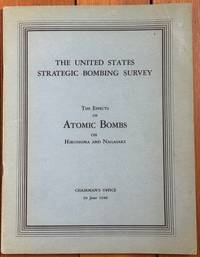
1945ref. 87713Washington DC: United States Strategic Bombing Survey 1945. Presumed First Edition First printing There is a place for a Copy No. but no number is present. Wraps. Fair. 8 33 29 pages of Exhibits. Photographs Figures. Tables. Front cover torn at two of the three staples and restrengthened with tape. RARE Surviving Copy. This report was written primarily for the use of the U. s. Strategic Bombing Survey in the preparation of further reports of a more comprehensive nature. Any conclusions or opinions expressed in this report must be considered as limited to the specific target covered and as subject to further interpretation in the light of further studies conducted by the Survey. It can be said without exaggeration that no matter what terms are used to explain the extent of damage caused by this one bomb any statement regarding the havoc created at HIROSHIMA would be an understatement. Yet should one attempt to do it justice through a complete and documented description the reader could still not conceive of the magnitude of the destruction both in human lives and property because of the lack of a parallel with which to make a comparison. Many of the personnel concerned with civilian defense were killed and much of the equipment destroyed. Nearly all records were burned. Because of the historical importance of the incident a brief study was made to determine the potentiality of a full survey of civilian defense organizations and operations before and at the time of the atomic bombing. The absence of informative sources made this impracticable and this report is therefore not a thorough analytical study. It consists of impressions based upon inspection and of such information as could be gleaned from officials citizens and records which were still available. The United States Strategic Bombing Survey USSBS was a written report created by a board of experts assembled to produce an impartial assessment of the effects of the Anglo-American strategic bombing of Nazi Germany during the European theater of World War II. After publishing its report the Survey members then turned their attention to the war efforts against Imperial Japan during the Pacific War including a separate section on the recent use of the atomic bomb Little Boy. In total the reports contained 208 volumes for Europe and another 108 for the Pacific comprising thousands of pages. The reports' conclusions were generally favorable about the contributions of Allied strategic bombing towards victory calling it "decisive". A majority of the Survey's members were civilians in positions of influence on the various committees of the survey. Only one position of some influence was given to a prominent military officer USAAF General Orvil A. Anderson and that only in an advisory capacity. Anderson was the only one on the survey board who knew about procedures of strategic bombing as Jimmy Doolittle's former deputy commander of operations. While the Board was not associated with any branch of the military it was established by General Hap Arnold along with Carl A. Spaatz. This report addresses the story of the attack civilian defense activities air-raid warnings fire services emergency medical services shelters evacuation informing and training of the general public and financing. Comments were provided. Exhibits includes a map of Hiroshima showing ground zero a chart showing the Chain of Command of civilian defense organizations the Table of Organization and equipment of the auxiliary police and fire units and several sub-divisions transcripts of interviews with S. Nimura Hiroshima city engineer; Y. Yamano acting chief of the city fire department and S. Yabuki chief of the East Hiroshima fire department. The report ends with a Glossary of Japanese characters with English terms. United States Strategic Bombing Survey paperback