1 159 résultats
1978réf. 2080302106808302Written and published by Kunimitsu Muta 1978. Soft Cover. Fine. Number of books: 1 book Written and published by Kunimitsu Muta paperback
1995réf. 2080302106806084Foundation Nagasaki Atomic Bomb Victims Council 1995. Soft Cover. Fine. Number of pages: 305 pages Size: A5 size Number of books: 1 volume (Foundation) Nagasaki Atomic Bomb Victims Council paperback
1977réf. 2080302106808317Published by the Nagasaki Testimony Publishing Committee 1977. Soft Cover. Fine. Number of pages: 300P Size: A5 version 300 pages Published by the Nagasaki Testimony Publishing Committee paperback
1975réf. 2080302106806848Nagasaki Testimony Publishing Committee 1975. Soft Cover. Fine. Size: A5 version 300 pages Number of books: 1 Nagasaki Testimony Publishing Committee paperback
1975réf. 2090202120408343future company 1975. Soft Cover. Fine. Number of books: 1 future company paperback
1975réf. 2092902137405007future company 1975. Soft Cover. Fine. Number of books: 2 future company paperback
1992réf. 2080302106802556Nagasaki Testimony Meeting 1992. Soft Cover. Fine. Size: A5 version 251 pages Number of books: 1 Nagasaki Testimony Meeting paperback
1988réf. 2080302106804694Shio bun-sha 1988. Soft Cover. Fine. The book is in fine condition. Shio bun-sha paperback
2014réf. 2080302106803836Not Available 2014. Soft Cover. Fine. Number of pages: 201 Size: A5 Not Available paperback
1970réf. 2081002109001145Nagasaki Atomic Bomb Victims Council 1970. Soft Cover. Fine. Number of pages: 143p Size: 26cm Nagasaki Atomic Bomb Victims Council paperback
2006réf. 2080502106907482Not Available 2006. Soft Cover. Fine. The book is in fine condition. Not Available paperback
réf. 2080702109504174Nagasaki Museum of Art N.A. Soft Cover. Fine. Number of pages: 180p Size: 22×31cm Number of books: 1 Nagasaki Museum of Art paperback
1933réf. 2080502106511333Imperial Chamber of Commerce 1933. Soft Cover. Fine. Volume: 1 Imperial Chamber of Commerce paperback
1929réf. 2080502106917119Not Available 1929. Soft Cover. Fine. The book is in fine condition. Not Available paperback
1986réf. 2080302106807718Not Available 1986. Soft Cover. Fine. The book is in fine condition. Not Available paperback
2001réf. 2083002117801460Nakatomi Medicine Museum 2001. Soft Cover. Fine. Number of pages: 259p Map size: 21cm Nakatomi Medicine Museum paperback
2008réf. 2080402107100854Not Available 2008. Soft Cover. Fine. The book is in fine condition. Not Available paperback
1990réf. 2081402110001348Not Available 1990. Soft Cover. Fine. Number of books: 1 Not Available paperback
1990réf. 2080502106510731Junshin Women's Junior College 1990. Soft Cover. Fine. Volume: 1 Junshin Women's Junior College paperback
1990réf. 2080302106805529Junshin Women's Junior College 1990. Soft Cover. Fine. Size: A5 version 197 pages Number of books: 1 Junshin Women's Junior College paperback
2000réf. 2092902141800302Tanaka Honke Museum 2000. Soft Cover. Fine. Number of books: 1 Tanaka Honke Museum paperback
réf. 11453Scroll 535 x 2790 mm. pale brown silk on outer front endpaper inside covered with gold paper wooden core roller. Japan: late Edo 1855 or later. While Edo was the center of government and Osaka the national market hub Nagasaki was an extremely important center of commerce crafts and travel. It is no wonder that Nagasaki became the locus for trade with the rest of the world during the Tokugawa era: the port facing China and near Korea is at the end of a long and narrow entranceway - ideal for soldiers to observe from elevated positions the comings and goings of ships. The city itself at the eastern end of this long "neck" is shaped as an amphitheater by low mountains that enclose the bay to the north and west. Nagasaki was the only official port in Japan allowed to receive goods from around the world brought in initially by the Portuguese and Chinese and then by the Dutch. It served as the main port for export as well. The city also became the main conduit of "Dutch learning" and Chinese knowledge into the island nation. Artificial islands - Dejima for the Dutch and the dock island Shinchi 新地 for the Chinese connected to the Chinese quarter called TÅjin yashiki å”人屋敷 - were created for the myriad of goods and strange objects imported into Japan from the West and throughout Asia. Our scroll consists of one long highly detailed map of the city port areas and entrance to Nagasaki all surrounded by hills and low mountains. The map depicts cliffs beaches mountains and hills the many islands and dangerous rock outcroppings of the entrance outer observation stations etc. The beginning depicts the Urakami shinden 浦上新田 area of reclaimed land built in the 1730s used as fields for crops. As we proceed westward we see warehouses for saltpeter and rice storage and then the artificial islands of Dejima and the Chinese loading docks attached to the Chinese quarter by a bridge. The surrounding mountains and notable islands and points are labelled throughout as are the magistrates' offices of a number of domains. In the harbor we see Dutch two British American and Russian trading ships each with its national flag along with the ShÅhei Maru the first Western-style warship built in Japan 1853-54 constructed by the Satsuma fiefdom and presented to the Tokugawa shogunate in 1855. The scroll then shows the long narrow entranceway to Nagasaki with eight odaiba 御å°å ´ forts with cannons placed in strategic locations protecting the port from unwanted ships. Constructed in the early 19th century these were the first odaiba built in Japan as the government became increasingly anxious about possible attacks by foreign ships. Red lines depict the desired routes of entrance and exit for trading ships allowing the Japanese to easily observe the arriving Chinese and Dutch vessels. Distances from many points of the entrance to Nagasaki are given. The beginning of the outer GotÅ islands and the Nomozaki peninsula are shown at the end of the scroll. Fine condition; preserved in a modern wooden box. unknown books
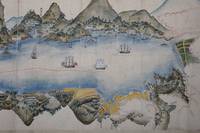
réf. 11453Scroll 535 x 2790 mm. pale brown silk on outer front endpaper inside covered with gold paper wooden core roller. Japan: late Edo 1855 or later. While Edo was the center of government and Osaka the national market hub Nagasaki was an extremely important center of commerce crafts and travel. It is no wonder that Nagasaki became the locus for trade with the rest of the world during the Tokugawa era: the port facing China and near Korea is at the end of a long and narrow entranceway - ideal for soldiers to observe from elevated positions the comings and goings of ships. The city itself at the eastern end of this long "neck" is shaped as an amphitheater by low mountains that enclose the bay to the north and west. Nagasaki was the only official port in Japan allowed to receive goods from around the world brought in initially by the Portuguese and Chinese and then by the Dutch. It served as the main port for export as well. The city also became the main conduit of "Dutch learning" and Chinese knowledge into the island nation. Artificial islands - Dejima for the Dutch and the dock island Shinchi 新地 for the Chinese connected to the Chinese quarter called TÅjin yashiki å”人屋敷 - were created for the myriad of goods and strange objects imported into Japan from the West and throughout Asia. Our scroll consists of one long highly detailed map of the city port areas and entrance to Nagasaki all surrounded by hills and low mountains. The map depicts cliffs beaches mountains and hills the many islands and dangerous rock outcroppings of the entrance outer observation stations etc. The beginning depicts the Urakami shinden 浦上新田 area of reclaimed land built in the 1730s used as fields for crops. As we proceed westward we see warehouses for saltpeter and rice storage and then the artificial islands of Dejima and the Chinese loading docks attached to the Chinese quarter by a bridge. The surrounding mountains and notable islands and points are labelled throughout as are the magistrates' offices of a number of domains. In the harbor we see Dutch two British American and Russian trading ships each with its national flag along with the ShÅhei Maru the first Western-style warship built in Japan 1853-54 constructed by the Satsuma fiefdom and presented to the Tokugawa shogunate in 1855. The scroll then shows the long narrow entranceway to Nagasaki with eight odaiba 御å°å ´ forts with cannons placed in strategic locations protecting the port from unwanted ships. Constructed in the early 19th century these were the first odaiba built in Japan as the government became increasingly anxious about possible attacks by foreign ships. Red lines depict the desired routes of entrance and exit for trading ships allowing the Japanese to easily observe the arriving Chinese and Dutch vessels. Distances from many points of the entrance to Nagasaki are given. The beginning of the outer GotÅ islands and the Nomozaki peninsula are shown at the end of the scroll. Fine condition; preserved in a modern wooden box. unknown
1972réf. 2090202120408750Doshin-sha 1972. Soft Cover. Fine. Number of books: 1 Doshin-sha paperback
2008réf. 2080302106804876Not Available 2008. Soft Cover. Fine. The book is in fine condition. Not Available paperback