212 résultats
In 4°; 45, (19) pp. Brossura editoriale illustrata. Tiratura di 1000 esemplari. Prima edizione di questa monografia dedicata alla 2° Biennale Internazionale della pietra "Città di Marino" nella quale venne presentata l'opera del grande scultore giapponese, nato a Kozan (Hiroshima) nel 1942. Kuetani fu allievo di Pericle Fazzini.
1998réf. V34825Hamburg (Gruner + Jahr AG) [1998] (= wöchentliche Beilage zum Stern). 4°, illustrierter Originalumschlag ( Klammerheftung) 30 S., Abbildungen, 1
1995réf. 174782New York Tokyo and Washington DC: Weatherhill in association with Arthur M. Sackler Gallery Smithsonian Institution 1995. Second printing. Oblong softcover. Exhibition catalog for a show that ran November 20 1994 through July 9 1995. Foreword by Milo Cleveland Beach. A look at the baskets of Hiroshima Kazuo. Includes numerous color and black and white illustrations. A fine copy in French style wrappers. Weatherhill in association with Arthur M. Sackler Gallery, Smithsonian Institution unknown books
Folio 160p., illus. SOFTCOVER. Paperback Very good condition
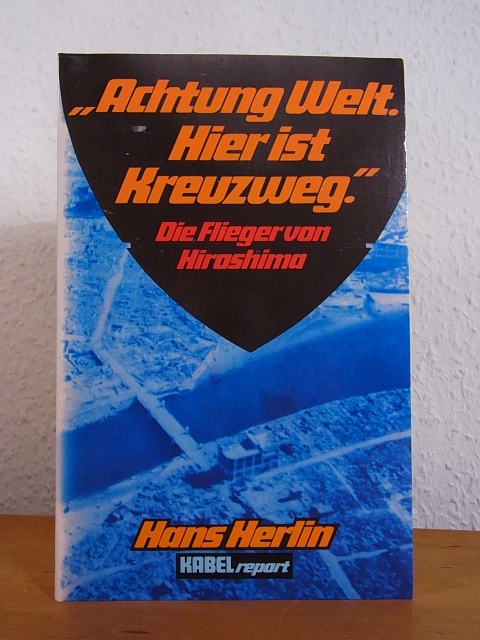
1983réf. 96699Hamburg: Ernst Kabel Verlag, 1983. 21,5 cm ; kart.
réf. 5332HIROSHIMA. An archive of 22 original aerial photographs of Japan at the end of World War II; seven of them are marked “Hiroshima” on the verso. The photos were likely taken by a bomber crewman who flew over Hiroshima and other parts of Japan. The near-total flattening of Hiroshima is obvious in some images and there are images of horrific destruction perhaps from firebombing. Each image measures 4 ½” x 4”. Some has some minor scuffing and loss to the image and all have mounting remnants to the verso from where they were once attached to an album. unknown books
1981réf. KFZZQ100522Hiroshima City Museum of Contemporary Art 1981. Soft Cover. Fine. KFZZQ100522 Hiroshima City Museum of Contemporary Art paperback
In folio. Dim. 40x30,5 cm. Pp. da 30 a 40+(4). Numero del 25 gennaio 1952 della rivista settimanale "Ali" di aviazione. "Ali" il periodico degli aviatori italiani nasce a Milano il 28 Marzo 1944 per essere pubblicato fino al 28 Aprile 1945 quando si interruppe a causa della guerra. Riappare nel 1951 fino al 1977 variando più volte di nome. Tra gli articoli presenti: Tecnica di riflesso, C.c.2 Caproni Campini Primato italiano, Aviazione cino coreana, Villaggio Milano, I delta di Lippisch a reazione, MAntova, LA morte è discesa a Hiroshima ecc... Numerose notizie di attualità e foto d'epoca all'interno. In buone condizioni. Copertina editoriale in buone condizioni generali con lievi usure ai margini e dorso. Legatura assente. All'interno le pagine si presentano in ottime condizioni con rare fioriture. Number of the 25th of january 1952 of the weekly magazine "Ali" of aviation. "Ali" the magazine of italian aviators was born in Milan the 28th of March 1944 to be published until the 28th of April 1945 when it was blocked due to the war. It reappeared in 1951 until 1977 changing names different times. Between the articles inside: Technique of reflexion, C.c.2 Caproni Campini Primato italiano, Aviation Chine Chorea, Village Milan, I delta di Lippisch, Mantova, death in Hiroshima ecc... Different information of actuality and photoes inside. In good conditions. Editorial cover in good general conditions slightly worn in the edges and spine. (see the photo). Binding is almost missing. Inside pages are in good conditions with occasional foxings.
1998réf. 28839Hiroshima Japan : Hiroshima Peace Cultural Foundation 1998. First Edition. Paperback. Color-printed presentation box-set fine very slight toning to the edge . Corners sharp with an overall tight bright and clean impression. ; 0 pages; Description: 1 vol. : plates ; 24 cm. Subjects: World War 1939-1945 --Hiroshima Japan --History --Photo-journalism. UNdated. Date is suggested/cannot be verified. Hiroshima (Japan) : Hiroshima Peace Cultural Foundation paperback
74 pages. Features: Parallel and Linked Genocides - Iraq and Palestine; The Nazification of Israel; The Growing Clamor for Ethnic Cleansing; Anti-Semitism and the Beirut Pogrom; George Bush and the American Empire; Ground Zero - Hiroshima haunts 9/11; and much more. Average wear. Unmarked. A sound copy. Book
Book is in excellent condition with lightly bumped corners, very light edge wear to dark red cloth covers with gilt print at spine. Binding is solid and square, exterior shows no other blemishes, text/interior is clean and free of marking of any kind. Dust jacket shows extensive edge wear, small tears at hinge, top spine, scuffing, small stain. Contents include: Organization of the profession, The Japanese hotel, Transport and tourism, Town planning in evolution, Architectural education The architects, etc. Featured buildings or sights include Frank Lloyd Wright's Imperial Hotel, Diet Library, Gakushuin University, Museum of western art, memorial hall at Hiroshima, Sakakura's art gallery, Town hall, Gotsu, museum at Matsue, Dentsu building Osaka, Hasshokan hotel at Nagoya, Kenzo Tange hotel at Atami and a great many others. Architects featured in chapter "Architects" : Antonin Raymond, Togo Murano, Junzo Sakakura, Isao Sibaoka, Tsutomu Ikota, Hideo Kosaka, Kunio Maekawa, Kenzo Tange, Hirosohi Oe, Takamasa Yoshizaka, Yoshinobu Ashihara, Kiyonori Kikutake, and many others. Copyright 2011 Pistil Books
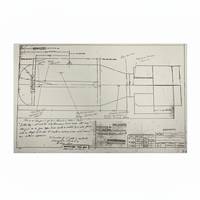
1945réf. 125961945. World War IIAtomic Bomb Van Kirk Theodore J. "Dutch". Single blueprint copy inscribed and signed dated "6 Aug 1945." Single blueprint sheet. Annotated blueprint of "Little Boy" the uranium-235 atomic bomb detonated over Hiroshima on August 6 1945 inscribed and explained by Theodore Van Kirk navigator of the B-29 Enola Gay during the first wartime use of a nuclear weapon. Developed under the direction of the Manhattan Project the bomb marked a decisive technological and geopolitical rupture at the close of World War II inaugurating the nuclear age and reshaping global military doctrine. Approximately 70000 people were killed as a direct result of the blast with comparable numbers injured rendering the event one of the most consequential military actions of the twentieth century. Black-and-white blueprint copy approximately 18 x 24 inches illustrating the internal configuration of "Little Boy" employing the gun-type assembly method in which a sub-critical uranium-235 projectile was fired into a hollow uranium-235 target to achieve supercritical mass and initiate a nuclear chain reaction. Van Kirk has added detailed manuscript notations in pencil and ink identifying principal components including the "Neutron Source" "Steel Tamper" "Gunpowder" "Explosion Device" "Highly Sensitive Radio Antennae" "Uranium 235 'Bullet' Fired into Target to Create a Critical Mass" and "Uranium 235 Hollowed out Target." Along the margin in black ink he writes: "This is a blue print of our Hiroshima Atomic bomb 'Little Boy.' It was the only uranium bomb made. The bomb was designed as a gun type bomb with a bullet of U-235 fired into a U-235 target to create a critical mass." Signed below in blue ink: "Theodore J 'Dutch' Van Kirk Navigator - Enola Gay 6 Aug 1945." The design of "Little Boy" was finalized by early 1945 and reflected a conservative engineering approach intended to ensure detonation reliability despite the unprecedented nature of atomic warfare. As a navigational officer on the mission Van Kirk occupied a critical operational role in delivering the weapon to its target and his explanatory annotations reveal how participants later articulated the bomb's mechanics and singular status as the only uranium-based device used in combat. Minor edge wear and light handling marks; blueprint lines sharp and legible; manuscript annotations and signature clear and strong. Overall very good to near fine condition. unknown
2026réf. x-1032670371Taylor & Francis Ltd 2026. Paperback. New. 188 pages. 6.14x0.44x9.21 inches. Taylor & Francis Ltd paperback
réf. A9783110403503Hardback. New. This is the second updated and extended edition of the successful book on Feynman-Kac theory. It offers a state-of-the-art mathematical account of functional integration methods in the context of self-adjoint operators and semigroups using the concepts and tools of modern stochastic analysis. In the second volume these ideas are applied principally to a rigorous treatment of some fundamental models of quantum field theory. hardcover
réf. ria9783110403503_inpHardcover. New. New Book; Fast Shipping from UK; Not signed; Not First Edition; N/A hardcover
réf. 33622150-nnew. unknown
réf. 33622150like new. unknown
2020réf. BN676814De Gruyter 2020. 2020. Applications in Rigorous Quantum Field Theory De Gruyter Studies in Mathematics 34/2 Band 2 Applications in Rigorous Quantum Field Theory De Gruyter Studies in Mathematics 34/2 Band 2 Lörinczi József and Fumio Hiroshima De Gruyter unknown
réf. 68856Traduit du japonais, Gallimard, Haute enfance, 1996, 234 pp., broché, légères traces de plis sur le dos, couverture insolée, état correct.
1945réf. 129721945. Field Marshall III publisher. The Chicago Sun August 7 1945 documents the first full day of American press coverage following the atomic bombing of Hiroshima and the sudden public disclosure of the secret wartime program that produced the weapon. The United States dropped the uranium bomb "Little Boy" on Hiroshima on August 6 and President Harry S. Truman announced its use the same day disclosing the existence of the atomic bomb and declaring that the release of atomic energy opened a new era in humanity's understanding of natural forces. The issue is particularly significant for showing how a mass-circulation American newspaper initially presented the bomb through three interconnected narratives: the destructive results of atomic science the formerly secret industrial infrastructure of the Manhattan Project and expectations for the peacetime uses of atomic power. It provides primary-source evidence for the study of Hiroshima World War II journalism the public revelation of the Manhattan Project nuclear technology and the opening of the atomic age. The Chicago Sun. Chicago: The Chicago Sun Tuesday August 7 1945. 22 pages printed recto and verso. Complete issue. The front page contains extensive atomic-bomb coverage including "Story of Our Secret Weapon"; "Scientists Tell Of Watching First Blast. Steel Tower is Vaporized; Cloud Rises 8 Miles"; and "Truman Visions New Era Powered by Atomic Force." A large photograph depicts an atomic-production facility at the Clinton Engineer Works at Oak Ridge Tennessee giving readers a first visual introduction to part of the immense industrial system that had operated under wartime secrecy. The Clinton Engineer Works served as the Manhattan Project's administrative headquarters and contained the K-25 S-50 and Y-12 facilities used in uranium-isotope separation; enriched uranium produced at Oak Ridge contributed directly to the Hiroshima weapon. The juxtaposition of the first atomic test industrial production Hiroshima and Truman's predictions for atomic energy illustrates how quickly American newspapers began constructing a public explanation for technology that had remained secret throughout most of the war. The August 7 date gives the issue considerable documentary immediacy: American readers were encountering the scale scientific origins industrial production and possible future applications of atomic energy almost simultaneously with learning of its use against a populated city. Truman's August 6 statement itself moved rapidly between military destruction and predictions that atomic energy might eventually supplement coal oil and hydroelectric power a dual framing closely echoed by the headlines preserved here. Oak Ridge's appearance on the front page is equally significant because the sprawling Tennessee installation had been created under extraordinary secrecy beginning in 1942 and encompassed several parallel processes for uranium enrichment. Light age toning and spotting with slight wear to edges; otherwise complete and well preserved. Very good. An unusually immediate newspaper record of the transition from a secret wartime weapons program to a publicly recognized atomic age published one day after Hiroshima and preserving the first explanations offered to American readers of the bomb its production and its anticipated consequences. unknown
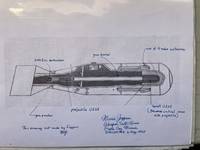
1945réf. 125771945. Jeppson Morris. Hand-annotated diagram of the "Little Boy" atomic bomb 1945 provides a direct technical interpretation of the weapon used in the bombing of Hiroshima by a participant who bridged both its development and deployment. As weapons officer aboard the Enola Gay and a scientist present at Los Alamos Laboratory Jeppson occupied a rare dual role linking the Manhattan Project's design phase with the operational execution of nuclear warfare. His annotations explain the internal structure and function of the uranium gun-type bomb offering a contemporaneous explanation of how critical mass was achieved and how the weapon was triggered. The document situates technical knowledge of nuclear fission within the lived experience of those responsible for its first use in warfare during World War II. Jeppson Morris. "Little Boy" atomic bomb diagram. United States 1945. One-page black-and-white printed diagram with extensive handwritten annotations and arrows in ink signed at lower margin "Morris Jeppson / Weapon Test Officer / Enola Gay Mission / HIROSHIMA 6 Aug. 1945." The annotations identify and explain key components including "target U235" "projectile 235" and the process by which the bomb "Becomes critical mass with projectile" along with labeled elements such as the "electric detonator" "gun barrel" and "one of 4 radar antennas." The markings function as a technical overlay to the printed schematic clarifying both structure and mechanism from the perspective of the officer responsible for in-flight arming and monitoring of the device. The atomic bombing of Hiroshima marked the first combat use of nuclear weapons and introduced a new phase of warfare defined by unprecedented destructive capacity and strategic implications. Jeppson's role in both the scientific and operational dimensions of the mission positions this document within the immediate transmission of specialized knowledge from laboratory to battlefield. His annotations provide insight into how participants understood and communicated the bomb's function contributing to the historical record of nuclear science military technology and the transformation of warfare at the end of World War II. Light handling wear; diagram remains clear with strong legible annotations and signature. Overall very good. unknown
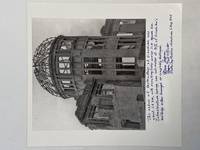
1945réf. 127651945. Jeppson Morris. Inscribed photograph of the Hiroshima Atomic Dome following the atomic bombing provides a quantified assessment of destruction written by the weapons officer responsible for arming the bomb aboard the Enola Gay on August 6 1945. As the individual who physically armed the device prior to release Morris Jeppson links technical execution of the mission with retrospective evaluation of its effects. His inscription records measured estimates of blast radius fire spread and infrastructure damage contributing to the historical record of how participants in the bombing articulated its scale and consequences in numerical terms. Jeppson Morris. Hiroshima Atomic Dome photograph. United States post-1945. Black-and-white photograph measuring approximately 9 x 8.5 inches inscribed in ink by Morris Jeppson. The inscription reads: "The radius of destruction of Hiroshima was about 1.6 km with resulting fires across 11.4 square km. Infrastructure damage was estimated at 90% of Hiroshima's buildings either damaged or completely destroyed. Morris Jeppson - Weapon Test Officer - Enola Gay Mission - Hiroshima 6 Aug. 1945." The image depicts the Atomic Dome one of the few surviving structures near the hypocenter paired with Jeppson's statistical summary of destruction integrating visual evidence with numerical interpretation. The Hiroshima bombing introduced a new scale of urban destruction defined by nuclear technology with immediate and long-term consequences for civilian populations and infrastructure. Jeppson's inscription reflects how participants in the mission communicated its impact through measurable data aligning with postwar efforts to document and understand the physical effects of atomic weapons. The combination of a landmark image of the Atomic Dome with a participant-authored damage assessment offers a primary source for the study of nuclear warfare urban devastation and the translation of technological force into quantifiable outcomes. Light handling wear; photograph remains clean with strong legible inscription. Overall very good. unknown
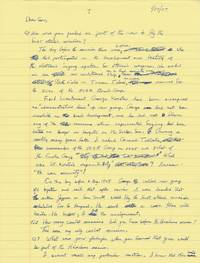
1945réf. 143931945. Jeppson Morris R. Autograph letter recounting his role in the Hiroshima atomic bombing mission written by the weapons test officer aboard the B 29 Enola Gay the aircraft that delivered the first atomic weapon used in warfare on 6 August 1945. Morris Jeppson served as the electronic officer responsible for the bomb's fuzing system and for arming the uranium bomb known as "Little Boy" shortly before it was released over Hiroshima. His recollections provide firsthand testimony concerning the selection of the mission crew the operational procedures followed aboard the aircraft and the technical responsibilities associated with the deployment of the atomic weapon during the closing days of World War II. Jeppson Morris R. Autograph Letter Signed. Three pages written on yellow lined paper composed as responses to a series of questions concerning the Hiroshima mission. The manuscript appears to be a draft with numerous corrections and annotations with both the questions and answers written in Jeppson's hand. Addressing how he was selected to fly on the mission Jeppson recounts: "The day before the mission there were 6 of us who had participated in the development and testing of the electronic fuzing system for atomic weapons. George called our group of 6 together and said it was decided that whether Jeppson or Lt. Leon Smith would fly the first mission scheduled for 6 August. He said a coin toss will decide. He tossed I got the assignment." When asked about his role aboard the aircraft Jeppson describes assisting Captain William Parsons in preparing the weapon after takeoff and monitoring the bomb's electronic fuzing system during the flight. He explains that shortly before the bombing run he entered the bomb bay and "replaced an electrical component plug in the bomb with a red coded plug that armed the bomb so that it would self detonate when it reached an elevation above ground of about 1800 feet." The letter concludes with reflections on the mission's perceived outcome noting that the detonation confirmed the operational success of the weapon's design. The Hiroshima bombing represented the first combat use of nuclear weapons and marked a decisive technological and political turning point at the end of World War II. Personnel involved in the Manhattan Project and the 509th Composite Group later became central witnesses to the development and deployment of atomic weapons. Jeppson's manuscript responses offer detailed technical and personal recollections concerning the operational procedures aboard the Enola Gay including the late decision to arm the weapon in flight and the responsibilities assigned to the crew members who developed the bomb's electronic fuzing system. The document provides insight into the internal mechanics of the Hiroshima mission as remembered by the officer who physically armed the weapon shortly before its release. Signed "Morris R. Jeppson" in a different pen. Light handling wear; overall excellent condition. A detailed firsthand account of the technical preparation and execution of the first atomic bombing mission. unknown
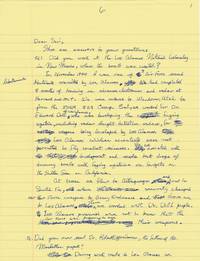
1945réf. 143891945. Jeppson Morris R. Autograph Letter Signed written after World War II a first person technical and eyewitness account by the weapons officer of the Enola Gay the B 29 aircraft that dropped the first atomic bomb on Hiroshima on 6 August 1945. As one of eight Army Air Forces second lieutenants recruited to support Los Alamos weapons development Jeppson occupied a rare operational position linking laboratory science to combat deployment. In the present two page letter written entirely in his hand in question and answer format he explains his recruitment after advanced electronics and radar training at Harvard and MIT and his assignment to the 509th Bomb Group at Wendover Utah. He describes working under Dr. Edward Doll of Los Alamos on the bomb's fuzing system including radar height detection noting that "Los Alamos civilian scientists were not permitted to fly combat missions" and recounts test drops of dummy bombs over the Salton Sea. His narrative situates him among the very small circle beyond senior scientists who understood the weapon's intended use as he was responsible for arming the fuzing system inside the bomb bay shortly before release over Hiroshima. Jeppson Morris R. Autograph Letter Signed. No place no date. Two pages on yellow lined paper written in ink signed "Sincerely Morris R. Jeppson." In response to a question about J. Robert Oppenheimer Jeppson recounts a May 1945 flight in which "The sole passenger was Dr. Oppenheimer. This very gracious man was smiling to visit with me and he answered my questions about where I should attend graduate school in nuclear physics after the war" recommending the University of California Berkeley. He emphasizes the strict compartmentalization of the Manhattan Project: "Because of very tight security restrictions neither of us ever mentioned nuclear weapons." The letter provides granular insight into the operational secrecy of the project the integration of military officers into laboratory development and the transition from experimental design to battlefield use at the close of World War II. Numerous corrections and annotations appear throughout reflecting careful retrospective clarification. Paper clean and fully legible signature strong. Overall condition: excellent. unknown
1945réf. 129771945. Hecht Selig. Explaining the Atom signed and inscribed by Theodore Van Kirk framing the atomic bombing of Hiroshima within a longer intellectual history of atomic theory and modern physics. As navigator of the Enola Gay during the August 6 1945 mission Van Kirk contributed directly to the operational execution of nuclear warfare and his inscription frames that event as the culmination of developments beginning with ancient atomism and extending through 20th-century scientific breakthroughs. By referencing figures such as Democritus and Einstein alongside the Manhattan Project the inscription integrates scientific theory with wartime application offering a condensed narrative linking philosophical origins of atomic thought to its realization in military technology. Hecht Selig. Explaining the Atom. New York: Viking Press 1947. 205 pages. Hardcover with dust jacket. Signed and extensively inscribed on the inside title page by Theodore Van Kirk. The inscription reads: "'Page 9; In 400 B.C. Deocritus theoryed the existence of atoms. In 1905 Einstein theorized E=MC squared. In 1943 Oppenheimer heads the Manhattan Project. In 1945 our 'Enola Gay' crew drops the atomic bomb on Hiroshima - Theodore 'Dutch' Van Kirk Navigator - Enola Gay August 6 1945." The text presents a chronological sequence of scientific and historical developments culminating in Van Kirk's own role in the Hiroshima mission. Published in the immediate postwar period Explaining the Atom aimed to make atomic science accessible to a broad audience at a time when nuclear technology had reshaped global politics and warfare. Van Kirk's inscription reflects how participants in the atomic mission interpreted their actions within a broader scientific and historical continuum linking abstract theory to its most consequential application. The juxtaposition of popular scientific exposition with firsthand annotation from a mission participant offers a layered artifact for the study of nuclear history scientific communication and the integration of intellectual and military developments in the mid-20th century. Dust jacket shows moderate wear; volume itself remains clean and well-preserved with strong legible inscription. Overall very good. unknown