Le Passepoil - Bulletin Périodique illustré de la Société d'Etude des Uniformes - Emile Nussbaum et Commandant BucquoyLivre Rare Book

1162 resultados
1935ref. 1245951935 A Troyes, Imprimerie J.-L. Paton - Bulletin illustré de la Société d'Étude des Uniformes (Paraissant 4 fois par an) - 1935 - 4 Brochures In-4 (Premier, deuxième, troisième et quatrième trimestre) - Feuillets non relié sous couverture brochée de l'éditeur - 120 + 8 pages - Nombreuses illustrations N&B et couleurs - Bien complet de ses 16 planches hors-texte en couleurs
1937ref. 1245961937 A Paris, Nancy & Strasbourg, Imprimerie Berger-Levrault - Bulletin illustré de la Société d'Étude des Uniformes (Paraissant 4 fois par an) - 1937 - 4 Brochures In-4 (Premier, deuxième, troisième et quatrième trimestre) - Feuillets non relié sous couverture brochée de l'éditeur - 117 pages - Nombreuses illustrations N&B et couleurs - Bien complet de ses 16 planches hors-texte en couleurs
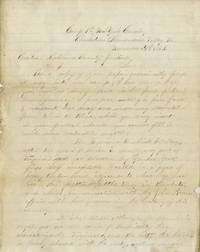
1863ref. List3846Camp 1st New York Cavalry Charlestown Shenandoah Valley Virginia 1863. Incomplete autograph letter addressed to the editors of the Rockland County Journal. Two page letter measuring 7 ¾ x 9 ¾ inches. Discoloration and chipping to margins; tears at folds repaired with archival tape; very good to excellent. An incomplete letter written by a soldier in Virginia in 1863. The writer proposes to send occasional correspondence from the army then turns to a lively local sketch of Charlestown John Brown memory disloyal but hospitable Virginians guerrilla anxiety squirrel shooting and a visit to the "renowned Masonic Cave" allegedly used as a meeting place by George Washington. He writes: "Camp 1st New York Cavalry Charlestown Shenandoah Valley Va. November 14th 1863 Editors Rockland County Journal "Sirs "As a copy of your paper occasionally finds its way into our camp & I have observed you have no correspondent in this part of the 'sham federacy' I propose writing a few facts & incidents that may come under my observation from time to time which you may insert in your Journal whenever you cannot fill it with more valuable matter. "The Regiment to which I belong after two years of service in nearly every part of Virginia's soil yet trodden by Yankee feet finds itself comfortably located in a piece of heavy timber land adjacent to what had once been the prettiest little town in the state and which in connection with the John Brown affair will live forever in the history of this country. "Its inhabitants altogether far from being loyal yet are not devoid of hospitality that characterizes the Virginians and the little they have is freely shared with the needy without regard to the color of his uniform provided he deports himself as a gentleman. "A few days ago with a few comrades I visited the renowned 'Masonic Cave' situated about 2 miles from Camp in a South East direction. "As a precaution against guerrillas who disguised as citizens hover about our pickets constantly we carried our carbines & a number of squirrels repaid the trouble. But to the Cave. "The entrance is on the top of a hill some 50 or 60 feet above the general level of the surrounding country. A hole large enough for the cellar of an ordinary sized house one side of which is composed of a large rock leaning inward first attracts the attention. At the terminus of this rock is built an ordinary door frame passing through which a few steps brings you into the main apartment of the cave & into total darkness. Lights are now requisite and after a few minutes you are enabled to see a large rock rising before you which will form a good seat. As the cave is quite dry you sit down on it until the eye gets accustomed to the darkness or as one of our party remarked 'until the light from the candles reach the sides of the cave'. Leaning forward you elbow rests on another rock the same that served as a table for the immortal Washington when sitting on the seat you now occupy he presided over the meeting of the". An incomplete but appealing wartime local sketch describing Charlestown in the shadow of John Brown and an odd excursion to the Masonic Cave along with his guarded but generous view of local Virginians. . unknown
1863ref. List3846Camp 1st New York Cavalry Charlestown Shenandoah Valley Virginia 1863. Incomplete autograph letter addressed to the editors of the Rockland County Journal. Two page letter measuring 7 ¾ x 9 ¾ inches. Discoloration and chipping to margins; tears at folds repaired with archival tape; very good to excellent. An incomplete letter written by a soldier in Virginia in 1863. The writer proposes to send occasional correspondence from the army then turns to a lively local sketch of Charlestown John Brown memory disloyal but hospitable Virginians guerrilla anxiety squirrel shooting and a visit to the "renowned Masonic Cave" allegedly used as a meeting place by George Washington. He writes: "Camp 1st New York Cavalry Charlestown Shenandoah Valley Va. November 14th 1863 Editors Rockland County Journal "Sirs "As a copy of your paper occasionally finds its way into our camp & I have observed you have no correspondent in this part of the 'sham federacy' I propose writing a few facts & incidents that may come under my observation from time to time which you may insert in your Journal whenever you cannot fill it with more valuable matter. "The Regiment to which I belong after two years of service in nearly every part of Virginia's soil yet trodden by Yankee feet finds itself comfortably located in a piece of heavy timber land adjacent to what had once been the prettiest little town in the state and which in connection with the John Brown affair will live forever in the history of this country. "Its inhabitants altogether far from being loyal yet are not devoid of hospitality that characterizes the Virginians and the little they have is freely shared with the needy without regard to the color of his uniform provided he deports himself as a gentleman. "A few days ago with a few comrades I visited the renowned 'Masonic Cave' situated about 2 miles from Camp in a South East direction. "As a precaution against guerrillas who disguised as citizens hover about our pickets constantly we carried our carbines & a number of squirrels repaid the trouble. But to the Cave. "The entrance is on the top of a hill some 50 or 60 feet above the general level of the surrounding country. A hole large enough for the cellar of an ordinary sized house one side of which is composed of a large rock leaning inward first attracts the attention. At the terminus of this rock is built an ordinary door frame passing through which a few steps brings you into the main apartment of the cave & into total darkness. Lights are now requisite and after a few minutes you are enabled to see a large rock rising before you which will form a good seat. As the cave is quite dry you sit down on it until the eye gets accustomed to the darkness or as one of our party remarked 'until the light from the candles reach the sides of the cave'. Leaning forward you elbow rests on another rock the same that served as a table for the immortal Washington when sitting on the seat you now occupy he presided over the meeting of the". An incomplete but appealing wartime local sketch describing Charlestown in the shadow of John Brown and an odd excursion to the Masonic Cave along with his guarded but generous view of local Virginians. . unknown books
1899ref. 020109NY: Harper & Bros. Very Good with no dust jacket. 1899. First Edition. Hardcover. Spine a bit darkened. ; Fold-out map; 187 pages . Harper & Bros. hardcover
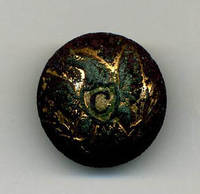
1861ref. 84401861. Unidentified maker. Gilt Eagle "C" cavalry coat button circa 1861-1865 is a battlefield-recovered artifact associated with mounted service during the American Civil War and supports research into military uniforms insignia and the material culture of cavalry personnel. The central eagle and letter "C" identify the button's cavalry designation while its excavated condition preserves evidence of its postwar history at a battle site. Coat-size button with a raised eagle-and-shield device above the letter "C" traces of gold-colored gilt outlining the design and an upright shank on the reverse. The button retains a smooth chocolate-brown patina with visible ground-related surface wear from burial and recovery. Exact battlefield location maker dimensions and recovery date are not recorded in the supplied information. Scattered ground action and surface wear with no visible dents pushed areas or repairs; shank remains upright and intact. Very good condition for an excavated example. A tangible piece of Civil War cavalry material culture combining recognizable branch insignia with documented battlefield recovery. unknown
1861ref. 84401861. Unidentified maker. Gilt Eagle "C" cavalry coat button circa 1861-1865 is a battlefield-recovered artifact associated with mounted service during the American Civil War and supports research into military uniforms insignia and the material culture of cavalry personnel. The central eagle and letter "C" identify the button's cavalry designation while its excavated condition preserves evidence of its postwar history at a battle site. Coat-size button with a raised eagle-and-shield device above the letter "C" traces of gold-colored gilt outlining the design and an upright shank on the reverse. The button retains a smooth chocolate-brown patina with visible ground-related surface wear from burial and recovery. Exact battlefield location maker dimensions and recovery date are not recorded in the supplied information. Scattered ground action and surface wear with no visible dents pushed areas or repairs; shank remains upright and intact. Very good condition for an excavated example. A tangible piece of Civil War cavalry material culture combining recognizable branch insignia with documented battlefield recovery. unknown books
1909ref. 49257n.p.: U.S. Army 1909. good. 35" x 22.5" 1 sheet 1 color map folded size 4.5" x 7.5" small tears at a few creases. Sgt. J. Howry was the draftsman for this map. This map is a reduced copy of 3-inch map referred to in Problems to include 1908-1909. Scale: 2 inches equals 1 mile. Contour intervals 20 feet. U.S. Army unknown
1902ref. 130649Paris, Albin Michel, coll. « Paul Paclot » 1902 In-4 31 x 21,5 cm. Cartonnage éditeur percaline rouge, plats biseautés, report auteur & titre argent sur le dos et le premier plat orné d’un décor floral à l’identique, tranches dorées, III-309 pp., orné de 75 reproductions en simili-gravure d’après les plus célèbres tableaux du musée de Versailles, table des gravures. Etat correct d’occasion
1876pp. x, 648 + Engraved Portrait Frontis and full page plates and maps. Damp stained. Age stained. Blind embossed XLib stamp on title page. XLib bookplate of State Teachers College, Millersville from the library of Sanders P. McComsey. Inner hinges taped. Some signatures loose. Numerous pencil notations. 4to. Original full green cloth binding, decorated and lettered in gold and black. Front board decorated with a portrait of Custer on horseback. Remnants of library call letters on spine. Binding worn. Extremities worn with some loss. Hardbound. A poor-ish copy of a scarce and valuable book. LOC W16
1856ref. 8543London: H. Bailliere. Good with no dust jacket. 1856. First Edition. Original Cloth. Covers are worn & soiled. Wear at the spine ends and split ~1 1/2" bottom front hinge. Interior is fine or better except for some loosening of the signatures. 252pp.; 5x7 1/2" . H. Bailliere hardcover
ref. 22079Saumur, Javaud, et P., Dumaine, 1865, in 8° broché, 299pp. ; rares piqûres ; couverture défraichie.
8vo, 12pp., manuscript on vellum, hand illuminated by Frank Walker, illuminator to the Queen, in colours and gold, with a green morocco binding, wide gilt decorative border to upper cover, centre lettered in gilt, a nice copy.
ref. ORD-14079Nouvelle édition. Paris. Magimel. An X - 1802. In-12 (100 x 162mm) pleine basane racinée à dos lisse, filets et fleurons doré, pièce de titre verte, gardes marbrées, 2ff., 450, (1) pages. Le dos est tomé II par erreur. Le tome II qui nous manque contient 152 planches. Dos de reliure un peu abîmé avec un petit trou 4 x 6 mm, sinon bon exemplaire. Sans le volume de planches.
ref. 215295S.l.n.d. in-8, demi-basane rouge, dos lisse orné de filets dorés (reliure de l'époque). Dos frotté, épidermures. Qqs traits au crayon dans les marges.
ref. 182887Paris, Berger-Levrault, 1893 gr. in-8, 347 pp., 4 cartes dépl. (qqs déchirures), demi-basane aubergine, dos lisse, filets dorés (rel. de l'époque). Trace d'étiquette au dos. Cachet (annulé).
ref. 220594Paris, Ernest Flammarion, s.d. (1914) in-12, VIII pp., 156 pp., avec un portrait-frontispice sous serpente et 22 figures dans le texte, percaline verte, titre poussé en lettres dorées au centre du plat supérieur (reliure de l'éditeur).
ref. 018194[Militaria] Paul-François de Béthune (1682-1759), marquis d'Ancenis, 4e duc de Charost, brigadier et mestres de camp du régiment de cavalerie de Bretagne (futur Royal Bourgogne). P.A.S. « D'Ancenis », Paris, 30 octobre 1714, 1p in-4. Certificats de bons services pour un cavalier, Saint Maurice, ayant servi depuis 1688 dans la compagnie de Béthune, afin qu'il puisse entrer à l'hôtel des Invalides. Document contresigné avec note par Morand (non identifié) avec un cachet de cire armorié. Une note au dos indique « Philippe Gallice de St Maurice ». Beau document. [420]
ref. 206988S.l., s.d. (mai 1794) placard in-folio de 53 x 41 cm, texte sur trois colonnes, en feuille, contrecollée sur papier fort moderne, importante mouillure latérale, bords atteints par l'humidité.
1899Royal octavo. Pp. xv, 200. With 34 text figures. Original printed wrappers, worn and partly detached, old shelf tickets to spine, old military institutional stamps. In a very good internal condition. Untrimmed and with ample margins, preserved entirely in the original state. ~ First edition.
1879Duodecimo. Pp. 91. Plus two plates on one folding sheet, printed in several colours, bound at end. Hardcover, bound in contemporary pebbled half cloth and matching marbled boards, spine lettered and decorated in gilt, shelf tickets, old institutional stamps to title-page. In a very good condition. Nice copy. ~ First edition.
1928Crown quarto. Pp. viii, 121, (3). Plus 4 large folding sheets with a total of 44 sketch maps loosely inserted in rear pocket. Original publisher's printed wrappers, discoloured and shabby, trace of adhesive tape along inner hinges, old shelf ticket to spine, old military institutional stamps to title. In good condition, fine maps. ~ First edition. Rare original treatise. The four sheets of maps are sealed with the official notification: "Diese Kartenbeilagen werden nur mit geschlossenen, unbeschädigten Streifbändern zurückgenommen".
1893Crown octavo. Pp. iv, 160, (12) publishers' ads. Plus folding plan. Set in Gothic type. Bound in the original printed wrappers, faded stamp, bit frayed along spine. In a very good condition, preserved in the original state. ~ First edition.
ref. 40947Sans lieu ni nom, s.d., in-8°, 291-(3) pp, biographie de l'auteur par le lieutenant Prodhomme, préface du Général Weygand, 16 pl. de gravures hors texte, qqs illustrations en culs de lampe, reliure demi-chagrin vert, dos à 4 nerfs soulignés à froid, titres et fleurons dorés, plats de couverture conservés, bon état
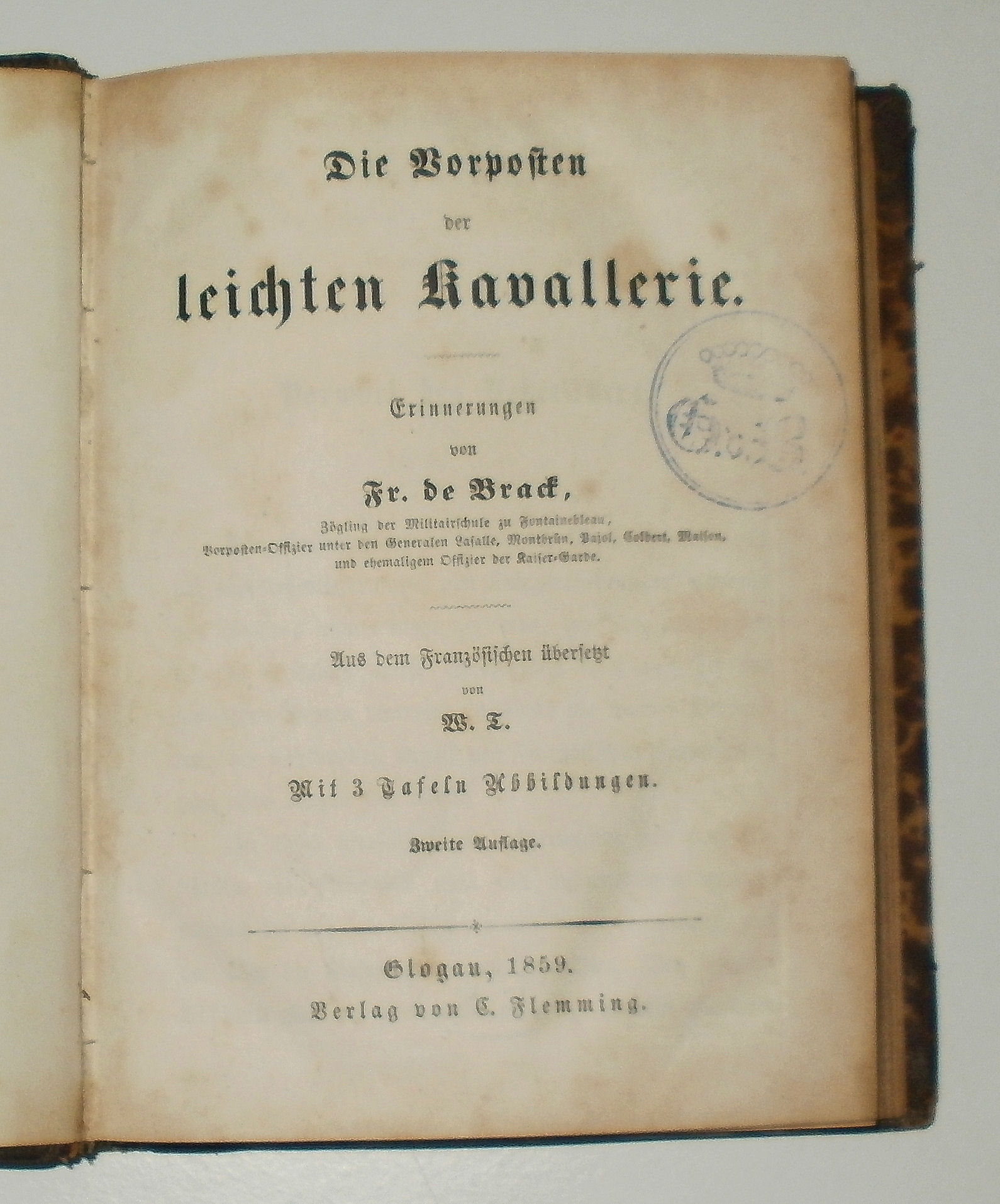
1859ref. 10805Glogau, 1859. Zweite Auflage mit 3 Tafeln Abb. (auf 2 Falttafeln zum Schluß) HLdr.d.Zt., VIII; 335 S., kl.8° [2 Warenabbildungen]