1174 resultados
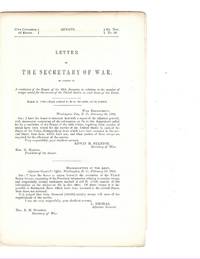
1862ref. 126661862. Stanton Edwin M. Report of the Secretary of War concerning cavalry forces of the United States 1862 documents the federal system for assessing and organizing Union mounted troops during the rapid military expansion of the Civil War. Prepared in response to a Senate resolution of January 29 the report required the War Department to determine how many troops had been raised in each state distinguish cavalry that had been mounted from units that had not and assess what portion of the force was needed for effective service. Adjutant General Lorenzo Thomas concluded that approximately 40000 cavalry troops would meet the requirements of the service illustrating how federal officials used state-level returns to evaluate military readiness and manpower needs. The document provides primary-source evidence for the study of Union cavalry organization recruitment equipment federal-state military coordination and wartime administrative planning. Stanton Edwin M. Report of the Secretary of War. Washington D.C.: Government Printing Office 1862. 37th Congress 2d Session Senate Executive Document No. 26. Eight pages measuring approximately 9.75 x 5.75 inches. Seven pages consist principally of tabular returns headed "Report of the cavalry forces of the United States" prepared in compliance with a February 14 1862 request from Assistant Adjutant General George D. Ruggles. The tables identify units and commanders by state list numerical strength and the authority under which troops were raised and record operational condition with distinctions such as mounted armed equipped partially organized or unarmed. A concluding return compiled from muster rolls records volunteer cavalry by state and distinguishes regiments companies commissioned officers enlisted men and aggregate strength; the total shown is 64133 volunteer cavalry including 62 regiments and 45 additional companies. The report demonstrates the process by which the Union converted rapidly raised cavalry formations into standardized administrative information revealing the uneven condition of mounted forces across the states and the difficulty of maintaining complete central records during wartime mobilization. The Adjutant General explicitly noted that some units could not yet be distinguished as mounted or unmounted and that information was incomplete for several states and territories making the report useful not only for numerical strength but also for understanding the limitations of Civil War military bureaucracy. Minor wear to edges; otherwise no significant defects noted. Very good. A data-rich congressional document showing how the War Department measured the strength readiness and organization of Union cavalry in early 1862. unknown books
1863ref. 51386Mobile: S. H. Goetzel 1863. First edition 16mo 3 parts in 1; pp. 2 ii 220; 104; 47 1; 97-108 Bugle Signals; xiv index 2 ads; 38 engraved plates 8 folding; original paper-covered boards rebacked in blue cloth sometime in the 20th century; boards worn text occasionally dampstained and foxed without the front free endpaper and hinges with old archival paper repair; but in all a good sound and compelling copy of a poorly made book. Parrish & Willingham 5116. S. H. Goetzel unknown books
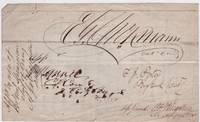
1861ref. 45596n.p. 1861. Very good folded edge worn light soiling and ink staining. 1 sheet. 7.75 x 4.5 inches. Signed by Ernest G. Chormann Brig. Gen. Fitz John Porter Col. William Woods Averell Chief of ordnance Charles P. Kingsbury and Assistant Adjutant-General Andrew J. Alexander for Gen. George Stoneman with the note "approved" by three signatures. Though undated it was likely signed between September 1861 and January 17 1862 based on the service records of those who signed it. 1. Ernest G. Chormann in 1861 recruited a volunteer regiment called "Chorman’s Independent Mounted Rifle Rangers" in Philadelphia. See Library Company of Philadelphia for the broadside. The first company of this regiment was mustered into service July 23 1861 and the last was mustered Sept. 15th 1861. The regiment was then under the command of Col. E. G. Chormann. It was numbered the 89th of the line and the 8th Cavalry and left Pennsylvania for Washington on Oct. 4 where it was brigaded with the 3rd Pa. cavalry thus putting Chormann under the command of William Woods Averell who in turn was under the command of Brigadier General Fitz John Porter. On Nov. 9 1861 the New York Times reported "The Eighth Pennsylvania Cavalry Col. Chormann has been brigaded with the Third from the same State. The brigade is commanded by Col. W.W. Averell of the latter regiment. Both are rapidly improving in efficiency and drill." But on Nov. 27 the Philadelphia Inquirer reported that "The statement that charges have been filed against Col. Chormann is said to be erroneous. The Colonel is laboring energetically to ensure the perfection of drill desireable in all well disciplined regiments." By January 17 1862 Chormann had resigned his commission to be replaced by Capt. David Gregg of the 6th U. S. cavalry an experienced officer and a graduate of West Point. Chormann had endorsed Merrill’s Patent Breech-Loading Carbine on September 19th 1861 his letter to General J. W. Ripley Chief of Ordnance Washington D. C. soon appearing in an advertisement for the weapons but so had many other officers. Thus both the reason for his resignation and the purpose of this document remain unknown. Little is known about Ernest G. Chormann other than in his autobiography below and for his filing of numerous patents. He was an inventor and also active as an artist between 1853-1880 See Frick Museum Art Reference Library. In 1852 he exhibited saddle patterns at the Twenty-second Exhibition of American Manufactures at the Franklin Institute; in 1861 listed as an engraver and die sinker he bid on a $2500 contract with the U.S. Government for coin designs as part of ongoing experiments into how to prevent “abrasion counterfeiting and deterioration of the coins of the United States; ” he was hired as the engraver; he filed for optical and mechanical patents; in 1880 he painted "Letitia Street House 1880" now at the Historical Society of Pennsylvania. The Pennsylvania's Rangers' War song: "Up ! up ! with our flag let its bright stars gleam out" was dedicated to him. The Pennsylvania Historical Review 1886 lists his firm Chormann & Mitchell as "inventors and patentees of the specialties manufactured. They manufacture all kinds of art furniture including parlor easels novel and chaste in design labor- saving studio easels sketching easels artists’ kits etc. together with interior decorations. the studio easel being awarded the first premium and diploma at the Centennial Exposition of 1876." Chormann adds his somewhat rather fanciful biography: "Mr. Chormann the founder of this business was born in France. Early in life he was noted for his energy talent and determination and visited as an explorer and traveller nearly every country in the civilized world. In 1836 he was a colonel in the San Jacinto war where he manifested great courage and prudence and on its termination made an effort to explore almost alone the sources of the Nile. Eventually after exploring various portions of Australia New Mexico Arizona and Lower California and undergoing great hardships and dangers from climate and Indians he was appointed on his arrival in Texas in 1845 captain and superintendent of the Texan Rangers. He was actively engaged in 1847 and 1848 in the Mexican war where his distinguished military ability was of great service to the United States. During his explorations and travels in the West he was associated with those famous old Indian fighters namely De Soto and California Joe. Mr. Chormann was the first white man who explored the Western portion of the Colorado River the whole of the country at that period 1843 watered by this stream being inhabited by tribes of Indians of the most cruel and treacherous nature. Colonel Chormann organized the first regiment that served during the war and which was known as Chormann’s Mounted Rangers. On the 14th April 1861 immediately after the bombardment of Fort Sumpter he began recruiting and put 5000 men in the field. In 1865 he brought East the first specimen of the moss agate. In a few months Mr. Chormann intends to publish a work on Colorado and the West illustrated with splendid engravings which will prove of the greatest interest to all lovers of nature. He was the inventor of stylograph printing and is noted in scientific and artistic circles for his inflexible integrity and sterling ability." 2. Fitz John Porter 1822-1901 Civil War Union Major General West Point 1845 served in the Mexican–American War promoted to brigadier general of volunteers in 1861 and divisional commander in the newly formed Army of the Potomac under Maj. Gen. George B. McClellan who was soon is patron. On November 25 1862 Porter was arrested and court-martialed for his actions at Second Bull Run after McClellan was dismissed by Lincoln. He spent the next 16 years trying clear his name and record which he finally did in 1878. 3. William Woods Averell 1832-1900 Civil War Union Brigadier General West Point 1855 2nd Lieutenant assigned to the United States Army Mounted Rifles and served in the Indian Wars on the Western frontier severely wounded in a fight with Navajos in 1859 became a 1st Lieutenant with the Mounted Riflemen and was placed on staff duty in Washington D.C. In August 1861 he was appointed as Colonel of the 3rd Pennsylvania Volunteer Cavalry and soon became a Brigadier General. 4. Andrew Jonathan Alexander 1833-1887 Civil War Union Brevet Brigadier General served first as a Captain in the 3rd United States Regular Cavalry then as Lieutenant Colonel and Assistant Adjutant General on the staff of Union General George Stoneman. 5. Charles Peeble Kingsbury 1816-1879 graduated from West Point in 1840 2nd in a class of 42 served in the Mexican War as General Wolf's ordnance officer and on General Taylor’s staff wrote 'Elementary Treatise on Artillery and Infantry' 1849 and was a contributor to the American Whig Review Western Quarterly Review Putnam’s Monthly and the Southern Literary Messenger from 1840-67 was superintendent of the Armory at Harper's ferry and Chief of Ordnance for the Army of the Potomac August 12 1861 to July 1862 promoted to Colonel and aide-decamp September 28 1861. unknown books
1902ref. 228743First edition. Octavo. Frontispiece portrait over 20 b/w illustrations from drawing by Constance Farris. 2 page introductory essay by Amy Dudley. Original stiff black printed wrappers. Very good. 130 pages. Scarce. No signatures or bookplates. Includes chapters on Father Serra land titles Mormons etc. Howes C-1; Rocq #7052; Cowan p. 91. Times-Index Press books
1890ref. 52035Rockland Me.: First Maine Cavalry Association 1890-1892. A significant run of nine of fourteen total issues with two additional supplements of a periodical for Civil War veterans of the First Maine Cavalry. "Published four times a year and will contain the proceedings of the yearly reunions of the First Maine Cavalry matters of historic value to the regiment and items of personal interest to all the members." The volunteer cavalry regiment served with the Army of the Potomac for the duration of the war and participated in many of the critical battles including Brandy Station the largest cavalry engagement of the entire Civil War. Original printed wrappers mostly detached and chipping heavily. A few chips to initial leaves of one issue otherwise internally very good. unknown books
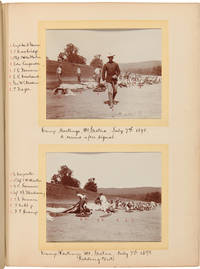
1898ref. 54683Various places including Pennsylvania Virginia at sea New Jersey and Puerto Rico. May to September 1898. Hundreds of Images Showing Philadelphia Troops Preparing for and Participating in the Spanish-American War A remarkable assemblage of photographs documenting the Spanish-American War experiences of the First Troop Philadelphia City Cavalry which was at that time the oldest volunteer military unit in continuous service to the United States. The photographs are arranged chronologically in four contemporary photo albums with the images occasionally annotated in a contemporary hand and including the identification of numerous members of the Troop. The first volume opens with images of Mt. Gretna Pennsylvania "where troops were sworn into U.S. service May 7th 1898 by Maj. Thompson U.S.A." The photographs record field exercises camp building and tent organization at Camp Hastings cavalry drills an image of "Capt. Groome reading the Articles of War to Troop June 1898" a "first arrival of government horses" several shots of men training and "throwing" their horses shooting practice "Capt. Groome assigning Government horses to Troopers" and various shots of the men at work and even some play. Over the course of the album the names of numerous soldiers are recorded below several of the photographs. The second album opens with several photographs of the Troop striking their tents in preparation for leaving Camp Hastings at Mt. Gretna headed for Camp Alger at Dunn Loring Virginia. Here the Troop was ordered to increase their enlistment numbers. At Camp Alger the Troop was also fitted out with federal supplies and assigned to the Second Army Corps commanded by Maj. Gen. William Graham who is pictured here. Other photographs capture the camp scene at Alger "the First Troop picket line" the Troop receiving their federal-issue khaki uniforms the Troop at roll call and some shots featuring African-American helpers. In late July the Troop was sent to Newport News and several photographs record their brief time there with about a dozen shots of their temporary camp. On July 28 1898 the Troop left Virginia on the transport ship Massachusetts bound for Puerto Rico. Several images here capture the frenetic loading of the troops and their horses onto the ship with the remaining half dozen or so shots recording the Troop's time on board. The third album picks up where the second left off with the First City Troop embarked on the transport ship Massachusetts headed for Guanica Puerto Rico. Shipboard activities captured here include a few shots of groups of men being showered with water hoses. Several shots record the arrival of the men in the port of Guanica where they encounter the hospital ship Nueces which reports of the news of the "surrender of Ponce." After the men disembark they pitch their camp around Cathedral Virgin del Carmen on August 5. The next day several photographs record the unloading of horses and stores in the harbor at Ponce. The remaining thirty-eight photographs in this volume record scenes in the interior of Puerto Rico and are the most heavily annotated of the four albums. The images record scenes from the "road from Port of Ponce to Ponce" several scenes capturing a market day in Ponce and recording numerous native islanders the Troop's "temporary camp about 2 miles beyond Ponce" the "Troop wagon leaving camp beyond Ponce to join wagon train for Guayama" on August 8 a shot of the Troop's wagon "on road to Guayama in a Porto Rico mudhole" images of the wagon train to Guayama with the H Troop 6th U.S. Cavalry the "Point of Advance Guard entering Guayama within the lines" the Troop itself "entering Guayama passing General Brooke's Headquarters" a "View of First Troop Phila. City Cavalry U.S.V. Camp at Arroyo August 10th to 6 A.M. Aug. 13th 1898" with the last ten images recording the camp or the streets at Arroyo. The fourth album documents the Troop's voyage home to Philadelphia. This time they take passage on the transport ship Mississippi and about half of the images record their voyage on board. On September 10 1898 they reach Jersey City in New York harbor where they camp for a short time before returning to camp in Pennsylvania where the album ends. A couple of months later all three officers and the ninety-eight enlisted men of the First City Troop were mustered out of federal service for the Spanish-American War. Originally founded in 1774 by twenty-eight Philadelphia patriots as the "Light Horse of the City of Philadelphia" the First Troop of Philadelphia Cavalry is the oldest mounted military unit operating in continuous service to the American republic being the first volunteer cavalry troop organized in defense of the colonies. Among the Troop's original founders was John Dunlap printer to Congress from 1778 to 1789 publisher of the first American daily newspaper and the first printer of the Declaration of Independence. Most of the earliest members were similarly notable professional men of Philadelphia. The Troop served with valor in the American Revolution the War of 1812 the Mexican-American War the Civil War the Spanish-American War and every major American war through the Korean War. The present albums present a unique and important visual record of the First City Troop's activities before during and on the way home from the Spanish-American War. 171pp. with 342 photographs. Four large quarto photograph albums. Matching contemporary three-quarter crimson morocco and cloth front covers gilt. Minor shelf wear and some rubbing. Images in overall very good condition. hardcover books
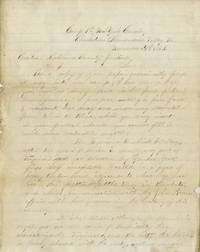
1863ref. List3846Camp 1st New York Cavalry Charlestown Shenandoah Valley Virginia 1863. Incomplete autograph letter addressed to the editors of the Rockland County Journal. Two page letter measuring 7 ¾ x 9 ¾ inches. Discoloration and chipping to margins; tears at folds repaired with archival tape; very good to excellent. An incomplete letter written by a soldier in Virginia in 1863. The writer proposes to send occasional correspondence from the army then turns to a lively local sketch of Charlestown John Brown memory disloyal but hospitable Virginians guerrilla anxiety squirrel shooting and a visit to the "renowned Masonic Cave" allegedly used as a meeting place by George Washington. He writes: "Camp 1st New York Cavalry Charlestown Shenandoah Valley Va. November 14th 1863 Editors Rockland County Journal "Sirs "As a copy of your paper occasionally finds its way into our camp & I have observed you have no correspondent in this part of the 'sham federacy' I propose writing a few facts & incidents that may come under my observation from time to time which you may insert in your Journal whenever you cannot fill it with more valuable matter. "The Regiment to which I belong after two years of service in nearly every part of Virginia's soil yet trodden by Yankee feet finds itself comfortably located in a piece of heavy timber land adjacent to what had once been the prettiest little town in the state and which in connection with the John Brown affair will live forever in the history of this country. "Its inhabitants altogether far from being loyal yet are not devoid of hospitality that characterizes the Virginians and the little they have is freely shared with the needy without regard to the color of his uniform provided he deports himself as a gentleman. "A few days ago with a few comrades I visited the renowned 'Masonic Cave' situated about 2 miles from Camp in a South East direction. "As a precaution against guerrillas who disguised as citizens hover about our pickets constantly we carried our carbines & a number of squirrels repaid the trouble. But to the Cave. "The entrance is on the top of a hill some 50 or 60 feet above the general level of the surrounding country. A hole large enough for the cellar of an ordinary sized house one side of which is composed of a large rock leaning inward first attracts the attention. At the terminus of this rock is built an ordinary door frame passing through which a few steps brings you into the main apartment of the cave & into total darkness. Lights are now requisite and after a few minutes you are enabled to see a large rock rising before you which will form a good seat. As the cave is quite dry you sit down on it until the eye gets accustomed to the darkness or as one of our party remarked 'until the light from the candles reach the sides of the cave'. Leaning forward you elbow rests on another rock the same that served as a table for the immortal Washington when sitting on the seat you now occupy he presided over the meeting of the". An incomplete but appealing wartime local sketch describing Charlestown in the shadow of John Brown and an odd excursion to the Masonic Cave along with his guarded but generous view of local Virginians. . unknown books
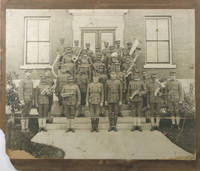
1910ref. List304Fort Ethan Allen 1910. Gelatin silver print mounted to board 16 ¼ x 14 ½ inches. Fair to Good. The 10th Cavalry was one of the original “Buffalo Soldier” regiments of the post-Civil War segregated U.S. Army first seeing action in the Indian Wars. Their band is shown here most likely during their stint at Fort Ethan Allen in Vermont. They are wearing a mix of insignia from 1902 to 1908 and some are shown in civilian clothing which suggests the picture was taken in Vermont as this was during the time the Army used a vast mix of insignia and the brick architecture of the background also matches that of the fort. They were exposed to some racism during their time in Vermont - the soldiers were punished for associating with neighboring white women with some of the offenders being confined to the guardhouse for punishment which fits with the strictly segregated Army policies of the time. The soldiers did also record positive aspects of their time at the fort including studying at the fort’s library and playing nightly games of the newly-invented sport of basketball. These amenities provided some positive contrast to the previous assignments of the regiment who had been mostly stationed on the frigid plains where the army believed racial tensions would be kept to a minimum. The picture shows the band with the normal marching band instruments of clarinets tubas and sousaphones as well as an alto clarinet oboe and what appears to be a baritone saxophone. We find no other examples of the 10th Cavalry Band and the picture shows the regiment at a relatively calm time as they would soon be sent to the Mexican-American border in 1913 to deal with rising tensions. The picture has condition issues with damage to the mount some damage to the bottom left corner and a crease along the bottom third of the image along with closed tears and chipping to the title label. It remains in fair to good condition attractive and worthy of preservation. unknown books
1865ref. List2438Camp Low 1865. Original partially printed document 26cm x 77cm. Printed on both sides of the sheet completed in manuscript. Darkening at folds from old tape repairs; partial splits to folds and extremities; complete and quite Good. Docketed verso signed in ink by Lieutenant Morgan Owen. Lists twelve enlisted soldiers most with Spanish surnames two with French surnames. Fine. The formation of the California Native Cavalry in 1863 marked a significant chapter in the state's history. Comprising primarily Mexican-American individuals colloquially referred to as "native" Californians the California Native Cavalry unit was formed 1863. Initially commanded by Maj. Andreas Pico a distinguished hero from the Mexican-American War and later under Salvador Vallejo the regiment drew its ranks from diverse backgrounds. Recruitment efforts began with vaqueros from southern California expanding to include individuals from San José and San Francisco. The unit boasted a varied composition encompassing not only Mexican-Americans but also Chilenos California and Yaqui Indians and even French legionnaires. Company "B" a contingent largely recruited from the northern part of the state is reflected in the existing muster roll. The company assembled at Camp Low near San Juan Bautista in 1865 making a striking entrance into the town. Described as "gay and gallant Spanish lancaroes" the cavalrymen presented a formidable sight with lances in hand and flags flying leaving a lasting impression on the townspeople who had never before encountered soldiers."The gay and gallant Spanish lancaroes sic came dashing through the town with the lances in their hand a flag flying from each of them. I assure you that they presented a war like appearance the people here had never seen a soldier in their lives – Yes Sir!." letter Maj. Michael O'Brien to Gov. Frederick Low January 1865; quoted in Prezelski "Lives of the Californio Lancers: the First Battalion of Native California Cavalry" in Journal of Arizona History v.40 no.1 Spring 1999. Under the command of Capt. Porfirio Jimeno Company B swiftly engaged in a critical mission: dismantling the notorious Mason-Henry Gang that had terrorized the San Juan region in the preceding months. Despite successfully wounding John Mason in early April 1865 the gang persisted for another month until Mason met his demise at the hands of a miner he sought to kidnap. However Company B faced challenges including low morale and a high rate of desertions with over 40 men leaving the company in 1865 alone. Transferred to Tubac Arizona Territory to confront the Apaches the company encountered further desertions along the way. The muster roll listing only twelve soldiers alongside Capt. Porfirio Jimeno reflects this tumultuous period. Overall the muster roll provides scarce documentation of the role of Mexican-Americans in the Civil War with few other examples in the trade or institutionally. unknown books
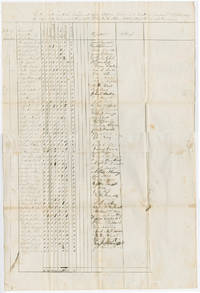
1862ref. 23879.02COMPANY D 1st VERMONT CAVALRY. CIVIL WAR. Manuscript Document Signed June 1862: List of clothing distributed to 54 men including 25 caps 24 blouses 50 trousers 66 flannel shirts 15 drawers 19 bootees 69 stockings and 3 blankets. Each row signed by the soldier who received the items. 1 p. 15½ x 23¾ in. "We the undersigned Non Commissioned Officers Artificers Musicians & Privates of Company 'D' 1st Vt Cavalry do acknowledge to have received of Capt. A. W. Preston the articles of Clothing set oposite our respective names" Soldiers included: Jacob Trussell Rodney Eames Harrison B. Michell James Esdon Josiah H. Moore Samuel L. Higgins George P. Blair Orin S. Hendrick George C. C. Clemment Azro H. Kinerson Horace Ide Harvey A. Marckres Barney Decker Arthur Murray George A. Austin John Morse Dan Adams Henry A. Moore Harvey Bickford Kyron Morrill William Buck Warren Norris B. H. Bard Elijah C. Page Bartlett S. Bard Francis Rowell John A. Beaton L. S. F. Reed George F. Bennett Curtis L. Stacy Austin A. Bailey Edwin W. Southworth C. W. Clifford Martin V. B. Vance Ansen L. Chandler John Woodard Loren Chase Jr. William Woodard Antipas H. Curtis signed with mark John Woodbury Milo J. Corliss Fernal H. Webber Consealer F. Durlam William Wheaton John S. Coombs Mark M. Wheeler James Davis James Wright John C. Gracy Darwin J. Wright Joseph W. Gordon Died J. Hale Powers Patrick C. Gilligan Charles Knapp books
1902ref. 302558San Bernardino Cal. Times-Index Press 1902. 1902. First edition. 8vo. Frontispiece portrait; illustrations. Original gray wrappers stamped in gold tape repair to spine; front cover lower corner chipped; back cover detached. Good. 130 pages. Ex-library copy with the usual markings. Includes chapters on Father Serra land titles Mormons etc. Howes C-1; Rocq #7052; Cowan p. 91. 1st Edition. Soft cover. Good. San Bernardino, Cal., Times-Index Press, 1902. paperback books
2018ref. GB07XTYQHBTI4N00Acclaim Press 2018. Hardcover. Very Good. May have limited writing in cover pages. Pages are unmarked. ~ ThriftBooks: Read More Spend Less.Dust jacket quality is not guaranteed. Acclaim Press hardcover
2021ref. x-1948717328Xenophon Press LLC 2021. Hardcover. New. 238 pages. 7.00x0.56x10.00 inches. Xenophon Press LLC hardcover
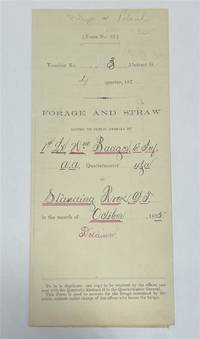
1875ref. 320963Standing Rock 1875. unbound. Partly printed military document signed 6th Infantry seven months before Little Big Horn 16.75 x 10.75 inches Standing Rock Nov. 1 1875 "A Statement Of Forage and Straw Issued to and Consumed by the Public Animals under my direction at Standing Rock Dakota Territory during the month of October 1875" for transient animals from Fort Rice signed by Captain and Commander of Post James S. Poland an officer who served under Major Reno at the Little Big Horn and was erroneously reported as "Killed In Action" when severely wounded in the back. At the time this document was signed Poland was ordered to cease his sale of rifles and ammunition to Indians at the Standing Rock Reservation as the recipients were closely connected with Sitting Bull's band. One month later the Commissioner of Indian Affairs called for the use of troops against those Indians. Also signed by Lieutenant William Badger a close friend of Custer who survived the Black Hills Campaign. His son Tom who filled out the body of this document became General Custer's personal secretary in 1876 and was killed at Little Big Horn. Also included: a Xerox of a rare photograph of the 7th cavalry 6th infantry in uniform with accoutrements all identified including Custer Badger and Poland. Partial tearing along one of the folds; otherwise near fine condition. unknown
ref. DADAX1782270930New unknown
ref. DADAX1557285047New unknown
ref. DADAX1931721211New unknown
ref. DADAX0253205492New unknown
ref. DADAX0754664678New unknown
ref. DADAX0786467746New unknown
ref. DADAX0809442167New unknown
ref. DADAX0870816608New unknown
ref. DADAX0415619394New unknown
ref. DADAX0415257131New unknown
ref. SONG1574411896Used: Good unknown