15th Pennsylvania Volunteer CavalryBiblio.com
To the Members of the Society of the 15th Pennsylvania Volunteer Cavalry
ref. 45187701-nnew. unknown

GreatBookPrices · United States$50.06≈ €44.72
1,169 results
ref. DADAX0870816608New unknown
ref. DADAX0891416749New unknown
ref. DADAX0415257131New unknown
ref. SONG1862273782Used: Good unknown
ref. SONG2913903002Used: Good unknown
ref. DADAX0359167780New unknown
ref. DADAX0359735487New unknown
ref. 45187701-nnew. unknown
ref. DADAX1436635160New unknown
ref. DADAX1426988427New unknown
ref. DADAX1436930448New unknown
ref. SONG0198144822Used: Good unknown
1797ref. 183961797. Fawcett William. Instructions and Regulations for the Formations and Movements of the Cavalry 1797 establishes the standardized system of cavalry drill and maneuver adopted by the British Army at the close of the eighteenth century forming part of the institutional reforms that shaped British military readiness during the French Revolutionary and Napoleonic Wars. Issued under War Office authority the manual codifies cavalry organization battlefield movement and command structure at a moment when the British Army was professionalizing its training systems following the disruptions of prolonged continental conflict. Fawcett serving as Adjutant-General and one of the most senior officers in the army directed reforms that imposed uniformity across regiments and this work documents the formal transmission of those standards into operational practice. Fawcett William. Instructions and Regulations for the Formations and Movements of the Cavalry. London: Printed for the War Office 1797. First edition. Octavo. 342 pages with 16 folding engraved plates. Original gray boards. The engraved plates illustrate cavalry formations movement sequences and positional alignments providing visual instruction to accompany the printed regulations. Textblock uncut. Produced during a period of sustained military engagement against Revolutionary France this manual aligns with broader War Office efforts to centralize command structure and standardize training across infantry and cavalry units contributing to the operational coherence later demonstrated in campaigns such as the Peninsular War. The work provides direct evidence of how doctrine was disseminated within the British Army offering material for the study of military pedagogy battlefield coordination and the administrative consolidation of state military power in the late eighteenth century. Upper cover detached spine chipped at head and tail with general wear consistent with use; textblock remains clean and uncut. Overall good to very good condition. unknown
ref. DADAX1437429041New unknown
ref. DADAX1526708965New unknown
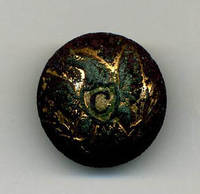
1861ref. 84401861. Unidentified maker. Gilt Eagle "C" cavalry coat button circa 1861-1865 is a battlefield-recovered artifact associated with mounted service during the American Civil War and supports research into military uniforms insignia and the material culture of cavalry personnel. The central eagle and letter "C" identify the button's cavalry designation while its excavated condition preserves evidence of its postwar history at a battle site. Coat-size button with a raised eagle-and-shield device above the letter "C" traces of gold-colored gilt outlining the design and an upright shank on the reverse. The button retains a smooth chocolate-brown patina with visible ground-related surface wear from burial and recovery. Exact battlefield location maker dimensions and recovery date are not recorded in the supplied information. Scattered ground action and surface wear with no visible dents pushed areas or repairs; shank remains upright and intact. Very good condition for an excavated example. A tangible piece of Civil War cavalry material culture combining recognizable branch insignia with documented battlefield recovery. unknown
ref. DADAX1436926858New unknown
ref. DADAX0548177333New unknown
ref. DADAX0548236070New unknown
ref. DADAX0548981418New unknown
ref. DADAX0548978417New unknown
ref. DADAX0548998973New unknown
ref. DADAX0862999847New unknown
ref. DADAX0942597532New unknown
ref. DADAX0415619394New unknown