FONTENAY (Abbé de)Livre Rare Book

1,136 results
1774ref. 002389Amsterdam et Paris Vincent 1774
ref. 0265097169.Gpaperback. Good. Access codes and supplements are not guaranteed with used items. May be an ex-library book. paperback
ref. 0260378933.Ghardcover. Good. Access codes and supplements are not guaranteed with used items. May be an ex-library book. hardcover
1894Small octavo. Pp. 23. Set in Gothic type. In the original printed self-wrappers, stapled as issued; faded stamp ("Inspecteur der Cavalerie"), staples rusty. In a very good condition. ~ First edition. Extremely rare. Only a single copy is located worldwide (Both OCLC and KVK), that in Berlin State Library - Prussian Cultural Heritage.
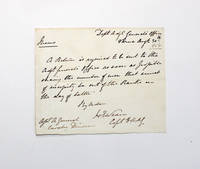
1854ref. 025835UK 1854. First Edition . Paper. Good. 24mo - over 5 - 5¾" tall. An Original Handwritten Letter from the Crimean War in the hand and signed by a Captain in the Cavalry H E Weares to Adjutant General Wetherall. Dated 1854. A letter stating that a return needs to be sent to Adjutant General's Office sharing the number of men that were out of ranks on the day of the battle. General George Wetherall 1788-1868 was a senior British Army officer. General Wetherall is most famous for his services during the rebellion in Canada of 1837/38 during which he was the Commander of the Royals' 2nd battalion in the Battle of Saint-Charles a battle part of the Lower Canada Rebellion fought on 25 November 1837 between Great Britain and Lower Canada Patriote rebels. Condition is good. Folding crease. More images can be taken upon request. Size is 165mm x 205mm unknown
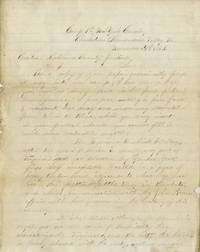
1863ref. List3846Camp 1st New York Cavalry Charlestown Shenandoah Valley Virginia 1863. Incomplete autograph letter addressed to the editors of the Rockland County Journal. Two page letter measuring 7 ¾ x 9 ¾ inches. Discoloration and chipping to margins; tears at folds repaired with archival tape; very good to excellent. An incomplete letter written by a soldier in Virginia in 1863. The writer proposes to send occasional correspondence from the army then turns to a lively local sketch of Charlestown John Brown memory disloyal but hospitable Virginians guerrilla anxiety squirrel shooting and a visit to the "renowned Masonic Cave" allegedly used as a meeting place by George Washington. He writes: "Camp 1st New York Cavalry Charlestown Shenandoah Valley Va. November 14th 1863 Editors Rockland County Journal "Sirs "As a copy of your paper occasionally finds its way into our camp & I have observed you have no correspondent in this part of the 'sham federacy' I propose writing a few facts & incidents that may come under my observation from time to time which you may insert in your Journal whenever you cannot fill it with more valuable matter. "The Regiment to which I belong after two years of service in nearly every part of Virginia's soil yet trodden by Yankee feet finds itself comfortably located in a piece of heavy timber land adjacent to what had once been the prettiest little town in the state and which in connection with the John Brown affair will live forever in the history of this country. "Its inhabitants altogether far from being loyal yet are not devoid of hospitality that characterizes the Virginians and the little they have is freely shared with the needy without regard to the color of his uniform provided he deports himself as a gentleman. "A few days ago with a few comrades I visited the renowned 'Masonic Cave' situated about 2 miles from Camp in a South East direction. "As a precaution against guerrillas who disguised as citizens hover about our pickets constantly we carried our carbines & a number of squirrels repaid the trouble. But to the Cave. "The entrance is on the top of a hill some 50 or 60 feet above the general level of the surrounding country. A hole large enough for the cellar of an ordinary sized house one side of which is composed of a large rock leaning inward first attracts the attention. At the terminus of this rock is built an ordinary door frame passing through which a few steps brings you into the main apartment of the cave & into total darkness. Lights are now requisite and after a few minutes you are enabled to see a large rock rising before you which will form a good seat. As the cave is quite dry you sit down on it until the eye gets accustomed to the darkness or as one of our party remarked 'until the light from the candles reach the sides of the cave'. Leaning forward you elbow rests on another rock the same that served as a table for the immortal Washington when sitting on the seat you now occupy he presided over the meeting of the". An incomplete but appealing wartime local sketch describing Charlestown in the shadow of John Brown and an odd excursion to the Masonic Cave along with his guarded but generous view of local Virginians. . unknown books
1863ref. List3846Camp 1st New York Cavalry Charlestown Shenandoah Valley Virginia 1863. Incomplete autograph letter addressed to the editors of the Rockland County Journal. Two page letter measuring 7 ¾ x 9 ¾ inches. Discoloration and chipping to margins; tears at folds repaired with archival tape; very good to excellent. An incomplete letter written by a soldier in Virginia in 1863. The writer proposes to send occasional correspondence from the army then turns to a lively local sketch of Charlestown John Brown memory disloyal but hospitable Virginians guerrilla anxiety squirrel shooting and a visit to the "renowned Masonic Cave" allegedly used as a meeting place by George Washington. He writes: "Camp 1st New York Cavalry Charlestown Shenandoah Valley Va. November 14th 1863 Editors Rockland County Journal "Sirs "As a copy of your paper occasionally finds its way into our camp & I have observed you have no correspondent in this part of the 'sham federacy' I propose writing a few facts & incidents that may come under my observation from time to time which you may insert in your Journal whenever you cannot fill it with more valuable matter. "The Regiment to which I belong after two years of service in nearly every part of Virginia's soil yet trodden by Yankee feet finds itself comfortably located in a piece of heavy timber land adjacent to what had once been the prettiest little town in the state and which in connection with the John Brown affair will live forever in the history of this country. "Its inhabitants altogether far from being loyal yet are not devoid of hospitality that characterizes the Virginians and the little they have is freely shared with the needy without regard to the color of his uniform provided he deports himself as a gentleman. "A few days ago with a few comrades I visited the renowned 'Masonic Cave' situated about 2 miles from Camp in a South East direction. "As a precaution against guerrillas who disguised as citizens hover about our pickets constantly we carried our carbines & a number of squirrels repaid the trouble. But to the Cave. "The entrance is on the top of a hill some 50 or 60 feet above the general level of the surrounding country. A hole large enough for the cellar of an ordinary sized house one side of which is composed of a large rock leaning inward first attracts the attention. At the terminus of this rock is built an ordinary door frame passing through which a few steps brings you into the main apartment of the cave & into total darkness. Lights are now requisite and after a few minutes you are enabled to see a large rock rising before you which will form a good seat. As the cave is quite dry you sit down on it until the eye gets accustomed to the darkness or as one of our party remarked 'until the light from the candles reach the sides of the cave'. Leaning forward you elbow rests on another rock the same that served as a table for the immortal Washington when sitting on the seat you now occupy he presided over the meeting of the". An incomplete but appealing wartime local sketch describing Charlestown in the shadow of John Brown and an odd excursion to the Masonic Cave along with his guarded but generous view of local Virginians. . unknown
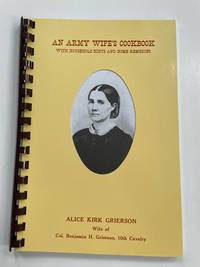
1972ref. 2847From title page: Compiled and Edited by Mary L. Williams Fort Davis National Historic Site Introduction by Alice Kirk Grierson and Sarah Joy Grierson Alice Kirk Grierson was not the typical army wife of the late 19th century for she rarely had to endure the extreme hardships associated with frontier army life. She had servants so the pages of her cookbook were in really good condition. In 1968 Mrs. Grierson's cookbook was donated to the National Park Service at Fort Davis National Historic Site. Through Park Service wives and friends recipes were tested and preparation procedures noted. In this edition Mrs. Grierson's recipes are printed in brown ink. Underneath in black ink are their modern adaptations and methods of preparation. There are all kinds of recipes what to do for a gunpowder burn and even a recipe for hair dye! New book in New condition. Yellow cover with oval opening to show photograph. Brown comb binding. I purchased this book new in 2010 but never used it - it has been stored away from light so is in pristine condition. Please use photos as part of the description. 71 pages including Index. Southwest Parks and Monuments Association paperback
18388vo., Second Edition, with 57 engraved plates, and numerous diagrams and tables in the text, some light and inoffensive spotting, neat contemporary signature on front free endpaper; original rose cloth, leather label lettered and framed in gilt mounted on upper boards, backstrip and joints mildly sunned else a very good, crisp, clean copy in contemporary binding. This copy was formerly in the library of Ralph Gillingham of Manor Farm, Pilsdon near Bridport in Dorset, and bears his holograph signature on front free endpaper. Loosely inserted is a holograph letter dated 1915 from a member of the Hannams family (successors of the Gillinghams at Pilsdon) confirming the gift of this copy to Major (later Lt.-Col.) Sir William Colfox . Sir William Philip Colfox, 1st Baronet (1888-1966), educated at Eton and Woolwich, served during the Great War as Major in the Royal Field Artillery. Wounded in 1917, he was awarded the MC and taught classics and mathematics at Eton for the remainder of the conflict. After the war he entered politics as MP first for Dorset North and then Dorset West. In 1920 he served as Minister for Pensions. During WWII he ran the Home Guard in West Dorset and continued to teach classics and mathematics at Colfox School in Bridport. A lovely copy in wholly unrestored contemporary state. De Ros's detailed manual was first published in 1835. Third and fourth issues are dated 1844 and 1853. All editions are scarce. No edition is listed in NUC; BLPC records only the third and fourth editions.
ref. 77041aafGenève, Ferdinand Ramboz, 1839, in-8vo, 16 p., brochure originale imprimée , couverture derrière tâchée.
1982ref. LFA-126742056Revue bimestrielle de 102 pages, format 210 x 295 mm, illustrée, brochée couverture couleurs, bon état
1652ref. 19255Ludovic Baschet éditeur / Librairie A.Pigoreau sans date. Reliure éditeur plein cartonnage cuir rouge avec plat polychrome au format 22 x 17 cm. Dos toilé rouge, passé et blanchi. Plats avec frottis aux coins. Intérieur avec une trace de mouillure qui affecte le haut et bord extérieur des pages du fascicule consacré à la Nouvelle-Calédonie. Rare cartonnage éditeur contenant 6 fascicules édités entre 1875 et 1890 des Cahiers d'enseignement illustrés. Les n° 49 - 51-54 & 55 sont consacrés à : La science des armes dans la cavalerie, partie 1,2,5 & 6 ( textes de Romuald Brumet & illustrations par Eugène Chaperon ). Le n° 34 est consacré aux bataillons scolaires ( texte de Désiré Lacroix & illustrations par J.Geoffroy ). Le n° 78 est consacré aux Colonies Françaises / La Nouvelle-Calédonie ( texte de Henri Jacottet & illustrations anonymes ). Ces fascicules étaient destinés à la formation militaire de l'ensemble des écoliers, afin de leur inculquer les rudiments des sciences et de la vie militaire dans la perspective de la Revanche contre l'Allemagne après la défaite de 1870. Assez bel état général. De toute rareté.
1890ref. 48771Le Mans (Sarthe), E. Lebrault 1890 In-8 à l’italienne 16 x 25 cm. Reliure demi-chagrin bordeaux, couverture polychrome d’origine conservée, plats granités bordeaux, dos lisse orné, 45 dessins pleine page, 45 ff. Coiffes, coins, bords légèrement, frottés, intérieur frais. Bel exemplaire.
ref. 3870Armand-Dumaresq Imprimerie Lemercier et Cie 45,5 x 34,5 Paris Album grand in-4, reliure demi-chagrin bordeaux à coins début XXème, dos à quatre nerfs, filets et titres dorés. Recueil, dédié à Robert d'Orléans duc de Chartres et signé par l'auteur, composé d'une page de titre imprimée comportant la dédicace et d'une suite de 66 planches contrecollées sur papier fort en recto, montées sur onglet. Il n'y a pas de pages de texte. La page de titre en noir est encadrée d'un cuirassier et d'un chasseur à cheval et comporte à gauche la signature "Armand-Dumaresq 1880" et à droite la mention "Imprimerie Lermercier et Cie Paris". Les 66 planches, lithographies d'après les dessins d'Armand-Dumaresq, sont rehaussées de couleurs. Elles représentent chacune des soldats à pied ou à cheval, sur la rangée supérieure et en dessous, les étendards. Elles sont numérotées en haut à droite de Pl.1 à Pl.66 et portent toutes la mention en bas au centre "Imprimerie Lemercier et Cie Paris". Les planches de notre album sont celles, qui seront publiées en 1881, accompagnées d'un texte, par la librairie J. Dumaine, Baudouin et Cie, sous le titre "Album de la cavalerie française, MDCV - MDCCCLXXXI". Chaque planche représente les uniformes et les étendards d'un même régiment depuis sa fondation jusqu'à la Troisième République. Robert d'Orléans (1840-1910) a été chef de corps du 12ème Régiment de chasseurs à cheval de 1878 à 1883. Il est le fils du duc d'Orléans, neveu du duc d'Aumale et le frère du comte de Paris son aîné, prétendant orléaniste au trône de France. Il connait l'exil après la Révolution de 1848, comme tous les membres de la famille d'Orléans. Le duc d'Aumale lui servit de tuteur, le faisant entrer dans l'armée du Piémont en 1859-1860. Il partit ensuite aux États-Unis lors de la guerre de Sécession, sous la conduite de son oncle le prince de Joinville, faisant partie en 1862 de l'armée du Potomac aux côtés de son frère le comte de Paris. En 1871, il rentra en France, combattant sous le nom de « Robert Lefort » avant d'être nommé dans les chasseurs d'Afrique. Il fut mis en non-activité en 1883, à l'âge de quarante-trois ans. Coins et coiffes légèrement usés. Unique et rare exemplaire. Bel ex-libris de J. Baeyens, gravé par Rousselot représentant un caisson d'artillerie avec au premier plan un artilleur de la garde, daté 1932. Etiquette de la librairie Clavreuil sur le premier contre plat. (ApB53) PHOTOS NUMERIQUES DISPONIBLES PAR EMAIL SUR SIMPLE DEMANDE-DIGITAL PHOTOGRAPS MAY BE AVAILABLE ON REQUEST Livre
ref. 3870Armand-Dumaresq Imprimerie Lemercier et Cie 45,5 x 34,5 Paris Album grand in-4, reliure demi-chagrin bordeaux à coins début XXème, dos à quatre nerfs, filets et titres dorés. Recueil, dédié à Robert d'Orléans duc de Chartres et signé par l'auteur, composé d'une page de titre imprimée comportant la dédicace et d'une suite de 66 planches contrecollées sur papier fort en recto, montées sur onglet. Il n'y a pas de pages de texte. La page de titre en noir est encadrée d'un cuirassier et d'un chasseur à cheval et comporte à gauche la signature "Armand-Dumaresq 1880" et à droite la mention "Imprimerie Lermercier et Cie Paris". Les 66 planches, lithographies d'après les dessins d'Armand-Dumaresq, sont rehaussées de couleurs. Elles représentent chacune des soldats à pied ou à cheval, sur la rangée supérieure et en dessous, les étendards. Elles sont numérotées en haut à droite de Pl.1 à Pl.66 et portent toutes la mention en bas au centre "Imprimerie Lemercier et Cie Paris". Les planches de notre album sont celles, qui seront publiées en 1881, accompagnées d'un texte, par la librairie J. Dumaine, Baudouin et Cie, sous le titre "Album de la cavalerie française, MDCV - MDCCCLXXXI". Chaque planche représente les uniformes et les étendards d'un même régiment depuis sa fondation jusqu'à la Troisième République. Robert d'Orléans (1840-1910) a été chef de corps du 12ème Régiment de chasseurs à cheval de 1878 à 1883. Il est le fils du duc d'Orléans, neveu du duc d'Aumale et le frère du comte de Paris son aîné, prétendant orléaniste au trône de France. Il connait l'exil après la Révolution de 1848, comme tous les membres de la famille d'Orléans. Le duc d'Aumale lui servit de tuteur, le faisant entrer dans l'armée du Piémont en 1859-1860. Il partit ensuite aux États-Unis lors de la guerre de Sécession, sous la conduite de son oncle le prince de Joinville, faisant partie en 1862 de l'armée du Potomac aux côtés de son frère le comte de Paris. En 1871, il rentra en France, combattant sous le nom de « Robert Lefort » avant d'être nommé dans les chasseurs d'Afrique. Il fut mis en non-activité en 1883, à l'âge de quarante-trois ans. Coins et coiffes légèrement usés. Unique et rare exemplaire. Bel ex-libris de J. Baeyens, gravé par Rousselot représentant un caisson d'artillerie avec au premier plan un artilleur de la garde, daté 1932. Etiquette de la librairie Clavreuil sur le premier contre plat. (ApB53) PHOTOS NUMERIQUES DISPONIBLES PAR EMAIL SUR SIMPLE DEMANDE-DIGITAL PHOTOGRAPS MAY BE AVAILABLE ON REQUEST Livre
ref. gg1167Jean de Bonnot Affiche In-4 (44 x 31,5 cm.), affiche noir et blanc composée de personnages et animaux à découper afin de construire un décor, sans date ; très bon état général. Livraison a domicile (La Poste) ou en Mondial Relay sur simple demande.
ref. 01-1226Paris: chez la Veuve Gandouin; Giffart; David l'Aîné; Jombert; Durand 1754. 4to. 3 vols. Folding engraved and etched plates. Original calf with 5 raised bands on spine. Paris: chez la Veuve Gandouin; Giffart; David l'Aîné; Jombert; Durand, 1754. hardcover
1882ref. 58456Fort Laramie WT 1882. 4to. Three pages approximately 275 words in part: "There is not to my mind outside of Divine Writ so convincing an evidence of the immortality of the soul as is furnished by the growth and development of the mind and character of this greatest of American Presidents to meet the exigencies of the direction and control of a great Revolution on the successful issue of which depended the happiness of one fifth of the world . as his career differed from that of the other heroes of history in that he lived and strove for reforms that would benefit mankind though his own life should be the price in so far is Abraham Lincoln the greatest of Reformers the noblest of Patriots the ablest of men." This essay was published along with other tributes to Abraham Lincoln in The Lincoln Memorial NY 1882. Very good. Folded. #6317. Wesley Merritt graduated from West Point in 1860 serving briefly in the West before returning east for Civil War service in the Union cavalry attached to the Army of the Potomac participating in its major campaigns and battles through Appomattox ending the war commanding a division as a Major General. Following the war he commanded the 9th Cavalry in Texas for eight years; promoted to colonel in 1876 he took command of the 5th Cavalry in Wyoming participating in the Custer campaign and other actions against the Indians and serving in that capacity until 1882 when he was appointed to a five-year posting as superintendent of West Point. He commanded the 1898 expedition to the Philippines during the Spanish-American War. unknown books
1882ref. 58456Fort Laramie WT 1882. 4to. Three pages approximately 275 words in part: "There is not to my mind outside of Divine Writ so convincing an evidence of the immortality of the soul as is furnished by the growth and development of the mind and character of this greatest of American Presidents to meet the exigencies of the direction and control of a great Revolution on the successful issue of which depended the happiness of one fifth of the world . as his career differed from that of the other heroes of history in that he lived and strove for reforms that would benefit mankind though his own life should be the price in so far is Abraham Lincoln the greatest of Reformers the noblest of Patriots the ablest of men." This essay was published along with other tributes to Abraham Lincoln in The Lincoln Memorial NY 1882. Very good. Folded. #6317. Wesley Merritt graduated from West Point in 1860 serving briefly in the West before returning east for Civil War service in the Union cavalry attached to the Army of the Potomac participating in its major campaigns and battles through Appomattox ending the war commanding a division as a Major General. Following the war he commanded the 9th Cavalry in Texas for eight years; promoted to colonel in 1876 he took command of the 5th Cavalry in Wyoming participating in the Custer campaign and other actions against the Indians and serving in that capacity until 1882 when he was appointed to a five-year posting as superintendent of West Point. He commanded the 1898 expedition to the Philippines during the Spanish-American War. unknown
ref. 111155aafParis, P. Asselin, Gendre et successeur de Labé, 1863, pt. in-8vo, X + 154 + 9 p., + une planche dépl. de cheval avec son anatomie détaillée (dépliant), reliure en toile originale.
ref. 118363sd London, Gale & Polden, Ltd. - Sans date (circa 1914) - In-12, broché, couverutre illustrée - 114 p. - Illustrations in et hors texte en N&B - Ouvrage en anglais
1927ref. 2090202122700544Shisei-do shoten 1927. Soft Cover. Fine. The book is in fine condition. Shisei-do shoten paperback
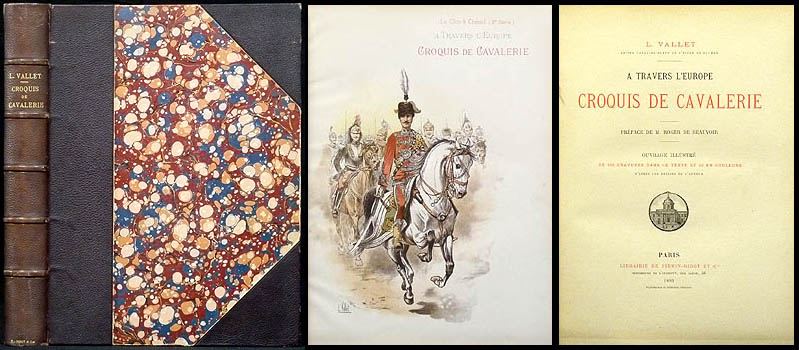
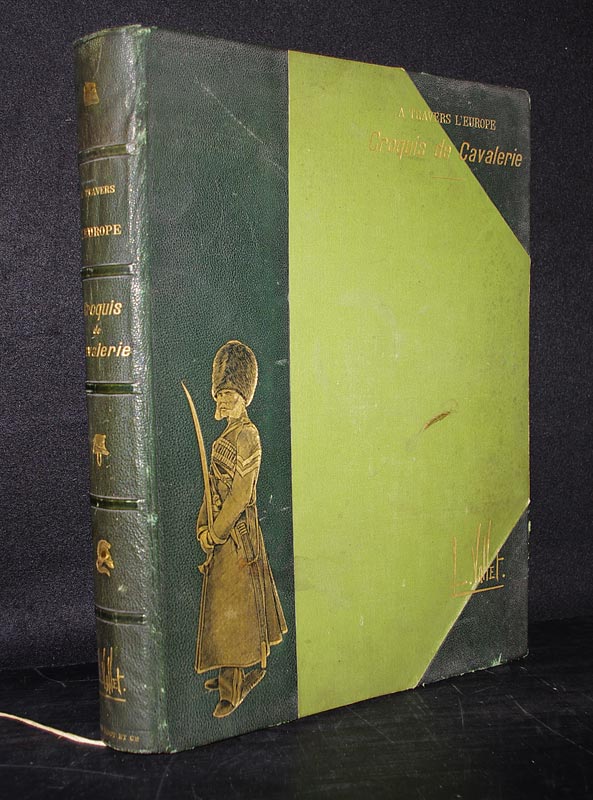
1893ref. 45480BBParis, Librairie de Firmin-Didot et Cie, 1893. 4°. 34 cm. XIV, 300 Seiten, 1 Blatt. Halblederband der Zeit mit goldgeprägtem Rückentitel und Kopfgoldschnitt.
1893ref. 2075205Paris: Librairie de Firmin-Didot 1893. XVI, 300 Seiten. Mit 50 Farbtafeln und 300 schwarz-weißen Abbildungen im Text. 4° (35 x 28 cm). Dekorativer Orig.-Halblederband mit goldgeprägtem Titel auf Deckel und Rücken, goldenem Kupferstich eines Kosaken auf dem Deckel sowie goldenen Rückenfiguren, Kopfgoldschnitt und Buntpapiervorsätzen. [Hardcover / fest gebunden].
1893ref. 60380Firmin-Didot 1893 In-4 reliure de l’époque demi-chagrin maroquiné bordeaux à coins, dos à nerfs, tête dorée, couverture illustrée conservée, XVI + 300 pages, 300 figures dans le texte et 50 planches en couleurs sous serpentes légendées. Dos légèrement passé, coins légèrement émoussés. Bon exemplaire. édition originale. Seconde série du Chic à cheval. Louis Vallet a servi dans la cavalerie avant de se consacrer au dessin et à la peinture, notamment hippique, mais également pour le théâtre.