1,174 results
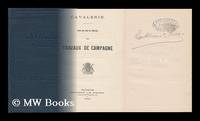
1888ref. fl1665Imprimerie Nationale Cartonné 1888 Deux volumes in-12 (9 x 14 cm), reliure cartonnée, Tome 1 : Rapports - Titres I et II (290 pages, 1888) // Tome 2 : Titres III et IV (352 pages, 1885) ; reliure abîmées, manques aux dos, plats frottés et salis, gribouillages aux contreplats/gardes, par ailleurs le texte est bien lisible, en l'état. Livraison a domicile (La Poste) ou en Mondial Relay sur simple demande.
1888ref. fl1668Librairie Militaire de L. Baudoin et Cie Cartonné 1888 Deux volumes in-12 (9,5 x 14,7 cm), reliure cartonnée, Tome 1 seul (Rapports - Titres I et II), 312 pages ; manques au dos, coupes usées, rousseurs aux plats, quelques rousseurs à l'intérieur par ailleurs bien conservé, en l'état. Livraison a domicile (La Poste) ou en Mondial Relay sur simple demande.
1884Royal octavo. Pp. iv, 149. Set in Gothic type. Hardcover, bound in contemporary full cloth with the original decorated cover laid-down. In a very good condition. ~ First edition.
ref. 134669768X.Ghardcover. Good. Access codes and supplements are not guaranteed with used items. May be an ex-library book. hardcover

1797ref. 183961797. Fawcett William. Instructions and Regulations for the Formations and Movements of the Cavalry 1797 establishes the standardized system of cavalry drill and maneuver adopted by the British Army at the close of the eighteenth century forming part of the institutional reforms that shaped British military readiness during the French Revolutionary and Napoleonic Wars. Issued under War Office authority the manual codifies cavalry organization battlefield movement and command structure at a moment when the British Army was professionalizing its training systems following the disruptions of prolonged continental conflict. Fawcett serving as Adjutant-General and one of the most senior officers in the army directed reforms that imposed uniformity across regiments and this work documents the formal transmission of those standards into operational practice. Fawcett William. Instructions and Regulations for the Formations and Movements of the Cavalry. London: Printed for the War Office 1797. First edition. Octavo. 342 pages with 16 folding engraved plates. Original gray boards. The engraved plates illustrate cavalry formations movement sequences and positional alignments providing visual instruction to accompany the printed regulations. Textblock uncut. Produced during a period of sustained military engagement against Revolutionary France this manual aligns with broader War Office efforts to centralize command structure and standardize training across infantry and cavalry units contributing to the operational coherence later demonstrated in campaigns such as the Peninsular War. The work provides direct evidence of how doctrine was disseminated within the British Army offering material for the study of military pedagogy battlefield coordination and the administrative consolidation of state military power in the late eighteenth century. Upper cover detached spine chipped at head and tail with general wear consistent with use; textblock remains clean and uncut. Overall good to very good condition. unknown books
1797ref. 183961797. Fawcett William. Instructions and Regulations for the Formations and Movements of the Cavalry 1797 establishes the standardized system of cavalry drill and maneuver adopted by the British Army at the close of the eighteenth century forming part of the institutional reforms that shaped British military readiness during the French Revolutionary and Napoleonic Wars. Issued under War Office authority the manual codifies cavalry organization battlefield movement and command structure at a moment when the British Army was professionalizing its training systems following the disruptions of prolonged continental conflict. Fawcett serving as Adjutant-General and one of the most senior officers in the army directed reforms that imposed uniformity across regiments and this work documents the formal transmission of those standards into operational practice. Fawcett William. Instructions and Regulations for the Formations and Movements of the Cavalry. London: Printed for the War Office 1797. First edition. Octavo. 342 pages with 16 folding engraved plates. Original gray boards. The engraved plates illustrate cavalry formations movement sequences and positional alignments providing visual instruction to accompany the printed regulations. Textblock uncut. Produced during a period of sustained military engagement against Revolutionary France this manual aligns with broader War Office efforts to centralize command structure and standardize training across infantry and cavalry units contributing to the operational coherence later demonstrated in campaigns such as the Peninsular War. The work provides direct evidence of how doctrine was disseminated within the British Army offering material for the study of military pedagogy battlefield coordination and the administrative consolidation of state military power in the late eighteenth century. Upper cover detached spine chipped at head and tail with general wear consistent with use; textblock remains clean and uncut. Overall good to very good condition. unknown
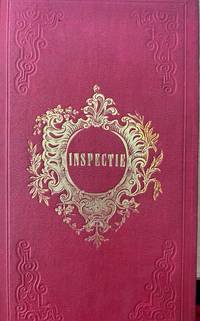
ref. 56817Scarce contemporary reply to Pieter Dekker Jr.'s controversial Zes jaren te paard 1852 defending the reputation of the Dutch cavalry against accusations of poor discipline and mistreatment of soldiers. Written anonymously by Joost Hendrik Burlage the pamphlet is an important primary source on military debate in the Netherlands during the mid-nineteenth century.Beautiful red linen binding with guilt decorations and text: Inspectie. Large octavo edition in -8 22 x 14 cm. Endpapers with some light foxing further a good copy. On titlepage stamp of Koninklijke Bibliotheek te s hage Verwijderd Doublet Kon. Bibl.NL Zeldzame publicatie met directe reactie op Pieter Dekker Jr.'s veelbesproken werk Zes jaren te paard. Herinneringen uit het Hollandsche dragonderleven dat eveneens in 1852 verscheen. Hoewel de titelpagina slechts vermeldt dat de auteur ""een gepasporteerd onder-officier der cavalerie"" is staat tegenwoordig vast dat de schrijver Joost Hendrik Burlage 18061873 was oud-vrijwilliger tijdens de Belgische Opstand publicist en later oprichter van de Vereniging Het Metalen Kruis.Pieter Dekker Jr. had in zijn boek een uiterst kritisch beeld geschetst van het Nederlandse leger en het leven bij de dragonders. Hij beklaagde zich over de behandeling van de soldaten de discipline de voeding en de organisatie van de cavalerie. Zijn publicatie veroorzaakte onmiddellijk veel discussie. Burlage nam het op voor het leger en schreef deze ""Inspectie"" als een weerwoord. Hij betoogt dat Dekker een eenzijdig en overdreven negatief beeld geeft en verdedigt de eer van de Nederlandse cavalerie en haar officieren. Daarbij vergelijkt hij zijn eigen ervaringen tijdens de krijgsverrichtingen van 18301831 met Dekkers beschrijvingen uit de vredesjaren.Belgische opstand - Belgium revolt unknown
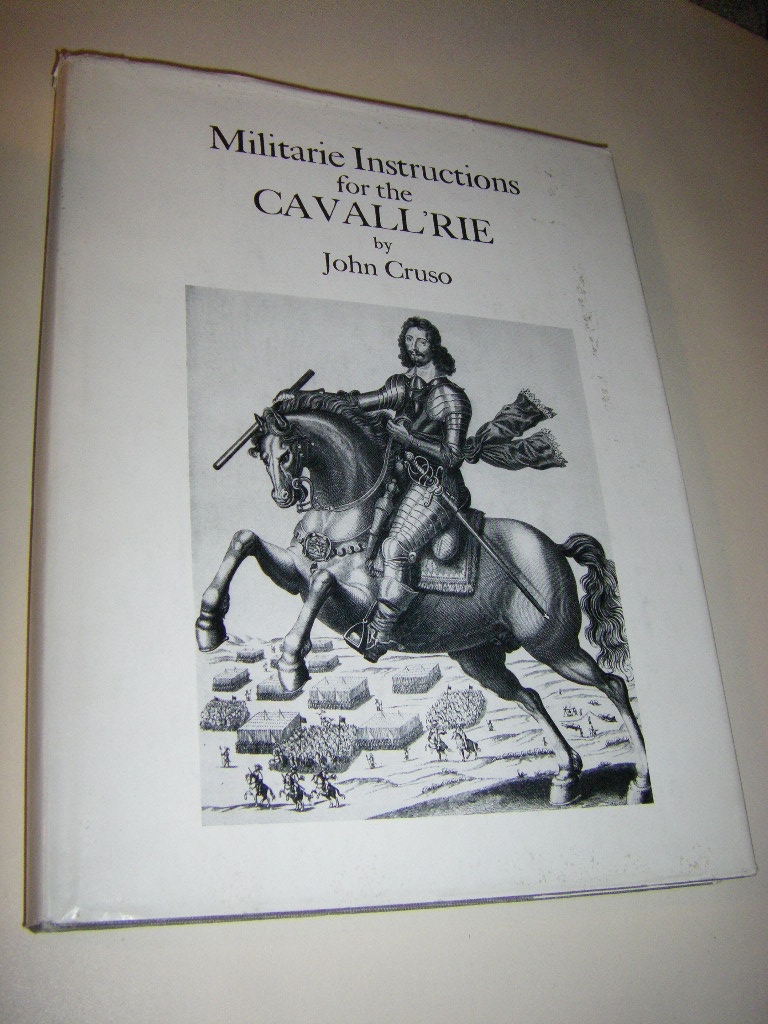
1972ref. 056832Kineton, The Roundwood Press, 1972. xxviii, (6 Bl.), 108 S.; mit zahlr. teils ausfaltbaren SW-Abb., Karten, farbigen u. SW-Abb. auf Tafeln; Reprint der Ausgabe 1632; mit Erläuterungen u. Kommentar von Peter Young; auf 1000 Expl. limitiert, hier ohne Nummer; Schutzumschlag unsauber u. mit Randläsuren, Buch sehr gut Leinen 31,3 cm Faksimile Beschädigter Schutzumschlag Sehr gut
1895ref. 496801895 PARIS/LIMOGES, H. Charles-Lavauzelle, 1895 - PARIS/NANCY, 1899 - Complet en 3 Volumes In-16 - Cartonnage éditeur (Dos fragile au T. I )- I) 59 gravures en texte, 192 pages - T.II & III) - Nombreuses illustrations en texte, Musique avec partitions - 175 & 138 pages - légères mouillures, Sinon bons exemplaires - Bel ensemble en cartonnage editeur -Réf. 49680
1956ref. LFA-126712520Un ouvrage de 316 pages, format 160 x 255 mm, relié percaline, publié en 1956, The British Bloodstock Agency, bon état, rare
1979Sm. folio, First Edition, with numerous coloured and monochrome illustrations throughout, and pictorial endpapers; red cloth, gilt back, a very good, bright, clean copy in unclipped dustwrapper.
1953Fine French Original red cloth. 12mo. (17 x 12 cm). In French. 256 p., 19 b/w plans, 32 numerous color plans, 1 map of Morocco in 18 pages. Maroc. Preface du Marechal de France Alphonse Juin de l'Academie française. First Edition.
1909ref. 49257n.p.: U.S. Army 1909. good. 35" x 22.5" 1 sheet 1 color map folded size 4.5" x 7.5" small tears at a few creases. Sgt. J. Howry was the draftsman for this map. This map is a reduced copy of 3-inch map referred to in Problems to include 1908-1909. Scale: 2 inches equals 1 mile. Contour intervals 20 feet. U.S. Army unknown
1814ref. 613521814. unknown
1861ref. 45596n.p. 1861. Very good folded edge worn light soiling and ink staining. 1 sheet. 7.75 x 4.5 inches. Signed by Ernest G. Chormann Brig. Gen. Fitz John Porter Col. William Woods Averell Chief of ordnance Charles P. Kingsbury and Assistant Adjutant-General Andrew J. Alexander for Gen. George Stoneman with the note "approved" by three signatures. Though undated it was likely signed between September 1861 and January 17 1862 based on the service records of those who signed it. 1. Ernest G. Chormann in 1861 recruited a volunteer regiment called "Chorman’s Independent Mounted Rifle Rangers" in Philadelphia. See Library Company of Philadelphia for the broadside. The first company of this regiment was mustered into service July 23 1861 and the last was mustered Sept. 15th 1861. The regiment was then under the command of Col. E. G. Chormann. It was numbered the 89th of the line and the 8th Cavalry and left Pennsylvania for Washington on Oct. 4 where it was brigaded with the 3rd Pa. cavalry thus putting Chormann under the command of William Woods Averell who in turn was under the command of Brigadier General Fitz John Porter. On Nov. 9 1861 the New York Times reported "The Eighth Pennsylvania Cavalry Col. Chormann has been brigaded with the Third from the same State. The brigade is commanded by Col. W.W. Averell of the latter regiment. Both are rapidly improving in efficiency and drill." But on Nov. 27 the Philadelphia Inquirer reported that "The statement that charges have been filed against Col. Chormann is said to be erroneous. The Colonel is laboring energetically to ensure the perfection of drill desireable in all well disciplined regiments." By January 17 1862 Chormann had resigned his commission to be replaced by Capt. David Gregg of the 6th U. S. cavalry an experienced officer and a graduate of West Point. Chormann had endorsed Merrill’s Patent Breech-Loading Carbine on September 19th 1861 his letter to General J. W. Ripley Chief of Ordnance Washington D. C. soon appearing in an advertisement for the weapons but so had many other officers. Thus both the reason for his resignation and the purpose of this document remain unknown. Little is known about Ernest G. Chormann other than in his autobiography below and for his filing of numerous patents. He was an inventor and also active as an artist between 1853-1880 See Frick Museum Art Reference Library. In 1852 he exhibited saddle patterns at the Twenty-second Exhibition of American Manufactures at the Franklin Institute; in 1861 listed as an engraver and die sinker he bid on a $2500 contract with the U.S. Government for coin designs as part of ongoing experiments into how to prevent “abrasion counterfeiting and deterioration of the coins of the United States; ” he was hired as the engraver; he filed for optical and mechanical patents; in 1880 he painted "Letitia Street House 1880" now at the Historical Society of Pennsylvania. The Pennsylvania's Rangers' War song: "Up ! up ! with our flag let its bright stars gleam out" was dedicated to him. The Pennsylvania Historical Review 1886 lists his firm Chormann & Mitchell as "inventors and patentees of the specialties manufactured. They manufacture all kinds of art furniture including parlor easels novel and chaste in design labor- saving studio easels sketching easels artists’ kits etc. together with interior decorations. the studio easel being awarded the first premium and diploma at the Centennial Exposition of 1876." Chormann adds his somewhat rather fanciful biography: "Mr. Chormann the founder of this business was born in France. Early in life he was noted for his energy talent and determination and visited as an explorer and traveller nearly every country in the civilized world. In 1836 he was a colonel in the San Jacinto war where he manifested great courage and prudence and on its termination made an effort to explore almost alone the sources of the Nile. Eventually after exploring various portions of Australia New Mexico Arizona and Lower California and undergoing great hardships and dangers from climate and Indians he was appointed on his arrival in Texas in 1845 captain and superintendent of the Texan Rangers. He was actively engaged in 1847 and 1848 in the Mexican war where his distinguished military ability was of great service to the United States. During his explorations and travels in the West he was associated with those famous old Indian fighters namely De Soto and California Joe. Mr. Chormann was the first white man who explored the Western portion of the Colorado River the whole of the country at that period 1843 watered by this stream being inhabited by tribes of Indians of the most cruel and treacherous nature. Colonel Chormann organized the first regiment that served during the war and which was known as Chormann’s Mounted Rangers. On the 14th April 1861 immediately after the bombardment of Fort Sumpter he began recruiting and put 5000 men in the field. In 1865 he brought East the first specimen of the moss agate. In a few months Mr. Chormann intends to publish a work on Colorado and the West illustrated with splendid engravings which will prove of the greatest interest to all lovers of nature. He was the inventor of stylograph printing and is noted in scientific and artistic circles for his inflexible integrity and sterling ability." 2. Fitz John Porter 1822-1901 Civil War Union Major General West Point 1845 served in the Mexican–American War promoted to brigadier general of volunteers in 1861 and divisional commander in the newly formed Army of the Potomac under Maj. Gen. George B. McClellan who was soon is patron. On November 25 1862 Porter was arrested and court-martialed for his actions at Second Bull Run after McClellan was dismissed by Lincoln. He spent the next 16 years trying clear his name and record which he finally did in 1878. 3. William Woods Averell 1832-1900 Civil War Union Brigadier General West Point 1855 2nd Lieutenant assigned to the United States Army Mounted Rifles and served in the Indian Wars on the Western frontier severely wounded in a fight with Navajos in 1859 became a 1st Lieutenant with the Mounted Riflemen and was placed on staff duty in Washington D.C. In August 1861 he was appointed as Colonel of the 3rd Pennsylvania Volunteer Cavalry and soon became a Brigadier General. 4. Andrew Jonathan Alexander 1833-1887 Civil War Union Brevet Brigadier General served first as a Captain in the 3rd United States Regular Cavalry then as Lieutenant Colonel and Assistant Adjutant General on the staff of Union General George Stoneman. 5. Charles Peeble Kingsbury 1816-1879 graduated from West Point in 1840 2nd in a class of 42 served in the Mexican War as General Wolf's ordnance officer and on General Taylor’s staff wrote 'Elementary Treatise on Artillery and Infantry' 1849 and was a contributor to the American Whig Review Western Quarterly Review Putnam’s Monthly and the Southern Literary Messenger from 1840-67 was superintendent of the Armory at Harper's ferry and Chief of Ordnance for the Army of the Potomac August 12 1861 to July 1862 promoted to Colonel and aide-decamp September 28 1861. unknown books
1861ref. 45596n.p. 1861. Very good folded edge worn light soiling and ink staining. 1 sheet. 7.75 x 4.5 inches. Signed by Ernest G. Chormann Brig. Gen. Fitz John Porter Col. William Woods Averell Chief of ordnance Charles P. Kingsbury and Assistant Adjutant-General Andrew J. Alexander for Gen. George Stoneman with the note "approved" by three signatures. Though undated it was likely signed between September 1861 and January 17 1862 based on the service records of those who signed it. 1. Ernest G. Chormann in 1861 recruited a volunteer regiment called "Chorman’s Independent Mounted Rifle Rangers" in Philadelphia. See Library Company of Philadelphia for the broadside. The first company of this regiment was mustered into service July 23 1861 and the last was mustered Sept. 15th 1861. The regiment was then under the command of Col. E. G. Chormann. It was numbered the 89th of the line and the 8th Cavalry and left Pennsylvania for Washington on Oct. 4 where it was brigaded with the 3rd Pa. cavalry thus putting Chormann under the command of William Woods Averell who in turn was under the command of Brigadier General Fitz John Porter. On Nov. 9 1861 the New York Times reported "The Eighth Pennsylvania Cavalry Col. Chormann has been brigaded with the Third from the same State. The brigade is commanded by Col. W.W. Averell of the latter regiment. Both are rapidly improving in efficiency and drill." But on Nov. 27 the Philadelphia Inquirer reported that "The statement that charges have been filed against Col. Chormann is said to be erroneous. The Colonel is laboring energetically to ensure the perfection of drill desireable in all well disciplined regiments." By January 17 1862 Chormann had resigned his commission to be replaced by Capt. David Gregg of the 6th U. S. cavalry an experienced officer and a graduate of West Point. Chormann had endorsed Merrill’s Patent Breech-Loading Carbine on September 19th 1861 his letter to General J. W. Ripley Chief of Ordnance Washington D. C. soon appearing in an advertisement for the weapons but so had many other officers. Thus both the reason for his resignation and the purpose of this document remain unknown. Little is known about Ernest G. Chormann other than in his autobiography below and for his filing of numerous patents. He was an inventor and also active as an artist between 1853-1880 See Frick Museum Art Reference Library. In 1852 he exhibited saddle patterns at the Twenty-second Exhibition of American Manufactures at the Franklin Institute; in 1861 listed as an engraver and die sinker he bid on a $2500 contract with the U.S. Government for coin designs as part of ongoing experiments into how to prevent “abrasion counterfeiting and deterioration of the coins of the United States; ” he was hired as the engraver; he filed for optical and mechanical patents; in 1880 he painted "Letitia Street House 1880" now at the Historical Society of Pennsylvania. The Pennsylvania's Rangers' War song: "Up ! up ! with our flag let its bright stars gleam out" was dedicated to him. The Pennsylvania Historical Review 1886 lists his firm Chormann & Mitchell as "inventors and patentees of the specialties manufactured. They manufacture all kinds of art furniture including parlor easels novel and chaste in design labor- saving studio easels sketching easels artists’ kits etc. together with interior decorations. the studio easel being awarded the first premium and diploma at the Centennial Exposition of 1876." Chormann adds his somewhat rather fanciful biography: "Mr. Chormann the founder of this business was born in France. Early in life he was noted for his energy talent and determination and visited as an explorer and traveller nearly every country in the civilized world. In 1836 he was a colonel in the San Jacinto war where he manifested great courage and prudence and on its termination made an effort to explore almost alone the sources of the Nile. Eventually after exploring various portions of Australia New Mexico Arizona and Lower California and undergoing great hardships and dangers from climate and Indians he was appointed on his arrival in Texas in 1845 captain and superintendent of the Texan Rangers. He was actively engaged in 1847 and 1848 in the Mexican war where his distinguished military ability was of great service to the United States. During his explorations and travels in the West he was associated with those famous old Indian fighters namely De Soto and California Joe. Mr. Chormann was the first white man who explored the Western portion of the Colorado River the whole of the country at that period 1843 watered by this stream being inhabited by tribes of Indians of the most cruel and treacherous nature. Colonel Chormann organized the first regiment that served during the war and which was known as Chormann’s Mounted Rangers. On the 14th April 1861 immediately after the bombardment of Fort Sumpter he began recruiting and put 5000 men in the field. In 1865 he brought East the first specimen of the moss agate. In a few months Mr. Chormann intends to publish a work on Colorado and the West illustrated with splendid engravings which will prove of the greatest interest to all lovers of nature. He was the inventor of stylograph printing and is noted in scientific and artistic circles for his inflexible integrity and sterling ability." 2. Fitz John Porter 1822-1901 Civil War Union Major General West Point 1845 served in the Mexican–American War promoted to brigadier general of volunteers in 1861 and divisional commander in the newly formed Army of the Potomac under Maj. Gen. George B. McClellan who was soon is patron. On November 25 1862 Porter was arrested and court-martialed for his actions at Second Bull Run after McClellan was dismissed by Lincoln. He spent the next 16 years trying clear his name and record which he finally did in 1878. 3. William Woods Averell 1832-1900 Civil War Union Brigadier General West Point 1855 2nd Lieutenant assigned to the United States Army Mounted Rifles and served in the Indian Wars on the Western frontier severely wounded in a fight with Navajos in 1859 became a 1st Lieutenant with the Mounted Riflemen and was placed on staff duty in Washington D.C. In August 1861 he was appointed as Colonel of the 3rd Pennsylvania Volunteer Cavalry and soon became a Brigadier General. 4. Andrew Jonathan Alexander 1833-1887 Civil War Union Brevet Brigadier General served first as a Captain in the 3rd United States Regular Cavalry then as Lieutenant Colonel and Assistant Adjutant General on the staff of Union General George Stoneman. 5. Charles Peeble Kingsbury 1816-1879 graduated from West Point in 1840 2nd in a class of 42 served in the Mexican War as General Wolf's ordnance officer and on General Taylor’s staff wrote 'Elementary Treatise on Artillery and Infantry' 1849 and was a contributor to the American Whig Review Western Quarterly Review Putnam’s Monthly and the Southern Literary Messenger from 1840-67 was superintendent of the Armory at Harper's ferry and Chief of Ordnance for the Army of the Potomac August 12 1861 to July 1862 promoted to Colonel and aide-decamp September 28 1861. unknown
ref. AQ24115s.l.: s.n. 1842-46 Manuscript on paper. 102 leaves. 14 used the remainder blank. Contemporary green cloth contrasting red paper lettering-piece to upper board title in manuscript to spine and bottom edge metal clasp. Extremities rubbed and a trilfe marked. Upper hinge exposed. A mid-nineteenth-century manuscript guest book for the Westmorland Yeomanry Cavalry. The regiment was raised by Colonel Henry Lowther as the Westmorland Yeomanry Cavalry in 1819. It was re-raised as the Westmorland and Cumberland Yeomanry Cavalry in 1828 and was called upon to suppress chartist riots at Penrith and Carlisle in 1839. It was called upon again to suppress fighting between English and Irish labourers working on the Lancaster and Carlisle Railway at Lowther Park in 1846. Although there had been no intention for the Yeomanry to serve overseas a series of defeats during Black Week in December 1899 convinced the British Government that additional troops were needed to supplement the regular army. A Royal Warrant was issued on 24th December 1899 to allow volunteer forces to serve in the Second Boer War and the Yeomanry were duly dispatched. . 8vo. [s.n.], [1842-46] hardcover
ref. 78379Berne, Imprimerie de C.-J. Wyss 1875, 140x100mm, V - 162pages, cartonnage de l'éditeur. Nom du possesseur sur la plat supérieur. Déchirures au dos.
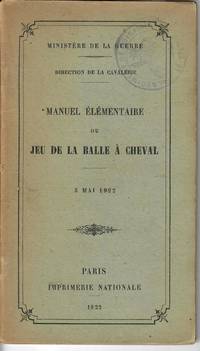
1922ref. 16810Paris: Imprimerie Nationale 1922. First edition. Soft cover. Very good pages age browned. 55p 22 line ills. Old regimental library stamp on cover and half-title. In French. There are very few French books on polo and this cavalry manual was printed only in this one edition. Covers training rules tactics etc. Very scarce: one location in WorldCat Bibliotheque Nationale. Can be sent outside the US for less than the default shipping rate. 55p 22 line ills. Old regimental library stamp on cover and half-title. In French. Imprimerie Nationale paperback
1937ref. 119957Charles-Lavauzelle & Cie, 1937, fort pt in-8°, xxi-1392 pp, nombreuses figures dans le texte et 3 planches hors texte dont deux dépliantes, reliure percaline violette imprimée de l'éditeur (lég. défraîchie), pt trace d'humidité ancienne au bas de qqs feuillets, bon état. Avec un petit additif de 30 pages sur le canon de 25mm S.A., modèle 1934 (1939)
1915Paris, Limoges, Henri Charles-Lavauzelle 1915. Fort et grand in-12 relié pleine toile éditeur bleue, au plat estampé en noir. XXXIII + 1078 pages.
1896ref. 152509Bruxelles : J. B. Stephens 1896. First Edition. Hardback. A fine copy in the original blind tooled pebbled cloth. Remains particularly well-preserved overall; tight bright clean and especially sharp-cornered. Ex-libris copy with minor internal marks remaining. ; 61 pages; Description: 61 p. : ill. some foldng ; 15 cm. Subjects: Explosives --Tactics --Warfare. Lieutenant Piret's copy with signature. Bruxelles : J. B. Stephens hardcover
ref. 19299Saumur, Dubosse [impr. P. Godet], 1850. 1 vol. in-12 carré, cartonnage de l'époque, réparation au dos. 139 pp. Exemplaire manipulé, salissures.[D31]
1876ref. LFA-126721758Un ouvrage de 212 pages, format 90 x 140 mm, illustré, relié cartonnage, publié en 1876, Imprimerie Nationale, état d'usage
1911ref. ga2503Librairie militaire Berger-Levrault Brochure 1911 In-12 (11,5 x 19 cm), brochure, dos toilé sous chemise cartonnée reliée par un amateur, 72 pages, quelques figures en noir dans le texte ; pliures et traits de crayon au premier plat, par ailleurs bon état général. Livraison a domicile (La Poste) ou en Mondial Relay sur simple demande.