1969réf. 62496Forest Grove OR: Normount Armament Company 1969. Reprint. Reprint of 1959 Department of the Army publication. Wraps. Good. No dust jacket as issued. Cover has some wear and soiling. 142 1 p. Includes: illustrations diagrams index. Glossary. References. This manual superseded FM 20-32 19 July 1955 and TC 5-6 3 April 1958. It represented the state of knowledge and the state of practice at the time the United States entered the Vietnam War. Normount Armament Company paperback
1976réf. 78294Washington DC: United States. Department of the Army. Headquarters 1976. This is a reprint which includes current pages from C1. Wraps. Good. Format is approximately 5.25 inches by 8.25 inches. ii 139 3 pages. Illustrations. Appendix A: References. Appendix B: Master Training Program. Appendix C: Tactical Employment of Climbers. Appendix D: Measurement Conversion Factors. Glossary. Index. Cover is scuffed and has sticker residue. This training circular #TC 90-6-1 is designed to help the reader become an expert military mountaineer. Gives information for survival in different terrains climates and types of weather. Tactics with climbing ropes and knots operations on glaciers and snow covered mountains. This is the finest book written on 'real world' mountaineering not just for sport. In current use with Navy Seals Army Rangers and Special Forces Marines and sport climbers. Covers basic techniques movement of individuals and units and evacuation. Military Mountaineering Covers basic techniques movement of individuals and unit movement and evacuation. Operations on glaciers and snow covered mountains fixed alpine paths also master training program. TCs contain material that is directive or informational is transitory or needs to be published only once. Circulars expire 2 years from the date of issue or earlier. The Army subsequently issued Field Manual FM 3-97.61 Military Mountaineering. Military mountaineering is a means to enable a commander to negotiate complex terrain both ascent and descent in mountainous environments using ropes and other specialized equipment Military mountaineers understand how environmental factors and terrain can be overcome and used to gain an advantage over enemy forces. Topics such as intelligence collection offensive and defensive postures sustainment operations direct and indirect fires and communications are examined by military mountaineers. Mountainous environments have variables that elevate the risk level because of the lack of mobility or how quickly the weather can change while the same mission in other terrain would be low risk and routine. Basic Military Mountaineering training provides soldiers in the fundamental knowledge and skills required to successfully conduct small-unit operations in typical mountainous terrain found throughout the world. Advanced training builds on previous instruction and trains soldiers in the knowledge and skills required to lead small units and teams over technically difficult hazardous or exposed mountainous terrain during summer months. The course is intended for units or individuals who will conduct operations in mountainous terrain and must operate independently of major units or organizations or who will lead larger organizations over technically hazardous terrain. United States. Department of the Army. Headquarters paperback
1985réf. 73443W: U. S. Department of the Army 1985. Supersedes GTA 3-6-2 June 1975. Ephemera. Good. Single sheet printed on both sides 10 inches by 12 inches. Folded and re-folded so that there are 16 panels eight on each side. Two panels are for notes and is almost completely blank space. Illustrations. Pencil erasure residue on title panel. The primary means of warning units of an actual or predicted CB hazard is the NBC Warning and Reporting system NBCWRS. It is a key in limiting the effects of attacks. The NBCWRS allows units to determine required protective measures and plan operations. Units take action depending on the mission and type of hazard present. Affected units alter plans to avoid the hazard. The units can upgrade protective measures and occupy or cross the hazard area. The NBCWRS consists of six reports. Each is standardized. The six standard reports are- NBC 1-Initial report used for passing basic data compiled at unit level. NBC 2-Report used for passing evaluated data. NBC 3-Report used for immediate warning of predicted contamination and hazard areas. NBC 4-Report used for passing monitoring and survey results. NBC 5-Report used for passing information on areas of actual contamination. NBC 6-Report used for passing detailed information on chemical or biological attacks. The reports use standard formats. The warning and reporting system is based on a code letter system. NBC has been updated to be described as Chemical biological radiological and nuclear defense CBRN defense or CBRNE defense is protective measures taken in situations in which chemical biological radiological or nuclear warfare including terrorism hazards may be present. CBRN defense consists of CBRN passive protection contamination avoidance and CBRN mitigation. A CBRN incident differs from a hazardous material incident in both scope i.e. CBRN can be a mass casualty situation and intent. CBRN incidents are responded to under the assumption that they are intentional and malicious; evidence preservation and perpetrator apprehension are of greater concern than with HAZMAT incidents. This ephemeral training aid was distributed to US Army Training and Audio-visual Support Centers TASC. Distribution was restricted because it contained technical or operational information that was for official government use only. Distribution was limited to US government agencies. Request for release outside the US government needed to be made to HQ TRADOC Fort Monroe Virginia. Due to its age and advances in technical and operational information it is understood that this distribution restriction no longer applies. U. S. Department of the Army unknown
réf. 63-3433Washington D.C. : Departments of the Army and the Air Force 1956. 4to. 573 pp. Soft covers Very Good with minor staining creasing. Illustrations some color charts. [Washington, D.C.] : Departments of the Army and the Air Force, [1956]. paperback
1951réf. 68859Washington DC: U.S. Government Printing Office 1951. Presumed first edition/first printing thus. Wraps. Good. Ink notation at top of front cover. Pencil erasure residue on t-p. Change 1 1 page paid in. vi 102 p. Includes: illustrations diagrams index. Review Questions. The manual addresses the evolution from amplitude modulation and voice modulation to the use of pulses as the basic means of transmitting intelligence. During this time period pulses were used significantly in radar and microwave communication systems This manual reflects the state of the art state of knowledge and state of practice at the time of the Korean War. U.S. Government Printing Office paperback
1980réf. 71392Research Triangle Park NC: U.S. Army Research Office 1980. Presumed first edition/first printing thus. Wraps. Good. No dust jacket. Cover has some wear discoloration and soiling. vii 1 123 p. Distribution letter laid in. List of Abbreviations. Indexes. This report was exempt from Reports Control under AR 335-15 Paragraph 7-2V. The U.S. Army Research Laboratory's Army Research Office ARO mission is to serve as the Army's premier extramural basic research agency in the engineering physical information and life sciences; developing and exploiting innovative advances to insure the Nation's technological superiority. Basic research proposals from educational institutions nonprofit organizations and private industry are competitively selected and funded. ARO's research mission represents the most long-range Army view for changes in its technology. ARO priorities fully integrate Army-wide long-range planning for research development and acquisition. ARO executes its mission through conduct of an aggressive basic science research program on behalf of the Army so that cutting-edge scientific discoveries and the general store of scientific knowledge will be optimally used to develop and improve weapons systems that establish land force dominance. The ARO research program consists principally of extramural academic research efforts consisting of single investigator efforts university-affiliated research centers and specially tailored outreach programs. Each approach has its own objectives and set of advantages. Programs are formulated in consultation with the Army Research Laboratory Directorates; the Research Development and Engineering Command's Research Development and Engineering Centers; the Army Medical Research and Materiel Command; the Army Corps of Engineers; and the Army Research Institute for the Behavioral and Social Sciences. The programs are also jointly coordinated and planned through the Defense Science and Technology Reliance process under the Basic Research Panel. U.S. Army Research Office paperback
1983réf. 060787Fort Benning GA: United States Army Infantry School 1983. Paper Back. Very Good/No Jacket. 4to - over 9¾" - 12" tall. 16pp.; SC staple-bound; blue & white; some rub w/clean tight pgs. "This handbook outlines the Manual of the Saber for ROTC cadets." b/w photos. United States Army Infantry School unknown
1953réf. 7156Department of the Army 1953. Paperback. Very good. 12mo. Staple-bound wraps. Departmental stamp and markings on front cover. Tight and clean. This is a Korean War-era book of short plays and skits to be performed by US Army soldiers for entertainment. Most of them are licensed from Jack Benny Bob Hope Your Show of Shows and other comedy programs of the era. Department of the Army paperback
1983réf. 61156Fort Leavenworth KS: United States Army Command and General Staff College 1983. Wraps. Good. No dust jacket. Cover has some wear and soiling. Includes: illustrations diagrams maps. Various paginations approximately 220 pages. Occasional footnotes. This presents a snapshot of the state of information/knowledge shortly after the Soviet invasion of Afghanistan. United States, Army, Command and General Staff College paperback
réf. 66017Washington DC: Department of the Army; U.S. Government Printing Office. Good. No dust jacket. Some edge discoloration and some wear to corners. Ink mark on the 1776 image. McBarron H. Charles. Includes illustrations. 10 9 by 12.75 inch pages with image size of 7 by 9.75 inches. Color illustrations. Accompanies by 12 page staple bound sheets on the American Soldier series and each image. This appears to be a publication associated with the time period of Bicentennial of the American Revolution. These illustrations are full-color reproductions of paintings. This set spans the period 1775 to 1965. The dean of American Military artists H. Charles McBarron was commissioned to create these drawings. As part of the Army Historical Program the series depicts the American fighting en at various periods in our history The ten images show a number of U.S. Army activities in support the the nation's peacetime progress. The 10 images cover tthe years or periods: 1776 1815 1848-1885 1881-1883 1886 1903 1908-1909 1944-1945 1954-1976 1975The associated pamphlet has about a page of text on each image. Department of the Army; U.S. Government Printing Office unknown
réf. 66016Washington DC: Department of the Army; U.S. Government Printing Office. Good. No dust jacket. In mailing envelop. Some edge discoloration and some wear to corners. McBarron H. Charles. Includes illustrations. 10 9 by 12.75 inch pages with image size of 7 by 9.75 inches. Color illustrations. Accompanies by 12 page staple bound sheets on the American Soldier series and each image. This may have been a publication produced at the time of the Bicentennial of the American Revolution. These illustrations are full-color reproductions of paintings. This set spans the period 1775 to 1965. The dean of American Military artists H. Charles McBarron was commissioned to create these drawings. As part of the Army Historical Program the series depicts the American fighting en at various periods in our history The ten images show the years or periods: 1775 1782 1819 1839 1863 1918 1938 1944 1950 and 1965--depicting the Revolutionary War military exploration military scouting the Civil War WWi WWII Korean War and the Vietnam War. The associated pamphlet has about a page of text on each image. Department of the Army; U.S. Government Printing Office unknown
réf. 63-6837Washington DC: United States Government Printing Office 1928. 8vo. Soft Covers Stapled inside Pamphlet Binder. 72 pp. Charts fold-out maps black & white photographs. Good with losses marginal tears pencil scribblings; ex-library book with stamps and usual indicators. Washington, DC: United States Government Printing Office, 1928. paperback
1951réf. 68862Washington DC: United States Government Printing Office 1951. Presumed first edition/first printing. Hardcover. Fair. Writing on front cover. 11-669 colored in red. Cover has wear soiling and a scuff. Writing on back cover. Pencil erasure residue ont-p. iv 90 p. Includes: illustrations diagrams index. Three-hole punched. Review Questions. This reflects the state of the art state of knowledge and the state of practice at the time of the Korean War. Voltages having complex waveshapes were frequently used in military electronic equipment during this period. These waveshapes did not follow the conventional sine-wave pattern and were called nonsinusoidal waves. Exampes are distorted sine waves square waves rectangular waves trapezoidal waves and exponential waves. Advances in military electronics was focused on new ways of producing and utilizing these nonsinusoidal waves. United States Government Printing Office hardcover
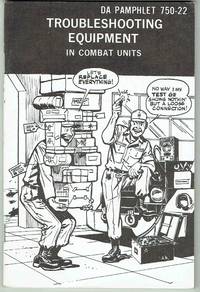
1973réf. 55250Washington DC: US Government Printing Office. Very Good. 1973. Softcover. Black & white pictorial paper binding rubbed & creased else a nice pamphlet. ; Profuse black & white illustrations.; DA PAMPHLET 750-22 Series; 12mo 7" - 7½" tall; 63 pages . US Government Printing Office paperback
2007réf. 70693Carlisle PA: U. S. Army War College Strategic Studies Institute 2007. Presumed first edition/first printing. Trade paperback. Very good. No dust jacket. Cover has slight wear and soiling. v. 1 139 1 p. The purpose of the Key Strategic Issues List was to give researches a ready reference of those issues of particular interest to the Department of the Army and the Department of Defense. From an on-line posting: "In today s dynamic strategic environment political changes can become challenges very quickly. Any list of key strategic issues must therefore include the broadest array of regional and functional concerns. This is a catalogue of significant issues arranged as potential research topics of concern to U.S. policymakers. As such the KSIL is a ready source of topics that members of the defense community and academia can use to focus their research efforts." U. S. Army War College, Strategic Studies Institute paperback
1968réf. 79091Topeka KS: Jostens Military Publications 1968. Presumed First Edition First printing thus. Hardcover. Good. Format is approximately 9 inches x 12 inches. Illustrations are in black and white and color. Hard covers somewhat scuffed and stained. Scarce surviving Vietnam War era unit commemorative book. This work addresses basic combat training. This unit book highlights Company D 1st Battalion which had its graduation date on December 5 1968. Some members of the units names are circled or underlined. Major General Collins wrote to the Graduates of Basic Combat Training: "It is hoped that this book in the years to come will serves as a pleasant reminder to you of this brief period of your military service in training - a reminder also of the truth that soldiers are made not born. May your continuing duty insure that the defense structure of this country is always maintained at the highest degree of readiness." Basic Combat Training often known as "boot camp" is the introduction to Army service and where recruits learn the traditions tactics and methods of becoming a Soldier. During Basic recruits learn how to work as a member of a team to accomplish tasks. Recruits learn discipline including proper dress marching and grooming standards. Most importantly recruits are instilled with the Seven Core Army Values and the Soldier Creed. Basic Combat Training comes in three phases and lasts about ten weeks depending on the recruits military occupational specialty MOS. After the recruit graduates from basic training the soldier will undergo two additional phases of training known as Advanced Individual Training where the soldier will learn the job skills required of his or her MOS. Jostens Military Publications hardcover
1990réf. 42-815BGPO 1990. 1990. Reprint of 1948 ed. 921p. Folding maps. Blue cloth. Very Oversize. Ex. lib. label on spine. Pocket. Clean and tight. Near Fine Copy. Hardcover. Near Fine. Book. GPO, 1990. Hardcover
1989réf. 32-444E2GPO 1989. 1989. 693p. Photos. Maps. Reprint of 1948 ed. Blue cloth. Very Oversize. Ex. lib. label on spine. Pocket. Near Fine Copy. Hardcover. Near Fine. GPO, 1989. Hardcover
1948réf. 50-1097GPO 1948. 1948. 1st ed. 1240p. Black cloth. Oversize. Very heavy. Ex.lib. Number inked lightly on spine. Rubber stamp inside. No pocket. Front hinge cracked. Clean & tight. Very Good copy. 1st. Hardcover. Very Good. Book. GPO, 1948. Hardcover
1927réf. 77-1187GPO 1927. 1927. 321p. Large Wraps. Very Good Copy. Paperback. Very Good. Book. GPO, 1927. Paperback
1918réf. 20861Washington 1918. Issued by the War Department Commission. Illustrated. Small oblong wraps. VG. WWI era book with all the traditional lyrics and music. unknown
1911réf. 65-1009GPO 1911. 1911. 403p. Red cloth. Lettering bright. No names or notations. Very Good copy. Hardcover. Very Good. Book. GPO, 1911. Hardcover
1931réf. 77-1467GPO 1931. 1931. 524p. Photos. Folding tables. Unit Rubber stamp 110th FA. . Wraps. Title inked on spine. Scotch tape reinforcement at top of spine. Near Fine Copy. Paperback. Near Fine. Book. GPO, 1931. Paperback
1921réf. 56-45GPO 1921. 1921. 85p. Photos. Canvas wraps. Fine Copy. Paperback. Fine. GPO, 1921. Paperback
1940réf. 78-1694GPO 1940. 1940. 51p. WW II AAF Air Doctrine. Wraps. Rubber stamps & label on front. Near Fine copy. Paperback. Near Fine. Book. GPO, 1940. Paperback