Nicholson, Lt.-Col. G.W.L. (Signed)MareMagnum

1956Signed and dated by author upon first blank leaf. 807 pages including extensive index, numerous fold-outs and black and white photographic plates. Map endpapers. Describes in detail Canada's part in the Italian campaign - the operations which began with the Allied invasion of Sicily in July 1943 and, developing into an arduous advance up the Italian peninsula, ended with the German capitulation in May 1945. Directed primarily to the general reader, and particularly to the Canadian reader who wishes to know what the Canadian Army accomplished and why its operations took the course they did. Gilt emblem and lettering upon red cloth boards. Average wear. Unmarked. Binding intact. Book
1937[8], 315, [13] pages. Black and white photographic plates. Eight maps on seven fold-outs. Roll of Honor. Nominal Roll. "A candid presentation of the human side of our experiences - highlighting the humorous incidents and skipping over, for the most part, the darker side of the war. We hope that those who read the book may recapture some of that wonderful spirit which then existed among us; and we use soldier language in order to stimulate the rousing of that spirit." - Introduction. Heavy wear to publisher's gilt-adorned navy blue cloth. Hinges open. Openings along backstrip. Undated but two of our three references suggest a 1937 printing date. A worthy reference copy of this informative World War I history. Dornbusch 329, Enser p.89, Cooke [3] p.201. Book
19568vo., First Edition, with 4 plates, illustrations in the text and a full-page map; handsomely bound in dark red full morocco, sides with gilt frames, back with raised bands ruled in gilt, second and fourth compartments lettered in gilt, all other compartments tooled in gilt, a most attractive copy ideal as a gift or for presentation. Masters' classic narrative of his service with 4th Gurkhas, Indian Army in the years preceding WWII. The best account of its kind since Yeats-Brown's 'Bengal Lancer' nearly thirty years earlier.
réf. Bloomsbury-9781441154804Bloomsbury Academic. Hardback. New. 208 pages Bloomsbury Academic hardcover
réf. Bloomsbury-9781441154804Bloomsbury Academic. Hardback. New. 208 pages Bloomsbury Academic hardcover
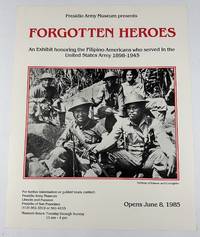
1985réf. 5617San Francisco: Presidio Army Museum 1985. Three photographically-illustrated posters printed in red and black each 20 x 16 inches. Very minor edge wear and toning. Near fine. A visually appealing trio of posters celebrating the military service of Filipino Americans during World War II created for an exhibition at the Presidio Army Museum in San Francisco in the summer of 1985. The exhibition was titled "Forgotten Heroes: An Exhibit Honoring the Filipino Americans Who Served in the United States Army 1898-1945." Each poster pictures a different unit of Filipino U.S. Army soldiers with experience in the Second World War as follows: a group of infantry soldiers identified as part of the "Defense of Bataan and Corregidor;" eight members of Company E of the 57th U.S. Infantry Filipino Scouts; and the four soldiers comprising the Color Guard of the 1st Filipino U.S. Infantry Regiment in 1942. The first two posters cary the same title "Forgotten Heroes" while the latter poster is titled "'Bahala Na!' 'Come What May!' The Story of the 1st and 2nd Filipino Infantry Regiments in the United States Army" perhaps a smaller display within the larger exhibition. No copies in OCLC though we doubt the posters are unique perhaps residing in larger collections of Filipino American material. Presidio Army Museum unknown
1985réf. 5617San Francisco: Presidio Army Museum 1985. Three photographically-illustrated posters printed in red and black each 20 x 16 inches. Very minor edge wear and toning. Near fine. A visually appealing trio of posters celebrating the military service of Filipino Americans during World War II created for an exhibition at the Presidio Army Museum in San Francisco in the summer of 1985. The exhibition was titled "Forgotten Heroes: An Exhibit Honoring the Filipino Americans Who Served in the United States Army 1898-1945." Each poster pictures a different unit of Filipino U.S. Army soldiers with experience in the Second World War as follows: a group of infantry soldiers identified as part of the "Defense of Bataan and Corregidor;" eight members of Company E of the 57th U.S. Infantry Filipino Scouts; and the four soldiers comprising the Color Guard of the 1st Filipino U.S. Infantry Regiment in 1942. The first two posters cary the same title "Forgotten Heroes" while the latter poster is titled "'Bahala Na!' 'Come What May!' The Story of the 1st and 2nd Filipino Infantry Regiments in the United States Army" perhaps a smaller display within the larger exhibition. No copies in OCLC though we doubt the posters are unique perhaps residing in larger collections of Filipino American material. Presidio Army Museum unknown books
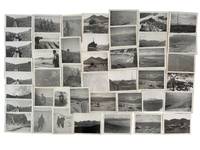
1945réf. 215781945. AArchive of 64 original black-and-white photographs documenting American military operations and engineering activities in the Aleutian Islands during World War II. Photographs measure approximately 4.5" x 3.5" and provide an extensive visual record of one of the most remote and environmentally challenging theaters of the war. The images chronicle the daily work of U.S. Army personnel and Army Engineers stationed across the Aleutian chain where military forces confronted not only the threat of enemy action but also some of the harshest conditions faced by American troops anywhere during the conflict. Soldiers appear throughout the archive wearing cold-weather gear field jackets heavy boots and M1 steel helmets while working patrolling and constructing infrastructure amid windswept volcanic landscapes. A significant portion of the collection documents the enormous logistical effort required to sustain military operations in the islands. Engineers are shown surveying terrain operating equipment cutting and processing timber and building facilities essential to maintaining isolated military outposts. Several striking photographs depict large timber-log chutes descending steep hillsides toward the shoreline apparently designed to move heavy equipment and supplies through terrain where conventional transportation proved difficult. Other images record lumber operations construction projects and the continual adaptation of military infrastructure to the rugged environment. The archive also contains numerous panoramic views of the Aleutian landscape itself. Snow-covered mountains barren volcanic ridges isolated coastlines glacial valleys and treeless tundra dominate many photographs illustrating why the campaign became as much a battle against geography and weather as against enemy forces. The Aleutian chain stretching deep into the North Pacific and containing dozens of active and dormant volcanoes represented one of the most isolated regions under American military control during the war. Naval and maritime operations are likewise represented. Several photographs show transport and supply vessels anchored offshore or approaching remote coastal installations highlighting the dependence of Aleutian bases upon sea-borne logistics. Military camps consisting of Quonset huts and tent encampments appear throughout the collection while one particularly notable image captures an aircraft flying above a military installation underscoring the importance of aerial reconnaissance and patrol operations in protecting the northern approaches to Alaska. Although often overshadowed by campaigns in Europe and the Central Pacific the Aleutian campaign held considerable strategic importance. Following the Japanese occupation of Attu and Kiska in 1942 American forces undertook a costly effort to secure the islands and maintain control of the northern Pacific. These photographs document the infrastructure manpower and determination required to operate in a theater where extreme weather isolation and difficult terrain shaped every aspect of military life. A substantial and visually compelling archive documenting the engineering logistical and environmental realities of America's northernmost front during World War II. Photographs remain in very good condition with minor surface wear and occasional light creasing. unknown
1945réf. 215781945. AArchive of 64 original black-and-white photographs documenting American military operations and engineering activities in the Aleutian Islands during World War II. Photographs measure approximately 4.5" x 3.5" and provide an extensive visual record of one of the most remote and environmentally challenging theaters of the war. The images chronicle the daily work of U.S. Army personnel and Army Engineers stationed across the Aleutian chain where military forces confronted not only the threat of enemy action but also some of the harshest conditions faced by American troops anywhere during the conflict. Soldiers appear throughout the archive wearing cold-weather gear field jackets heavy boots and M1 steel helmets while working patrolling and constructing infrastructure amid windswept volcanic landscapes. A significant portion of the collection documents the enormous logistical effort required to sustain military operations in the islands. Engineers are shown surveying terrain operating equipment cutting and processing timber and building facilities essential to maintaining isolated military outposts. Several striking photographs depict large timber-log chutes descending steep hillsides toward the shoreline apparently designed to move heavy equipment and supplies through terrain where conventional transportation proved difficult. Other images record lumber operations construction projects and the continual adaptation of military infrastructure to the rugged environment. The archive also contains numerous panoramic views of the Aleutian landscape itself. Snow-covered mountains barren volcanic ridges isolated coastlines glacial valleys and treeless tundra dominate many photographs illustrating why the campaign became as much a battle against geography and weather as against enemy forces. The Aleutian chain stretching deep into the North Pacific and containing dozens of active and dormant volcanoes represented one of the most isolated regions under American military control during the war. Naval and maritime operations are likewise represented. Several photographs show transport and supply vessels anchored offshore or approaching remote coastal installations highlighting the dependence of Aleutian bases upon sea-borne logistics. Military camps consisting of Quonset huts and tent encampments appear throughout the collection while one particularly notable image captures an aircraft flying above a military installation underscoring the importance of aerial reconnaissance and patrol operations in protecting the northern approaches to Alaska. Although often overshadowed by campaigns in Europe and the Central Pacific the Aleutian campaign held considerable strategic importance. Following the Japanese occupation of Attu and Kiska in 1942 American forces undertook a costly effort to secure the islands and maintain control of the northern Pacific. These photographs document the infrastructure manpower and determination required to operate in a theater where extreme weather isolation and difficult terrain shaped every aspect of military life. A substantial and visually compelling archive documenting the engineering logistical and environmental realities of America's northernmost front during World War II. Photographs remain in very good condition with minor surface wear and occasional light creasing. unknown books
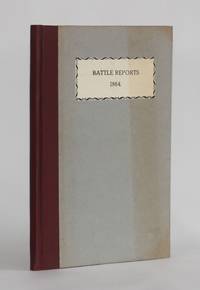
1864réf. 6016Richmond: R. M. Smith Public Printer 1864. Hard Cover. Very Good binding. Octavo. 98 pp. Confederate imprint. Bound in later cloth-backed boards with printed paper label on the front cover. Lacking wrappers if so issued. Cover and contents toned; title page is missing the bottom corner affecting only the margin. Uncommon. Dornbusch outlines the contents: "Enemy attack on Fort McAllister Feb. 1 1863; reports engagements at Fayette Court House Cotton Hill Gauley Charleston and pursuit of the enemy to the Ohio; General Bragg's reports of the battles of Richmond Munfordsville & Perryville; report of Rhode's brigade at Seven Pines; capture of the gunboat J.P. Smith at Stone river" Dornbusch III 1429. Howes O-31; Parrish & Willingham 2348. R. M. Smith, Public Printer unknown
1908réf. OVU8089Eckert Litho. Good with no dust jacket. 1908. Hardcover. 3/4 leather with black covers portfolio with black ribbons for tying three sides. Front cover is loose was hinged along side edge and has a red leather label with gilt lettering. Covers have some scuffing and leather spine has some wear and missing pieces at the ends. Title page has some markings from the flaps and some foxing. There are 127 total color plates originally had 144 numbered plates but 18 were removed for being obsolete and there is a Plate 93-A. Some plates have some small spots or slight foxing. Color images are in very good condition. Book is in good condition. 4.2 lb.; Oblong Small 4to 9" - 11" tall . Eckert Litho hardcover
1917réf. 69073Washignton DC: Government Printing Office 1917. War Department Document No. 562. Hardcover. Good. Signed by previous owner. Cover has some wear and soiling. 2 volume set. Includes: illustrations diagrams. Volume I iii 1 803 p. Volume II 594. Change 1 and Change 2 laid in. This two volume set represents the state of the art state of knowledge and state of practice at the time of the entry of the United States into the First World War. From Wikipedia: "The United States Army Quartermaster Corps is a Sustainment formerly combat service support CSS branch of the United States Army. It is also one of three U.S. Army logistics branches the others being the Transportation Corps and the Ordnance Corps. The Quartermaster Corps is the U.S. Army's oldest logistics branch established 16 June 1775. On that date the Second Continental Congress passed a resolution providing for "one Quartermaster General of the grand army and a deputy under him for the separate army". From 1775 to 1912 this organization was known as the Quartermaster Department. In 1912 Congress consolidated the former Subsistence Pay and Quartermaster Departments to create the Quartermaster Corps. Quartermaster units and soldiers have served in every U.S. military operation from the Revolutionary War to current operations in Iraq Operation Iraqi Freedom and Afghanistan Operation Enduring Freedom." Government Printing Office hardcover
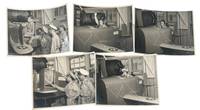
1942réf. 235381942. World War II U.S. Army Air Forces Link Trainer training photo archive of five large format silver gelatin prints circa 1942 to 1945 documenting simulator instruction during the wartime expansion of American military flight training using the first effective training device. The men wear Army Air Forces uniforms aviation badges officer caps and the winged star shoulder sleeve insignia commonly called the Hap Arnold emblem an insignia approved in 1942 for AAF personnel. The photographs place the pilot inside a ground based cockpit trainer while instructors and fellow cadets observe a visual record of how instrument procedure radio communication and cockpit discipline were taught before airborne practice. Invented by Edwin Albert Link in 1929 the Link Trainer was the world's first widely successful and effective mechanical flight simulator. Affectionately dubbed the "Blue Box" it revolutionized aviation by allowing pilots to safely train for blind instrument-only flying and poor weather conditions without leaving the ground. Photo archive of 5 silver gelatin photographs 8 x 10 inches United States circa 1942 to 1945. The photographs show Army Air Forces cadets and officers in a training room with a large cockpit simulator built with stub wings a tail round U.S. star insignia hinged canopy panels external bracing and a cockpit just large enough for one seated trainee. Several images show a trainee wearing headphones and working inside the enclosed trainer; another shows a man raising the canopy while holding a hand microphone; another shows three uniformed men observing a cadet seated at the controls. One image shows a pilot being congratulated or greeted at the simulator door by three officers with a placard on the fuselage reading "International flight." Visible uniform details include the AAF shoulder patch on a cadet's sleeve pilot or aircrew wings over shirt pockets aviation branch collar devices and officer cap insignia linking the group to the Army Air Forces rather than the postwar U.S. Air Force. The Link Trainer became one of the defining instruments of World War II flight instruction because it moved dangerous lessons in blind flying night navigation instrument reading and radio procedure into a controlled classroom setting. The U.S. Army Air Corps had adopted the device before the war and wartime mobilization turned simulator instruction into a standard component of pilot preparation as the Army Air Forces trained pilots at unprecedented scale for bomber fighter transport and liaison service. These photographs are strongest where they show the training process itself: the student isolated inside the cockpit the instructor watching from outside the headset and microphone linking simulated flight to communication procedure and the fuselage marked for an "International flight" exercise. Light curling and occasional creasing; some handling marks in the margins. Overall good condition. A focused visual record of World War II Army Air Forces simulator training and the classroom machinery that converted cadets into wartime pilots. unknown
1942réf. 235381942. World War II U.S. Army Air Forces Link Trainer training photo archive of five large format silver gelatin prints circa 1942 to 1945 documenting simulator instruction during the wartime expansion of American military flight training using the first effective training device. The men wear Army Air Forces uniforms aviation badges officer caps and the winged star shoulder sleeve insignia commonly called the Hap Arnold emblem an insignia approved in 1942 for AAF personnel. The photographs place the pilot inside a ground based cockpit trainer while instructors and fellow cadets observe a visual record of how instrument procedure radio communication and cockpit discipline were taught before airborne practice. Invented by Edwin Albert Link in 1929 the Link Trainer was the world's first widely successful and effective mechanical flight simulator. Affectionately dubbed the "Blue Box" it revolutionized aviation by allowing pilots to safely train for blind instrument-only flying and poor weather conditions without leaving the ground. Photo archive of 5 silver gelatin photographs 8 x 10 inches United States circa 1942 to 1945. The photographs show Army Air Forces cadets and officers in a training room with a large cockpit simulator built with stub wings a tail round U.S. star insignia hinged canopy panels external bracing and a cockpit just large enough for one seated trainee. Several images show a trainee wearing headphones and working inside the enclosed trainer; another shows a man raising the canopy while holding a hand microphone; another shows three uniformed men observing a cadet seated at the controls. One image shows a pilot being congratulated or greeted at the simulator door by three officers with a placard on the fuselage reading "International flight." Visible uniform details include the AAF shoulder patch on a cadet's sleeve pilot or aircrew wings over shirt pockets aviation branch collar devices and officer cap insignia linking the group to the Army Air Forces rather than the postwar U.S. Air Force. The Link Trainer became one of the defining instruments of World War II flight instruction because it moved dangerous lessons in blind flying night navigation instrument reading and radio procedure into a controlled classroom setting. The U.S. Army Air Corps had adopted the device before the war and wartime mobilization turned simulator instruction into a standard component of pilot preparation as the Army Air Forces trained pilots at unprecedented scale for bomber fighter transport and liaison service. These photographs are strongest where they show the training process itself: the student isolated inside the cockpit the instructor watching from outside the headset and microphone linking simulated flight to communication procedure and the fuselage marked for an "International flight" exercise. Light curling and occasional creasing; some handling marks in the margins. Overall good condition. A focused visual record of World War II Army Air Forces simulator training and the classroom machinery that converted cadets into wartime pilots. unknown books
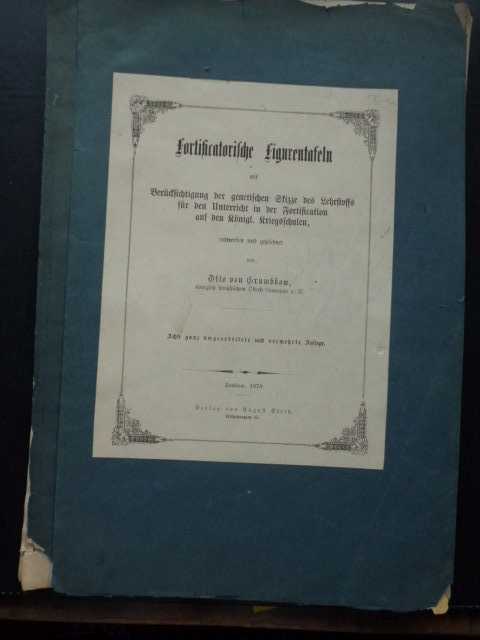
1878réf. 308466ABPotsdam, Stein, 1878. 3 S., XXVI doppelseitige Tafeln Original-Broschur. 8., ganz umgearb. und verm. Auflage. (Einband angerändert, Tafeln sehr gut).
réf. 103920aafum 1915, quer in-4to, 20 feste Albumbl., mit 205 eingeklebten sowie 2 losen s/w Originalfotografien und 1 farbigen gemalten Postkarte, guter Zustand, Originalfotoalbum d. Z. mit farbig gemustertem Leineneinband und Schnurbindung in passender Farbgebung (bei W. Leser, Papeterie-Lederwaren Davos-Platz, Preis 10.-), guter Zustand.
19618vo., First Edition, with a frontispiece, 12 plates and 5 maps in the text; handsomely bound in burgundy full morocco, back gilt with five raised bands, second and fourth compartments lettered and ruled in gilt, all other compartments tooled and ruled in gilt, uncut, a most attractive copy ideal as a gift or for presentation. Classic study of the notorious gulf between High Command and the Front Line on the Western Front in 1915, particularly the disastrous generalship of Second Ypres, Neuve Chapelle and Loos. Compiled with free access to the private files of Liddell Hart, it takes its title from the well-known quotation: Ludendorff: 'The English fight like lions.' Hoffman: 'But don't we know that they are lions led by donkeys'. A LOVELY CPY OF A VERY SCARCE WORK. Enser, p.23.
First Edition, oblong 8vo, [iv],12,[2],143,[1]pp., with errata leaf, some light spotting of text, there is a neatly cancelled Royal United Service Institution purchase label, later buckram-backed boards, uncut. A very rare handbook of the official rules and regulations for infantry drill and tactics. "The authors trust they may afford essential service to young officers of all descriptions, and particularly to the great body of Volunteer Officers whose peculiar situations do not permit them to have recourse to a School of Practice before they are called to functions which are extremely perplexing without the assistance of some succinct work like this".?Preface. Not on Copac; OCLC locating the State Library of Pennsylvania copy only.
1692réf. 029745Michel Brunet, Paris 1692. Halbleinen Sehr gut
réf. feb118764Used. For more details please contact me unknown
1823réf. 8-0-504Leipzig, Industrie-Comptoir, 1823-128. Kl.8°, mit 23 (von 24) lithografierten Frontispizen und ca. 1900 S. in gesamt 24 Heften (alles erschinene), dekorative, Pp d. Z. mit schöner Rückenvergoldung
1771réf. DEZ-3261Paris, Vincent, 1771. 3 volumes petits in-8, plein veau époque, dos à nerfs de fleurons, de filets et de roulettes dorés, titres dorés, toutes tranches rouges, XXXII, 670 pp; titre, 702 pp; titre, 472 pp et 352 pp, 1 f non chiffré (tome III en 2 parties). Ouvrage illustré d'un plan dépliant de la bataille de Fontenoy. Cet exemplaire contient 2 ex-libris manuscrit. Le premier figurant sur chaque page de titre: Comte de Boubers avec ses armes. Le second: Marie Darras Camon. Coupes usées, coins frottés, coiffes frottées et avec manques pour certaines, quelques frottements et épidermures, inversement de feuillets au tome II.
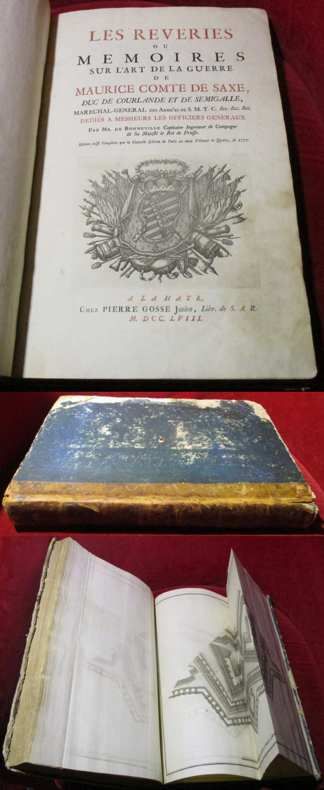
1758réf. 027265Pierre Gosse, à La Haye (den Haag) 1758. Halbleder Ordentlich
2003réf. 263365Moskau, Oruzhie i Tekhnologii, 2003.
réf. 14336Without place or date. Circa 1844. 30pp. 4to. On seven bifoliums and one single leaf the bioliums stitched to one another. With several watermarks of J. Whatman Turkey Mill all dated to 1844. In good condition on lightly aged and worn paper. Sibbald is not named but the item is from his papers and in his hand. Sibbald was in Ceylon between 1818 and 1833. There is no indication that this item has been published. The story begins: 'There was a certain King who reigned over a Realm called Kulutasem who had long mourned having no heir to his throne - but after many years had elapsed to his great joy his Queen bore him a Son an infant of great beauty and promise and the happy Father in the fullness of his joy assembled all his Counsellors the Priests of the Temple and Soothsayers at the Palace - that fortunate Omens might be observed and that Prosperity and Happiness might be predicted for the royal Child - but vain were the sanguine hopes and wishes of the Monarch'. It concludes: '. but what was his dismay to find on the following day Santirakasem seated on the Throne and that the King had left all the Kingdom to him. With sad misgivings he proceeded to the Temple where he beheld the mutilated Body of his Son - struck with remorse and agony he dahsed his head against the Stones of the Temple and perished in the presence of the assembled People - They hailed King Santirahasem with loud acclamations who reigned long & prosperously over that Realm'. From the Papers of William Sibbald perhaps the translator. Without place or date. [Circa 1844?] unknown