BARREIRO, Miguel Comisario General del Exercito del Norte of the Mexican Army (fl19th century) l 1ABAA
29.026 Ergebnisse
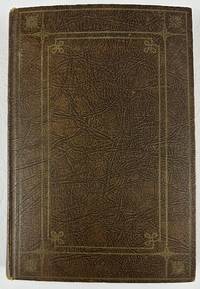
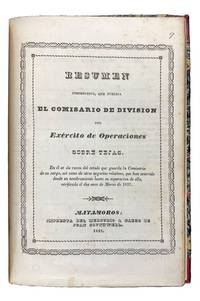
1837Best.-Nr. 41693Matamoros Mexico: Imprenta del Mercurio a Cargo de Juan Southwell 1837. 4to. 7 3/4 x 5 1/2 inches. 3 4-36 4. 40 pp. Engraved title-page with decorative border Resumen Instructivo Estado Table 1 by Manuel Mendiola Estado 2 by Luis Jose de la Peza and Vicente Daza. Both estados are accounting tables giving the "ingreso" income and the "egreso" expenditure of the operation. The title carries the date of 3.11.1837 while the text sections are dated 3.14.1837. With woodcut printer's device of an eagle and fleurons. Text in Spanish. Bound to style in 19th-century quarter red straight-grained morocco over 19th-century marble paper boards Provenance: Hubert Hudson Texas State Senator for Brownsville 1957-1963 A rare report detailing the failed Mexican mission to rein in the Republic of Texas following the Texan Revolution. "In the fall of 1836 the Mexican government attempted with complete lack of success another expedition into Texas." Streeter "Face-saving explanation for Mexico's failure against the despised Texans in 1836-7." Howes This official pamphlet details the failed Mexican expedition into the Republic of Texas over the period of October 21 1836 to March 14 1837. Barreiro an army commissioner in charge of the operation concludes that the "ridiculo" Texan rebels were far less dangerous than the hostile desert terrain. "No es el numero del exercito de Tejas el temible. Bien despreciable y ridiculo es ese peloton de aventureros que piensan que es como andar en cacerias de fieras haberselas con veteranos valientes y aguerridos: es el clima son los desiertos horrorosos son los rios invadeables son los pantanos." It is not the number of the Texas army that is fearsome. Very despicable and ridiculous is that platoon of adventurers who think that it is like going on wild beast hunts dealing with brave and seasoned veterans: it is the climate it is the horrible deserts it is the uncrossable rivers the swamps. Texas had declared its independence on March 2 1836 a culmination of the Texan Revolution which had begun on October 2 1835. The United States did not diplomatically recognize the Republic of Texas until March of 1837 near the publication date of this pamphlet. Texas would remain an independent nation for a decade until it was annexed by the USA on December 29 1845. Howes B 170. Palau 24651. Streeter sale I 357. Streeter Texas 918. Imprenta del Mercurio a Cargo de Juan Southwell unknown books
1943Best.-Nr. 277008Kamnik district Slovenia: Tehnika RK VI 1943. 30pp. 8vo mimeographed text with images original tan wrappers with mimeographed cover. This rare surviving pamphlet from World War II was produced by the Yugoslav Partisans the most accomplished armed resistance movement against the Axis occupation of Europe. Starting out as a guerilla group the Partisans soon created a complete underground society based on Communist principles including schools government and medical institutions financial systems and publishing presses. This pamphlet produced by one such press likely hidden in the mountains or forests of Slovenia addresses an emergent need in such a new clandestine society: that for maps. It proceeds in logical order: geographical vocabulary instructions for making field maps and later more sophisticated and symbolic drafting techniques. Within this technical know-how it also communicates tactical military advice that the Partisan guerillas employed in their battles with Axis armies. This tactical quality of the publication is most in evidence in the pamphlets many striking diagrams which demonstrate the importance of visual knowledge in situations of survival. This pamphlet was one of many Partisan publications designed to educate protect and encourage members of the movement. It is particularly fascinating for its simple means of production since the secrecy of Partisan operations limited them to mechanical methods such as mimeographs--in witness here--as well as heliotypes linocuts and typewriting. Given its fragility the pamphlet is in excellent condition with clean text. Slight stains and some very small tears in margins. As one of the few Partisan publications on cartography this pamphlet is a rare and fascinating record of the World War II resistance. Tehnika RK VI unknown books
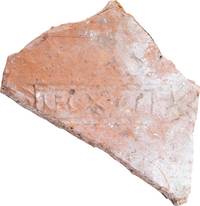
Best.-Nr. 1106Carnuntum c62AD-200AD. Fragment of a reddish clay brick with the stamp of Legio X Gemina Pia Fidelis “"LEG X C PF" the 10th Roman legion of 5280 men split into 10 cohorts. Mortar layer on the back otherwise a very good and well preserved stamp. Ex collection Piscator 1959. Cf. on this piece Brandl op. cit. no. 187-190. 6 1/2" x 4" x 1 1/4" Legio X Gemina was formed from the disbanded Legio X the first Roman legion levied personally by Julius Caesar in 58 BCE. It distinguished itself as one of the four legions used by Caesar in his invasion of Gaul fought for Octavian and Antony against Brutus and Cassius in the Battle of Philippi in 42 BCE and followed Antony in his campaigns against Parthia and Armenia 36-34 BCE. The legion surrendered to Octavian after the Battle of Actium in 31 BCE losing its prestigious name Equestris as punishment and receiving veterans from other legions which earned it the cognomen "Gemina" twin. After service in the Cantabrian Wars and brief deployments to various frontier posts the legion was sent to Carnuntum a fortress on the Danube between current day Vienna and Bratislava in about 61 CE where it remained vigilant against Germanic threats. Following participation in Trajan's Second Dacian War the legion moved twice more first to Aquincum Budapest in 103 CE then finally to Vindobona Vienna in 114 CE where they remained stationed defending the Danube frontier until the 5th century though vexillationes were periodically sent for campaigns in Judaea Mauritania and Parthia. Red clay bricks like these were a common building material in Roman architecture from about the time of Augustus and making bricks was among the chores for Roman soldiers during their down time. unknown books
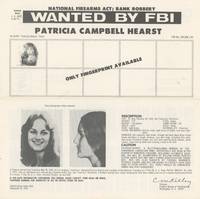
1974Best.-Nr. List3214Washington D.C.: Federal Bureau of Investigation 1974. Mailer measuring 8 x 15 ¾ inches folded in fours. Yellow tape to seal; else Fine. An FBI mailer soliciting information about Emily Harris and Patricia Hearst of the Symbionese Liberation Army SLA a left-wing militant group based in California and responsible for several killings and bank robberies between 1973 and 1975. Hearst the granddaughter of publishing tycoon William Randolph Hearst had been kidnapped by the SLA in February of 1974; in April she turned up on surveillance video robbing a San Francisco bank with other members of the SLA. Harris was involved in Hearst’s kidnapping and was at the time this mailer was distributed on the run with her husband William Harris and Hearst and wanted for firearms violations. The mailer describes the three as “armed and very dangerous.” The trio was arrested in San Francisco in 1975. The Harrises served eight years in prison but were re-arrested in 2002 for the murder of Myrna Opsahl during a 1975 bank robbery. Hearst served two years of a seven-year sentence; her sentence was commuted by Jimmy Carter and in 2001 she was pardoned by Bill Clinton. Federal Bureau of Investigation unknown books
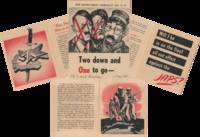
1945Best.-Nr. List2747Paris France; and Washington D.C. 1945. Six 8 x 10 inch and smaller typed pages; one 4 x 5 inch card with two tickets; one twenty-six page 4 x 5.5 inch pamphlet; one six page 6 x 8.5 inch pamphlet; six 2.5 x 3.5 photographs and two 3 x 4.5 inch photographs. Of the printed matter most is affixed to paper some small tears and folds; overall excellent; photographs near fine. Mary J. Bremer 1917–2019 was a Technician fourth grade from Grant Township Nebraska. Her correspondents here include June Miller 1920–deceased an aviation cadet from Michigan and John Melotte 1919–deceased an artilleryman from Philadelphia. Bremer and Miller were members of the Women’s Army Corps WAC. Established in May of 1942 as the Women’s Army Auxiliary Corps the WAC converted to active duty in July of 1943. The women of WAC known as Wacs served in noncombatant roles across the various theaters of World War II. Offered here is a small archive of Bremer’s documents and photographs relating to WAC: a few letters including a description of Paris the day after the Nazi surrender; two pamphlets including the War Department pamphlet Two down and One to go –; and a collection of photographs of Eisenhower’s victory parade and Roosevelt’s funeral procession. On April 12 1945 President Roosevelt died of a stroke in Warm Springs Georgia. His body was returned to Washington two days later and a military procession escorted it from the train station to the White House. Two photographs of the funeral procession are included in the archive. One showing a woman at the start of a section of the parade is identified verso as “WACs led by Capt. Machen”. The following month the Nazis surrendered. Bremer’s friend June Miller was stationed in Paris at the time. She wrote to Bremer the next day describing the celebration: “It began the night before when we stood on the roof and watched the flares go off all over the city--just like the 4th of July; the Sacred Couer was blazing with lights and it looked like a miniature fairy-land. Last night all the famous old buildings including the Arc d’Triumph was all lit up the fountains in the parks at Concord in front of the Trocadero--they were all going and the kids were wading and splashing around having the time of their life. It was really something to see--something the French had been waiting a long time for. “Fini le guerre” they kept saying--the end of the war!” Miller also claims to have witnessed a bomber flying a celebratory loop through the Eiffel Tower: “When we came out of the Trocadéro the fountains were on and what a sight that is. Looking down over the water that looks like a miniature waterfall to the Eiffel Tower at the bottom of a small hill. And if I hadn’t seen it with my own eyes I would never have believed that I saw a small bomber come through the bottom but that’s just what it did--and just did clear it too. The planes seemed to be going as wild as the people on the ground--they were so thick up there that pretty soon we thought surely something would happen.” In June Dwight Eisenhower returned from Europe and a homecoming parade was held for him in Washington D.C. Six photographs of this parade are included in the archive including a shot of his plane arriving at the airport and one where he is visible standing in the back of a Jeep. Miller notes in her letter from Paris that “you wondered what was coming next; where we would go from here ‘cause in a sense there is still a war very definitely going on”. In fact John Melotte who seems to be Miller’s partner writes to Bremer that he “May be slated for that place they call the CBI but don’t tell June please. She does not want me to even mention the place in my letters so I let well enough alone” July 15 1945. Hostilities would continue in the CBI—the China-Burma-India theater—until September of that year. The process by which soldiers were selected to be sent to the Asia-Pacific theater is laid out in the War Department pamphlet Two down and One to go –. The pamphlet reminds them that there are still “a couple of big jobs ahead” the primary one being to “crush” or “smash” the “Japs” and the second one being to occupy and police “conquered lands . until the peril of future aggression is gone.” It is a visually striking piece with illustrations in a bold black and red color palette; its cover is a reproduction of a caricature of Hitler Mussolini and Hirohito by Polish-Jewish artist Arthur Szyk. Also included in the archive are a card from a friend with tickets to an American League baseball game; a humorous poem congratulating Wacs Ruth O.B. and Lenore I. Nier on new work assignments; and a Christmas 1945 WAC pamphlet with a dinner menu and list of WAC officers. The pamphlet assures the Wacs with a note from Colonel Kenton Cooley “Before another Christmas you all will have returned to civilian life and each of you will take with you my appreciation and my sincere admiration for a great job well done.” Of interest to scholars of women’s history especially in the military; and of the events leading up to the end of the Second World War. unknown books
1890Best.-Nr. 1410180Chicago: The Craig Press 1890. Hardcover. Octavo 129 pages. In Fair minus condition. Spine is red with gold print. Boards in red cloth gold print mitred edges; tattering to spine caps and corners blemishes toning shelf wear cocked spine. Text block has cracked hinges front flyleaf loose intermittent spine breaks light age toning to paper. Illustrated: b&w frontispiece and plates photographs with tissue guards. NOTE: Shelved in Netdesk Column Z. 1410180. FP New Rockville Stock. The Craig Press hardcover books
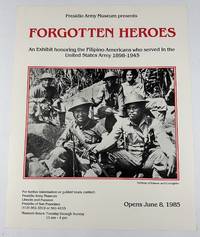
1985Best.-Nr. 5617San Francisco: Presidio Army Museum 1985. Three photographically-illustrated posters printed in red and black each 20 x 16 inches. Very minor edge wear and toning. Near fine. A visually appealing trio of posters celebrating the military service of Filipino Americans during World War II created for an exhibition at the Presidio Army Museum in San Francisco in the summer of 1985. The exhibition was titled "Forgotten Heroes: An Exhibit Honoring the Filipino Americans Who Served in the United States Army 1898-1945." Each poster pictures a different unit of Filipino U.S. Army soldiers with experience in the Second World War as follows: a group of infantry soldiers identified as part of the "Defense of Bataan and Corregidor;" eight members of Company E of the 57th U.S. Infantry Filipino Scouts; and the four soldiers comprising the Color Guard of the 1st Filipino U.S. Infantry Regiment in 1942. The first two posters cary the same title "Forgotten Heroes" while the latter poster is titled "'Bahala Na!' 'Come What May!' The Story of the 1st and 2nd Filipino Infantry Regiments in the United States Army" perhaps a smaller display within the larger exhibition. No copies in OCLC though we doubt the posters are unique perhaps residing in larger collections of Filipino American material. Presidio Army Museum unknown books
1946Best.-Nr. 12885Various locations 1946. 58 leaves illustrated with 114 photographs generally two per page tipped in on rectos. Octavo. Contemporary plain paper photograph album bound in brown textured cloth with decorative stamping on spine and front board. Minor wear. Internally quite clean. Very good plus. A tidy and informative collection of photographs memorializing the wartime stateside training of numerous women serving in Company 7 of the Women's Army Auxiliary Corps. The photographs are largely individual and group portraits of the women training at various locations throughout the country including Fort Oglethorpe in Georgia as well as Alpine Texas; Fort Devens in Massachusetts; Des Moines Iowa; and Mapleton Maine. The album is partially annotated with manuscript captions on many of the margins or on the verso many dated and identifying the women in the images or the location. The women identified in the captions include Corporal Kaiser Elaine Flaherty Lt. Tapajina Lt. Haggard Private Rosalyn Caley T-4 Ethel O'Brian Capt. Lawson Sgt. Boomer Florence McClure and Capt. Chapman providing a valuable record of the women serving in the WAAC at this time. One group shot of WAACs at Fort Devens is captioned on the verso with the last names of all ten women and a few other portraits are captioned the same way White Melin Phillips etc. A handful of the images picture the women in the midst of training including images of a retreat parade raising the American flag working in the barracks and climbing a rope ladder. The album was apparently compiled by a WAAC named Almena L. Belyea according to a laid-in note from a former owner of the album. Almena L. Belyea 1902-1963 served in the WAAC as a Technician Fifth Grade during the war. Afterwards she apparently never married and lived a quiet life in Maine where she is buried in Presque Isle. unknown books
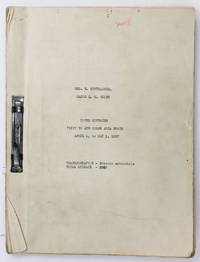
1937Best.-Nr. 4173N.p. 1937. Very good. 353pp. rectos only including fifty-nine vernacular sepia-toned photographs measuring 2.5 x 3.5 inches and a few maps and manuscript diagrams. Typed self wrappers brad-bound. Minor creasing and dust-soiling to wrappers. Clean internally. A profusely illustrated report with a few hand-drawn diagrams and numerous manuscript emendations focused on various U.S. Army installations in the American Southeast. The author Major George H. Schumacher of the U.S. Army's Quartermaster Corps visited several Army bases and other posts in Florida South Carolina North Carolina Alabama and Georgia in the Spring of 1937. His report includes inspection details notes on personnel recommended repairs and other information for each site he visited on his 3065-mile tour beginning with Fort Barrancas and Key West in Florida to Fort Moultrie in South Carolina to Fort Bragg and Raleigh Cemetery in North Carolina Fort McClellan in Alabama and ending with a couple of bases in Georgia. The text of the report is supplemented with almost sixty annotated photographs which are interspersed throughout. A sampling of the photographs includes the Bachelor Quarters in Key West the CCC Camp at Fort Taylor the St. Augustine Cemetery a WPA road under construction at Fort Moultrie various buildings at Fort Bragg and the Raleigh Cemetery a road and bridge at Fort McClellan and various features at Georgia forts Screven and Oglethorpe. A unique production and an informative assessment of 1930s Army installation in the American South and Southeast. unknown books
Best.-Nr. 60370The letter reads: Washington DC Apl 51864 I have examined the new gun and saber shield invented by Crpl Moffett and would recommend its adoption for such veteran Rang who have been known to make and receive a casualty claim with saber I would not recommend it for any cavalry of less than two years service and constantly in the field US Grant Lt Gen unknown books
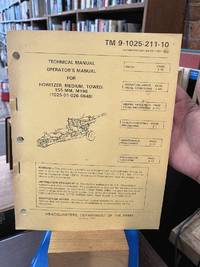
1991Best.-Nr. 225219Department of the Army 1991. Paperback. Good. Stapled Softcover. Clean has a good binding no marks or notations.TNOS Department of the Army paperback books
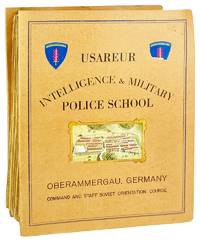
1954Best.-Nr. 31165Oberammergau Germany: Intelligence and Military Police School 1954. Very Good. Oberammergau Germany: Intelligence and Military Police School 1954. Quarto; stiff illustrated covers with hundreds of pages of reports bound in. Includes charts and graphs of Soviet governmental and military organization. Additional monographs laid in include Armed Forces Talk's four-part Communism Series and three issues of the U.S. Constabulary School's Department of Geopolitics series covering German History up to the rise of the Nazi Party the United Nations and International Relations. Staining to rear cover; pages toned but largely unmarked; a Very Good copy. Binder prepared by the United States Army for training Cold War-era officers and staff on USSR history ideology and military capabilities. The trove of documents here covers nearly everything an early Cold War American military or intelligence officer would need to know at the time: a history of Marxist ideology and its development in the 19th-century; details on the physical geography of the USSR; an ethnography of Central Asia detailing the Turkomen Kazakhs and Tatars; as well as extended analyses on who the power players in the Communist Party were and what the capabilities of their rifle and artillery division might be. Logistics psychological warfare and the role of Communism in the Middle East are also covered with detailed but succinct chapters on each. An impressive array of information highlighting the early Cold War Western perspective. No copies in retail and three holdings found in OCLC at the US Army War College Georgetown University and the University of Iowa. Intelligence and Military Police School unknown books
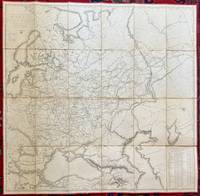
1818Best.-Nr. 327855Paris: Depot Topographique Militaire 1818. Case map. Engraving with outline hand coloring. Dissected and laid on linen with red silk selvedge total size 60 by 50 inches. Marbled paper slipcase with paper label and some wear. Map in very good condition with some stains library stamp below title otherwise in very good condition. St. Petersburg: Depot Topographique Militaire 1818. Official large scale map of Russia in French spurred by the invasion plans. The French invasion of Russia also known as the Russian campaign the Second Polish War and in Russia as the Patriotic War of 1812 was initiated by Napoleon with the aim of compelling the Russian Empire to comply with the continental blockade of the United Kingdom. The War Depot was the military cartography and archives office of the French army since Louis XIV. Its role was amplified under the Revolution and the Empire. Created by Marquis de Louvois in 1688 the War Depot was responsible for collecting and preserving historical archives military memoirs plans and maps having them engraved and published. This is a good example of their work. Depot Topographique Militaire unknown books
1959Best.-Nr. 292737Washington: Government Printing Office 1959. hardcover. very good. Illus. 558pp. 8vo gray cloth cloth lightly soiled corners lightly bumped. Washington: Government Printing Office 1959. ROTC Manual. Government Printing Office unknown books
1956Best.-Nr. 283285Washington: Government Printing Office 1956. hardcover. very good-. Illus. and maps. 510pp. 8vo gray cloth cloth lightly soiled corners lightly bumped. Washington: Government Printing Office 1956. ROTC Manual. Government Printing Office unknown books
Best.-Nr. 154455paperback. Thin 12mo 102pp. original green printed wrappers. Washington: Government Printing Office 1914. Very good. War Department Document No. 465. unknown books
Best.-Nr. 143691hardcover. xxiv 441pp. 8vo cloth d.w. London: Frederick Muller 1970. vg Facsimile of the London 1816 edition. Consists of the 1811 regulations with additional regulations added up to 1816. unknown books
1931Best.-Nr. 1021681931. hardcover. very good. Two volumes lacks third volume which contains the plates. 8vo cloth-backed boards; corners bumped. Paris: Librairie de Medecine Folklore et Anthropologie 1898. Reprint of the second enlarged edition. Very good. Limited edition of 500 copies. unknown books
1908Best.-Nr. 288258Washington Barracks D. C.: The Battalion Press Press of the Engineer School Government Printing Office 1908. Hard Cover. Very Good binding. Six pamphlets from the late 19th early 20th century primarily on military engineering bound together in one volume. Brown buckram with a black leather label. Spots of discoloration to the spine. Very Good binding. The Battalion Press | Press of the Engineer School | Government Printing Office unknown books
1904Best.-Nr. 269456Washington Barracks D.C.: Press of the Engineer School 1904. Second Edition. Very Good binding. Includes Piarron de Mondesir’s “Notes on Intrenching Tools”; Colonel William Miller’s interesting “Water Supply of Washington D.C.” with black and white photographs; C. F. Porter’s “A Brief History of Works Erected for the Defense of Portland Maine” with large folding maps; Lieutenants Elliot Dent and George Spalding’s “Russian Provisional Fortifications” with many folding maps; and 9 other reports; Bound in buckram with new spine label; mylar custom cut to protect the binding. Very Good binding. Press of the Engineer School unknown books
1908Best.-Nr. 269457Washington Barracks D.C.: Press of the Engineer School 1908. Second Edition. Very Good binding. Includes E. N. Johnson’s “Report on the Construction of Lock and Dam No. 4 Ohio River” with folding charts and black and white photographs; First Lieutenant Julian Schley’s “Reconnaisance Map of Cuba”; and several articles on the Loire. Altogether 10 articles bound together. Bound in buckram with new spine label; mylar custom cut to protect the binding. Very Good binding. Press of the Engineer School unknown books
1918Best.-Nr. 20861Washington 1918. Issued by the War Department Commission. Illustrated. Small oblong wraps. VG. WWI era book with all the traditional lyrics and music. unknown books
1944Best.-Nr. 521693New York: Harper & Brothers 1944. Hardcover. Fine/Near Fine. First American edition. Foreword by General Sir Bernard Montgomery. Small light stain on top edge else a fine copy in near fine dust jacket with a touch of toning on the spine. 27 "poems by officers and soldiers of the British Eighth Army all written under fire in the midst of one of the greatest campaigns of this war- while Rommel was retreating across the Western Desert." from the dust jacket. Harper & Brothers hardcover books
1920Best.-Nr. 388632Fontainebleau France: Ecole Militaire de l'Artillerie 1920. Hardcover. Very Good. First edition. Quarto. 525pp. Half cloth and marbled paper-covered boards gilt-stamped spine label. Text in French. Pages are toned a few light color pencil markings hinges are cracked but still snug about very good. A detailed battle history of World War I for soldiers in training at the French Military Academy at Fontainebleau. Contemporary owner's inscription on front fly: "R. Heard Ecole Militaire de L'Artillerie Fountainebleau May 1921." Very scarce in the trade. (Ecole Militaire de l'Artillerie) hardcover books
1875Best.-Nr. 1359789Washington DC: Government Printing Office 1875. Hardcover. Quarto 2 v-lix 2 3-567 pages. In Good condition. Bound in contemporary three-quarter calf in brown cloth and gilt titling to spine. Boards show large scratches to covers and areas of discoloration to cloth covers. Text block has light age toning to pages. Text block edges marbled. Plates intact and present as indicated. Previous owner bookplate to inside front pastedown: "Mr. G. N. Whittington". Marbled end papers. MF Consignment. 1359789. Special Collections. Government Printing Office hardcover books