US Army U SBiblio.com
30.930 risultati
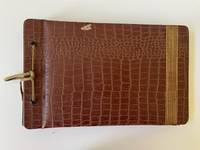
rif. 17320WWII-era photographs measuring 11.5" x 7.25" Multiple locations undated Ca. 1940s. With 67 photographs ranging in size from 3.5" x 2.5" to 5" x 4" of a serviceman and multiple generations of his family. Photo Album. U.S. Army Training Camp and Domestic Life in the American South circa 1940s. Oblong photograph album containing approximately estimate based on images shown original black-and-white vernacular photographs most snapshot size corner-mounted to black paper leaves. Circa 1940-1945. This photo album documents the intertwined military and domestic life of a white American serviceman during the World War II era combining images of U.S. Army training facilities with scenes of rural Southern family life. The military photographs depict a cantonment landscape of low wooden barracks dirt roads telephone poles and regimented formations of soldiers assembled outdoors. One sequence shows uniformed men standing in formation across an open parade ground while others capture military transport vehicles-open troop carriers filled with soldiers-moving through base streets lined with identical wood-frame buildings. Individual portraits show a soldier in full uniform posed formally in front of barracks and beside mid-1940s automobiles suggesting pride in service and upward mobility through military affiliation. A small chapel with a steeple appears prominently underscoring the role of religion in wartime military culture. Another building features an exterior metal slide descending from a second-story opening-likely part of a training or emergency drill structure-emphasizing the regimented preparedness of wartime camps. Interwoven with these military scenes are intimate images of domestic life: a woman and uniformed soldier standing together on the steps of a clapboard house; a couple tending a vegetable garden beside a brick home; a man seated in a wooden rocking chair reading a newspaper on a brick porch; and several rural outdoor scenes including hunting practice cooking over an open fire and resting beside a parked automobile in a wooded clearing. One photograph shows a small brick utility structure with a cupola and central doorway possibly a pump house or guard building with a suited man posed formally in its doorway-an image that contrasts sharply with the utilitarian wooden barracks of the training camp. A sequence labeled "Camp" partially visible in the images depicts a married couple posing with a wooden sign in a wooded recreational setting indicating leisure travel or stateside furlough during wartime. The album thus captures the dual identity of the mid-century American serviceman: disciplined soldier within the expanding military-industrial system and family member rooted in agrarian and small-town America. Historically the photographs reflect the rapid expansion of U.S. Army training installations in the early 1940s following mobilization after 1940 and especially after the United States' entry into World War II in December 1941. Temporary wooden cantonments-often constructed quickly and economically-became defining features of Southern and Southwestern landscapes. The imagery of standardized housing blocks troop transports and parade formations corresponds with this wartime infrastructure boom. Simultaneously the domestic photographs illustrate gender roles and social norms of the era: women appear primarily in domestic or garden settings while men are shown in uniform hunting or performing outdoor labor. The album therefore offers institutional collectors insight into the lived experience of wartime mobilization rural domestic culture and the social fabric of white middle- and working-class America during the WWII home-front era. As a cohesive vernacular record rather than an official military archive the album provides valuable visual evidence of how national service reshaped everyday landscapes and identities. Condition: Photographs are corner-mounted to black paper leaves; overall clean with minor silvering and light surface wear typical of mid-century snapshots. Album binding shows expected handling wear along edges but remains intact. Very good overall condition. unknown
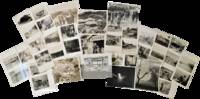
1945rif. 189141945. U.S. Army and Navy photographs of Okinawa 1945 document the immediate aftermath of the Battle of Okinawa and the establishment of American control over a strategically critical island at the close of the Pacific War. The images place American troops within the Okinawan interior and along coastal installations following the April 1945 landings including the secured Yontan airfield a primary objective of the invasion. The archive records the physical destruction resulting from one of the war's most intensive campaigns alongside scenes of civilian movement and return situating the photographs within the transition from active combat to military occupation. Archive of 37 black and white silver gelatin photographs. Okinawa Japan circa 1945. Photographs measure approximately 3.75 x 4.5 inches to 7 x 10.5 inches with brief handwritten captions on verso. Images depict American troops in villages farmland and near shrines as well as at Yontan airfield. Several photographs show destroyed aircraft including a crashed Japanese plane and associated debris along with damaged infrastructure and equipment. Naval activity is represented through images of American ships in harbor and offshore including a landing ship dock LSD transport vessel. An aerial photograph shows a harbor with multiple wrecked ships and flattened industrial areas. One image documents a column of civilians carrying belongings captioned "civilians returning to homes." The Battle of Okinawa fought from April to June 1945 resulted in extensive military and civilian casualties and widespread destruction of the island's infrastructure. The subsequent American occupation transformed Okinawa into a major U.S. military base in the western Pacific a status it retained even after reversion to Japanese administration in 1972. These photographs document both the operational objectives of the invasion and the conditions encountered in its aftermath including the displacement and return of local populations. The archive provides material for examining military strategy occupation practices and the impact of large-scale warfare on civilian landscapes in the Pacific theater. Light wear consistent with handling; overall very good condition. unknown
1976rif. MILI1114Poole, Dorset, Blandford Press (1976). 188 S., mit zahlr., meist farb. Taf. u. Abb. von Michael Chappell, im Text, OPp. m. farb. ill. OU., geringe Gebrauchsspuren.
2001rif. 28939Augsburg : Bechtermünz, 2001. 167 S. : Ill. Gr. 8°. Ill. OPpbd.
1997rif. 299642PN. New. 1997. . Soft Cover. Date is original print. This is a reprint edition . PN paperback
1986rif. 777386PN. New. 1986. Soft Cover. Date is original print. This is a reprint edition. . PN paperback
1980rif. 761483PN. New. 1980. Soft Cover. Date is original print. This is a reprint edition. . PN paperback
1976rif. 752741PN. New. 1976. Soft Cover. Date is original print. This is a reprint edition. . PN paperback
1943rif. 2111902154602815Haruna shobo 1943. Soft Cover. Fine. The book is in fine condition. Haruna shobo paperback
1943rif. 46514Washington DC: Army Service Forces 1943. First Edition. First Printing. good. 78 wraps illus. covers somewhat worn and soiled a few ink and pencil marks to text. The Second World War drove a series of management and organizational innovations including statistical process control. This is one of the as yet under-evaluated aspects of how the Second World War positioned the United States for the significant industrial and economic growth that followed victory. Army Service Forces paperback
rif. 57964816-6Hodder & Stoughton. Used - Good. Former library copy. Pages intact with minimal writing/highlighting. The binding may be loose and creased. Dust jackets/supplements are not included. Includes library markings. Stock photo provided. Product includes identifying sticker. Better World Books: Buy Books. Do Good. Hodder & Stoughton unknown
rif. 0340908963.Gpaperback. Good. Access codes and supplements are not guaranteed with used items. May be an ex-library book. paperback
2011rif. SBBIH-ECXVA6KQKTV4Hodder & Stoughton Ltd 2011. paperback. Very Good. Most of our very good books have only minor imperfections such as shelf wear consistent with a new book that's sat on a bookshop shelf for a year or two. Occasionally we may miss other minor imperfections as we have to grade books at speed. Our books are dispatched from a Yorkshire former cotton mill. We list via barcode/ISBN so please note that the images are stock images and may not be the exact copy you receive furthermore the details about edition and year might not be accurate as many publishers reuse the same ISBN for multiple editions and as we simply scan a barcode or enter an ISBN we do not check the validity of the edition data when listing. If you're looking for an exact edition please don't order at least not without checking with us first although we don't always have time to check. We aim to dispatch prompty the service used will depend on order value and book size. We can ship to most countries see our shipping policies. Payment is via Abe only. Hodder & Stoughton Ltd paperback
rif. 0340995416.Gpaperback. Good. Access codes and supplements are not guaranteed with used items. May be an ex-library book. paperback
rif. 4324880Hodder & Stoughton. Paperback. Used; Very Good. Simply Brit welcome to our online used book store where affordability meets great quality. Dive into a world of captivating reads without breaking the bank. We take pride in offering a wide selection of used books from classics to hidden gems ensuring theres something for every literary palate. All orders are shipped within 24 hours and our lightning fast-delivery within 48 hours coupled with our prompt customer service ensures a smooth journey from ordering to delivery. Discover the joy of reading with us your trusted source for affordable books that do not compromise on quality. 03/17/2011 Hodder & Stoughton paperback
rif. 40690Rotterdam, Universitaire pers., 1974 Softcover, 309pp, 22x15cm., goede staat.
rif. B9781013494291Hardback. New. hardcover
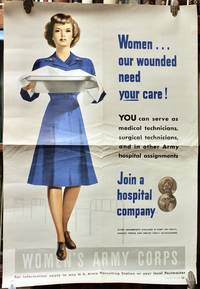
1945rif. 16951WashingtonD.C. United States Army Recruiting Publicity Bureau 1945 First edition. Full text as follows: "Women…our wounded need your care! You can serve as medical technicians surgical technicians and other Army hospital assignments. Join a hospital company. Other assignments available at Army Air Forces Ground Forces and Service Forces installations. Text printed in blue black and gray. Some creasing. A very good bright and clean copy of this uncommon item encouraging women to serve in Army hospital assignments. Broadside 17" x 25". . With full-color printed illustration of a woman medical technician in uniform carrying a tray of medical instruments. Also with two medals printed in bronze bearing the emblems of the U.S. Army Medical Corps. The Women's Army Corps evolved from the Women's Auxiliary Army Corps a civilian organization of women working with the United States Army when Congress granted military status to its members in 1943. Forty percent of WAC members were assigned to positions as weather observers radio and control tower operators and aerial photograph analysts. Many other women worked as cryptographers medical technicians and mechanics. As the war entered its last two years and as the WAC fought for further inclusion in the ranks of the Army more women were enlisted in roles previously reserved for men Yellin Our Mothers' War pp. 114-116. United States Army Recruiting Publicity Bureau books
1945rif. 16951WashingtonD.C. United States Army Recruiting Publicity Bureau 1945 First edition. Full text as follows: "Women…our wounded need your care! You can serve as medical technicians surgical technicians and other Army hospital assignments. Join a hospital company. Other assignments available at Army Air Forces Ground Forces and Service Forces installations. Text printed in blue black and gray. Some creasing. A very good bright and clean copy of this uncommon item encouraging women to serve in Army hospital assignments. Broadside 17" x 25". . With full-color printed illustration of a woman medical technician in uniform carrying a tray of medical instruments. Also with two medals printed in bronze bearing the emblems of the U.S. Army Medical Corps. The Women's Army Corps evolved from the Women's Auxiliary Army Corps a civilian organization of women working with the United States Army when Congress granted military status to its members in 1943. Forty percent of WAC members were assigned to positions as weather observers radio and control tower operators and aerial photograph analysts. Many other women worked as cryptographers medical technicians and mechanics. As the war entered its last two years and as the WAC fought for further inclusion in the ranks of the Army more women were enlisted in roles previously reserved for men Yellin Our Mothers' War pp. 114-116. United States Army Recruiting Publicity Bureau
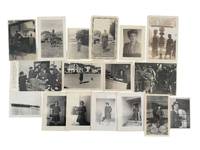
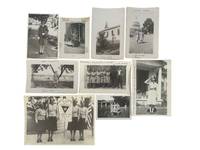
1944rif. 218341944. Women's History Military History Photography Unidentified photographer Women's Army Corps photographs mid 1940s document female military service during World War II and provide direct visual evidence of women's roles within the U.S. Army following the formal incorporation of the Women's Army Corps in 1943. The images record administrative work training routines and social life among enlisted servicewomen situating WAC personnel within the broader wartime expansion of women's participation in military infrastructure. The archive supports research into gendered labor in the armed forces wartime mobilization and the institutional integration of women into military systems. United States including Fort Lee Virginia and Westfield Massachusetts mid 1940s. Archive of 17 silver gelatin photographs ranging from approximately 3.5 x 2.5 inches to 5.5 x 3.5 inches with manuscript annotations on several versos identifying locations and contexts. The photographs depict WAC servicewomen in uniform engaged in administrative duties formation drills and off duty activities. One image shows a woman seated at a desk beneath a clock with a nameplate reading "M.V. Ramsey WAC" with visible chevrons indicating rank while others show groups gathered around mess tables standing in inspection formation or marching in coordinated drills. Outdoor scenes include annotated locations such as "Flattop - Ft. Lee Va." and "Taken in Westfield a suburb of Springfield" as well as a roadside photograph showing two servicewomen beneath directional signage indicating distances to nearby Massachusetts cities. Several portraits focus on individual women posed in multiple settings near military installations suggesting personal documentation of service life. The archive situates WAC service within the broader reorganization of the U.S. military during World War II when women assumed clerical logistical and support roles essential to sustaining wartime operations. Training centers such as Fort Lee and regional encampments in Massachusetts functioned as key sites for integrating women into military systems while maintaining structured discipline and hierarchy. These photographs document both institutional expectations and informal camaraderie among servicewomen illustrating how gender roles were renegotiated within military contexts during the war. Light curling and minor surface creasing to some photographs; most remain well preserved with strong tonal clarity. Overall very good condition. A cohesive photographic record of women's military service and daily life within the Women's Army Corps during World War II. unknown books
1944rif. 218341944. Women's History Military History Photography Unidentified photographer Women's Army Corps photographs mid 1940s document female military service during World War II and provide direct visual evidence of women's roles within the U.S. Army following the formal incorporation of the Women's Army Corps in 1943. The images record administrative work training routines and social life among enlisted servicewomen situating WAC personnel within the broader wartime expansion of women's participation in military infrastructure. The archive supports research into gendered labor in the armed forces wartime mobilization and the institutional integration of women into military systems. United States including Fort Lee Virginia and Westfield Massachusetts mid 1940s. Archive of 17 silver gelatin photographs ranging from approximately 3.5 x 2.5 inches to 5.5 x 3.5 inches with manuscript annotations on several versos identifying locations and contexts. The photographs depict WAC servicewomen in uniform engaged in administrative duties formation drills and off duty activities. One image shows a woman seated at a desk beneath a clock with a nameplate reading "M.V. Ramsey WAC" with visible chevrons indicating rank while others show groups gathered around mess tables standing in inspection formation or marching in coordinated drills. Outdoor scenes include annotated locations such as "Flattop - Ft. Lee Va." and "Taken in Westfield a suburb of Springfield" as well as a roadside photograph showing two servicewomen beneath directional signage indicating distances to nearby Massachusetts cities. Several portraits focus on individual women posed in multiple settings near military installations suggesting personal documentation of service life. The archive situates WAC service within the broader reorganization of the U.S. military during World War II when women assumed clerical logistical and support roles essential to sustaining wartime operations. Training centers such as Fort Lee and regional encampments in Massachusetts functioned as key sites for integrating women into military systems while maintaining structured discipline and hierarchy. These photographs document both institutional expectations and informal camaraderie among servicewomen illustrating how gender roles were renegotiated within military contexts during the war. Light curling and minor surface creasing to some photographs; most remain well preserved with strong tonal clarity. Overall very good condition. A cohesive photographic record of women's military service and daily life within the Women's Army Corps during World War II. unknown
1945rif. 225281945. Women History World War II WWII Women's Army Corps photo archive documenting women's military service during World War II and the expansion of women's logistical and technical roles within the United States Army. The photographs record daily activity surrounding Women's Army Corps personnel including ambulance operation vehicle maintenance military training environments and informal moments of rest and recreation. Established in 1943 Women's Army Corps enabled women to enter the Army in noncombat roles that were essential to wartime mobilization including clerical work communications mechanics and medical transport. The images document this institutional transformation through scenes of uniformed women working with military vehicles operating ambulances and participating in the broader infrastructure of wartime military camps. One photograph shows a WAC standing in full service uniform before a low administrative building while others depict women outdoors in wooded settings during moments of leisure illustrating both the disciplined and personal dimensions of wartime service. Archive of 20 gelatin photographs created during the 1940s depicting Women's Army Corps personnel military vehicles and associated Army training activities. Photographs measure approximately 3.5 x 5 inches. The photographs show WAC members in both uniform and off duty settings including outdoor portraits and camp scenes. Several images focus on military ambulances and transport vehicles bearing visible Army markings such as "U.S. ARMY 432621" and "AMB-34." Verso inscriptions provide firsthand commentary on military duties and equipment including one caption reading "This is my new AMBULANCE hope you like it sis. safe & OK" and another written beside an ambulance photograph noting "good old Baker 5 kept me from walking." Operational scenes include soldiers crouched behind sandbags with a handwritten note identifying personnel as "Eselinger Conrad Palmer Carvey Boss." Other photographs document the broader military environment surrounding WAC activity including a drill or parade ground and a large motor pool with rows of Army trucks one marked "U.S. Army 008909" positioned in front of a multi story barracks. Additional annotated images identify fellow servicemen and technical details of equipment including "Hines Gallop and myself. Gallop is a jeep driver from North Carolina" and another describing "my radio on right fender" while one photograph is labeled simply "motor pool." Women's Army Corps personnel served throughout the United States and overseas during World War II performing essential logistical and administrative work that supported Allied military operations. Ambulance drivers such as the woman referenced in the captions transported wounded soldiers during training exercises and operational deployments and were often responsible for maintaining their own vehicles in field conditions. WAC members later served across European theaters including England France and Italy after the Allied landings in 1944 contributing to the wartime medical evacuation system that moved casualties from combat zones to field hospitals and rear medical facilities. Light edge wear mild surface handling and faint silvering to some prints; overall very good condition. These photographs document both the operational infrastructure of wartime motor transport and the presence of women within that system illustrating how the mobilization of female personnel expanded the technical and logistical capacities of the U.S. Army during the global conflict. unknown books
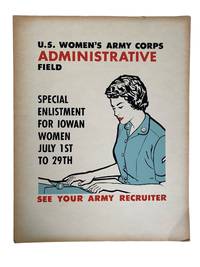
1944rif. 207311944. Archive of two items related to the Women's Army Corps W.A.C. 1 The WAC Officer: A Guide to Successful Leadership. Washington: United States Government Printing Office 1944. A February 1945 pamphlet distributed by the War Department. 2 U.S. Women's Army Corps poster. Poster reads: US Women's Army Corps Administrative Field Special Enlistment For Iowan Women July 1st to 29th See Your Army Recruiter. 11" x 14.75". Depicts a young woman in military dress typing on a typewriter to represent the openings in the Administrative division of the Women's Army Corps. The WAC was a great source of pride for many women during WWII as it allowed them to patriotically contribute to their country's war efforts. The WAC during WWII were trained to handle auxiliary functions for the military as switchboard operators mechanics drivers stenographers armorers to maintain and repair smalls arms & heavy weapons which they unfortunately weren't allowed to use and many other war-time support operations. Uncommon. In very good condition overall. unknown books
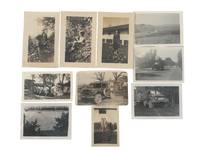
1943rif. 220591943. Women's Army Corps service photographs dated 1943 to 1944 document the participation of enlisted women in U.S. Army support operations during World War II with particular attention to transportation training environments and stateside military life. The images identify individual service members including Hilda Goble described in captions as an "ambulance driver during War II" and Abbie E. Bachelder situating named women within the broader expansion of female labor following the establishment of the Women's Army Corps in 1942. These photographs support research into women's military service wartime labor structures and the integration of women into logistical and medical support roles essential to the functioning of the U.S. Army during the war. Archive consists of 9 original silver gelatin photographs most approximately 3 x 5 inches several with scalloped or deckled edges and period ink captions identifying subjects and dates. Two portraits show Hilda Goble in full uniform standing before a porch and saluting each inscribed "Hilda Goble Ambulance driver during War II" documenting her role in transporting injured personnel within military systems. A group photograph captioned "Ambulance Driver Team War II Hilda Goble" depicts seven uniformed women indicating coordinated service within ambulance units. Additional images include a portrait labeled "Abbie E Bachelder / June - 1944" showing a uniformed WAC posed before a landscape of barracks buildings and another dated 1943 identifying Bachelder outside a wooden structure. A photograph captioned "Oct 29 - 1944 / Reims" shows two women identified as Roberta and Abbie posed on the grounds of the U.S. Capitol indicating travel or official assignment within government contexts. Other photographs depict WAC personnel standing near a military chapel and within training or hospital environments while one image titled "Marine Corps Wives of America - Hdqtrs Chap 1" shows four women beneath an organizational banner documenting affiliated civic or support networks connected to military service. These images documents the Women's Army Corps expantion to meet wartime labor demands assigning women to clerical transportation medical and logistical roles across domestic and overseas installations. The presence of ambulance drivers within the archive demonstrates the direct involvement of women in medical transport and support infrastructure while scenes at the U.S. Capitol and organized groups indicate both official recognition and the development of social and institutional networks among servicewomen. Light edge wear and minor creasing with one photograph showing tape residue; images otherwise clear with captions legible; overall very good condition. This archive provides a concentrated visual record of named WAC personnel and their roles within the operational and social framework of the U.S. Army during World War II. unknown books
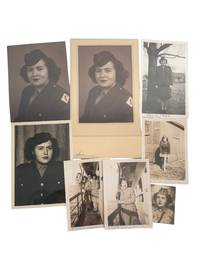
1944rif. 240421944. Women's Army Corps photo archive documenting service and personal relationships during World War II and its immediate aftermath partially identified and captioned. Established in 1943 following its auxiliary predecessor the WAC gave women military status within the Army. These portraits and snapshots document the service life relationships friendships and recreational activities accompanying women's expanding military participation. Photo archive of 28 black and white photographs including studio portraits and vernacular snapshots with one WAC recruitment brochure circa 1944-1946. Des Moines Iowa; Philadelphia Pennsylvania; Chicago Illinois; San Diego California; and Italy. Several women recur throughout some identified en verso. 9 photos trace to a woman named Sylvia; she appears in uniformed portraits and aboard a boat during an outing captioned "Boat Trip to Provincetown June 1946" Massachusetts. Another photograph places her at Fort Devens Massachusetts in March 1946; a portrait mount bears a photographic-service sticker from Camp Edward Massachusetts. Particularly noteworthy is the stamp on the reverse of her portrait reading "Compliments / Boston / Jewish Welfare Board / Army & Navy Club" documenting a connection with Jewish military welfare services without establishing her religious identity. One photo shows a woman standing before the U.S. Grant Hotel in San Diego. One photo shows a woman smiling in uniform with the en verso written caption "July - 44 / me - by the lake Chicago - beforer going on duty." Another photo shows a group of WACs in a military vehicle being driven by a man in uniform signs in the distance read in Italian. Other named women include "Lorraine Montecarlo" and "Barbara Bobby Evans. Another set of photos showcase a WAC in a domestic setting with a sailor. The accompanying recruitment brochure declares "The Army needs more WACs at once!" and that "Every eligible woman is needed!" The WAC's establishment in July 1943 granted its members military status and Army pay and benefits replacing the more limited protections of auxiliary service. Their work helped sustain Army operations at home and overseas while opening military occupations to women on an unprecedented scale. Handwritten identifications and dated captions connect the portraits with particular places and social occasions. Some toning and edge wear with mounting remnants on some versos and pronounced corner wear to one print. Prints and captions remain legible and clear. Overall in very good condition. This archive preserves the intimate and active duty lives of just some of the 150000 women that served in the Women's Army Corps and its auxiliary predecessor during World War II. unknown books