30 566 résultats
1990réf. 79710Department of the Army 1990. Presumed First Edition First printing thus. Wraps. Good. Three-hole punched and stapled at left side. Sticker residue on front cover. Various paginations approximately 60 pages. Figures. Tables. References. Glossary. Index. This publication supersedes FM 9-84 28 December 1984. It also rescinds DA Form 3549-R 1 October 1970. When issued distribution was only authorized to U.S. Government agencies. This field manual prescribed doctrine and provides techniques procedures and guidance for commanders staffs and soldiers. It applies to all echelons that include nuclear weapons units and their security in support of the AirLandBattle. This field manual also provides training doctrine specifically for nuclear ordnance units and their supporting units during the dispersing modes transition to war and dispersed mode wartime. It explains the nuclear weapons support structure and the associated military police and ordnance units and describes how US host-nation and user-nation support unites are structures and how they divide and deploy with their host-nation units to form NASPs. This field manual also provides general guidance for many of the emergency operations associated with nuclear weapons. As noted in the field manual ordnance soldiers must maintain transport store issue and provide security for nuclear weapons. Military police and other personnel performing security must aggressively screen nuclear weapon storage sites and movements of nuclear weapons. They must also detect delay or divert threat using an overall in-depth security operation that is based on the factors of METT-T. Ordnance MP and host-nation or user-nation soldiers must work together to assure that custodial and nuclear delivery units receive proper types and quantities of nuclear weapons in a reliable condition. They also must be able to defeat forces targeted against US and NATO nuclear capabilities. This manual addresses Nuclear Weapons Units the Threat the Dispersing Mode the Dispersed Mode Ground Convoy Procedures and Emerging Operations. There is also an Appendix on the Military Working Dog and an Appendix on the Ammunition Ordnance Battalion Command Post Diagrams. Department of the Army paperback
réf. 1782664394.Gpaperback. Good. Access codes and supplements are not guaranteed with used items. May be an ex-library book. paperback
1980réf. 82-330GPO 1980. 1980. Reprint of 1970. 450p. Folding maps not included in this edition. Oversize. Wraps. Fine copy. Paperback. Fine. Book. GPO, 1980. Paperback
réf. 6127747186Papeback. New. pp. 296 unknown
1977réf. 79711Washington DC: United States Department of the Army 1977. Presumed First Edition First printing. Wraps. Good. 39 5 pages. Illustrations. Cover has some wear and soiling and corner crease at back cover. This manual prescribes doctrine and minimum standards for units with a nuclear mission operating under combat conditions in a combined conventional-nuclear environment. It provides procedures and guidance for those functions which are peculiar to nuclear missions and capabilities. This manual pertains as appropriate to all echelons from engineer Atomic Demolition Munitions ADM teams field artillery howitzer sections and special ammunition supply and storage personnel through higher headquarters and larger units have a nuclear weapons mission. For the purposes of this manual a unit with a nuclear missions can perform or be responsible for at least one of the following functions: Security Maintenance Storage transportation Assembly Firing/Delivery and Demolition. This manual covers Personnel Reliability Program Command and Control Field Operations Technical Operations Logistics Nuclear Accident and Incident Control and Training and Readiness. Appendix A is References. Appendix b is Standardization Agreement STANAG No. 2104. Within this manual are discussion of topics such as the nuclear environment nuclear weapon effects such as Electromagnetic Pulse-EMP Human Reliability Nuclear Duty positions Permissive Action Links Nuclear Weapon Safety Rules Survivability the Two-Man Rule Operations Security Military Training Physical Security Field Storage Remote Firing and Emergency Destruction. United States Department of the Army paperback
2008réf. 1348750PN. New. 2008. Soft Cover. This is a reprint edition. . PN paperback
1964réf. 83699Washington DC: Department of the Army Headquarters 1964. Presumed First Edition First printing. Three hole punched with metal fasteners. Fair. Format is approximately 9 inches by 11 inches. 6 pages plus many tabs with one or more pages per tabbed section. Rare surviving original copy. Ink notation on front cover. Pages 1/2 is ahead of page 'i' The contents include: Introduction including Instructions for the use of the nuclear play calculator Strike Assessment Procedures including sections for cannons free rockets missiles air delivered weapons atomic demolition munitions and new weapons; Damage Determination ReferencesSample Problem Strike Assessment and Nuclear Play Calculator Aids in envelope. The Aids are present. This manual includes tabbed sections on Cannons Rockets Missiles Air-delivered weapons Atomic Demolition Munitions and then by yield from 0.5 KT through 5 MT. The Tab for I KT is mislabeled 1 MT. This manual provides guidance on procedures and techniques for nuclear play during tactical exercises. This manual provides the necessary aids for the Aggressor to determine the damage to United States and Allied forces from nuclear strikes. The weapons systems in this manual are based on material contained in the Handbook on Aggressor Military Forces FM 30-102. Aids envelop includes 8 plastic sheets of horizontal dispersion templates for cannons free rockets and Guided missiles and air delivered weapons and Damage circle templates for 1:50000 and 1:25000. The nuclear play calculator is a device for applying performance probabilities to nuclear delivery systems. The horizontal dispersion template is an aid used to determine the actual ground zero of a nuclear weapon. The damage circle template is an aid used in conjunction with the damage letters to evaluate the damage to personnel and equipment. The target element table describes target categories and the damage to be expected within each letter damage circle. The Damage circle radii tables are a series of tables showing the damage radii based on the height of burst and the weapon yield. This manual reflects the state-of-the-art the state of knowledge the state of training and the state-of-tactical nuclear weapons employment during the height of the cold war after the Cuban Missile Crisis and before the focus of the Army shifted to ground combat in Vietnam. Department of the Army, Headquarters unknown
1964réf. 83035Washington DC: Department of the Army Headquarters 1964. Presumed First Edition First printing. Disbound three hole punched held together with a binder clip. Some of the punch holes are torn. Fair. Format is approximately 9 inches by 11 inches. Approximately 50 pages plus many tabs. Rare surviving original copy. Table of Contents includes: Introduction including Instructions for the use of the nuclear play calculator Strike Assessment Procedures including sections for cannons free rockets missiles air delivered weapons atomic demolition munitions and partisan atomic demolition munitions and new Aggressor weapons; Damage Determination References and Nuclear Play Calculator Aids in envelope. The Aids are present. This manual includes 11 tables in Chapter 2 and 15 tables in Chapter 3. This manual provides guidance on procedures and techniques for evaluation the nuclear play of aggressor forces during tactical exercises. This manual provides the necessary aids for the Aggressor to determine the damage to United States and Allied forces from nuclear strikes. The weapons systems in this manual are based on material contained in the Handbook on Aggressor Military Forces FM 30-102. Chapter 2 contains the tables for Aggressor strike assessments from nuclear weapons. Chapter 3 contains the damage radii tables from the nuclear weapons employed by the aggressor forces. Large Strategic Weapons 20MT-100MT were not included. Source date were extracted from FM 101-31-1. Aids envelop includes 8 plastic sheets of horizontal dispersion templates scaled 1:50000 and 1:25000 for cannons free rockets and Guided missiles and air delivered weapons and Damage circle templates for 1:50000 and 1:25000. Plastic sheets show wear and loss of text. The nuclear play calculator is a device for applying performance probabilities to nuclear delivery systems. The horizontal dispersion template is an aid used to determine the actual ground zero of a nuclear weapon. The damage circle template is an aid used in conjunction with the damage letters to evaluate the damage to personnel and equipment. The target element table describes target categories and the damage to be expected within each letter damage circle. The Damage circle radii tables are a series of tables showing the damage radii based on the height of burst and the weapon yield. Pagination is i; Chapter 1 1-1 to 1-3; Chapter 2 2-1 through 2-13 with tabs for Cannons Free Rockets Guided Missiles Air-Delivered Weapons and Atomic Demolition Munitions; Chapter 2 3-1 through 3-29 with tabs for 0.1 kt 0.5kt 1 kt 2 kt 5 kt10 kt 20 kt 50kt 100 kt 500 kt 1 mt 2 mt 5 mt Appendix is A-1 through A-2. Last page unpaginated is a distribution list. The envelop with the aids is affixed inside the back cover. Among the Aggressor weapons address were the 203-mm gun/howitzer 240-mm mortar 310-mm gun 400-mm mortar Nerono and Kolosso free rockets Tondro Fulmo Supro Sago and Aglo missiles Pafago Detruizo and Forviso air delivered weapons and atomic demolition munitions. This manual reflects the state-of-the-art the state of knowledge the state of training and the state-of-tactical nuclear weapons employment during the height of the cold war after the Cuban Missile Crisis and before the focus of the Army shifted to ground combat in Vietnam. Department of the Army, Headquarters unknown
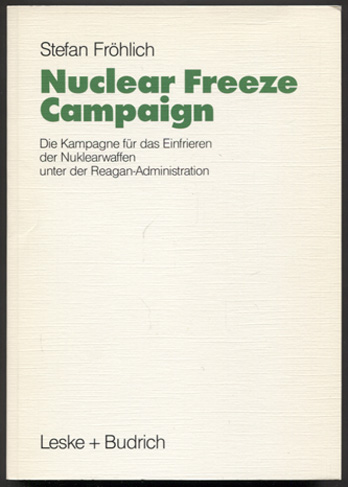
1990réf. 43836Opladen, Leske + Budrich, 1990. 264 Seiten, 21 x 15 cm, Broschur.
1978réf. 757818PN. New. 1978. Soft Cover. Date is original print. This is a reprint edition. . PN paperback
1994réf. 84973Washington DC: Department of the Army Headquarters and US Marine Corps 1994. Presumed First Edition First Printing thus. Wraps. Good/No Dust Jacket issued. Three hole-punched and staplebound. Format is approximately 8.5 inches by 11 inches. Distribution was authorized to US government agencies only to protect technical or operational information as well as unclassified controlled nuclear information UCNI material from automatic dissemination under the International Exchange Program or by other means. This determination was made 29 November 1991. It is understood that due to the passage of time and increase in publicly available information this restriction no longer applies. This publication supercedes the nuclear/radiological portions of FM 3-3 dated 30 September 1986. Various paginations approximately 300 pages. Figures. Tables/Tabular Data Appendices. References. Glossary. Reproducible Forms. This we understand was the Army's last and most comprehensive word on how troops would confront the effects of nuclear weapons on the battlefield. IT was also jointly issued with the Marine Corps since their troops could also be expected to be on the ground in a 'post-detonation' operational environment. Much of the emphasis is on establishing and communicating the spatial extent of fallout from adversarial nuclear weapons explosions and understanding its impact on battlefield operations. This really is the definitive work on the subject at the end of the Twentieth Century. Included also is AREA PREDICTOR RADIOLOGICAL FALLOUT ABC-M5A2 a 24"X39" flexible translucent overlay sheet with stenciled templates for first-order fallout area delineation on US Army maps; its use is fully described in the FM 3-3-1 manual. The mission of the Chemical Corps is to prepare the Army to survive and win in a nuclear environment by developing doctrine organizations training products and equipment for nuclear defense and nuclear retaliation. Minimizing the impact of nuclear weapons through contamination avoidance protection and decontamination. Employing smoke and flame are part of the operational options. This manual FM 3-3-1 defines and clarified the entire process of nuclear contamination avoidance. It details the NBC Warning and Reporting System NBCWRS how to locate and identify nuclear contamination and how to operate in and around nuclear contamination. This manual is designed and intended to be an easy-to-read step-by-step manual depicting the manual method of calculating nuclear contamination avoidance procedures for chemical officers and NCOs at brigade level and high organizations. The manual addresses vulnerability analysis nuclear operations Fallout prediction Radiation Monitoring Reconnaissance Nuclear Defense Neutron-Induced Radiation Civilian Radiation Hazards Operational Exposure Guidance Shielding Nuclear Burst Effects Nuclear Effects on Electronics Wind Vector Planning Nomograms and Nuclear Operations Checklists. Department of the Army, Headquarters and US Marine Corps paperback
1998réf. 1305592PN. New. 1998. Soft Cover. Date is original print. This is a reprint edition . PN paperback
1980réf. 69059Washington DC: United States Department of the Army Headquarters 1980. Presumed first edition/first printing does not 'supercede". Ringbound. Good. Three-hole punched in a binder. Includes: illustrations diagrams maps. Various paginations approximately 100 pages. Fold-outs. References This manual describes how Nuclear Biological and Chemical NBC units operated on the modern battlefield. NBC units perform two basic tasks. First they conduct reconnaissance operations to locate contaminated areas and to find duitable decontamination sites. Second they conduct decontamination operations. United States Department of the Army Headquarters unknown
2001réf. 1334409PN. New. 2001. Soft Cover. Date is original print. This is a reprint edition . PN paperback
2000réf. 1326575PN. New. 2000. Soft Cover. Date is original print. This is a reprint edition . PN paperback
1996réf. 290565PN. New. 1996. Soft Cover. Date is original print. This is a reprint edition . PN paperback
1976réf. 67424Washington DC: Army 1976. Presumed first edition thus/first printing. Wraps. Good. Staple bound. Last page has some discoloration and is creased at corner. Pencil erasure residue on first page. various paginations approximately 100 pages. Tables. This regulation which was effective 1 January 1977 supersedes AR 11-17 17 May 1972 AR 50-21 6 November 1974 and AR 190-3 9 September 1968. This regulation describes the Chemical Surety PRogram and incorporates all applicable guyidance and directions for the safe secure and reliable life-cycle management of chemica agends and their associated weapon systems. It provides specific policies and procedures for physical seucrity safety and accident and incident control; transportation aof and technical escorts for chemical surety materiel; and for counterintelligence activities. It established the Chemical Personnel Suitability and reliability Program. Army paperback
1987réf. 77065Fort Leavenworth KS: US Army Combined Arms Combat Developments Activity Nuclear and Chemical Directorate 1987. Coordinating Draft. Wraps. Good. Various paginations approximately 140 pages. Illustrations. Appendix A-F including acronyms. References. Glossary. Two lines of highlighting on distribution list. The Official Use Only distribution restriction is understood to have expired on 1 July 1990. This field manual was intended to provide a consolidated summary of procedural guidance training methods technical information and responsibilities of the initial response force IRF in preparing for a wartime or peacetime nuclear weapon accident or incident. It concentrated on IRF procedures and techniques for limiting radiation hazards to the public and response force personnel. FM 3-15 was intended to supplement DNA 5100.e Nuclear Weapon Accident Response Procedures NARP manual for peacetime NAIRA and expand on FM 100-50 for wartime NAIRA. FM 3-15 will also cover procedures for survey and monitoring decontamination casualty treatment fire suppression public affairs and security as it relates to the IRF and as outlined in AR 50-5. This field manual is a coordinating draft for the revision of Field Manual 3-15 Nuclear Accident Contamination Control Nov 1975 and is published in accordance with TRADOC Regulation 11-7 and TRADOC Pamphlet 310-6. FM 3-15 is intended for use by CONUS and OCONUS commanders staff and soldiers at corps level or below and by Army Depot personnel who respond to a nuclear accident or incident. It provides doctrine and training guidance for Nuclear Accident and Incident Response and Assistance NAIRA which will be applicable in wartime and peacetime. This FM will outline NAIRA processes necessary for the Initial Response Force IRF to prepare for and provide immediate safety security rescue and control at the accident scene to save lives and reduce exposure hazards. The IRF will be composed of available assets as determined by the commander of the army installation nearest to the accident site. US Army Combined Arms Combat Developments Activity, Nuclear and Chemical Directorate paperback
1998réf. 1305177PN. New. 1998. Soft Cover. Date is original print. This is a reprint edition . PN paperback
1907réf. RO10033464Petit journal.. 3 février 1907. In-12. Broché. Bon état, Couv. convenable, Dos satisfaisant, Intérieur frais. 15 pages environ illustrées de nombreuses gravures et photographies noir et blanc. Premier plat de couverture illustré d'une photo noir et blanc.. . . . Classification Dewey : 944.171-Histoire coloniale
1966réf. 729668PN. New. 1966. Soft Cover. Date is original print. This is a reprint edition. . PN paperback
1967réf. 732209PN. New. 1967. Soft Cover. Date is original print. This is a reprint edition. . PN paperback
réf. *W128413.- Madrid. 1886. Diego Pacheco Latorre. 4º menor. 2 tomos. 880 pgs 701 pgs. Holandesa piel nervios hierros. Pequeñas faltas extremo lomera tomo I y en puntas. Buen estado. . . Derecho / Derecho Militar hardcover
1965rel. postérieure pl. toile vert d’eau, tit. doré sur pc. rouge, très bon état