1930rif. 000769CAIRO EGYPT JERUSALEM ISRAEL. Very Good. 1930. On offer is a large oblong photo album circa 1935 to 1945 with over 180 mounted pictures and photographs providing a visual diary of one soldier's tour through Egypt and the Holy Land. Unique photos beautifully presented in a well kept cloth cover 10 x 13 inch album. ; Folio - over 12" - 15" tall; HANDWRITTEN MANUSCRIPT DOCUMENT LETTER AUTOGRAPH DIARY JOURNAL LOG KEEPSAKE WRITER HAND WRITTEN DOCUMENTS SIGNED LETTERS MANUSCRIPTS HISTORICAL HOLOGRAPH WRITERS DIARIES JOURNALS LOGS AUTOGRAPHS PERSONAL MEMOIR MEMORIAL PERSONAL HISTORY TRAVEL PHOTOGRAPHY INDIA ILLUSTRATED antiquité contrat vélin document manuscrit papier Antike Brief Pergament Dokument Manuskript Papier oggetto d'antiquariato atto velina documento manoscritto carta antigüedad hecho vitela documento manuscrito Papel PALESTINE ISRAEL BRITISH MANDATE BETHLEHEM EGYPT HOLY LAND JUDEA SAMARIA WEST BANK CAIRO JERUSALEM PHOTO ALBUM PHOTOGRAPHIC ALBUM . hardcover
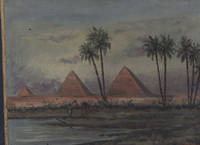
1940rif. 45303Egypt & The Sudan: Photographs Taken By Donald Stone 1940-1944. 1940-1944. WORLD WAR II. First edition. 12" x 16" cloth string-tied album with an original color oil painting on the front cover of the Pyramids. Photographs by British soldier Donald Stone who was part of the RAF's 203 Group 1940-1944 headquartered in Khartoum. The album has 276 neatly mounted photographs with captions on both sides of 17 leaves each with a tissue guard. Additionally there are 23 loose photographs including 19 photographs of British planes in an envelop. These military photographs of aircraft were strictly forbidden during the War years. Also there are 2 pieces of printed ephemera including a menu for the 203 Group Xmas dinner in 1942 signed by the entire membership. An interesting album of people and places visited by this British airman throughout Egypt and the Sudan. Most of the photos are 2‑1/2" x 3-1/2" but many are larger. Laid-in is a three-page history of RAF Squadron 203. Very good with photographs in fine condition. Photographs Taken By Donald Stone, 1940-1944. hardcover
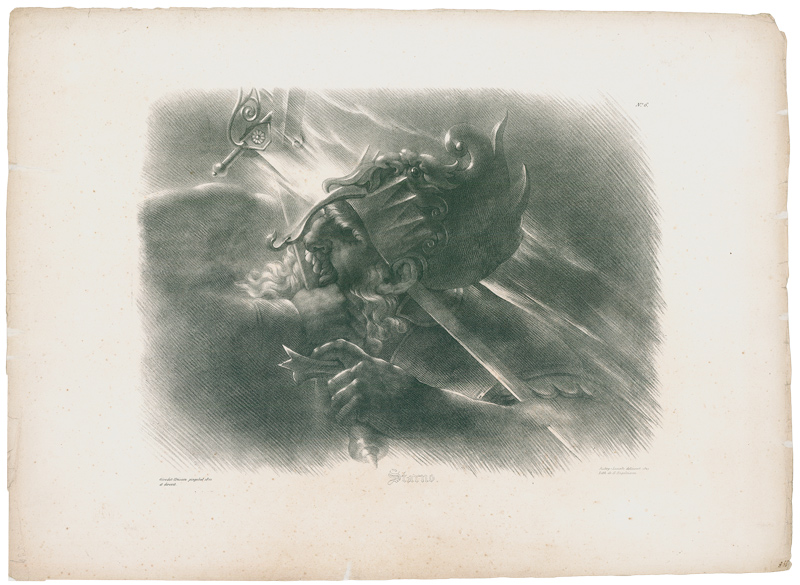
1821rif. 004-L1821. Kreidelithographie, 1821, nach Anne-Louis Girodet-Trioson, 1801. 42,5:59,3 cm. Lith. de G. Engelmann. - Im ganzen nicht ganz frisch. Provenienz: Trockenstempel, nicht bei Lugt. Literatur: Meyers Künstlerlexikon 128, 6; Thieme-Becker II, S. 233; McAllister Johnson 72, 6. ? Blatt 6 der Folge ?Têtes tirées du tableau représentant les ombres des héros francais recues dans les palais aériens d?Ossian??. ? 1801 hatte Napoleon Anne Louis Girodet-Trioson (1767-1824) den Auftrag gegeben, für Schloß Malmaison die Apotheose der gefallenen Helden Frankreichs, deren Schatten im Elysium Ossians empfangen wurden, zu malen. Noch zu Lebzeiten Girodet-Triosons lithographierte dessen Schüler Aubry-Lecomte unter seiner Aufsicht eine Folge von Köpfen aus diesem Gemälde.
1941rif. 196921941. African American Army Transportation Corps photo archive depicting Black enlisted men and noncommissioned officers in wartime transport service occupation duty and domestic training between 1941 and 1952. The strongest identified material centers on the 3528th Transportation Corps Truck Company active from 1943 to 1946 and its successor the 551st Transportation Corps Truck Company active from 1946 to 1947. A captioned portrait places Joseph Galloway "somewhere in Belgium" on December 6 1944 ten days before Germany opened the Ardennes offensive that became the Battle of the Bulge. President Harry S. Truman issued Executive Order 9981 on July 26 1948 requiring "equality of treatment and opportunity" in the armed services but Army integration unfolded gradually through the occupation years and into the 1950s. Photo archive of 100 silver gelatin photographs ranging from 1.75 x 2.25 inches to 3.75 x 5.5 inches United States Belgium Japan and West Germany circa 1941-1952. More than half show Black soldiers in uniform including studio and outdoor portraits weapons training field scenes recruits and senior noncommissioned officers. Galloway poses with a pistol in Belgium; transport trucks appear in operation and maintenance; unit facilities domestic training camps interregimental competitions a 155 mm howitzer and soldiers beside a Sherman tank marked "Barbra" extend the record beyond portraiture. Occupation-era scenes include bombed urban landscapes in Japan locations identified as Osumi and Kyoto Black troops with Japanese civilians Buddhist monks at a temple and later service in West Germany including Bonn and Karlsruhe. Approximately one quarter bear manuscript captions identifying individuals dates or locations. In WWI many Black troops were denied combat roles and assigned to stevedore work labor battalions butchery companies road work hauling unloading ships and other manual support duties. The National Archives specifically notes that many Black units were kept from front-line fighting and "relegated to support duties." These Black soldiers served heavily in transportation engineering construction and supply roles during World War II making Army logistics one of the central places where African American military labor sustained Allied movement while the armed forces remained segregated. Several scenes place Black and White soldiers working alongside one another preserving the transitional military culture between wartime segregation and the uneven implementation of Truman's desegregation order. Light edge wear occasional creasing and minor surface abrasions to several prints; manuscript captions legible where present; no significant losses observed. Overall in very good condition. The archive gives named faces unit evidence vehicles weapons occupation landscapes and manuscript identifications across the decade when Black military service moved from segregated wartime labor toward formal integration. unknown
1941rif. 196921941. African American Army Transportation Corps photo archive depicting Black enlisted men and noncommissioned officers in wartime transport service occupation duty and domestic training between 1941 and 1952. The strongest identified material centers on the 3528th Transportation Corps Truck Company active from 1943 to 1946 and its successor the 551st Transportation Corps Truck Company active from 1946 to 1947. A captioned portrait places Joseph Galloway "somewhere in Belgium" on December 6 1944 ten days before Germany opened the Ardennes offensive that became the Battle of the Bulge. President Harry S. Truman issued Executive Order 9981 on July 26 1948 requiring "equality of treatment and opportunity" in the armed services but Army integration unfolded gradually through the occupation years and into the 1950s. Photo archive of 100 silver gelatin photographs ranging from 1.75 x 2.25 inches to 3.75 x 5.5 inches United States Belgium Japan and West Germany circa 1941-1952. More than half show Black soldiers in uniform including studio and outdoor portraits weapons training field scenes recruits and senior noncommissioned officers. Galloway poses with a pistol in Belgium; transport trucks appear in operation and maintenance; unit facilities domestic training camps interregimental competitions a 155 mm howitzer and soldiers beside a Sherman tank marked "Barbra" extend the record beyond portraiture. Occupation-era scenes include bombed urban landscapes in Japan locations identified as Osumi and Kyoto Black troops with Japanese civilians Buddhist monks at a temple and later service in West Germany including Bonn and Karlsruhe. Approximately one quarter bear manuscript captions identifying individuals dates or locations. In WWI many Black troops were denied combat roles and assigned to stevedore work labor battalions butchery companies road work hauling unloading ships and other manual support duties. The National Archives specifically notes that many Black units were kept from front-line fighting and "relegated to support duties." These Black soldiers served heavily in transportation engineering construction and supply roles during World War II making Army logistics one of the central places where African American military labor sustained Allied movement while the armed forces remained segregated. Several scenes place Black and White soldiers working alongside one another preserving the transitional military culture between wartime segregation and the uneven implementation of Truman's desegregation order. Light edge wear occasional creasing and minor surface abrasions to several prints; manuscript captions legible where present; no significant losses observed. Overall in very good condition. The archive gives named faces unit evidence vehicles weapons occupation landscapes and manuscript identifications across the decade when Black military service moved from segregated wartime labor toward formal integration. unknown books
rif. 41587Oblong double-folio 13 x 17 inches seal affixed; docketed on verso. Several small breaks at corner folds corner torn away just touching the docketing. A very good copy. In this document Jonathan Tucker was appointed second lieutenant of a company in the 5th Regiment of Militia in Worcester County. In the following month Lincoln was named Major General of all the Massachusetts state militia; he was given command of the southern department in 1778 and after his capture and exchange was with Washington at Yorktown where he was chosen to receive Cornwallis's sword. Other members of the council who signed this document include Perez Morton James Otis Benjamin Greenleaf Caleb Cushing John Winthrop Joseph Gerrish John Whetcomb Elias Taylor Michael Farley Joseph Palmer Moses Gill Samuel Holton B. White Charles Chauncey and John Taylor. unknown
rif. 41587Oblong double-folio 13 x 17 inches seal affixed; docketed on verso. Several small breaks at corner folds corner torn away just touching the docketing. A very good copy. In this document Jonathan Tucker was appointed second lieutenant of a company in the 5th Regiment of Militia in Worcester County. In the following month Lincoln was named Major General of all the Massachusetts state militia; he was given command of the southern department in 1778 and after his capture and exchange was with Washington at Yorktown where he was chosen to receive Cornwallis's sword. Other members of the council who signed this document include Perez Morton James Otis Benjamin Greenleaf Caleb Cushing John Winthrop Joseph Gerrish John Whetcomb Elias Taylor Michael Farley Joseph Palmer Moses Gill Samuel Holton B. White Charles Chauncey and John Taylor. unknown books
1821rif. 003-L1821. Kreidelithographie, 1821, nach Anne-Louis Girodet-Trioson, 1801. 42,5:59,3 cm. Lith. de G. Engelmann. - Im ganzen nicht ganz frisch. Provenienz: Trockenstempel, nicht bei Lugt. Literatur: Meyers Künstlerlexikon 128, 5; Thieme-Becker II, S. 233; McAllister Johnson 72, 5. ? Blatt 5 der Folge ?Têtes tirées du tableau représentant les ombres des héros francais recues dans les palais aériens d?Ossian??. ? 1801 hatte Napoleon Anne Louis Girodet-Trioson (1767-1824) den Auftrag gegeben, für Schloß Malmaison die Apotheose der gefallenen Helden Frankreichs, deren Schatten im Elysium Ossians empfangen wurden, zu malen. Noch zu Lebzeiten Girodet-Triosons lithographierte dessen Schüler Aubry-Lecomte unter seiner Aufsicht eine Folge von Köpfen aus diesem Gemälde.
1962rif. 0001450KOREA. Very Good. 1962. Manuscript. On offer is a super manuscript relic of Canada's Korean War participation being a handwritten day book diary pages of a soldier with the famed French Canadian regiment the 'Van Doos'. The 2-ring 6 x 4 inch pages record terse fact filled sometimes intimate personal notations of this soldier's duties and life in the Korean Theatre. Some pages are missing but from April 2nd 1952 through November 3rd 1952 he notes 216 days in Korea at this point this serviceman provides an intimate picture of a support soldier laying cables building rafts laying out minefields and many times under attack. June July August and September are the most filled months and in roughly 137 pages one reads the day to day mundane and of course the definitely not mundane entries - how he was driving a jeep with a Sergeant and a military officer and the jeep was under mortar fire and it rolled over down an embankment. Other entries include: May 17th 1952 29 years old; check Vandoos reg. 2000 mine A/P minefield. Got shelled in the valley. 18 - 75 mm came in on us in ½ hour. No casualties; received letters from patootie. Wrote letter to patootie; started booby trap MF mine field; Sgt. Jackson went to battle school in Japan; attended class pontoon raft demonstration at Widgeon bridge; June 25th 7th Wedding Anniversary; mention of Operations Buster and Buckingham Noahs Ark; went over to Sgt's mess a HQ. Tied one on; constructed & operated close 50/60 raft all day; buffet lunch @ Vandoos HQs; took 5 L/Cpls up to Black Watch; almost got clobbered by a heavy mortar which landed 25' behind jeep and much more. One online source provides: BACKGROUND NOTES: The Royal 22e Régiment is an infantry regiment and the most famous francophone organization of the Canadian Forces. The regiment comprises three Regular Force battalions two Primary Reserve battalions and a band making it the largest regiment in the Canadian Army. The ceremonial home of the regiment is La Citadelle in Quebec City where the regimental museum is housed. The regiment is nicknamed the Van Doos an anglicized mispronunciation of vingt-deux "twenty-two" in French. The regiment's regimental headquarters is located in Quebec City with all three of its regular battalions stationed at various bases in the province of Quebec. The regiment serves as the "local" infantry regiment for Quebec. During the Korean War 1951-1953 the regiment expanded to three battalions each serving in turn as part of the Canadian brigade in the 1st Commonwealth Division. Thus the "Van Doos" represented one-third of Canada's infantry contingent throughout the war. Overall in very good condition save for one page chewed as noted by 'Kibbles'.; 12mo - over 6¾" - 7¾" tall; KEYWORDS: CANADIANA FRENCH CANADIAN REGIMENTS VAN DOOS VANDOOS 22ND REGIMENT KOREAN WAR SEOUL PYONG YANG OPERATION NOAHS ARK OPERATION BUCKINGHAM MINE FIELDS BLACK WATCH CANADA Personal Memoir Handwritten hand written autograph autographs signed letters document documents manuscript manuscripts writers writer author holograph personal ANTIQUITÉ CONTRAT VÉLIN MANUSCRIT PAPIER ANTIKE BRIEF PERGAMENT DOKUMENT . unknown
rif. 030103No Binding. Good. two letters two pages folio paper tanned some staining old folds some nicks and chips at edges with some minor loss separations at fold joints else in good legible condition. Inscribed on laid paper water-marked "OCR" a mark not found in Gravell. This pair of letters from General Philip Schuyler to Major Yates contains orders for the troops including preparations and various actions to be undertaken in the field issued in late June the week before the Siege of Fort Ticonderoga the first week of July 1777. The 1777 Siege of Fort Ticonderoga occurred between July second and sixth 1777 near the southern end of Lake Champlain in the state of New York. Lieutenant General John Burgoyne's 8000-man army occupied high ground above the fort and nearly surrounded the defenses. These movements forced the occupying Continental Army an under-strength force of 3000 under the command of General Arthur St. Clair to withdraw from Ticonderoga and the surrounding defenses. Some gunfire was exchanged and there were some casualties but there was no formal siege and no pitched battle. Burgoyne's army occupied Fort Ticonderoga and Mount Independence the extensive fortifications on the Vermont side of the lake without opposition on 6 July. Advance units pursued the retreating Americans. The uncontested surrender of Ticonderoga caused an uproar in the American public and in its military circles as Ticonderoga was widely believed to be virtually impregnable and a vital point of defense. General St. Clair and his superior General Philip Schuyler were vilified by Congress. Both were eventually exonerated in courts martial but their careers were adversely affected. Schuyler had already lost his command to Horatio Gates by the time of the court martial and St. Clair held no more field commands for the remainder of the war. Saratoga June 26 1777 "Sir As a body of the Enemy are encamped at Gilliland's creek on Lake Champlain from whence they will probably send parties to harass us I entreat you to keep a good Look out to send scouts continually Distance to the West and North West of your Garrison to make discoveries and lest an attempt should be made to burn our vessels on Lake George I have ordered Commodore Wynkoop to get the guns in the vessel already launched that he may be in a condition of Defence. Please to send the Letter to General St. Clair by the first Boat together with the Horses which the Bearer will deliver you to be forwarded to General Fermois. I am sir Your most obedient Humble servant Ph. Schuyler" Albany June 29 1777 "Sir The Necessity of forwarding any more Batteaus or provisions to Tyconderoga for the present being superseded you will please to desist from sending any until further orders from General St. Clair or me. Cause all the spades shovels axes & pick-axes to be helved and make as many cartridges as you possibly can - Continue to keep out scouts to the westward as to intersect the Road from Jesups towards Crown Point. I am Sir Your very humble Servant Ph Schuyler" Philip John Schuyler was born into the prominent family of New Yo unknown
rif. 030103No Binding. Good. two letters two pages folio paper tanned some staining old folds some nicks and chips at edges with some minor loss separations at fold joints else in good legible condition. Inscribed on laid paper water-marked "OCR" a mark not found in Gravell. This pair of letters from General Philip Schuyler to Major Yates contains orders for the troops including preparations and various actions to be undertaken in the field issued in late June the week before the Siege of Fort Ticonderoga the first week of July 1777. The 1777 Siege of Fort Ticonderoga occurred between July second and sixth 1777 near the southern end of Lake Champlain in the state of New York. Lieutenant General John Burgoyne's 8000-man army occupied high ground above the fort and nearly surrounded the defenses. These movements forced the occupying Continental Army an under-strength force of 3000 under the command of General Arthur St. Clair to withdraw from Ticonderoga and the surrounding defenses. Some gunfire was exchanged and there were some casualties but there was no formal siege and no pitched battle. Burgoyne's army occupied Fort Ticonderoga and Mount Independence the extensive fortifications on the Vermont side of the lake without opposition on 6 July. Advance units pursued the retreating Americans. The uncontested surrender of Ticonderoga caused an uproar in the American public and in its military circles as Ticonderoga was widely believed to be virtually impregnable and a vital point of defense. General St. Clair and his superior General Philip Schuyler were vilified by Congress. Both were eventually exonerated in courts martial but their careers were adversely affected. Schuyler had already lost his command to Horatio Gates by the time of the court martial and St. Clair held no more field commands for the remainder of the war. Saratoga June 26 1777 "Sir As a body of the Enemy are encamped at Gilliland's creek on Lake Champlain from whence they will probably send parties to harass us I entreat you to keep a good Look out to send scouts continually Distance to the West and North West of your Garrison to make discoveries and lest an attempt should be made to burn our vessels on Lake George I have ordered Commodore Wynkoop to get the guns in the vessel already launched that he may be in a condition of Defence. Please to send the Letter to General St. Clair by the first Boat together with the Horses which the Bearer will deliver you to be forwarded to General Fermois. I am sir Your most obedient Humble servant Ph. Schuyler" Albany June 29 1777 "Sir The Necessity of forwarding any more Batteaus or provisions to Tyconderoga for the present being superseded you will please to desist from sending any until further orders from General St. Clair or me. Cause all the spades shovels axes & pick-axes to be helved and make as many cartridges as you possibly can - Continue to keep out scouts to the westward as to intersect the Road from Jesups towards Crown Point. I am Sir Your very humble Servant Ph Schuyler" Philip John Schuyler was born into the prominent family of New Yo unknown books
1772rif. 2750NANTES 1772 in-folio demi-vélin janséniste un Manuscrit, reliure demi-velin janséniste in-folio, dos 5 nerfs - titre manuscrit à l'encre brune façon Janséniste au dos à l'encre brune, les 3 premières pages ainsi que les deux dernières ont été habilement restaurées en marge sur un centimètre de large lors d'une restauration ancienne, texte manuscrit à l'encre brune orné de trés nombreuses lettrines calligraphiées réhaussées en couleurs sur toute les pages ainsi que des calligraphies en ornementation du texte, en bandeaux et culs-de-lampes réhaussées en couleurs (Thèmes : oiseaux divers, portraits divers, papillons divers, fleurs diverses, lapins divers etc...), orné d'un dessin à l'encre brune réhaussé en couleurs sur la moitié de la page de titre représentant "la manière de tenir la plume" et d'un dessin à l'encre brune réhaussé en couleurs représentant un portrait en pied d'un NÉGOCIANT dans son intérieur devant une Sphère Armilliaire, dessin prenant toute la dernière page , quelques légères piqûres, Table des Matières et sur les dernières pages : Rêgles d'Arithmétique, 545 pages avec une erreur de pagination (mais complet), Fait à Lourmarin, le huitième octobre 1772,
1899rif. 0012049Donsol Pilar Manila Philippines New York Malta. Poor with no dust jacket. 1899-1901. Other. On offer is an unbelievable handwritten account of 19 months of action on the frontlines of the Philippine Insurrection the Philippine-American War between November 1899 and June 1901. An unknown American soldier writes of his experiences in a level of detail that cannot be overstated. This diary places the reader in the Philippines with shocking realism making this diary exceedingly rare. The 139 pages of this journalled account of events have been removed from a larger document and someone has pinned these loose pages together. This writing begins at the end of a sentence penned on presumably November 17 1899 and concludes half way through a sentence written on June 23 1901. There seem to be very few missing pages from within the journal and it reads very smoothly. The content is outstanding. The diary opens with our soldier diarist sailing from New York to the Philippines via the British Naval base at Gibraltar and the Suez Canal. He describes his experiences sailing sharing about a stop ashore in Malta a Thanksgiving spent at sea a concert enjoyed aboard the gunboat Nashville on the way to Manila and more. He arrives with his regiment in Manila on Dec 22 1899. The troops explore Manila and meet Filipino locals. In early January of 1900 they receive orders to head to southern Luzuon on the Kobbe Expedition which refers to General William Kobbes Expedition to Bicolandia. This expedition was in response to an urgent order from Washington to open up hemp ports of Southern Luzon due to an American hemp shortage. The problem was the port towns were largely controlled by Filipino Insurgents. Our diarist provides absolutely remarkable detail about Americas role in defeating the Insurgents and the tragedy of the Filipino peoples experience. Context indicates that our diarist was possibly a member of the 43rd Volunteer Infantry Regiments USV Company A. An excerpt that provides a sense of how our soldier explains the circumstances in the Philippines follows: Jan 16th we got the order to pack up and get ready to leave Mikata and to proceed to the Southern part of Luzon we were put aboard the transport Hancock which was at anchor in the Bay of Manila All combined we were named the Kobbe Expedition to the Southern Luzon to open up the Hemp ports and protect the natives from the Insurgents down there On the 21st of Jan 1900 our boats dropped anchor in a bay named the bay of Sorsogon in the Province of Albay All over this province there are large gangs of Insurgents holding the towns so at many towns our boys had a hard fight with the Insurgents before they could take the towns and the gun boat had to shell many of the towns. Our Regt. Occupied nine towns. Our detachment of A and D. Co. Were taken to a town named Donsol the gunboat Helena took us ashore from the Hancock On their arrival ashore they were met by a crowd of Philippinos. They had an order from the officers of the Insurgents it read saying that they would not haul down their colors nor surrender for three days. So our Major returned to the gunboat and a short conversation was held with the officers of the gun-boat and it was decided to prepare the gun boat for action and land all of us. If the Insurgents fired one shot at us the gun-boat would shell the town The hills were full of fleeing people. A detail of men were sent out on the hills at once then the Insurgents fired their first shot at us. Our boys had a warm fight for 15 minutes. They found the hills well entrenched and also found one big cannon. Lots of spears Bolas and wooden guns. They returned to town bringing in a few prisoners. A scouting party was seent and they saw a lot of Philippinos fleeing to the mountains. This town had a population of 10000 and three hundred were Insurrectors. The next thing we done was to find ourselves some good houses to live in. Outposts were put out all around the town. A few natives came across our post for a few nights and on the 22th Jan the Insurgents paid our town a visit setting fire to one of the big houses where our men were sleeping. Our men got out of the house without anyone being hurt. We surrounded the town fired a few volleys . Later in January our soldiers regiment goes on the first of many missions all of which he describes in glaring detail. On this mission the troops attempt to leave Donsol for Pilar when they run into trouble as the connecting bridge was destroyed by Insurgents. They make it to Pilar and find the town has been deserted. As they march back to Donsol they find someone has lit the bridge ablaze: Jan 28th We had a very hard time crossing the bridge burning our shoes and legs but we got safely on the Donsol side before the bridge fell with a crash into the river. We marched on we heard several shots from the Mauser and Remington rifles. Next we discovered a big fire and a call to arms and fire call was sounded The fire of the Insurgents got heavier. Our Major gave an order not to fire. He was going out in the front of our lines. He went out with a detail of men and discovered that our town was surrounded and the hills were full of Insurgents. He fired a few volleys then he came into town. The Insurgents answered him by firing a cannon. Then the Insurgents gave a yell and started to advance and we kept quiet and let them get close to our lines. Then we got the order to commence firing and the boys opened up all around the town and we soon put the Insurgents to flight firing a few shots as they ran. Next morning we discovered a few dead Insurgents close to our lines. The Insurgents almost always carry their dead and wounded along with them in their flight Our soldier does an absolutely phenomenal job of describing not only the day-to-day in Donsol where he spends majority of his time but also the various missions in which he participates. His words paint a fulsome picture of the war: 21st Feb at noon our Major asked for a detachment of men to volunteer to go up the river on a scouting expedition. I along with 12 more men went out of our company and 12 out of D. Co. Along with Capt. Hart of D. Co. And our Major left Donsol in a hard paddle boat and one white boat in tow On our way up the river we could see high hills on each side and the river was very narrow. There were many Insurgents outposts in the high trees all the way up and we fired at every one we saw. We went up a distance of 8 miles before we thought of coming home as it was getting late We had traveled one mile on our homeward way when the Insurgents fired on us from the left hand ashore. Our men in the rear boat fired a volley into the two Insurgents and were taking good aim for a second volley when the hills fairly echoed with the yells from the Insurgents. They then opened up on the right hand side which was aimed at the white boat hitting one of our men our company in the head and he was killed instantly. Then we answered their shots from each of our boats and from that time until we got back to Donsol we were under the hot fire of the Insurgents we could see the hills full of Insurgents and we had plenty to shoot at. We made every shot count. The insurgents even fired rocks at us from the high hills . More texture is added when our soldier discusses aspects of the war that dont involve active fire. Some examples follow: March 5th Gen Kobbe of the 8th Army Cor was here on a visit and he said these two companies were a very industrious lot of men and that the building of the stocade and trenches was a very sensible work he also brought us 17 of the Battery G 3rd Artillery men and one Hotch Kiss gun for reinforcements. April 10th the mail boat was here bringing the report of Gen. Pawa likely Jose Ignacio Paua an Insurgent Gen in Command of the Insurgent troops through this province. He surrender to our Colonel in Legaspi Legazpi and was sent to the Military Prison in Manila. April 21st We took a long march across the hills in a round about manner to a town named Sevilla merely an Insurgent camp. The town was deserted on our arrival. Fires were still burning in the houses. Everything was just as they had dropped it in their flight. We passed through the town and discovered many traps laid in the roads for us. One trap was an arrow trap on each side of the path in the bushes and by pulling a strong the arrows would stick into anyone going down the path. None of their traps caught us. Our soldier writes frequently about expeditions for which he volunteers. He describes a mission to Banningaran sic. En route the men captured Captain Hernandiz sic; possibly Adriano Hernández y Dayot and his family before being caught unprepared by the Insurgents who severely injured one of the American sargeants. On their hike back to Donsol they are again attacked by the Insurgents this time caught off guard as they attacked from the rear. And so it goes for many more months. Our author describes the movements of the men with whom he is stationed his commanding officers and the various wins and setbacks of both the Americans and the Insurgents. In May of 1901 our soldier and his regiment begin the process of boarding a ship to return to America. There is of course never a straightforward path and there are many bumps in the road. However our soldier does eventually board a ship and begins again to describe his journey in detail. The diary cuts off abruptly mid-sentence on June 23 1901 as our soldier is describing being at sea with nothing but a sailboat in sight for miles. While we do not know our soldiers identity we do know he was safely heading home at the conclusion of his diary. We know he was a highly motivated volunteer soldier who displayed total buy-in to the mission of the Americans in the Philippines and we know he was a gifted writer penning his experiences with such texture and realism that the reader feels as though they too have been on the front lines of a bloody wet miserable war in the Philippines - fighting for America and for the displaced Philippino people forced to flee from the Insurgents to the mountains. This journal measures 8x5 inches and contains 139 single-sided sheets. The pages were all loose so the author has pinned them together with a single round-headed fastener post. There are no covers to this journal. As a result the first and last few pages show obvious and significant wear and tear including a large corner of the first page being completely ripped off obstructing the text. The handwriting is quite legible. Overall Fair to Poor. ; Manuscripts; 8vo 8" - 9" tall; 139 pages . unknown
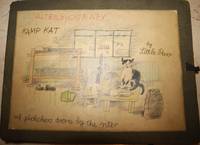
1943rif. 0072801943. Hardcover. Cloth Box. Very Good. Inimitable and disarming tales that represent the pinnacle of outsider art and folk art with the naive drawings richly full of life as they speak of the daily routine at a British army camp during the Second World War from the point-of-view of a camp mascot cat who excels at mangling English in its creative attempts at phonetic spelling. Folios are oblong 41 by 30 cm each. The first folio contains "The Alterbyografy" a 56 pages long unpaginated with 54 illustrations including the folio cover 28 of which are full page 24 of which are half page. The second folio is entitled "Kamp Karacters" . This is 51 leaves with 92 illustrations including the cover 51 of which are full page 40 a third page generally with the area above entirely blank. Illustrations are rendered with colored pencil and crayon. The first manuscript is a continuous narrative of army life its humdrum rhythms and routines its various inanities its social life sports and other activities etc. while the second part is more character sketches. The second folio is even more visually driven than the autobiography. Another distinction between the two is that the autobiography is done with the leaves oblong while the character studies are applied with the leaves vertical. While one part isn't exactly a sequel to the other the two parts are truly complementary. The two folios are of a rough burlap material with a large title sheet mounted on their front cover. The folios have three flap folds to hold the loose sheets in plus ribbon ties on their right sides. hardcover
1943rif. 0072801943. Hardcover. Cloth Box. Very Good. Inimitable and disarming tales that represent the pinnacle of outsider art and folk art with the naive drawings richly full of life as they speak of the daily routine at a British army camp during the Second World War from the point-of-view of a camp mascot cat who excels at mangling English in its creative attempts at phonetic spelling. Folios are oblong 41 by 30 cm each. The first folio contains "The Alterbyografy" a 56 pages long unpaginated with 54 illustrations including the folio cover 28 of which are full page 24 of which are half page. The second folio is entitled "Kamp Karacters" . This is 51 leaves with 92 illustrations including the cover 51 of which are full page 40 a third page generally with the area above entirely blank. Illustrations are rendered with colored pencil and crayon. The first manuscript is a continuous narrative of army life its humdrum rhythms and routines its various inanities its social life sports and other activities etc. while the second part is more character sketches. The second folio is even more visually driven than the autobiography. Another distinction between the two is that the autobiography is done with the leaves oblong while the character studies are applied with the leaves vertical. While one part isn't exactly a sequel to the other the two parts are truly complementary. The two folios are of a rough burlap material with a large title sheet mounted on their front cover. The folios have three flap folds to hold the loose sheets in plus ribbon ties on their right sides. hardcover books