Hess, Peter von - 1792 Düsseldorf - München 1871Antiquariat.de
1 316 résultats
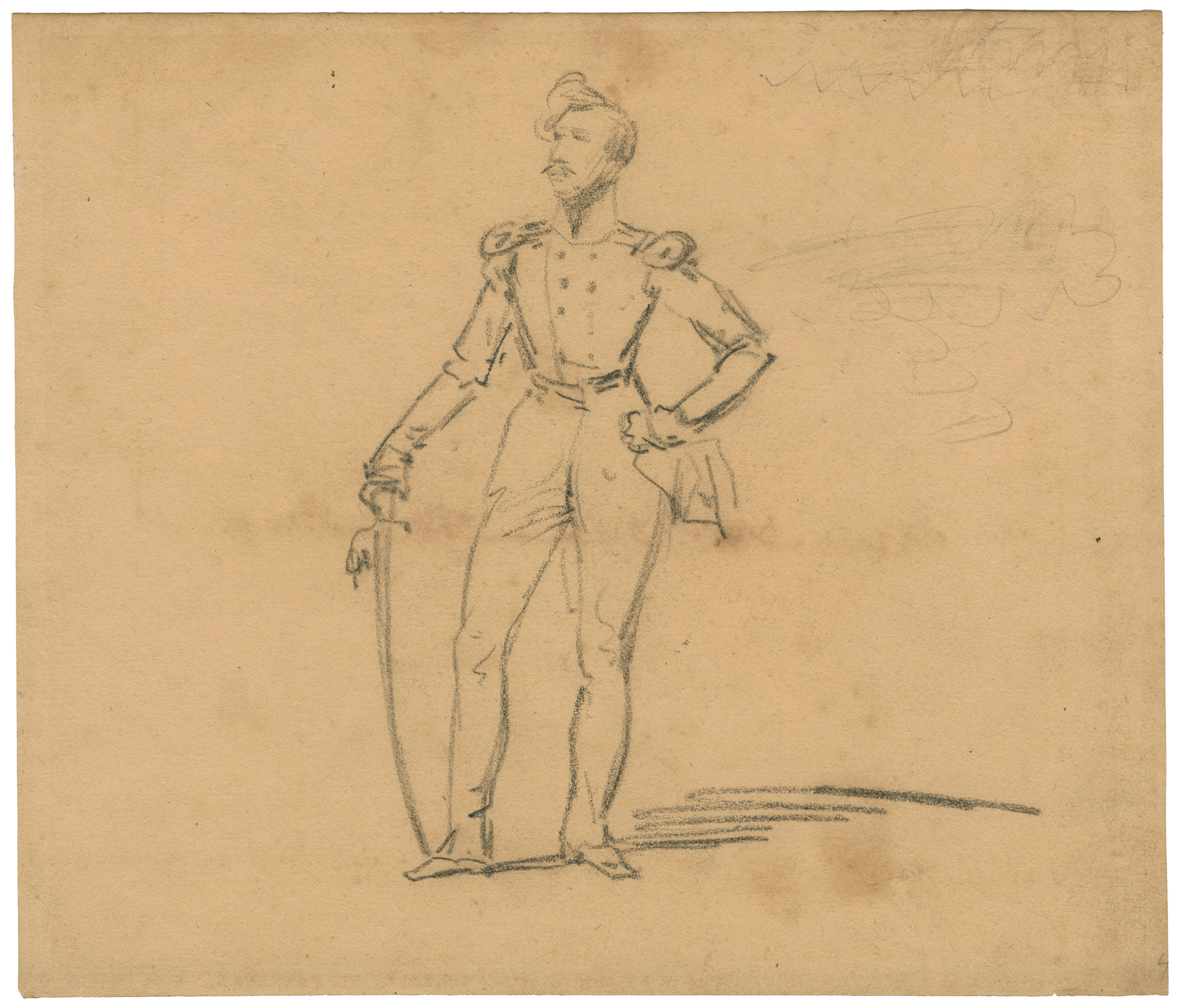
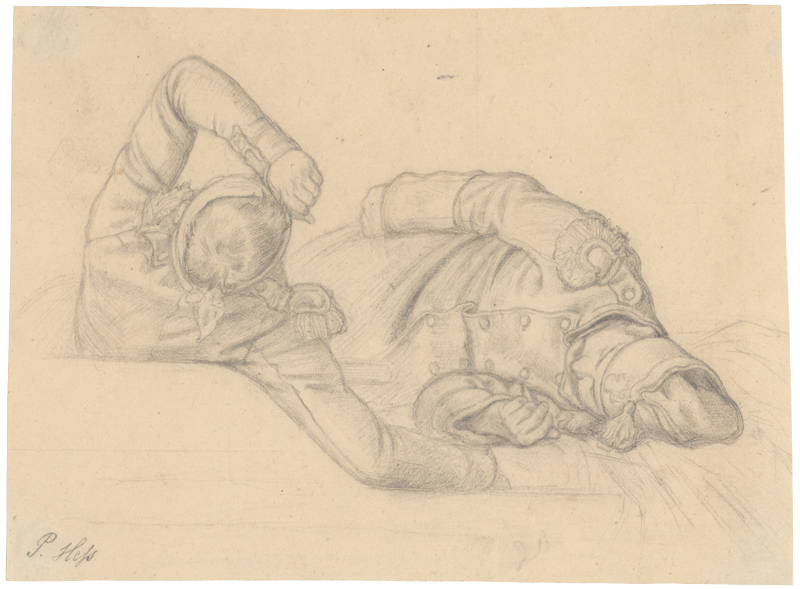
réf. 229-Eo.J. Bleistift, auf chamoisfarbenem Bütten, links unten signiert ?P. Hess?. 16,5:22,8 cm Rand rechts unregelmäßig beschnitten, minimal fleckig, verso in den Ecken Reste alter Verklebung. Sicher Figurenstudien zu einem Gemälde.
1952réf. 002334Paris Gérard Le Gris 1952
réf. 542-Eo.J. Schwarze Kreide und etwas Bleistift, auf bräunlichem Velin, verso bezeichnet ?Ferdinand von Rayski?. 2124,7 cm. Verso an den Rändern Reste einer alten Verklebung. Vorstudie zu einem Porträt, vermutlich um 1845/55 entstanden. Zur Körperhaltung des Dargestellten vgl.: Ausst. Katalog: Ferdinand von Rayski. Dresden, Galerie Neue Meister 2006, Farbabb. Ss. 65 und 75.
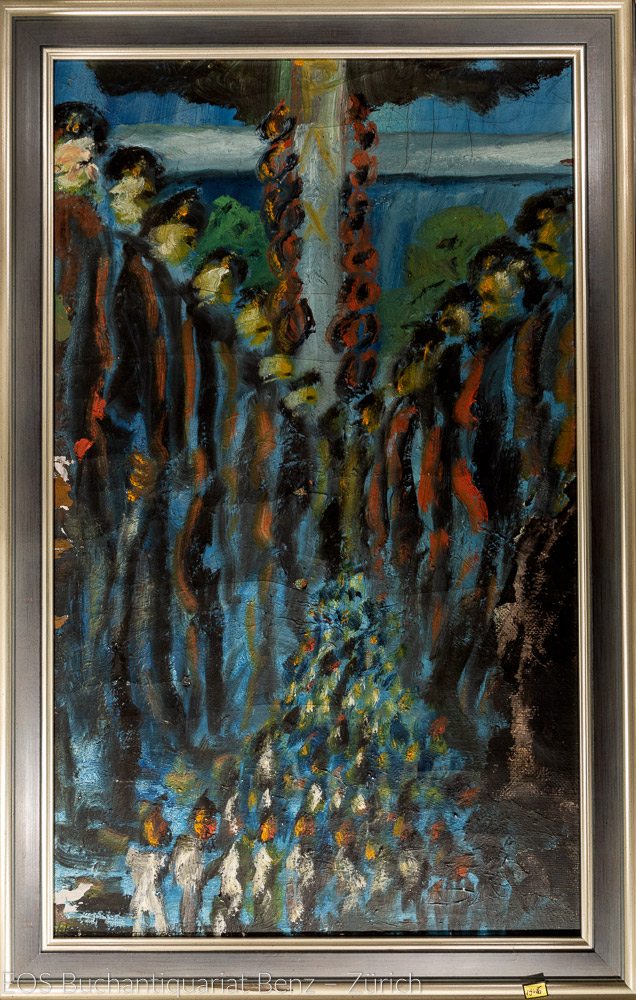
1946réf. 1045CG1946. Oel auf Holz. 72 x 43 cm. + Wichtig: Für unsere Kunden in der EU erfolgt der Versand alle 14 Tage verzollt ab Deutschland / Postbank-Konto in Deutschland vorhanden +
réf. 16269Grant Cottage King's Road Sloane Square London. 21 January 1813. 2pp. cr.8vo 30 x 18.5cm. In fair condition aged and worn with slight damage to one corner resulting in loss of one word of text. 62 lines of text with deletions and emendations and the thirteen lines of the conclusion largely rewritten. Headed: 'To the Right Honorable the Earl of sic Bathurst His Majestys Principal Secretary of State for the Colonial & War Department &c &c &c the Memorial of Major General Charles Viscount Grant de Vaux Shewest sic'. The first paragraph reads: 'That your memorialist although a french Emigrant is descended from two ancient and noble British families both by his father and mother and holds at present the rank of major general in the British Service - having resided in England since the year 1790 during which period after his services in the Emigrants Army became unnecessary he devoted his attentions to objects of Science and has published several works on Astronomy Navigation History &c tending to discoveries particularly on Nautical Science and on the history of Mauritius; which having met the approbation of men of talents and the patronage of Government your memorialist humbly hopes that his labours will ultimately prove beneficial to this country and to his unfortunate and numerous family.' The second paragraph concerns 'a large tract of Land in Canada' granted to him in 1794 'with a view to remove to that country a considerable number of french Emigrants who were to be conducted by him'. The third paragraph concerns 'the island of Mauritius where your memorialist was born' where his father 'the late Baron Grant &c commanded the troops' which has been 'conquered by his majesty's arms and is a valuable colony of Great Britain' The fourth paragraph concerns his family he having married 'a native of this country by whom he has eight children not provided for all born in England'. In the fifth paragraph he stresses his 'loyalty and integrity'. In conclusion he prays that 'your Lordship be pleased to issue an order that his Grant of land may be conferred to him in the isle of France 'the Isle of France' was another name for Mauritius his native country in lieu of the grant in Canada which was extensive according to his rank and numerous family'. Biographical/Historical NoteCharles Grant vicomte de Vaux was the descendant of a family of nobles who had emigrated from Scotland to France in the 14th century. Vaux was born in 1749 on the island of Mauritius where his father Louis-Charles Grant the Baron de Vaux served as governor. As a youth Vaux sailed to France to be educated and settled at Vaux-sur-Seulle in Normandy and eventually became an army officer. During the American Revolution he sided with the colonists and earned money selling supplies to the colonies and investing in ships to engage in privateering. The majority of the ships were lost and after the war Vaux petitioned the United States Congress for compensation. Though Vaux considered emigrating to North America he remained in France until forced by the revolution in France to flee to Great Britain in 1790. During his time as a refugee Vaux became interested in the prospect of starting a settlement in Canada and much of his energy during the next decade was focused on gaining permissions and raising money for the expedition. In the mid-1790s Vaux attempted to support himself as an army officer after being granted the position of colonel and permission to recruit a regiment which he formed with other French émigrés; it was stationed temporarily in Holland. This pursuit failed however and the regiment was dispersed after France invaded Holland during the French Revolutionary wars. Vaux then turned to writing to support himself publishing numerous books which included History of Mauritius and Introduction to Four New Maps of the Four Quarters all the while still attempting to plan a Canadian settlement. Despite his constant petitioning planning and pleas for aid Vaux was never able to realize his dream of moving to Canada. Little is known of the last two decades of his life but he is thought to have died in France around 1818." Grant Cottage, King's Road, Sloane Square [London]. 21 January 1813. unknown
1946réf. 1045CG1946. Oel auf Holz. 72 x 43 cm.
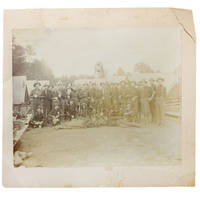
1890réf. 187391890. African American soldier photographed among members of a United States Army camp unit in the American West during the late nineteenth century providing visual documentation of Black participation within the military environment during the era of segregated service. African American soldiers served in the United States Army throughout the nineteenth century most prominently in units known as the Buffalo Soldiers which were formally organized after the Civil War. While Black soldiers were typically assigned to segregated regiments images occasionally record their presence in mixed military environments such as camps labor details or logistical units. The photograph captures a group of soldiers gathered in a temporary camp setting and includes a seated Black soldier identified by a contemporary handwritten note on the verso reading "Notice 'Black Soldier.'" Albumen sepia tone photograph mounted on photographer's board showing a group of American soldiers posed within a military encampment. Photograph measuring approximately 8.5 x 10 inches mounted on a photographer's board measuring approximately 10.75 x 10 inches. The men are dressed in clothing typical of western military and frontier settings of the late nineteenth century including dark buttoned shirts trousers supported by suspenders and boots. The African American soldier appears seated among the group with a cigarette in his mouth. The soldiers are gathered in a clearing surrounded by trees where rows of tents are arranged on raised wooden platforms suggesting an organized encampment. Cooking equipment stacked blankets plates and tankards are visible indicating a communal meal or informal gathering. One soldier holds what appears to be a long rifle with a visible barrel and wooden stock. Several soldiers sit or recline on the ground in the foreground while others stand behind them creating the appearance of an informal group portrait taken during daily camp life rather than a formal military arrangement. Handwritten note on the verso reads "Notice 'Black Soldier.'" Top right corner of the board cracked with tape repairs on the verso; slight water staining at the top left corner and damp staining at the lower left corner with partial cracking at the lower right corner. Image itself remains clear and largely unaffected. Overall condition good. The photograph preserves a visual record of African American presence within the late nineteenth century U.S. Army camp environment during a period when the armed forces remained formally segregated. unknown
1890réf. 187391890. African American soldier photographed among members of a United States Army camp unit in the American West during the late nineteenth century providing visual documentation of Black participation within the military environment during the era of segregated service. African American soldiers served in the United States Army throughout the nineteenth century most prominently in units known as the Buffalo Soldiers which were formally organized after the Civil War. While Black soldiers were typically assigned to segregated regiments images occasionally record their presence in mixed military environments such as camps labor details or logistical units. The photograph captures a group of soldiers gathered in a temporary camp setting and includes a seated Black soldier identified by a contemporary handwritten note on the verso reading "Notice 'Black Soldier.'" Albumen sepia tone photograph mounted on photographer's board showing a group of American soldiers posed within a military encampment. Photograph measuring approximately 8.5 x 10 inches mounted on a photographer's board measuring approximately 10.75 x 10 inches. The men are dressed in clothing typical of western military and frontier settings of the late nineteenth century including dark buttoned shirts trousers supported by suspenders and boots. The African American soldier appears seated among the group with a cigarette in his mouth. The soldiers are gathered in a clearing surrounded by trees where rows of tents are arranged on raised wooden platforms suggesting an organized encampment. Cooking equipment stacked blankets plates and tankards are visible indicating a communal meal or informal gathering. One soldier holds what appears to be a long rifle with a visible barrel and wooden stock. Several soldiers sit or recline on the ground in the foreground while others stand behind them creating the appearance of an informal group portrait taken during daily camp life rather than a formal military arrangement. Handwritten note on the verso reads "Notice 'Black Soldier.'" Top right corner of the board cracked with tape repairs on the verso; slight water staining at the top left corner and damp staining at the lower left corner with partial cracking at the lower right corner. Image itself remains clear and largely unaffected. Overall condition good. The photograph preserves a visual record of African American presence within the late nineteenth century U.S. Army camp environment during a period when the armed forces remained formally segregated. unknown books
réf. 6252EDWARD ALLEN GOODWIN unknown-1862. Goodwin was the Sergeant in Company K of the 23rd Regular Massachusetts Volunteers. This is the diary of Edward A. Goodwin Co. K 23rd Regt. M. of. M. This diary is THE AMERICAN UNION DIARY FOR 1862 an annual published diary accessible and likely provided to Union soldiers during the Civil War. After a few pages that include a calendar and interest tables the diary provides space for each day of the year 1862. Goodwin wrote entries every day from January 1st to April 7th and none thereafter. At the time Goodwin was serving in the 23rd Massachusetts Infantry Regiment which was a part of the Coast Division under General Ambrose Burnside. Entries are handwritten in either pencil or black ink. Notable entries include: aFriday 7: Naval engagementplace lasting from noon till sunset. Troops were landedin the afternoon and evening. Bivouacked on Roanoke Island in the rain. b Saturday 8: Captured a rebel battery in a swamp. Took 3000 rebel provisions and the whole island wasSergt. Howard hurt his foot. W.S. Clark missing. Both entries describe the Battle of Roanoke Island fought February 7th and 8th 1862. Part of General Ambrose Burnsides expedition to capture key ports in the Outer Banks the battle first saw Union gunboats first firing on Confederate forts under the command of Henry Wise until Burnsides soldiers could land ashore unopposed. and the forts on shore engaged in a gun battle with occasional contributions from the Mosquito Fleet. The next day the Union soldiers successfully flanked the Confederate artillery and infantry defenders on both sides forcing a retreat into the Confederate forts. The forts were then individually taken with the Union suffering only 264 casualties and capturing 2500 Confederate defenders. c Friday 14: Fought the battle of New Bern. Took over 100 pieces of artillery ammunitioncamp equipment &c. I arrived at night in the tents of the enemy. This entry describes the Battle of New Bern fought on March 14th 1862. After first advancing up the Trent River General Burnside had his soldiers exploit the weakened center of the line of the defending Confederates under Lawrence O'B. Branch. This allowed the Union Navy to shell Fort Thompson forcing its abandonment and shortly thereafter the city of New Bern too. 90 Union soldiers were killed and 64 Confederates were killed and 413 were captured. d Monday 31: Sick all day. Took horses.e Monday 7: Saw Amoat the hospital. DeceasedRain in the afternoon. These two entries foreshadow Goodwins ultimate fate including his last entry on April 7th 1862. Goodwin would pass away in New Bern on April 16th. Having survived two major battles unscathed at least according to his diary Goodwin most likely succumbed to disease. It is estimated that 2/3 of Civil War soldiers who died during the war died of disease not in battle. His body was ultimately returned to Massachusetts and is buried in Mansfield. The pages of the journal are in good condition but the exterior of black leather is frayed and partially torn. It should be handled very delicately but its value as a lens into the mindset of a Civil War soldier is immense. hardcover
réf. 6252EDWARD ALLEN GOODWIN unknown-1862. Goodwin was the Sergeant in Company K of the 23rd Regular Massachusetts Volunteers. This is the diary of Edward A. Goodwin Co. K 23rd Regt. M. of. M. This diary is THE AMERICAN UNION DIARY FOR 1862 an annual published diary accessible and likely provided to Union soldiers during the Civil War. After a few pages that include a calendar and interest tables the diary provides space for each day of the year 1862. Goodwin wrote entries every day from January 1st to April 7th and none thereafter. At the time Goodwin was serving in the 23rd Massachusetts Infantry Regiment which was a part of the Coast Division under General Ambrose Burnside. Entries are handwritten in either pencil or black ink. Notable entries include: aFriday 7: Naval engagementplace lasting from noon till sunset. Troops were landedin the afternoon and evening. Bivouacked on Roanoke Island in the rain. b Saturday 8: Captured a rebel battery in a swamp. Took 3000 rebel provisions and the whole island wasSergt. Howard hurt his foot. W.S. Clark missing. Both entries describe the Battle of Roanoke Island fought February 7th and 8th 1862. Part of General Ambrose Burnsides expedition to capture key ports in the Outer Banks the battle first saw Union gunboats first firing on Confederate forts under the command of Henry Wise until Burnsides soldiers could land ashore unopposed. and the forts on shore engaged in a gun battle with occasional contributions from the Mosquito Fleet. The next day the Union soldiers successfully flanked the Confederate artillery and infantry defenders on both sides forcing a retreat into the Confederate forts. The forts were then individually taken with the Union suffering only 264 casualties and capturing 2500 Confederate defenders. c Friday 14: Fought the battle of New Bern. Took over 100 pieces of artillery ammunitioncamp equipment &c. I arrived at night in the tents of the enemy. This entry describes the Battle of New Bern fought on March 14th 1862. After first advancing up the Trent River General Burnside had his soldiers exploit the weakened center of the line of the defending Confederates under Lawrence O'B. Branch. This allowed the Union Navy to shell Fort Thompson forcing its abandonment and shortly thereafter the city of New Bern too. 90 Union soldiers were killed and 64 Confederates were killed and 413 were captured. d Monday 31: Sick all day. Took horses.e Monday 7: Saw Amoat the hospital. DeceasedRain in the afternoon. These two entries foreshadow Goodwins ultimate fate including his last entry on April 7th 1862. Goodwin would pass away in New Bern on April 16th. Having survived two major battles unscathed at least according to his diary Goodwin most likely succumbed to disease. It is estimated that 2/3 of Civil War soldiers who died during the war died of disease not in battle. His body was ultimately returned to Massachusetts and is buried in Mansfield. The pages of the journal are in good condition but the exterior of black leather is frayed and partially torn. It should be handled very delicately but its value as a lens into the mindset of a Civil War soldier is immense. hardcover books
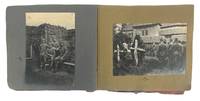
1917réf. 200631917. Czechoslovak Legion soldiers photographed during World War I document the participation of Czech and Slovak troops fighting alongside Allied forces in campaigns across Europe. Approximately seventy eight photographs record military life among soldiers associated with the Czechoslovak armed formations that emerged during the war as nationalist units seeking independence from the Austro Hungarian Empire. The images depict trench warfare troop encampments drills and daily life among soldiers whose political objective was the creation of an independent Czechoslovak state. The photographs illustrate the conditions and routines experienced by these soldiers during the conflict that ultimately contributed to the establishment of Czechoslovakia at the end of the war in 1918. Photographic album containing approximately seventy eight photographs measuring about 4.75 x 6.5 inches mounted on album leaves. The images depict soldiers in trench positions infantry movements across terrain and group formations during drills. Additional photographs show military camps outdoor meals mess areas and group portraits including one of a military band. Several photographs capture village architecture including houses courtyards and churches encountered by the soldiers during the campaign. The album also contains images of wartime medical care including a medic working with wounded soldiers a funeral scene with graves and cemetery crosses and a horse drawn wagon train traveling along a mountain road. Other photographs depict staged performances and theatrical scenes presented outdoors for soldiers. During World War I Czech and Slovak nationalist leaders organized volunteer military formations known collectively as the Czechoslovak Legions composed of soldiers drawn from prisoners of war and expatriate communities who sought to fight alongside the Allied powers against Austria Hungary. Their participation in the war strengthened international support for the creation of an independent Czechoslovakia which was established following the collapse of the Austro Hungarian Empire in 1918. Photographs of trench systems encampments and military drills in this album illustrate the entrenched character of warfare that dominated much of the conflict as armies constructed extensive defensive systems while attempting to break enemy lines through periodic assaults. Album containing approximately seventy eight photographs measuring about 4.75 x 6.5 inches. Album boards show chipping along the edges while photographs remain clear with strong contrast. Overall condition very good. unknown
1917réf. 200631917. Czechoslovak Legion soldiers photographed during World War I document the participation of Czech and Slovak troops fighting alongside Allied forces in campaigns across Europe. Approximately seventy eight photographs record military life among soldiers associated with the Czechoslovak armed formations that emerged during the war as nationalist units seeking independence from the Austro Hungarian Empire. The images depict trench warfare troop encampments drills and daily life among soldiers whose political objective was the creation of an independent Czechoslovak state. The photographs illustrate the conditions and routines experienced by these soldiers during the conflict that ultimately contributed to the establishment of Czechoslovakia at the end of the war in 1918. Photographic album containing approximately seventy eight photographs measuring about 4.75 x 6.5 inches mounted on album leaves. The images depict soldiers in trench positions infantry movements across terrain and group formations during drills. Additional photographs show military camps outdoor meals mess areas and group portraits including one of a military band. Several photographs capture village architecture including houses courtyards and churches encountered by the soldiers during the campaign. The album also contains images of wartime medical care including a medic working with wounded soldiers a funeral scene with graves and cemetery crosses and a horse drawn wagon train traveling along a mountain road. Other photographs depict staged performances and theatrical scenes presented outdoors for soldiers. During World War I Czech and Slovak nationalist leaders organized volunteer military formations known collectively as the Czechoslovak Legions composed of soldiers drawn from prisoners of war and expatriate communities who sought to fight alongside the Allied powers against Austria Hungary. Their participation in the war strengthened international support for the creation of an independent Czechoslovakia which was established following the collapse of the Austro Hungarian Empire in 1918. Photographs of trench systems encampments and military drills in this album illustrate the entrenched character of warfare that dominated much of the conflict as armies constructed extensive defensive systems while attempting to break enemy lines through periodic assaults. Album containing approximately seventy eight photographs measuring about 4.75 x 6.5 inches. Album boards show chipping along the edges while photographs remain clear with strong contrast. Overall condition very good. unknown books
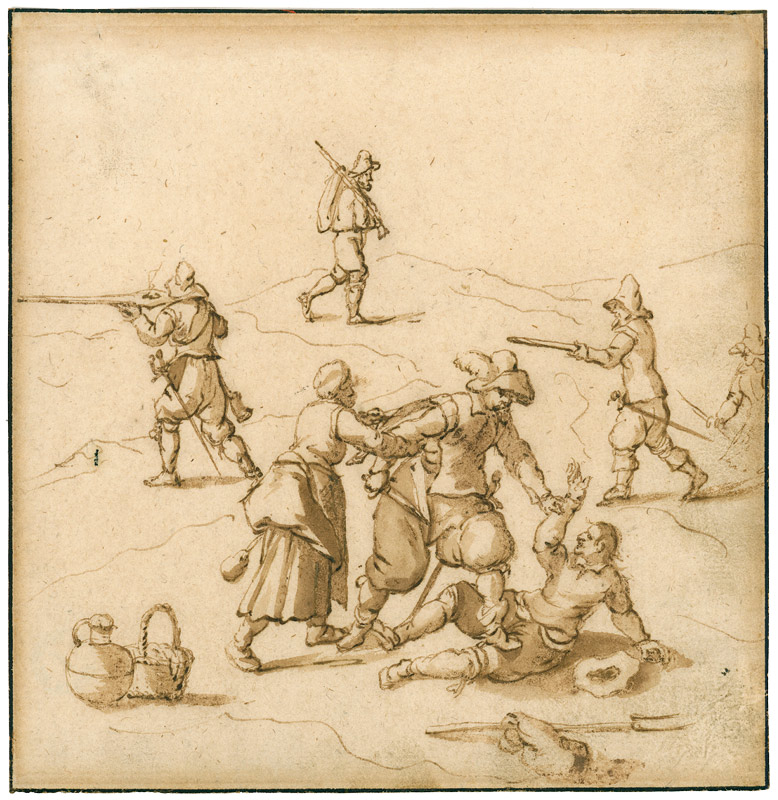
réf. 076-Do.J. Feder in Braun, braun laviert, mit einzelner schwarzer Federlinie umrandet, auf Bütten. 16,2:15,6 cm. Papier etwas gebräunt., sonst sehr gut erhalten. Provenienz: Sammlung Christian Hammer, Stockholm.
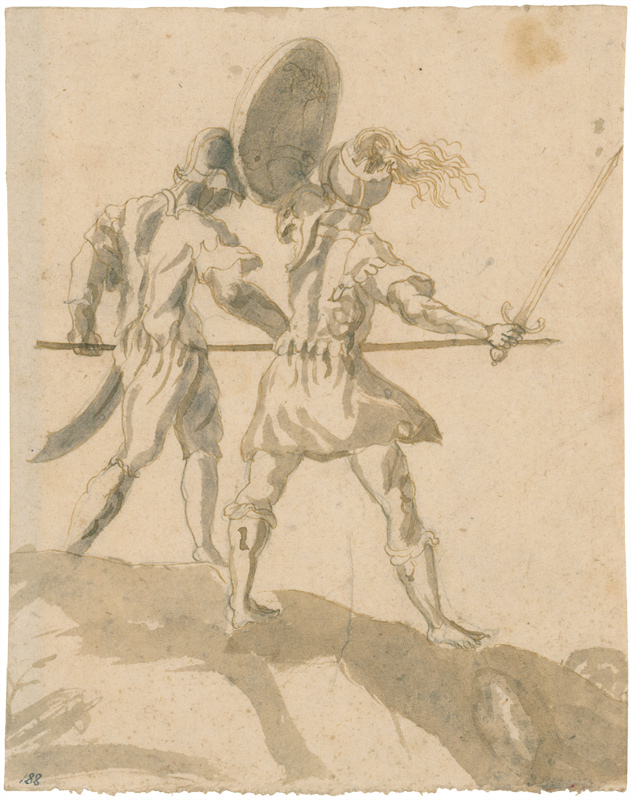
réf. 065-Do.J. Feder in Braun, braun und grau laviert, auf Bütten. 16,5:12,7 cm. Links unten Nummer ?188?. Verso Verklebung am linken Rand.
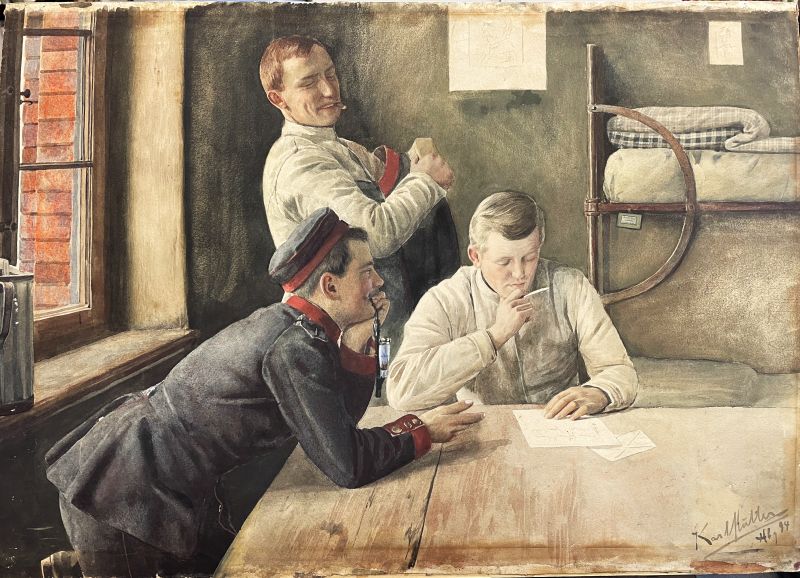
1894réf. 2400991894. Signiert, datiert und bezeichnet "Karl Müller / Hb, 94". 43,5 x 60,5 cm.
1925réf. 536421925. Folio. Eight pages approximately 2750 words; accompanied by another autograph letter from Russell to Trowbridge 14 March 1925; 4to four pages approximately 750 words with more information on the political situation in Missouri on the eve of war and an autograph transcription by Russell of the long poem "The Battle of Wilson's Creek August 10 1861" folio two pages with his own commentary on the poem. Folded. Insect damage to the poem and first leaf of the longer letter resulting in the loss of a number of letters but quite legible throughout. 813. Russell a native of St. Louis enlisted under Lincoln's first call for troops and served in a Missouri regiment through the summer of 1864. Following an outline of sectional struggle from 1820 and early events of the war given in the first half of the longer letter Russell describes the events of the Wilson's Creek Campaign and then his own eyewitness to history: "The Kansas boys like ourselves were resting when all at once the rebels crept up the hill to the top of the crest opened a tremendous fire right into the Iowa boys and our regiment but we went at them anyway and a hand to hand struggle began . My Captain Cary Gratz was killed . I was wounded four times and the Kansas boys were holding their own. Capt. Lyon had been hit twice once a scratch along the forehead and a light superficial wound in the knee. I was carried down the hill and placed on the hill side opposite the line of battle the valley being merely a hollow. I had a good view of the fight as it went on. My first attention was attracted to my right as I lay there and watched Capt. Lyon trying to rally the Iowa boys who were in a panic their Colonel had been killed and although the Kansas boys had saved them Capt. Lyon was rallying them into formation to use as they were then near the front. All at once I saw him rear off that dople sic gray horse and fall to the ground. Maj. Schofield also ran to his side a messenger sent for our surgeon Dr. Comyns . Capt. Lyon was carried down the hill he was shot nearly half way up from the hollow to the battle lines. The bullet had struck him squarely in the breast and had gone through his hear and he had lost the pleasure of seeing the victory his indomitable courage had won."_The Confederates commanded by Gen. Sterling Price made another assault following the death of Lyon but Samuel Sturgis rallied the Union troops and the Federal lines held. Sturgis then left the field toward Springfield and the Confederates did not pursue him. "The campaign marked the beginning of the war in Missouri and the trans-Mississippi. Afterward the Federal army withdrew to rolla Missouri leaving the Southerners in possession of most of the southwestern region of the state" "Encyclopedia of the Confederacy"._Lyon 1818-1861 a Connecticut native graduated from West Point in 1841 served in the Mexican War and on the western frontier most of the time to the eve of Civil War in "Bleeding Kansas" becoming involved in the political issue of slavery in the territories. Appointed brigadier general in May 1861 to command the Union forces in St. Louis he also led discussions with Confederate sympathizers on Missouri's position in the union; when compromise failed he launched his first military campaign which culminated in his death at Wilson's Creek. "The entire north mourned his death and he immediately became a national hero and martyr . his brilliant work had done much to hold Missouri for the Union" DAB. unknown
1925réf. 536421925. Folio. Eight pages approximately 2750 words; accompanied by another autograph letter from Russell to Trowbridge 14 March 1925; 4to four pages approximately 750 words with more information on the political situation in Missouri on the eve of war and an autograph transcription by Russell of the long poem "The Battle of Wilson's Creek August 10 1861" folio two pages with his own commentary on the poem. Folded. Insect damage to the poem and first leaf of the longer letter resulting in the loss of a number of letters but quite legible throughout. 813. Russell a native of St. Louis enlisted under Lincoln's first call for troops and served in a Missouri regiment through the summer of 1864. Following an outline of sectional struggle from 1820 and early events of the war given in the first half of the longer letter Russell describes the events of the Wilson's Creek Campaign and then his own eyewitness to history: "The Kansas boys like ourselves were resting when all at once the rebels crept up the hill to the top of the crest opened a tremendous fire right into the Iowa boys and our regiment but we went at them anyway and a hand to hand struggle began . My Captain Cary Gratz was killed . I was wounded four times and the Kansas boys were holding their own. Capt. Lyon had been hit twice once a scratch along the forehead and a light superficial wound in the knee. I was carried down the hill and placed on the hill side opposite the line of battle the valley being merely a hollow. I had a good view of the fight as it went on. My first attention was attracted to my right as I lay there and watched Capt. Lyon trying to rally the Iowa boys who were in a panic their Colonel had been killed and although the Kansas boys had saved them Capt. Lyon was rallying them into formation to use as they were then near the front. All at once I saw him rear off that dople sic gray horse and fall to the ground. Maj. Schofield also ran to his side a messenger sent for our surgeon Dr. Comyns . Capt. Lyon was carried down the hill he was shot nearly half way up from the hollow to the battle lines. The bullet had struck him squarely in the breast and had gone through his hear and he had lost the pleasure of seeing the victory his indomitable courage had won."_The Confederates commanded by Gen. Sterling Price made another assault following the death of Lyon but Samuel Sturgis rallied the Union troops and the Federal lines held. Sturgis then left the field toward Springfield and the Confederates did not pursue him. "The campaign marked the beginning of the war in Missouri and the trans-Mississippi. Afterward the Federal army withdrew to rolla Missouri leaving the Southerners in possession of most of the southwestern region of the state" "Encyclopedia of the Confederacy"._Lyon 1818-1861 a Connecticut native graduated from West Point in 1841 served in the Mexican War and on the western frontier most of the time to the eve of Civil War in "Bleeding Kansas" becoming involved in the political issue of slavery in the territories. Appointed brigadier general in May 1861 to command the Union forces in St. Louis he also led discussions with Confederate sympathizers on Missouri's position in the union; when compromise failed he launched his first military campaign which culminated in his death at Wilson's Creek. "The entire north mourned his death and he immediately became a national hero and martyr . his brilliant work had done much to hold Missouri for the Union" DAB. unknown books
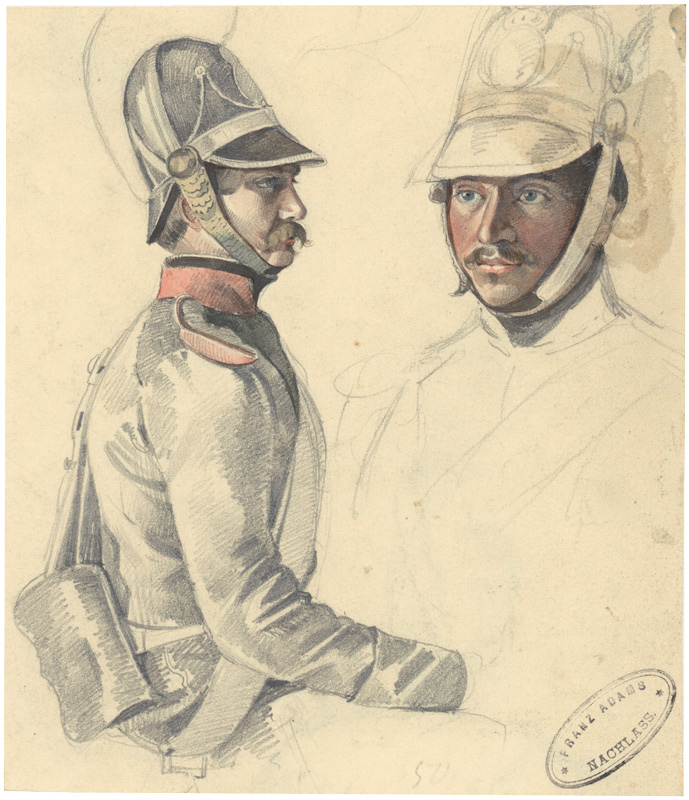
réf. 399-Eo.J. Bleistift, teils aquarelliert, auf Velin, rechts unten Nachlassstempel. 14,5:12,3 cm. Verso an den oberen Ecken Reste von Verklebungen, recto rechts oben Leimspur. Provenienz: Nachlaß Otto Seitz, München. Studie zu einem Gemälde, das vermutlich in Zusammenarbeit mit seinem Vater Albrecht Adam (1786-1862) entstanden ist.
1915réf. 4227France Belgium England 1915. Good. Oblong 8vo. Small "Walker's Service Notebook" 154 x 94 mm lined 26 pages filled with neat entries in pencil and pen final page of diary loose the remaining portion of the notebook i.e. about 2/3 blank. Original limp cloth covers worn. § Extraordinary manuscript diary of an anonymous British soldier beginning April 12th 1915 and ENDING ABRUPTLY IN THE TRENCHES AFTER A GAS ATTACK. The final entry was dated December 19th 1915 which was THE FIRST DAY PHOSGENE GAS WAS USED AGAINST BRITISH SOLDIERS. The short diary is rich in detail of life at the front. The anonymous soldier belonged to the 49th West Riding Division which had a large number of gas casualties when soldiers in reserve lines did not receive a warning in time to put on their helmets. A study by British medical authorities arrived at a figure of 1069 gas casualties 120 of which were fatal. It is very possible that the present manuscript was written by one of those men. It seems probable that with access to the right regimental records the identity and fate of the soldier could be learned and his story told in full; however even as an anonymous diary the interest and poignancy of this personal record is clear. The events recorded span just nine months. On April 12th the soldier leaves Edenthorpe near Doncaster and crosses the channel to Le Havre that evening "packed like herrings" and accompanying horses and wagons. Over the next few months he records laying lines opening signal offices handling horses towns and villages visited billets and meals injuries regiments encountered names of comrades and O.C.s shelling rain and mud. He sees the Northumberland Hussars the Indian Corps and Royal Horse Artillery. On May 9th he records the Battle of Aubers Ridge: "Off duty at 7am. Attack began at 5am by Artillery. Signal thro' during day showed heavy losses in E. Lancs Lincolns. 13th London and other Batts. Had coffee in Fleurbaix and then to bed in barn. Off duty 3pm. Attack still proceeding without much impression on our line. French said to be doing well. At night we have the two windows in our Signal Office made up with corrugated iron & sandbags." For the entry dated May 12th our author notes that the name of the Division has been "altered to the 49th" thereby confirming the identity of his Division. On May 24th: "The Allamands dropped about 6 shrapnel in our vicinity." From a period of steady work and periodic pleasures "had tea & cakes at a patisserie & and then back after buying some books" "glorious day" the situation deteriorates with the weather "torrential rain dugouts leaking & 18" water on my floor". They move to Chateau de Trois Tours and on July 13th there is "rather an exciting night" with a bombardment from 7.30 to 10.30. On the 14th "The whole place is being encircled by barbed wire & trenches & the furniture is being moved out of the chateau." On the 15th "At 12.45pm about 12 shells fell round the chateau made a dive for the Signal Office Billy Edwards & Gus Harris wounded in thigh and ankle." They were shelled again on the 16th. On December 1st he travels back to Sheffield on leave returning on December 8th. The company are now holed up near Ypres at Hospital Farm the name given to a farm building used as a dressing station. The final entry reads "Dec 19th 'S.O.S.' Gas attack 5.30 am things lively until 8.30am. 146 & 148 des. 148 soon repaired from chateau". The cemetery at Hospital Farm contains 115 Commonwealth burials of the First World War. On the significance of the 19 Dec. 1915 battle at Wieltje Belgium northeast of Ypres see the long Wikipedia entry "German Phosgene Attack of 19 December 1915." The diary contains many clues that could help identify our writer in military records. It is not certain that he was one of the first British casualties to Phosgene gas but it seems tragically likely. As it stands the final entry in the diary marks an important milestone in the war: phosgene gas would eventually be responsible for about 85% of the 90000 deaths caused by chemical weapons during World War I. unknown
1915réf. 4227France Belgium England 1915. Good. Oblong 8vo. Small "Walker's Service Notebook" 154 x 94 mm lined 26 pages filled with neat entries in pencil and pen final page of diary loose the remaining portion of the notebook i.e. about 2/3 blank. Original limp cloth covers worn. § Extraordinary manuscript diary of an anonymous British soldier beginning April 12th 1915 and ENDING ABRUPTLY IN THE TRENCHES AFTER A GAS ATTACK. The final entry was dated December 19th 1915 which was THE FIRST DAY PHOSGENE GAS WAS USED AGAINST BRITISH SOLDIERS. The short diary is rich in detail of life at the front. The anonymous soldier belonged to the 49th West Riding Division which had a large number of gas casualties when soldiers in reserve lines did not receive a warning in time to put on their helmets. A study by British medical authorities arrived at a figure of 1069 gas casualties 120 of which were fatal. It is very possible that the present manuscript was written by one of those men. It seems probable that with access to the right regimental records the identity and fate of the soldier could be learned and his story told in full; however even as an anonymous diary the interest and poignancy of this personal record is clear. The events recorded span just nine months. On April 12th the soldier leaves Edenthorpe near Doncaster and crosses the channel to Le Havre that evening "packed like herrings" and accompanying horses and wagons. Over the next few months he records laying lines opening signal offices handling horses towns and villages visited billets and meals injuries regiments encountered names of comrades and O.C.s shelling rain and mud. He sees the Northumberland Hussars the Indian Corps and Royal Horse Artillery. On May 9th he records the Battle of Aubers Ridge: "Off duty at 7am. Attack began at 5am by Artillery. Signal thro' during day showed heavy losses in E. Lancs Lincolns. 13th London and other Batts. Had coffee in Fleurbaix and then to bed in barn. Off duty 3pm. Attack still proceeding without much impression on our line. French said to be doing well. At night we have the two windows in our Signal Office made up with corrugated iron & sandbags." For the entry dated May 12th our author notes that the name of the Division has been "altered to the 49th" thereby confirming the identity of his Division. On May 24th: "The Allamands dropped about 6 shrapnel in our vicinity." From a period of steady work and periodic pleasures "had tea & cakes at a patisserie & and then back after buying some books" "glorious day" the situation deteriorates with the weather "torrential rain dugouts leaking & 18" water on my floor". They move to Chateau de Trois Tours and on July 13th there is "rather an exciting night" with a bombardment from 7.30 to 10.30. On the 14th "The whole place is being encircled by barbed wire & trenches & the furniture is being moved out of the chateau." On the 15th "At 12.45pm about 12 shells fell round the chateau made a dive for the Signal Office Billy Edwards & Gus Harris wounded in thigh and ankle." They were shelled again on the 16th. On December 1st he travels back to Sheffield on leave returning on December 8th. The company are now holed up near Ypres at Hospital Farm the name given to a farm building used as a dressing station. The final entry reads "Dec 19th 'S.O.S.' Gas attack 5.30 am things lively until 8.30am. 146 & 148 des. 148 soon repaired from chateau". The cemetery at Hospital Farm contains 115 Commonwealth burials of the First World War. On the significance of the 19 Dec. 1915 battle at Wieltje Belgium northeast of Ypres see the long Wikipedia entry "German Phosgene Attack of 19 December 1915." The diary contains many clues that could help identify our writer in military records. It is not certain that he was one of the first British casualties to Phosgene gas but it seems tragically likely. As it stands the final entry in the diary marks an important milestone in the war: phosgene gas would eventually be responsible for about 85% of the 90000 deaths caused by chemical weapons during World War I. unknown books
réf. 265131959 . 'If he survives he may well be a great man at 40':Glubb Pasha gives his assessment of King Hussein of Jordan in 1959Three autograph documents by 'Glubb Pasha' giving a detailed and perceptive assessment of the character and situation of his erstwhile master King Hussein of Jordan 1935-1999 written to assist John Freeman 1915-2014 in preparing the interview with King Hussein broadcast in the BBC series 'Face to Face' on 1 January 1960. From the papers of the programme's producer Hugh Burnett 1924-2011. The first item is a long letter from Glubb to Burnett giving a thoughtful and perceptive assessment of Hussein's character and situation including a discussion of relations between Jordan and Britain and a comparison between Hussein and President Nasser of Egypt. The second item is a series of 34 potential questions which Glubb suggests be put to the king. The third item is the covering letter to the second describing the questions in it as 'ideas which I hope may be useful' and offering to involve himself in the preparation for the interview 'we have lots of time'. The fourth item is the printer's copy of the transcript of the interview as published in Burnett's 1964 book of the series.Sir John Bagot Glubb 1897-1999 is described in his entry in the Oxford DNB as 'servant of both Britain and Jordan' and 'the last in the long line of powerful British proconsuls'. In 1939 Glubb took command of the Arab Legion subsequently the Jordan Royal Army transforming it into the best-trained and most effective military force in the Arab world and himself leading it across the River Jordan to occupy the West Bank during the 1948 Arab-Israeli War. According to the ODNB Glubb 'was greatly reliant on King Abdullah's support which vanished when the king was assassinated on 20 July 1951. His son Talal reigned only a few months before abdicating and was succeeded by his son Hussein still only sixteen and a schoolboy at Harrow. Although Hussein respected Glubb the gap between their ages proved impossible to bridge and they soon fell out. Military and political developments were rapidly outgrowing Glubb and the influential foreign adviser to an oriental monarch was becoming an anachronism.' In 1956 Glubb was dismissed from his command and given 24 hours to leave the country. He returned to Britain with only £5 and did not receive a general's pension from either Britain or Jordan. Despite the manner of Glubb's dismissal the two documents present here reflect the 'exemplary dignity' with which the ODNB notes he always acted thereafter.The four items are in fair condition lightly aged and worn all four with punch-holes for binding.ONE: Autograph Letter Signed with Glubb's stylised curling signature. Mayfield Sussex; 5 December 1959. 6pp. foolscap 8vo. With Televsion Registry date stamp.A thoughtful assessment of King Hussein's character Addressed to 'Dear Burnett' and written 'In continuation of my previous notes on King Husain sic.'The letter covers:Hussein's 'extremely democratic & informal' nature on first coming back from England to assume the Jordanian throne: 'He liked jumping alone into his car without a hat and driving into the Town - perhaps to go to the cinema. The police the officials & the escort used to be in a frenzy looking for him. … I don't think he can do that so much now there seems to be too much risk of his being assassinated.'Hussein's 'attitude to everything' which is 'in schoolboy language' 'flat out': 'In 1953 1954 & 1955 there were several ugly incidents on the Jordan Israeli frontier villages being raided by the Israeli army & many people killed. In every case the king's first instinct was to jump into a car and drive himself to the frontier to see in person what was happening. … He was most anxious to meet the people and would get out of his car in the villages to talk with villagers and get their first hand knowledge.'His love of risk: 'He delighted to drive his car at breakneck speed along the roads at imminent risk to himself & the public. I do not know if he still does that.'His headstrong nature: 'Although however he was then 18 19 or 20 years old all the cabinet ministers & officials were afraid of him & unable to control him. … he always won. Thus although he did a great many foolish things from lack of experience there was no doubt that he had a remarkably strong & independent personality and was full of initiative.'How he was 'deceived by politicians into thinking that Britain was the enemy of his country' resulting in a breaking-off of relations between Jordan & Britain'. Of Hussein's dismissal of 'all the British officers' including Glubb himself he writes: 'He did this entirely on his own initiative using his own courage & will-power. The extremists merely gave him the ideas but he carried all the responsibility. Now he has discovered that he was deceived and is drawing near to Britain again - once more on his own responsibility.'His political position. Jordan has 'a parliament almost in theory like Britain' and 'The influence of his grandfather King Abdulla & his own power are not due to an "Oriental despotic constitution but to the personalities of their two characters.' Although Hussein 'now thinks Britain can be his helper he is an enthusiastic Arab nationalist.'The contrast between Hussein with President Nasser of Egypt. 'Nasser likes to brand everybody who does not bow to his personal leadership as being a traitor and a "colonialist tool" etc. This is a local political line. Hussein is as nationalist as Nasser but his personality will not allow him to be a subordinate of Nasser. Nasser is inclined to want only subordinates. King Husain also feels strongly about Israel and is of course bitterly opposed to the present Iraqi regime which began by murdering all his family - King Feisal of Iraq was his cousin.'Glubb sums up his opinion of Hussein's character: 'In brief the picture is one of a young man of considerable character still retaining a strong streak of teenage enthusiasm for jet aircraft and fast motor cars. He came to the throne at 17 and was swept off his feet by the usual anti-imperialist propaganda. Now gaining first hand experience he is becoming wiser.'Glubb concludes the letter: 'If he survives he may well be a great man at 40'.TWO: Autograph List by Glubb of thirty-three suggested questions for Freeman to pose to King Hussein. Without date place or signature but sent with Item Three below dated 3 December 1959 as its covering letter stating that Glubb is sending 'some ideas which I hope may be useful'. 13pp. foolscap 8vo. With slip carrying a further question numbered 8A. With a few minor emendations. Topics include: Hussein's time at Sandhurst his view on the British boarding school and military service; his activities as a pilot and 'driving in car races'; military affairs; ceremonial and recreation; King Abdulla. The first question indicates the respectful tone that Glubb considered the interviewer should adopt: '1. The people of Britain emended from 'England' admire the personal courage which Your Majesty has shown in facing your difficulties in Jordan. May I ask how you sir feel towards the British people' A number of questions concern military matters and the following reflects Glubb's personal knowledge: '12 Everybody expects Arabs to fight but many people are surprised that the Jordan Army is so completely mechanized and has its own workshops and technical services. In England such units are possible because the technicians exist in factories in civil life and the army can draw on them Is not this difficult in a largely agricultural country like Jordan' The conclusion of the document demonstrates Glubb's attempt to 'prime' the interviewer: "Thank you very much Sir and may I wish you every success to BREAKS OFF HERE Insert further back somewhere. 33. I am afraid that I am not very experienced in Arab affairs but we have the idea in Britain that King's sic in "The East" live in great state but rather isolated from their subjects. I think that perhaps this does not apply to Arab countries. Does Your Majesty succeed in getting about and meeting the people of the country Note. He is very keen on doing this.' Question 30 reads: 'Is it true sir that you were actually standing beside King Abdulla when he was assassinated'THREE: Typed Letter Signed from Glubb to Burnett. On letterhead of West Wood St. Dunstan Mayfield Sussex. 3 December 1959. 2pp. 12mo. With Television Registry date stamp. Covering letter to Item Two above. 'Here are some ideas which I hope may be useful. As it is not until 1st January we have lots of time. Please ring up or write or send my draft back with marginal notes or anything else you like which will help you.' In a postscript he explains that he has not typed Item Two 'to save time'.FOUR: Typed text prepared for publication of the section on 'KING HUSSEIN' in the book 'Face to Face Edited and introduced by Hugh Burnett' Jonathan Cape 1964. 2pp. foolscap 8vo. With instructions to the typesetter in pencil and red ink. Corresponding to the text as published on p.30 of the book. [ 1959 ] unknown
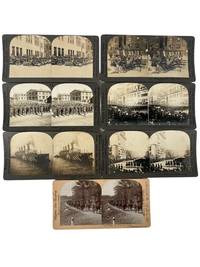
1918réf. 205021918. Buffalo Soldier regiments depicted in stereoview photographs from the World War I era document African American cavalrymen and infantry units serving in segregated formations of the United States Army during the early twentieth century. These images record soldiers from several historically significant Black military units including the 9th U.S. Cavalry the 10th Cavalry and the 369th Infantry Regiment. African American soldiers served in large numbers during World War I despite segregation in the armed forces and the war marked a turning point in public recognition of Black military service. The photographs capture cavalry movement machine gun training and celebratory returns from the European front preserving visual evidence of the military presence and public visibility of Buffalo Soldiers during the conflict. Archive consists of seven stereoview photographs published by the Keystone View Company during the World War I period. The views depict soldiers from the 9th U.S. Cavalry the 8th Regiment of Colored Troops the 10th Cavalry the Chicago Regiment of Colored Troops and the 15th Regiment of the 369th Infantry. Two stereoviews show Black machine gun companies operating Lewis guns one of the principal light machine guns used on the Western Front during the war. Another view shows Troop K of the 10th Cavalry moving on horseback at Camp Chickamauga in Georgia. Additional stereoviews depict African American soldiers returning from European service and marching in public celebrations including scenes of troops parading along major boulevards such as Fifth Avenue in New York. The Buffalo Soldier regiments had already established a long military record before the First World War. Units such as the 10th Cavalry formed part of the segregated Regular Army created after the Civil War and served in campaigns across the western United States during the Indian Wars later participating in the Spanish American War the Philippine American War and operations during the Mexican Revolution. World War I marked one of the final periods in which cavalry units remained visible in American military organization as mechanized armor and motorized vehicles soon replaced mounted troops. At the same time Black soldiers who returned from service were celebrated in wartime parades yet continued to face segregation and racial discrimination within American society. Stereoview cards remain well preserved with light age wear typical of early twentieth century photographic prints. Very good condition overall and a visually compelling record of Buffalo Soldiers during the World War I era. unknown
1918réf. 205021918. Buffalo Soldier regiments depicted in stereoview photographs from the World War I era document African American cavalrymen and infantry units serving in segregated formations of the United States Army during the early twentieth century. These images record soldiers from several historically significant Black military units including the 9th U.S. Cavalry the 10th Cavalry and the 369th Infantry Regiment. African American soldiers served in large numbers during World War I despite segregation in the armed forces and the war marked a turning point in public recognition of Black military service. The photographs capture cavalry movement machine gun training and celebratory returns from the European front preserving visual evidence of the military presence and public visibility of Buffalo Soldiers during the conflict. Archive consists of seven stereoview photographs published by the Keystone View Company during the World War I period. The views depict soldiers from the 9th U.S. Cavalry the 8th Regiment of Colored Troops the 10th Cavalry the Chicago Regiment of Colored Troops and the 15th Regiment of the 369th Infantry. Two stereoviews show Black machine gun companies operating Lewis guns one of the principal light machine guns used on the Western Front during the war. Another view shows Troop K of the 10th Cavalry moving on horseback at Camp Chickamauga in Georgia. Additional stereoviews depict African American soldiers returning from European service and marching in public celebrations including scenes of troops parading along major boulevards such as Fifth Avenue in New York. The Buffalo Soldier regiments had already established a long military record before the First World War. Units such as the 10th Cavalry formed part of the segregated Regular Army created after the Civil War and served in campaigns across the western United States during the Indian Wars later participating in the Spanish American War the Philippine American War and operations during the Mexican Revolution. World War I marked one of the final periods in which cavalry units remained visible in American military organization as mechanized armor and motorized vehicles soon replaced mounted troops. At the same time Black soldiers who returned from service were celebrated in wartime parades yet continued to face segregation and racial discrimination within American society. Stereoview cards remain well preserved with light age wear typical of early twentieth century photographic prints. Very good condition overall and a visually compelling record of Buffalo Soldiers during the World War I era. unknown books
1945réf. 44498Okayama: Photographed in many Japanese Locations with most of the loose photographs taken in Okayama Japan n. d. ca 1945. 1945. WORLD WAR II JAPAN. First edition. Blue cloth photograph album 124 silver gelatin photographs mostly 2 1/4" x 3 1/4" with 106 of them in corner mounts. A fascinating vernacular photograph album capturing scenes in American-occupied Japan just after the Second World War. Most of the photographs are captioned in white ink on the black album pages and organized in sections such as "Landmarks" "The People" "The Cities" “The Military” and “Personalities.” “Landmarks” include views of sites in Kokura Yakata Okayma Prefecture picturing shrines country homes water works the "International Military Tribunal Far East" and more. "The People" shows Japanese residents of all ages some in Western dress others in traditional Japanese garb standing in front of structures on the streets at a military checkpoint playing "yakkyu national game" baseball swimming and other activities. The section on the cities comprises street views in Okayama Kokura Fukuoka Hiroshima Yakata Tokyo Kyoto and Yokohama. Surprisingly the four shots of Hiroshima do not contain much evidence of destruction and provide a rare contemporary glimpse of areas of the city not leveled by Little Boy. Views of Tokyo include the Dai Ichi Building the Imperial Museum and an image of an American soldier "on the Ginza." The various views in the other cities show Japan's largest steel works a partially-demolished department store temples and the Yokohama wharf. The military section includes photographs of Okayama Post the "A.G. Office" barracks headquarters of the 24th Division in Kokura Kyushu the Kokura Arsenal and Post Exchange Fukuoka's 118 Station Hospital and more. The "Personalities" section is comprised of shots of American soldiers in and out of uniform almost all of them identified by their first names or nicknames. This section also includes photographs of "A.G. Girls" a few Japanese people identified by name American soldiers at the War Ministry Hotel in Tokyo U.S. soldiers at the "4th Repl. Depot" in Sobudai" and more. A handful of the captions and some of the loose photographs are captioned in Japanese. Some of the loose photographs are stamped on the verso "Jack Woytych" with his Wisconsin address though it is unclear whether this refers to the owner/photographer of the album or the printer of the photographs. Most of the loose photographs emanate from Okayama. A noteworthy collection of personal images from an American serving in Japan at the end of World War II. Moderate wear to the spine ends and spine panel light edge wear and rubbing to the extremities else a very good copy. Photographed in many Japanese Locations, with most of the loose photographs taken in Okayama, Japan, n. d. (ca 1945). hardcover
1918Abundant black and white illustrations and reproductions of photos. Features: Beyond the Law - Part I of the First True Account of the Exploits of the World's Most Noted Outlaws, by Emmett Dalton, the only survivor of the "Dalton Gang" - article with photos and great cover illustration; Wonders of the Teleferica - an interesting account of the remarkable aerial lines/cableways used by the Italians to transport men, guns, and provisions in the high Alps - article with many photos; The Youngest Soldier in the French Army - photo of 11-year-old Charles Meux of the French Army; Tales of the Service - Part I - A Night in a Vat; A Woman's Journey Across Africa - Part II - Eva J. Jordan, F.R.G.S. travelled with her husband for four-thousand miles through the great Equatorial Forest of Central Africa, becoming the first woman to penetrate this area - article with photos; A Night of Terror - an associate of Izaak Walton sinks into quicksand while fishing; Buried in a Snowdrift - a mining engineer is caught in an avalanche in the Andes; "Hooshta!" - the Tragedy of an Australian camel race - a stirring story from the West Australian goldfields; Exploring the Ice-Wilds of Eastern Karakoram - Part I - Fanny and William Workman describe their Himalayan mountaineering exploits - article with map and great photos; Thrice Through the Jaws of Death - Sergeant J. Harte of the Inland Water Transport relates hair-breadth escapes at sea and on land; How We Built the Bridge - War story related by a corporal of the canadian Overseas Railway Construction Corps; Crossing the Canal - A despatch orderly attempts to cross the Suez Canal at night; Some Adventures of a Newspaper Woman - Marie Harrison provides a graphic and thrilling account of her startling adventures in search of 'copy'; The Railway Conquest of the Bay - a photo-illustrated account of the building of the Hudson Bay Railway; A Happy Family - humorous account of the antics of a number of strange pets belonging to a party of colonials in Singapore; A Modern Grace Darling - Miss Ella Trout rescues a sailor from a torpedoed ship off the coast of Devon - article with nice photos of Miss Trout; Photo of a group of Solomon Islands head-hunters reading The Wide World Magazine; Interesting four-page illustrated stock offering by Guaranteed Tractors, Inc., Edmund G. Soward, President; and more. pp. 8 [ads], [3], 4-88, 9-24 [ads]. Clean and unmarked with moderate wear. A quality vintage copy of this wonderful issue. Book