Private Soldier (Corporate Author)Biblio.com
1 215 résultats
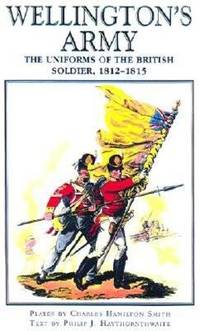
2006réf. x-1847345395Naval & Military Pr 2006. Hardcover. New. 216 pages. 8.50x5.50x0.63 inches. Naval & Military Pr hardcover
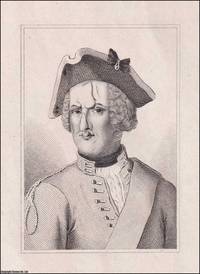
1809réf. 373329Robert Graves London Undated c.1809. Unframed Print. Very Good Condition. Robert Graves was renowned for his historical engravings which often depicted military figures and events. This particular illustration portrays Corporal Thomas Brown in 18th-century military attire. He is dressed in a distinguished uniform featuring a buttoned coat a sash across his chest and a striking tricorn hat an iconic piece of both military and civilian fashion of the time. His rank is indicated by the cord on his right shoulder. The tricorn was not just a stylish accessory; it served a practical purpose shedding rain and providing an unobstructed field of vision.Corporal Thomas Brown gained fame for his remarkable bravery during the Battle of Dettingen in 1743 a conflict within the War of the Austrian Succession. As a member of Kings Own Regiment Dragoons Blands Dragoons Brown demonstrated extraordinary courage by reclaiming his regiments standard after it had fallen into enemy hands. In the heat of battle he lost two horses beneath him and sustained grievous injuries including the loss of two fingers and most of his nose. Despite these wounds he fought his way through enemy lines recovered the standard and returned it to his regiment earning enthusiastic cheers from his fellow soldiers.His heroism was later recognized by King George II who awarded him a gold-topped walking stick a silver prosthetic nose and a pension. After retiring from military service Brown settled in Yarm where he ran an inn named after himself. He passed away in 1746 and was laid to rest in St Mary Magdalenes Church where his marked grave remains today. This unmounted image is approx 10 x 15 cms the sheet overall is 20 x 28 cms. Mildly creased in the outer margins which will simply disappear from view when mounted and framed. Category: PRINTS : Antiquarian Interest; Antiquarian & Rare; Printed before 1800; Special Interest B. This item may require more postage than the rates shown for delivery outside the UK. If extra postage is required we will contact you before processing your order and you will be given the details and option to decline the extra cost. Robert Graves unknown
réf. 1k4607Der Soldat Verlagsges. Bln. um 1930. zusammen ca. 210 S. mit Abbildungen u. Zeichnungen. privater Halbleinen der Zeit. - Enthalten: 1.: Das Königlich Preußische 5. Garde-Regiment zu Fuß/2.: Die Königlich Preußischen 1. und 2. Leibhusaren/3.: Das Königlich Preußische Magdeburgische Jäger-Bataillon Nr. 4/4.: Königlich Preußisches Grenadier-Regiment König Friedrich der Große/5.: Vom Cajütsmann zum Admiral/6.: Königlich Preußisches Füsilier-Regiment Generalfeldmarschall Graf Moltke/7.: Die deutschen Fliegertruppen - unknown
réf. 373289Unframed Print. Very Good Condition. Phoebe Hessel or Hassel born Smith March 1713-December 12 1821 is renowned for masquerading as a man to join the British Army enlisting in the 5th Regiment of Foot to fight alongside her partner. She remained undetected as a soldier for 17 years serving as a soldier in both the West Indies and Gibraltar and both she and her lover participated in the Battle of Fontenoy in 1745 where Phoebe sustained a bayonet injury to her arm. She passed away on December 12 1821 at the age of 108 despite the 102 as per the note on the drawing and was interred in the graveyard of St Nicholas Church in Brighton. She was occasionally called the 'Stepney Amazon'. Amazon Street and Hessel Street named in her honor still exist in Stepney now part of the London Borough of Tower Hamlets. This wood engraving on a single sheet with a likely contemporary or near so handwritten caption measures approx. 15.5 cms x 19cms with the image approx 8 x 8 cms. The top margin has an old creased fold. See picture. Category: PRINTS : Antiquarian Interest; Antiquarian & Rare; Printed before 1800; Special Interest B. This item may require more postage than the rates shown for delivery outside the UK. If extra postage is required we will contact you before processing your order and you will be given the details and option to decline the extra cost. unknown
réf. DADAX3791385372Prestel 2019-06-25. Bilingual. hardcover. New. 10.19x0.59x11.25. Buy with confidence. Excellent Customer Service & Return policy. Prestel hardcover
réf. SONG3791385372Prestel 2019-06-25. Bilingual. hardcover. Used: Good. 10.19x0.59x11.25. Buy with confidence. Excellent Customer Service & Return policy. Prestel hardcover
1975réf. 79194Frankfurt: Soldat & Technik 1975-79. 1st edition. As New. small folio. pictorial wrappers c.600pp. b/w plates text ills. diags. Editorial supplement to Soldat & Technik the German Army journal. Copiously illustrated with photos & diagrams primarily of armour & missiles Soldat & Technik unknown
2006réf. x-0810857243Scarecrow Pr 2006. Paperback. New. 2revised ed edition. 221 pages. 8.50x5.50x1.00 inches. Scarecrow Pr paperback
1886réf. 33244Paris A Quantin Imprimeur-editeur 1886 1886. Hardcover. 8vo xlx239pp half morocco with marbled boards title gilt on spine top edge gilt silk book mark binding and text fine Paris, A Quantin, Imprimeur-editeur 1886, hardcover
réf. 9788492337811-3-001Hardcover. ESTADO: BUENO. Libro en buen estado. Puede presentar marcas de uso. hardcover
réf. N03Q-00887Graywolf Press. Used - Good. Good condition. A copy that has been read but remains intact. May contain markings such as bookplates stamps limited notes and highlighting or a few light stains. Graywolf Press unknown
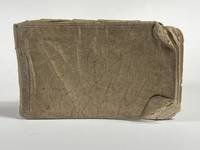
1915réf. 4227France Belgium England 1915. Good. Oblong 8vo. Small "Walker's Service Notebook" 154 x 94 mm lined 26 pages filled with neat entries in pencil and pen final page of diary loose the remaining portion of the notebook i.e. about 2/3 blank. Original limp cloth covers worn. § Extraordinary manuscript diary of an anonymous British soldier beginning April 12th 1915 and ENDING ABRUPTLY IN THE TRENCHES AFTER A GAS ATTACK. The final entry was dated December 19th 1915 which was THE FIRST DAY PHOSGENE GAS WAS USED AGAINST BRITISH SOLDIERS. The short diary is rich in detail of life at the front. The anonymous soldier belonged to the 49th West Riding Division which had a large number of gas casualties when soldiers in reserve lines did not receive a warning in time to put on their helmets. A study by British medical authorities arrived at a figure of 1069 gas casualties 120 of which were fatal. It is very possible that the present manuscript was written by one of those men. It seems probable that with access to the right regimental records the identity and fate of the soldier could be learned and his story told in full; however even as an anonymous diary the interest and poignancy of this personal record is clear. The events recorded span just nine months. On April 12th the soldier leaves Edenthorpe near Doncaster and crosses the channel to Le Havre that evening "packed like herrings" and accompanying horses and wagons. Over the next few months he records laying lines opening signal offices handling horses towns and villages visited billets and meals injuries regiments encountered names of comrades and O.C.s shelling rain and mud. He sees the Northumberland Hussars the Indian Corps and Royal Horse Artillery. On May 9th he records the Battle of Aubers Ridge: "Off duty at 7am. Attack began at 5am by Artillery. Signal thro' during day showed heavy losses in E. Lancs Lincolns. 13th London and other Batts. Had coffee in Fleurbaix and then to bed in barn. Off duty 3pm. Attack still proceeding without much impression on our line. French said to be doing well. At night we have the two windows in our Signal Office made up with corrugated iron & sandbags." For the entry dated May 12th our author notes that the name of the Division has been "altered to the 49th" thereby confirming the identity of his Division. On May 24th: "The Allamands dropped about 6 shrapnel in our vicinity." From a period of steady work and periodic pleasures "had tea & cakes at a patisserie & and then back after buying some books" "glorious day" the situation deteriorates with the weather "torrential rain dugouts leaking & 18" water on my floor". They move to Chateau de Trois Tours and on July 13th there is "rather an exciting night" with a bombardment from 7.30 to 10.30. On the 14th "The whole place is being encircled by barbed wire & trenches & the furniture is being moved out of the chateau." On the 15th "At 12.45pm about 12 shells fell round the chateau made a dive for the Signal Office Billy Edwards & Gus Harris wounded in thigh and ankle." They were shelled again on the 16th. On December 1st he travels back to Sheffield on leave returning on December 8th. The company are now holed up near Ypres at Hospital Farm the name given to a farm building used as a dressing station. The final entry reads "Dec 19th 'S.O.S.' Gas attack 5.30 am things lively until 8.30am. 146 & 148 des. 148 soon repaired from chateau". The cemetery at Hospital Farm contains 115 Commonwealth burials of the First World War. On the significance of the 19 Dec. 1915 battle at Wieltje Belgium northeast of Ypres see the long Wikipedia entry "German Phosgene Attack of 19 December 1915." The diary contains many clues that could help identify our writer in military records. It is not certain that he was one of the first British casualties to Phosgene gas but it seems tragically likely. As it stands the final entry in the diary marks an important milestone in the war: phosgene gas would eventually be responsible for about 85% of the 90000 deaths caused by chemical weapons during World War I. unknown
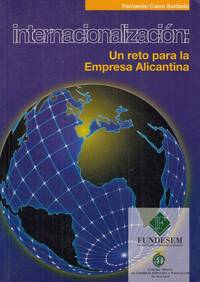
1997réf. 7355Gráficas Cubanas 1997. paperback. Bueno. Alicante 1997. Gráficas Cubanas. Sello del anterior propietario. Rústica. 424 pp. 21x14 Gráficas Cubanas paperback
réf. DG-49-485865777821New. unknown
réf. ria9781032666259_inpPaperback. New. New Book; Fast Shipping from UK; Not signed; Not First Edition; Le Soldat's Voluntary Servitude. Masochism and Morality presents an extraordinary analysis of masochism the subject death drive and sexual discourse inspired by Freudian drive theory philosophy gender theory political science and m paperback
réf. ria9780262017473_inpHardback. New. New Book; Fast Shipping from UK; Not signed; Not First Edition; N/A hardcover
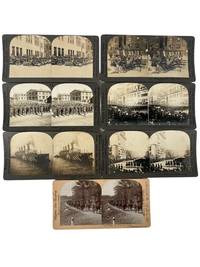
1918réf. 205021918. Buffalo Soldier regiments depicted in stereoview photographs from the World War I era document African American cavalrymen and infantry units serving in segregated formations of the United States Army during the early twentieth century. These images record soldiers from several historically significant Black military units including the 9th U.S. Cavalry the 10th Cavalry and the 369th Infantry Regiment. African American soldiers served in large numbers during World War I despite segregation in the armed forces and the war marked a turning point in public recognition of Black military service. The photographs capture cavalry movement machine gun training and celebratory returns from the European front preserving visual evidence of the military presence and public visibility of Buffalo Soldiers during the conflict. Archive consists of seven stereoview photographs published by the Keystone View Company during the World War I period. The views depict soldiers from the 9th U.S. Cavalry the 8th Regiment of Colored Troops the 10th Cavalry the Chicago Regiment of Colored Troops and the 15th Regiment of the 369th Infantry. Two stereoviews show Black machine gun companies operating Lewis guns one of the principal light machine guns used on the Western Front during the war. Another view shows Troop K of the 10th Cavalry moving on horseback at Camp Chickamauga in Georgia. Additional stereoviews depict African American soldiers returning from European service and marching in public celebrations including scenes of troops parading along major boulevards such as Fifth Avenue in New York. The Buffalo Soldier regiments had already established a long military record before the First World War. Units such as the 10th Cavalry formed part of the segregated Regular Army created after the Civil War and served in campaigns across the western United States during the Indian Wars later participating in the Spanish American War the Philippine American War and operations during the Mexican Revolution. World War I marked one of the final periods in which cavalry units remained visible in American military organization as mechanized armor and motorized vehicles soon replaced mounted troops. At the same time Black soldiers who returned from service were celebrated in wartime parades yet continued to face segregation and racial discrimination within American society. Stereoview cards remain well preserved with light age wear typical of early twentieth century photographic prints. Very good condition overall and a visually compelling record of Buffalo Soldiers during the World War I era. unknown
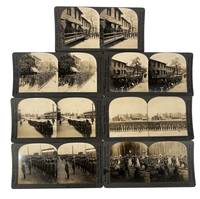
1918réf. 205031918. Keystone View Company. Buffalo Soldiers stereoview photographs World War I era document African American military service in the American Expeditionary Forces and place segregated Black troops within the broader Allied war effort in Europe. The images identify units of "Colored Troops" including engineers of the Signal Corps and depict formations logistical organization and moments of assembly such as soldiers "lined up for democracy." These photographs situate African American soldiers-many of whom descended from the Buffalo Soldier regiments established after the Civil War-within a transnational military environment that included French British and colonial forces. Scenes showing interaction with Moroccan and Indian troops on French roads reflect the multinational composition of Allied armies during the final phases of the war while the presence of Black American troops underscores their continued participation in major military operations despite segregation within the U.S. Army. France and possibly other European locations circa 1917-1919. Archive of seven stereoview photographs published by the Keystone View Company. Images depict African American soldiers in formation including lines for mess and organized ranks as well as mixed Allied groupings on roadways and near encampments. Stereographic format intended for three-dimensional viewing with printed captions identifying subjects and units. Photographs emphasize both structured military order and the varied roles occupied by Black troops particularly in engineering and support divisions. Produced during the final years of World War I these stereographs align with the expanded deployment of African American soldiers overseas and the broader visibility of Black troops within global conflict. While their service contributed to Allied operations these soldiers returned to a United States that maintained racial segregation and limited civil rights situating the archive within the larger history of African American military participation and postwar inequality. As visual records the images support research into race military organization and the international dimensions of the war. Light handling wear; overall very good condition. unknown
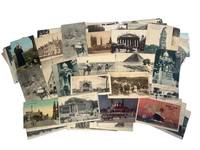
1915réf. 207331915. Australian Imperial Force soldiers postcard correspondence Archive 1915 to 1916 documents ANZAC service during the Gallipoli campaign and subsequent deployments across the Mediterranean theater through sustained communication with a civilian recipient in Sydney. The archive centers on letters addressed to a woman identified as Olga written by multiple soldiers including her brother Eric and another correspondent George. The material records trench conditions troop movement and the transmission of news from the front including the report of Eric's death. The correspondence situates individual experience within the Gallipoli campaign where Allied forces sustained heavy casualties in operations against Ottoman defenses and traces the continuation of service across France Egypt and Greece following the withdrawal. Archive of 54 handwritten postcard letters. Europe North Africa and the Mediterranean 1915 to 1916. Each message is written on the verso of a period postcard most measuring approximately 5.5 x 3.5 inches with photographic views of cities and towns including London French villages Cairo and locations in Greece. Several images depict damaged urban environments. One postcard bears a censorship marking with portions of text obscured. The correspondence includes multiple authors primarily Eric and George. In one letter from France George writes "Thank you for the pose.We are having beautiful weather at present. Just like an Australian spring. Love from George." Eric writing from Egypt on April 16 notes "We are once again in the trenches where we have had a very lovely time for a few days." A later letter reports Eric's death stating "You need have no fear that he was decently buried" while subsequent correspondence reflects diminished communication and shifting personal relationships including George's inquiry "Do you ever write to me Olga. I wish a few letters from you would turn up." The Gallipoli campaign fought from April 1915 to January 1916 resulted in extensive casualties and became central to the development of ANZAC identity commemorated annually as Anzac Day. Following the evacuation of Gallipoli Australian forces were redeployed across multiple theaters including the Western Front and Middle Eastern campaigns reflected in the geographic range of these postcards. The archive documents the function of wartime correspondence under censorship and the role of letters in conveying both military experience and personal loss to the home front. Light wear consistent with handling; overall very good condition. unknown
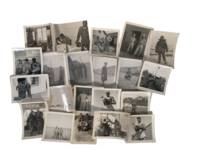
1941réf. 196921941. African American Army Transportation Corps photo archive depicting Black enlisted men and noncommissioned officers in wartime transport service occupation duty and domestic training between 1941 and 1952. The strongest identified material centers on the 3528th Transportation Corps Truck Company active from 1943 to 1946 and its successor the 551st Transportation Corps Truck Company active from 1946 to 1947. A captioned portrait places Joseph Galloway "somewhere in Belgium" on December 6 1944 ten days before Germany opened the Ardennes offensive that became the Battle of the Bulge. President Harry S. Truman issued Executive Order 9981 on July 26 1948 requiring "equality of treatment and opportunity" in the armed services but Army integration unfolded gradually through the occupation years and into the 1950s. Photo archive of 100 silver gelatin photographs ranging from 1.75 x 2.25 inches to 3.75 x 5.5 inches United States Belgium Japan and West Germany circa 1941-1952. More than half show Black soldiers in uniform including studio and outdoor portraits weapons training field scenes recruits and senior noncommissioned officers. Galloway poses with a pistol in Belgium; transport trucks appear in operation and maintenance; unit facilities domestic training camps interregimental competitions a 155 mm howitzer and soldiers beside a Sherman tank marked "Barbra" extend the record beyond portraiture. Occupation-era scenes include bombed urban landscapes in Japan locations identified as Osumi and Kyoto Black troops with Japanese civilians Buddhist monks at a temple and later service in West Germany including Bonn and Karlsruhe. Approximately one quarter bear manuscript captions identifying individuals dates or locations. In WWI many Black troops were denied combat roles and assigned to stevedore work labor battalions butchery companies road work hauling unloading ships and other manual support duties. The National Archives specifically notes that many Black units were kept from front-line fighting and "relegated to support duties." These Black soldiers served heavily in transportation engineering construction and supply roles during World War II making Army logistics one of the central places where African American military labor sustained Allied movement while the armed forces remained segregated. Several scenes place Black and White soldiers working alongside one another preserving the transitional military culture between wartime segregation and the uneven implementation of Truman's desegregation order. Light edge wear occasional creasing and minor surface abrasions to several prints; manuscript captions legible where present; no significant losses observed. Overall in very good condition. The archive gives named faces unit evidence vehicles weapons occupation landscapes and manuscript identifications across the decade when Black military service moved from segregated wartime labor toward formal integration. unknown
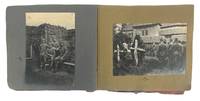
1917réf. 200631917. Czechoslovak Legion soldiers photographed during World War I document the participation of Czech and Slovak troops fighting alongside Allied forces in campaigns across Europe. Approximately seventy eight photographs record military life among soldiers associated with the Czechoslovak armed formations that emerged during the war as nationalist units seeking independence from the Austro Hungarian Empire. The images depict trench warfare troop encampments drills and daily life among soldiers whose political objective was the creation of an independent Czechoslovak state. The photographs illustrate the conditions and routines experienced by these soldiers during the conflict that ultimately contributed to the establishment of Czechoslovakia at the end of the war in 1918. Photographic album containing approximately seventy eight photographs measuring about 4.75 x 6.5 inches mounted on album leaves. The images depict soldiers in trench positions infantry movements across terrain and group formations during drills. Additional photographs show military camps outdoor meals mess areas and group portraits including one of a military band. Several photographs capture village architecture including houses courtyards and churches encountered by the soldiers during the campaign. The album also contains images of wartime medical care including a medic working with wounded soldiers a funeral scene with graves and cemetery crosses and a horse drawn wagon train traveling along a mountain road. Other photographs depict staged performances and theatrical scenes presented outdoors for soldiers. During World War I Czech and Slovak nationalist leaders organized volunteer military formations known collectively as the Czechoslovak Legions composed of soldiers drawn from prisoners of war and expatriate communities who sought to fight alongside the Allied powers against Austria Hungary. Their participation in the war strengthened international support for the creation of an independent Czechoslovakia which was established following the collapse of the Austro Hungarian Empire in 1918. Photographs of trench systems encampments and military drills in this album illustrate the entrenched character of warfare that dominated much of the conflict as armies constructed extensive defensive systems while attempting to break enemy lines through periodic assaults. Album containing approximately seventy eight photographs measuring about 4.75 x 6.5 inches. Album boards show chipping along the edges while photographs remain clear with strong contrast. Overall condition very good. unknown
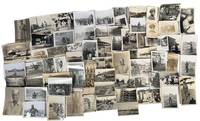
1957réf. 193551957. Vernacular photograph archive of African American soldiers in integrated U.S. Army units circa 1950s documents the early implementation of military desegregation following Executive Order 9981 and provides visual evidence of Black and white soldiers serving together during and after World War II including the Korean War. The photographs place African American servicemen within the first generation of formally integrated military units preceding broader civil rights gains in civilian society. Scenes of joint training transport and daily life show Black soldiers operating alongside white counterparts in contexts ranging from shipboard movement to antiaircraft defense positions indicating the practical realities of integration in active and post-conflict environments. The archive captures both structured military activity and informal moments offering a record of service that contrasts with the segregated conditions that had defined earlier periods of U.S. military history. United States and Korea circa 1950s. Archive of 21 silver gelatin vernacular photographs with several images bearing manuscript captions on the verso identifying individuals and locations including one noting Korea 1957-1958. Photographs depict a range of settings including military bases in Korea stateside camps shipboard scenes and antiaircraft gun emplacements in snowy terrain. Multiple images show interracial groups of soldiers posing with rifles and submachine guns while others capture informal activities including one sequence featuring a soldier holding an inflated puffer fish aboard a ship. One photograph includes a note written in Italian on the verso indicating cross-cultural contact or circulation. Composition and subject matter vary from posed group portraits to candid operational and leisure scenes. Created during the first decade of enforced military integration these photographs align with the transitional period in which desegregation policies were implemented unevenly across the armed forces with fuller integration not realized until the mid-1950s. The Korean War served as a critical testing ground for integrated units accelerating changes in military structure and social dynamics within the ranks. This archive provides a ground-level view of those developments documenting both the normalization of interracial military service and the persistence of shared routines duties and environments across racial lines. Light wear from handling with minor surface marks and occasional verso annotations; overall very good condition. unknown
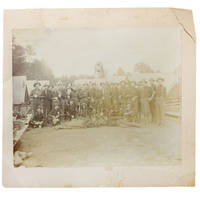
1890réf. 187391890. African American soldier photographed among members of a United States Army camp unit in the American West during the late nineteenth century providing visual documentation of Black participation within the military environment during the era of segregated service. African American soldiers served in the United States Army throughout the nineteenth century most prominently in units known as the Buffalo Soldiers which were formally organized after the Civil War. While Black soldiers were typically assigned to segregated regiments images occasionally record their presence in mixed military environments such as camps labor details or logistical units. The photograph captures a group of soldiers gathered in a temporary camp setting and includes a seated Black soldier identified by a contemporary handwritten note on the verso reading "Notice 'Black Soldier.'" Albumen sepia tone photograph mounted on photographer's board showing a group of American soldiers posed within a military encampment. Photograph measuring approximately 8.5 x 10 inches mounted on a photographer's board measuring approximately 10.75 x 10 inches. The men are dressed in clothing typical of western military and frontier settings of the late nineteenth century including dark buttoned shirts trousers supported by suspenders and boots. The African American soldier appears seated among the group with a cigarette in his mouth. The soldiers are gathered in a clearing surrounded by trees where rows of tents are arranged on raised wooden platforms suggesting an organized encampment. Cooking equipment stacked blankets plates and tankards are visible indicating a communal meal or informal gathering. One soldier holds what appears to be a long rifle with a visible barrel and wooden stock. Several soldiers sit or recline on the ground in the foreground while others stand behind them creating the appearance of an informal group portrait taken during daily camp life rather than a formal military arrangement. Handwritten note on the verso reads "Notice 'Black Soldier.'" Top right corner of the board cracked with tape repairs on the verso; slight water staining at the top left corner and damp staining at the lower left corner with partial cracking at the lower right corner. Image itself remains clear and largely unaffected. Overall condition good. The photograph preserves a visual record of African American presence within the late nineteenth century U.S. Army camp environment during a period when the armed forces remained formally segregated. unknown
réf. 100968The full-length albumen paper studio portrait 92 × 55 mm is mounted as issued on the printed card of W.H. Schroeder 649 George Street Haymarket 'and at Princes Street Grafton'. The firm was definitely active at that address from 1867 to 1879 but the image appears to be earlier rather than later in this period. The uniform is that of the NSW Volunteer Artillery from the 1860s. Very similar caps are also to be found in a Tasmanian photograph in the collection of the Australian War Memorial A04784 'ten men of the Hobart Town Volunteers Artillery and ten men from the First Rifles' dated October 1863. unknown
réf. B9781494107291Paperback / softback. New. paperback