4.708 Ergebnisse
2005Best.-Nr. 79903Albuquerque NM: Sandia National Laboratories 2005. Presumed First Edition First printing thus. Wraps. Very good. 2 ii 32 4 pages. Footnotes. Illustrations color. Appendices A-E includes Glossary Visuals. Tables. ASC Timeline. Cover has minor wear and soiling. The Advanced Simulation and Computing Program ASC is a cornerstone of the Stockpile Stewardship Program providing simulation capabilities and computational resources to support the annual stockpile assessment and certification to study advanced nuclear-weapons design and manufacturing processes to analyze accident scenarios and weapons aging and to provide the tools to enable Stockpile Life Extension Programs SLEPs and the resolution of Significant Finding Investigations SFIs. This requires a balanced resource including technical staff hardware simulation software and computer science solutions. This Program Plan describes the ASC strategy and the deliverables required to accomplish the FY 2006-2010 multifaceted objectives defines program goals introduces the new national work breakdown structure and details the new subprograms their strategics and their associated performance indicators. The plan also includes ASC Level 1 Milestones and the top ten risks. To ensure synchronizations with the SSP's needs the Program Plan will be reviewed and updated annually. The Advanced Simulation and Computing Program or ASC is a super-computing program run by the National Nuclear Security Administration in order to simulate test and maintain the United States nuclear stockpile. The program was created in 1995 in order to support the Stockpile Stewardship Program or SSP. The goal of the initiative is to extend the lifetime of the current aging stockpile. After the United States' 1992 moratorium on live nuclear testing the Stockpile Stewardship Program was created in order to find a way to test and maintain the nuclear stockpile. In response the National Nuclear Security Administration began to simulate the nuclear warheads using supercomputers. As the stockpile ages the simulations have become more complex and the maintenance of the stockpile requires more computing power. Over the years due to Moore's Law the ASC program has created several different supercomputers with increasing power in order to compute the simulations and mathematics. Within the ASC program there are six subdivisions each having their own role in the extension of the life of the stockpile. Facility Operations and User Support: The Facility Operations and User Support subdivision is responsible for the physical computers and facilities and the computing network within ASC. They are responsible for making sure the tri-lab network computing storage space power usage and the customer computing resources are all in line. Computational Systems and Software Environment: The Computational and User Support subdivision is responsible for maintaining and creating the supercomputer software according to NNSA's standards. They also deal with the data networking and software tools. The ASCI Path Forward project substantially funded the initial development of the Lustre parallel file system from 2001 to 2004. Verification and Validation: The Verification and Validation subdivision is responsible for mathematically verifying the simulations and outcomes. They help software engineers write more precise codes in order to decrease the margin of error when the computations are run. Physics and Engineering Models: The Physics and Engineering Models subdivision is responsible for deciphering the mathematical and physical analysis of nuclear weapons. They integrate physics models into the codes in order to gain a more accurate simulation. They deal with the way that the nuclear weapon will act under certain conditions based on physics. They also study nuclear properties vibrations high explosives advanced hydrodynamics material strength and damage thermal and fluid response and radiation and electrical responses. Integrated Codes: The Integrated Codes subdivision is responsible for the mathematical codes that are produced by the supercomputers. They use these mathematical codes and present them in a way that is understandable to humans. These codes are then used by the National Nuclear Society Administration the Stockpile Steward Program Life Extension Program and Significant Finding Investigation in order to decide the next steps that need to be taken in order to secure and lengthen the life of the nuclear stockpile. Advanced Technology Development and Mitigation: The Advanced Technology Development and Mitigation subdivision is responsible for researching developments in high performance computing. Once information is found on the next generation of high performance computing they decide what software and hardware needs to be adapted in order to prepare for the next generation of computers. Sandia National Laboratories paperback
2018Best.-Nr. 75706Washington DC: National Nuclear Security Administration 2018. Presumed First Edition First minting thus. Coin/Medal. As new. Approximately 2.25 inches in diameter. Front side has a black band at the outer edge with Mutual Defense Agreement at the top 60 years of partnership and Security at the bottom and the center image has the flags of both nations large number 60 and smaller dates 1958 and 2018. The back side has the same black band and text and the center has the following text: Here we are together defending all that to free man is dear. Prime Minister Winston Churchill Addressing the U.S. Congress December 24 1941. The 1958 US-UK Mutual Defense Agreement or UK-US Mutual Defence Agreement is a bilateral treaty between the United States and the United Kingdom on nuclear weapons cooperation. The treaty's full name is Agreement between the Government of the United States of America and the Government of the United Kingdom of Great Britain and Northern Ireland for Cooperation on the uses of Atomic Energy for Mutual Defense Purposes. It allows the United States and the UK to exchange nuclear materials technology and information. While the US has nuclear cooperation agreements with other countries including France and some NATO countries this agreement is by far the most comprehensive. Harold Macmillan called it "the Great Prize" National Nuclear Security Administration unknown
2006Best.-Nr. 80402Washington DC: National Nuclear Security Administration Office of Defense Programs 2006. Presumed First thus. Three Ring Binder. Good. This binder has seven tabs five with information. After a table of contents the tabs are: Agenda Attendee Listing NA-11 Opening Comments Draft QMU Business Operating Procedure missing Definition of Terms QMU Site Differences missing and White Paper on "National Certification Methodology for the Nuclear Weapon Stockpile" . The White Paper is 8 pages with color illustrations. The Table of Contents has the name Deeny sic Deeney written in the upper right corner. This is believe to have been the copy of a Dr. Christopher Deeny then a senior executive in the office of Assistant Deputy Administrator for Research Development and Simulation NA-11. He later rose to the Assistant Deputy Administrator position. The agenda included assessments of QMU Methodologies at each lab a W76 Nuclear example a W80 example QMU differences between sites QMU Inconsistencies and a Path Forward discussion. There are 30 attendees listed from Sandia Los Alamos Livermore Argonne DOE Office of Science and NNSA. The NA-11 Opening Comments is a nine vugraph presentation that addressed workshop purpose goals description history external interest and desired outcome. The White Paper was authored by Bruce T. Goodwin then of Livermore and Raymond Juzaitis then of Los Alamos later head of the LLC that operated the Nevada National Security Site. This is a rare surviving snapshot of the U.S. Weapons Program development and assessment of Quantification of Margins and Uncertainties in the context of the U.S. Nuclear Weapons Program absent underground testing. Derived from Wikipeida: Quantification of Margins and Uncertainty QMU is a decision-support methodology for complex technical decisions. QMU focuses on the identification characterization and analysis of performance thresholds and their associated margins for engineering systems that are evaluated under conditions of uncertainty particularly when portions of those results are generated using computational modeling and simulation. QMU has traditionally been applied to complex systems where comprehensive experimental test data is not readily available and cannot be easily generated for either end-to-end system execution or for specific subsystems of interest. Examples of systems where QMU has been applied include nuclear weapons performance qualification and stockpile assessment. QMU focuses on characterizing in detail the various sources of uncertainty that exist in a model thus allowing the uncertainty in the system response output variables to be well quantified. These sources are frequently described in terms of probability distributions to account for the stochastic nature of complex engineering systems. The characterization of uncertainty supports comparisons of design margins for key system performance metrics to the uncertainty associated with their calculation by the model. QMU supports risk-informed decision-making processes where computational simulation results provide one of several inputs to the decision-making authority. There is currently no standardized methodology across the simulation community for conducting QMU; the term is applied to a variety of different modeling and simulation techniques that focus on rigorously quantifying model uncertainty in order to support comparison to design margins. The fundamental concepts of QMU were originally developed concurrently at several national laboratories supporting nuclear weapons programs in the late 1990s including Lawrence Livermore National Laboratory Sandia National Laboratories and Los Alamos National Laboratory. The original focus of the methodology was to support nuclear stockpile decision-making an area where full experimental test data could no longer be generated for validation due to bans on nuclear weapons testing. The methodology has since been applied in other applications where safety or mission critical decisions for complex projects must be made using results based on modeling and simulation. Examples outside of the nuclear weapons field include applications at NASA for interplanetary spacecraft and rover development missile six-degree-of-freedom simulation results and characterization of material properties in terminal ballistic encounters. QMU focuses on quantification of the ratio of design margin to model output uncertainty. The process begins with the identification of the key performance thresholds for the system which can frequently be found in the systems requirements documents. These thresholds also referred to as performance gates can specify an upper bound of performance a lower bound of performance or both in the case where the metric must remain within the specified range. For each of these performance thresholds the associated performance margin must be identified. The margin represents the targeted range the system is being designed to operate in to safely avoid the upper and lower performance bounds. These margins account for aspects such as the design safety factor the system is being developed to as well as the confidence level in that safety factor. QMU focuses on determining the quantified uncertainty of the simulation results as they relate to the performance threshold margins. This total uncertainty includes all forms of uncertainty related to the computational model as well as the uncertainty in the threshold and margin values. The identification and characterization of these values allows the ratios of margin-to-uncertainty to be calculated for the system. These M/U values can serve as quantified inputs that can help authorities make risk-informed decisions regarding how to interpret and act upon results based on simulations. Verification and validation V & V of a model is closely interrelated with QMU. Verification is broadly acknowledged as the process of determining if a model was built correctly; validation activities focus on determining if the correct model was built. V&V against available experimental test data is an important aspect of accurately characterizing the overall uncertainty of the system response variables. V&V seeks to make maximum use of component and subsystem-level experimental test data to accurately characterize model input parameters and the physics-based models associated with particular sub-elements of the system. The use of QMU in the simulation process helps to ensure that the stochastic nature of the input variables as well as the underlying uncertainty in the model are properly accounted for when determining the simulation runs required to establish model credibility prior to accreditation. National Nuclear Security Administration, Office of Defense Programs unknown
2008Best.-Nr. 75228Washington DC: National Nuclear Security Administration Defense Programs Program Integration Office Office of Program Management & Evaluation 2008. Presumed First Edition First issuance of disc content included draft material. CD-R. Good. The NNSA proposed a new Weapon Surveillance Facility WSF for non-destructive weapon and pit surveillance to supplement the existing Weapons Evaluation Test Laboratory. By relocating some testing now done at Lawrence Livermore National Laboratory the NNSA says the new WSF would help consolidate non-destructive testing facilities and reduce the number of sites in the nuclear weapons complex with Category I/II SNM. Since all significant quantities of Cat I/II SNM have now been removed from Livermore the NNSA must either find another location for the environmental testing carried out there or seek special authorization to allow Livermore to continue working with SNM for limited periods. The WSF could also free up some Pantex bays now used for evaluation to return to use for assembly/disassembly operations. This CD includes a draft final report of the Weapon surveillance Facility Integrated Project Team unfilled out Official Use Only stamp which as such has no force or effect. In addition to the 23 page draft report there are six word Expert Choice files Minimize investment Impact Minimize Cost Impact Workforce Impact Reduced Length of Transition Reduce square footage Storage Consolidation Decision Criteria and WSF Design Criteria. Some of the functions were being performed at the Lawrence Livermore National Laboratory building 332 but the major emphasis was on options for new construction at Pantex. This type of material rarely survives in either hardcopy or electronic form. This offers a rare snapshot into facility planning and mission assignments within the United States Nuclear Weapons Complex. National Nuclear Security Administration, Defense Programs, Program Integration Office, Office of Program Management & Evalu unknown
1942Best.-Nr. 43613Nebraska Historical Records Survey Project. Near Fine. 1942. Softcover. Tan wrappers clean and unmarked. Survey of historical materials and records available in Webster County Nebraska. Index. ; MCN35949; 4to 11" - 13" tall; 157 pp . Nebraska Historical Records Survey Project paperback
1903Best.-Nr. 035771Self-published 1903. First Edition. Paperback. Very Good. Prepared by The Educational Council and adopted by the New Hampshire State Teachers' Association. Paperback. Original paper wraps in very good condition. Sewn booklet. 122pp. "Property of Town of Derry NH" stamp on title page. There is no other writing in the book. Full refund if not satisfied. Self-published paperback
1968Best.-Nr. 8287New York Office of the Mayor 1968. Paperback. Very Good. Trade softcover light shelfwear to covers. Spine sunned along with band on cover along spine. Contents clean and tight. Black and white illustrations of 88 designs submitted by 86 firms. One illustration per design. Unpaginated. Scarce architecture title. New York Office of the Mayor paperback
Best.-Nr. 0484823183.Ghardcover. Good. Access codes and supplements are not guaranteed with used items. May be an ex-library book. hardcover
Best.-Nr. 68-8320Portland OR: WPA 1940. 4to. Wraps. 32 pp. Very Good. Woodcuts throughout. Mylar Dust Jacket. Scarce. Portland, OR: WPA, 1940. paperback
1929Best.-Nr. 017701Boston: D. C. Heath and Company 1929. First Edition. Hardcover. Very Good. Green cloth illustrated a little light blue spotty soiling on spine and front board 116pp. A very scarce title. D. C. Heath and Company hardcover
1918Best.-Nr. 4052411Garden City: Doubleday Page & Co 1918. Hardcover. Very Good in cloth boards. 32mo. 102 pp. Hunger map of Europe artistic decorated title page. Art deco illustrated end pages. Illustrations tables. Rare World War I publication. Doubleday, Page & Co hardcover
1922Best.-Nr. 192374Hanoi-Haiphong : Imprimerie d'extreme Orient 1922. First Edition. Paperback. Good paperback copy; edges somewhat dust-dulled and nicked with some wear to spine. Loss to front cover. Remains particularly and surprisingly well-preserved overall; tight bright clean and especially sharp-cornered. ; 8vo 8"" - 9"" tall; 104 pages; Description: 104p. 1 diag. folding tables 1 folding ; 28cm. Subjects: French Indochina -- Trade -- Exports -- Imports -- Commerce. Language: French. Hanoi-Haiphong : Imprimerie d'extreme Orient paperback
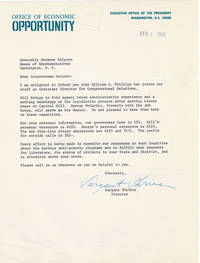
1966Best.-Nr. 101303Washington DC: February 5 1966. 1966. Very good. - Over 150 words typed on 10-1/2 inch high by 8 inch wide "Office of Economic Opportunity / Executive Office of the President" stationery. Sargent Shriver informs U.S. Congressman Seymour Halpern about new appointments to his office "I am delighted to inform you that William G. Phillips has joined our staff as Assistant Director for Congressional Relations." He goes on to tout Phillips qualifications and contact information concluding with "Every effort is being made to expedite our responses to your inquiries about the various anti-poverty programs and to fulfill your requests for literature the status of projects in your State and District and to otherwise serve your needs." Signed "Sargent Shriver" as director. Folded for mailing with creases to the bottom left corner else near fine. Sargent Shriver was an American politician and activist. He married Eunice Kennedy thus becoming part of the Kennedy family. Serving in the Kennedy and Johnson administrations he was the driving force behind the creation of the Peace Corps and founded the Job Corps Head Start and other programs as the architect of Johnson's "War on Poverty". He served as the first director of the Peace Corps from 1961 to 1965 and was the U.S. Ambassador to France under Lyndon Johnson from 1968 to 1970. The Queens New York Republican Congressman Seymour Halpern 1913-1997 started his political career as a campaign aide to New York's powerful mayor Fiorella La Guardia and first served in New York's State Senate for 14 years before seeking a seat in the U.S. Congress. In Albany Halpern sponsored 279 bills that became law including measures on schools housing civil rights nutrition and mental health. A Liberal he was something of an anomaly as the lone Republican representative from New York City and generally garnered support from Labor Unions and endorsement from the Liberal Party. Yet he never even considered switching parties as he considered membership in the Republican Party a family tradition and commitment. While he found ample time for his private pursuits including painting and collecting autographs he took his legislative duties very seriously. Of these he was proudest of his co-sponsorship of the 1964 Civil Rights Act and of the original 1965 Medicare legislation. Washington, DC: February 5, 1966.
1941Best.-Nr. 258604Richmond: Historical Records Survey of Virginia 1941. Soft Cover. Fair binding. Two Volumes plus Supplement. Bindings holding well. First and third volumes missing back wrappers; chipping to front wrapper vol. i minor loss to wrappers of vol. ii chipping to spines; tape marks to volumes. previous owner writing and tape mark to first blank page; light staining to edge of text block; no markings in text. Binding sound. Fair binding. Historical Records Survey of Virginia unknown
1940Best.-Nr. 131626Saint Paul MN: The Minnesota Historical Records Survey Project 1940. paperback. very good. 8 3/8 x 10 3/4" 166 pages. Previous owner's written and stamped name at upper corner of front cover and title page V. Everett. Smudge on first two pages marred at bottom front cover. The Cuyuna Range A History of a Minnesota Iron Mining District The Minnesota Historical Records Survey Project unknown
2001Best.-Nr. 73569Washington DC: U. S. Department of Energy 2001. Presumed First Edition First printing. Trade paperback. Very good. 217 3 pages. Illustrations. Cover has some wear and soiling. The mission of the Office of Nonproliferation and Arms Control NPAC is to prevent proliferation ensure peaceful nuclear uses and enable verifiable nuclear reductions. NPAC provides a comprehensive approach to strengthen nonproliferation and arms control regimes achieving its mission through four subprograms: International Nuclear Safeguards; Nuclear Controls; Nuclear Verification; Nonproliferation Policy. One of the gravest threats the United States and the international community face is the possibility that terrorists or rogue nations will acquire nuclear weapons or other weapons of mass destruction WMD. NNSA through its Office of Defense Nuclear Nonproliferation DNN works closely with a wide range of international partners key U.S. federal agencies the U.S. national laboratories and the private sector to secure safeguard and/or dispose of dangerous nuclear and radiological material and detect and control the proliferation of related WMD technology and expertise. The Office of Nonproliferation Research and Engineering part of the National Nuclear Security Administration within the Department of Energy conducts wide-ranging research for diverse end users at the federal and local level. As such the Office faces a number of unusual challenges in determining how to best serve its users' needs within its budget. The Chemical & Biological National Security Program was initiated in FY97 in response to the growing awareness of both the chemical and biological weapon capabilities available to potential attackers and the vulnerabilities of the U.S> population to these weapons. From the outset the program has drawn from the deep scientific and engineering talents in the national laboratories as well as from specialized expertise in academia and industry. A basic philosophy of the CBNP is that any near-term impact of research and development requires a mission focus. The program's goal was not just to develop technology but to apply it to solve real problems and to develop demonstrate and deliver technologies and systems to improved domestic defense capabilities and ultimately to save lives in the event of a chemical or biological attack. U. S. Department of Energy paperback
2002Best.-Nr. 76354Washington DC: United States Department of Energy National Nuclear Security Administration Defense Programs 2002. Presumed First Edition First printing. Wraps. Very good. iv 55 3 pages. Illustrations. Acronyms & Abbreviations. Glossary. This type of document is very ephemeral and it is believed that very few copies have survived in the more than two decades since it was issued. The United States government's Strategic Computing Initiative funded research into advanced computer hardware and artificial intelligence from 1983 to 1993. The initiative was designed to support various projects that were required to develop machine intelligence in a prescribed ten-year time frame from chip design and manufacture computer architecture to artificial intelligence software. The project was superseded in the 1990s by the Accelerated Strategic Computing Initiative and then by the Advanced Simulation and Computing Program. These later programs did not include artificial general intelligence as a goal but instead focused on supercomputing for large scale simulation such as atomic bomb simulations. The Advanced Simulation and Computing Program or ASC is a super-computing program run by the National Nuclear Security Administration in order to simulate test and maintain the United States nuclear stockpile. The program was created in 1995 in order to support the Stockpile Stewardship Program or SSP. The goal of the initiative is to extend the lifetime of the current aging stockpile. Among the sections in the Table of Contents are: Stockpile Stewardship Defense Applications Computer Science Integrated Computing Systems Strategic Alliances Verification and Validation Physics Modeling Weapons Simulation Modeling and Simulation Level 1 Milestones High Explosives Advanced Visualization Detonation Wave Titan IV Solid Rocket Motor Metropolis Center JCEL. United States Department of Energy, National Nuclear Security Administration, Defense Programs paperback
2017Best.-Nr. 74294Washington DC: United States. Department of Energy. National Nuclear Security Administration 2017. Presumed First Edition First printing. Wraps. Very good. vi 203 1 pages. Illustrations. Acronyms. References. Format us approximately 8.5 inches by 11 inches. Cover has slight wear and soiling. This is the final report on the NNSA's Security Roadmap Key Strategy 4 Develop and Sustain a Highly Capable Security Workforce. The report is the culmination of a year's work by a team of Industrial Organizational Leadership Development professionals from the National Training Center NNSA's Office of Human Capital Management and the Pacific Northwest National Laboratory. The report is a comprehensive states of how the NNSA can significantly improve the recruitment development maturation and retention of the security professional. The report was designed to address the whole-person in that the report uses a competency-modeling concept as a key predictor in human performance. The next steps will include teaming to actively work the approved recommendations as well as establishing working groups to develop action plans for achieving success of each recommendation. The National Nuclear Security Administration NNSA is the U.S. agency responsible for enhancing national security through the military application of nuclear science. NNSA maintains and enhances the safety security and effectiveness of the U.S. nuclear weapons stockpile without nuclear explosive testing; works to reduce the global danger from weapons of mass destruction; provides the U.S. Navy with safe and effective nuclear propulsion; and responds to nuclear and radiological emergencies in the U.S. and abroad. Established by the United States Congress in 2000 NNSA is a semi-autonomous agency within the United States Department of Energy. The National Nuclear Security Administration was created by Congressional action in 1999 in the wake of the Wen Ho Lee spy scandal and other allegations that lax administration by the Department of Energy had resulted in the loss of U.S. nuclear secrets to China. Originally proposed to be an independent agency NNSA gained the reluctant support of the Clinton administration only after it was instead chartered as a sub-agency within the Department of Energy to be headed by an administrator reporting to the Secretary of Energy. The first NNSA administrator appointed was Air Force General and CIA Deputy Director John A. Gordon. NNSA has four missions with regard to national security: · To manage the U.S. nuclear weapon stockpile. · To reduce global danger from weapons of mass destruction and to promote international nuclear safety and nonproliferation. · To provide the United States Navy with safe militarily effective nuclear propulsion plants and to ensure the safe and reliable operation of those plants. · To support United States leadership in science and technology. United States. Department of Energy. National Nuclear Security Administration paperback
1992Best.-Nr. 57374U. S. Department of Energy; Alaska Power Administration 1992. Wraps. good condition. Includes: illustrations diagrams maps. Various paginations approximately 200 pages. Map in rear pocket. Other References. Ink notation on front cover. This report was prepared to accompany the legislative proposal authorizing sale of the Eklutna and Snettisham Hydroelectric Projects and subsequent close out of the Alaska Power Administration. U. S. Department of Energy; Alaska Power Administration paperback
1967Best.-Nr. 73534Washington DC: National Aeronautics and Space Administration Office of Technology Utilization Scientific and Technical Information Division 1967. Presumed First Edition First printing. Wraps. Fair. vi 345 1 pages. Map. Illustrations some in color. Upper corner has gotten wet and some pages were stuck at the top fore-edge but are now separate with minimal impact on page content. Corporate library stamp on front cover. Name in ink on title page. Cover has other wear and soiling. Some page soiling. The Gemini Summary Conference emphasized the highlights of the Gemini Program and especially the flight results of the last five missions. This report contains the 21 technical papers presented at the conference as well as the introduction by George E. Mueller and concluding remarks by George M. Low. This copy once belonged to R. E. McGaughy who is listed as an author on some NASA technical reports. The Conference had sections on Space Orbital Maneuvering Man's Activities in Space Operational ExperienceGemini Onboard Experiments and Gemini summarization. Among the listed authors are: Edwin Aldrin Eugene Cernan Edward White Michael Collins Neil Armstrong Thomas Stafford and Charles Conrad. National Aeronautics and Space Administration, Office of Technology Utilization, Scientific and Technical Information Division paperback
2004Best.-Nr. 77646Amarillo TX: United States Department of Energy National Nuclear Security Administration and BWXT Pantex 2004. Presumed First Edition First printing thus. Spiral bound. Very good. Various paginations approximately 1/2 inch of material including stiff card tabs. 19 tabbed sections with vugraphs rather than text. This is marked Official Use Only exemption category 2h. Based upon Supreme Court rulings and other guidance this limitation is understood to no longer apply. The Pantex Plant is the primary United States nuclear weapons assembly and disassembly facility that aims to maintain the safety security and reliability of the nation's nuclear weapons stockpile. The facility is located near Amarillo Texas. The plant is managed and operated for the U. S. Department of Energy by Consolidated Nuclear Security and Sandia National Laboratories. Consolidated Nuclear Security LLC CNS is composed of member companies Bechtel National Inc. Leidos Inc. Orbital ATK Inc. and SOC LLC with Booz Allen Hamilton Inc. CNS also operates the Y-12 National Security Complex. Among the topics covered are: Authorization Basis/USQ Process Lightning W56 Incident Electro-Static Discharge Multi-Unit Processing Tooling LEP Preparations IWAP Program Management Budget Laboratory Partnership/Relations SMRI Performance Indicators Safety QA Delivery Performance Maintenance Software Quality Assurance SQA Long Term Operating Plan and BWXT Pantex Long-Term View. United States Department of Energy, National Nuclear Security Administration and BWXT Pantex unknown
Best.-Nr. 61771Washington DC; Boca Raton FL: National Archives Trust Fund Board; Social Issues Resources Series Inc. Hardcover. Good. No dust jacket as issued. Slipcase has been damaged but the contents are in good condition. vii 79 p. Includes illustrations. Glossary. Annotated bibliography. Time Line. In addition to the 86 page booklet there are a series of f54 acsimile documents all present provided for classroom use. This is the fourth in a special series to make National Archives records available to the public in appropriate forms in part through the work of its Office of Educational Programs in producing a series of supplementary tearching units. National Archives Trust Fund Board; Social Issues Resources Series, Inc hardcover
1943Best.-Nr. 62745Washington DC: United States Government Printing Office 1943. Presumed first edition/first printing. Wraps. Good. No dust jacket as issued. Cover has some wear and soiling. Ink note on front cover. iii 67 p. Includes illustrations. 78th Congress 1st Session. House Document No. 358. This report addresses price control rationing rent control and enforcement. These documents have becoming increasingly scarce in the secondhand scholarly and collector communities. United States Government Printing Office paperback
1942Best.-Nr. 31264Washington D.C.: United States of America Office of Price Administration 1942. Book. Very Good. Paperback. An assortment of war ration books from the United States of America and a Ration Book Holder Household with a V for Victory on the cover and when opened has pockets for the war ration books and stamps. Books include War Ration Book One 2; War Ration Book Two 2; War Ration Book Three five; War Ration Book Four four; all are filled in with names and have sets of ration stamps that go with them. Also some ration coupons for sugar are included in this group. The holder is paper with a leather-like texture and a cloth spine; it has wear to edges. No date circa 1942. United States of America Office of Price Administration Paperback
1907Best.-Nr. 035404Cambridge: The University Press 1907. Paperback. Very Good. Original paper wraps slightly torn around the edges. Small tear at head of spine. 65pp. Full refund if not satisfied. The University Press paperback