8.294 Ergebnisse
2021Best.-Nr. 2081502111900872Magazine Company 2021. Soft Cover. Fine. The book is in fine condition. Magazine Company paperback
Best.-Nr. 53K000002L7EUnited States Department of Comm. unknown_binding. Like New. . No writing or tears United States Department of Comm unknown
1945Best.-Nr. 61744Washington DC: United States. Department of State 1945. Presumed first pre-printed version. Hardcover. Fair. No dust jacket as issued. Highlighting/underlining. Signed by author. Worn and soiled. Covers torn with front corner missing on Appendices volume. Sectioned tabbed. 2 volume set. Rare. The second volume are the Appendices to the Final Report. Various paginations. Memeographed production. Errata. Two-hole punched with metal fastener. This report should not be characterized as an expression of the adopted policy or program of the U. S> Govern exepter as the policy recommend may have been reflected in the Yalta Declaration the Berlin Protocol or public announcements by the President or the Department of State. On Sepbert 28 1944 President directed the Foreign Economic Administration to conduct "studies form the economic standpoint of what should be done after the surrender of Germany to control its power and capacity to make war in the future. " This function was later transferred to the Department of State when the entire Foreign Economic Administration was dissolved shortly after the end of the war. This report largely completed under the aegis of the Foreign Economic Administration was submitted as the final accounting of the work of that government organization. United States. Department of State hardcover
1613Best.-Nr. 3684Salamanca: S.n. 1613. First edition. Signed at foot by royal and municipal officers. The name of the city “Villa de Grana dilla” added in manuscript with closure lines in ink after each paragraph. Unbound as issued. Pinholes at gutter some edge chipping and denting slight dampstain at margin. In good condition. First edition. Signed at foot by royal and municipal officers. The name of the city “Villa de Grana dilla” added in manuscript with closure lines in ink after each paragraph. Unbound as issued. 4 last blank p. Unrecorded 1613 circular from Salamanca enforcing the Armada-era servicio de millones Spain’s foundational fiscal levy. This printed circular addressed to the municipal authorities of the Villa de Granadilla district of Salamanca and dated 14 February 1613 was issued by the royal commission for the servicio de millones. It instructs the council to review the first two years of collection deposit surpluses and use them to cover future shortfalls thereby avoiding new sisas consumption levies. From 1 April 1613 only the necessary taxes were to remain with any excess applied to public benefit. The order mandates detailed accounting before a scrivener and imposes fines for neglect. Signed by royal and municipal officers including Bernardino de Zúñiga and Francisco de Medina y Paz. The servicio de millones was an indirect tax introduced by Felipe II approved by the Cortes de Castilla on 4 April 1590 originally conceived to raise eight million ducados over six years to finance the royal expenditure associated with the Armada Invasion of England and other military commitments. Rather than remaining temporary it evolved into a regular levy on six staple items—wine oil vinegar meat soap and tallow candles—becoming embedded in Castilian fiscal practice. Over time the burden of collection shifted to local authorities and consumption-based levies sisas increased exacerbating pressure on towns and rural communities. The document therefore captures a moment when the Habsburg fiscal state under Felipe III was consolidating central control over municipal finances demanding proper accounting and deposit of surpluses and trying to prevent over-taxation—reflecting broader patterns of state building fiscal strain and local reticence in early-seventeenth-century Spain. Reference: Yun Casalilla B. 1987. Sobre la transición al capitalismo en Castilla: Economía y sociedad en Tierra de Campos 1500–1830. Valladolid: Junta de Castilla y León Consejería de Educación y Cultura. . [S.n.] unknown
1973Best.-Nr. ZB644081Berkeley Calif. ; Vancouver : Faculty of Commerce and Business Administr 1973. Volumes 9-26 lacking Volume 18 else an uninterrupted run of complete volumes partly bound minor library markings else text clean & bindings tight. - If you are reading this this item is actually physically in our stock and ready for shipment once ordered. We are not bookjackers. Buyer is responsible for any additional duties taxes or fees required by recipient's country. Photos available upon request. Berkeley, Calif. ; Vancouver : Faculty of Commerce and Business Administr unknown
1850Best.-Nr. #4258vo. 215 x 160 mm. 8 ½ x 6 ¼ inches. 306 leaves chapters separated by blanks. 19th century leather backed marbled paper boards; inner hinge cracked edges bumped some abrasion to the head of the spine; sound. Beautifully written manuscript volume containing an extensive discussion of library management and practices written by an anonymous Spanish author in the middle of the 19th century. This dissertation organized in 70 chapters begins with a discussion of the library profession and its importance to civil society. His first chapters describe the "Archive" with reference to Spanish monastic governmental and diplomatic collections that have been preserved. He focuses his attention on Aragon Mallorca Navarra and Santiago. He turns to France to furnish some interested information on the archives in Paris before getting into the chapters on classification of materials and the creation of inventories. After nearly 200 leaves of text on the subject of archives the authors turns his attention to libraries. From the beginning he takes a historical approach focusing his attention on both books and manuscripts mentioning the collections at Cambridge University. Paleography is a subject he spends some time describing and then he moves into the history of printing typography Gutenberg and the spread of printing to Spain. The final dozen chapters are devoted to the rules for managing a library lessons in classification and inventory control. He quotes from both DeBure and Brunet in his lessons on cataloguing. A rather remarkable piece of work thought to be unpublished. An examination of both United States and Spanish national collections turned up no reference to this anonymous piece of library scholarship.
Best.-Nr. 224055S.l., 1788 2 vol. in-8, 196 pp., 54 pp. ; 328 pp., 106 pp., avec 7 tableaux dépliants hors texte, veau fauve marbré, dos lisses cloisonnés et fleuronnés, pièces de titre et de tomaison brique et vertes, encadrement de simple filet à froid sur les plats, simple filet doré sur les coupes, tranches rouges (reliure de l'époque). Nombreux ff. roussis.
2001Signed by Steadman and Clark upon front free endpaper. 270 pages. "In 1983, when Sally Ride became the first American woman to enter space, there was no question of whether she could handle the physical stress of the flight, because in 1961 a secret study found thirteen women were physically fit and properly motivated to become astronauts. Bernice Steadman was one of the twenty-five women invited, and one of the thirteen to pass that early strenuous physical. But then she was only allowed to watch, not to participate, as American men first flew into space." - from dust jacket. "A window into the life of a very remarkable lady. Bernice fought the battle of gender discrimination with grace, determination and, above all, ability." - Jerri Truhill, Pilot, Mercury 13. Appears unread. A superb copy. Book
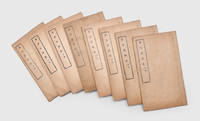
1927Best.-Nr. 172731Likely Beijing: Jinghan tielu guanli ju before 1927. From bustling Beijing to historic Hankow First edition first printing of this guide to the towns and counties traversed by the Peking-Hankow railroad China's first long-distance railway line and the lifeblood of the country's modernizing economy. Aimed at the armchair traveller and tourist alike the parts discuss scenery local customs important historical events and matters of cultural interest The Peking to Hankow railway was built as a co-operative venture between the Imperial Chinese Railway Company and the Belgian China Railway Survey Company. The German engineer Heinrich Hildebrand was engaged to survey the 1500-mile route and in June 1898 the contract was awarded to a Belgian syndicate. Bonds worth 112 million Francs were issued to French investors to raise the necessary finance. Construction began at both ends of the line and progressed at a rate of 500 metres per day. The first trains began to run on sections of the track in 1901 and in 1902 the Empress Dowager Cixi made her triumphant return to the capital using part of the line. Four years later construction was finally completed. An engineering triumph the project facilitated unprecedented levels of commercial and leisure travel between north and central China. The title evokes the long history of the Beijing and Hankow regions by referring to them as "Yan" and "Chu" the names of their equivalent Zhou dynasty states. This guide was issued the Peking-Hankow Railway Administration Chinese: Jinghan tielu guanli ju. In 1927 Chiang Kai-Shek's government established its capital at Nanjing and the name of the route was changed to "Beiping-Hankow Railway" providing a terminus ante quem for the date of publication. Copies are recorded at Berkeley Chicago Harvard Princeton Columbia Stanford the University of Hong Kong and Bukkyo. 20 parts in 8 vols octavo 253 x 149 mm. Original brown paper wrappers white thread xianzhuang stitching front covers lettered in black. With original blue cloth folding case contemporary manuscript title label bone toggles. Contemporary Beijing bookseller's ink stamp on final page of first volume contemporary red ink stamp on rear wrapper of same volume. Covers with a few small closed tears and chips rear wrapper of volume I soiled contents toned a few leaves browned. A near-fine copy in like case. hardcover
1932Best.-Nr. 2091502135500223Not Available 1932. Soft Cover. Fine. Number of pages: 204p Size: 13x18.5㎠Not Available paperback
1997Best.-Nr. ZB393001Bank Administration Institute. 1997-2000. volumes 73 75-76 price is for the lot. - If you are reading this this item is actually physically in our stock and ready for shipment once ordered. We are not bookjackers. Buyer is responsible for any additional duties taxes or fees required by recipient's country. Photos available upon request. Bank Administration Institute. unknown
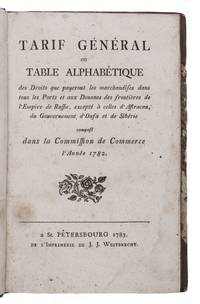
1783Best.-Nr. 18774St. Petersburg: J.J. Weitbrecht 1783. Contemporary half calf marbled sides sprinkled edges. 8vo. Second known copy of a commercial publication of statutes promulgated in French by the Russian Empress Catharine the Great concerning import duties for commercial merchandise in Russian ports and at other frontiers of the Russian Empire as they were determined and accepted in 1782. There is an exception for Astrakhan a major port and market city in southern Russia at the head of the Volga river which was under the government of Siberia which apparently maintained its own commercial regulations.This publication is very rare WorldCat lists only 1 copy Kress Library of Business and Economics Harvard University. Other libraries worldwide have only the microfilm of the Kress copy.A faint stain and one tiny hole in the margin of the first 20 pp. Cover slightly rubbed. Otherwise in good condition.l Goldsmiths'-Kress 12431.16. J.J. Weitbrecht, unknown
1967Best.-Nr. ZB3938311967. volumes 2-3; 5-18; 22-24; 31. 1967-1996. partly bound library markings textually clean & tight price is for the lot. - If you are reading this this item is actually physically in our stock and ready for shipment once ordered. We are not bookjackers. Buyer is responsible for any additional duties taxes or fees required by recipient's country. Photos available upon request. unknown
1995Best.-Nr. 35874Washington DC: Nat Academy of Public Admin 1995. First Edition. First Printing. good ex-lib. 28 cm 60 wraps references usual library markings some wear and soiling to covers Nat Academy of Public Admin paperback
1704Best.-Nr. (LCPCECO-0004)(Un précieux manuscrit calligraphié sur vélin, sans doute destiné à un membre très éminent de la Chancellerie Royale de Louis XIV) "TARIF DES DROITS DU SCEAU, TANT DE 1672, 1674, 1691, QUE DE L'AUGMENTATION DE 1704, QUE LE ROY DE L'ADVIS DE MONSIEUR LE CHANCELIER VEUT ESTRE LEVEZ A L'AVENIR SUR LES LETTRES ET EXPEDITIONS QUI SERONT SCELLEES EN LA GRANDE CHANCELLERIE...". s.d. (vers 1704) 4 parties en 1 volume in-12° (175x125 mm) (dimensions pages 169x114 mm) (7) ff. b. de papier, (1) f. b. de vélin, (48) ff. de vélin, (1) f. b. de vélin, (7) ff. b. de papier. Reliure de l'époque en maroquin noir. Encadrement de triple filet doré sur les plats avec fleurons dorés aux angles et fleurs de lys dorés en écoinçons. Dos à cinq nerfs avec compartiments décorés avec fleurs de lys et titre en lettres dorées. Roulette intérieure dorée. Tranches dorées. Précieux et rarissime manuscrit sur vélin, parfaitement calligraphié, dans sa reliure du temps en maroquin noir aux fleurs de lys, sans doute destiné à un des membres les plus éminents de la haute administration royale. A l'époque le Chancelier en charge (de 1699 à 1714) était le M.is Louis Phélypeaux, C.te de Maurepas et de Pontchartrain (1643-1727), qui "redonna à la chancellerie une importance et un éclat oubliés depuis la vieillesse de Pierre Séguier". Manques aux coiffes et partie inférieure du mors du premier plat fendu sur 3 cm, mais très bel exemplaire avec intérieur frais et magnifiquement conservé. Le texte est divisé en quatre parties. La première présente les tarifs par actes et par offices ; vient ensuite la liste des archevêchés et des évêchés ; suit un état de ce que doivent payer les chancelleries supérieures ; et, enfin, un "Tarif des droits de la Chancellerie de Paris et des chancelleries près de nos cours présidiaux...". Cette dernière partie semble ne pas être reprise dans l'édition de 1704. Ce rarissime manuscrit sur les droits de la Chancellerie royale et leur augmentation de 1704 est le précieux témoignage de la période fort troublée des dernières années du règne de Louis XIV. Nous sommes en pleine guerre pour la succession au trône d'Espagne, déclenchée en 1701 à la suite du décès de Charles II (le 1er novembre 1700), mort sans descendance. C'est le grand conflit qui oppose la France des Bourbons, qui soutient le Duc d'Anjou (futur Philippe V d'Espagne), deuxième fils du Grand Dauphin et petit-fils de Louis XIV, à l'Autriche des Habsbourg, qui soutient Charles, second fils de l'Empereur Léopold Ier. En 1702 l'Angleterre, le Saint-Empire romain germanique et les Provinces-Unies déclarent la guerre à la France, une guerre qui durera douze ans et qui épuisera toute l'Europe jusqu'à 1713 et aux signatures des Traités d'Utrech et de Rastatt (1714). Le coût des armées françaises est faramineux et l'augmentation des droits de chancellerie est un des premiers moyens employés pour remplir les caisses de l'Etat. Mais cela ne suffira pas. La France sera particulièrement frappée par la crise financière de 1709, étroitement liée à l'inflation causée par les colossales dépenses de guerre et aggravée par la plus terrible famine de son histoire, celle de l'hiver de la même année (avec 600.000 décès, le prix du blé multiplié de six à dix fois dans de nombreuses villes du royaume et le Roi obligé à mettre ses pierreries en gage de la monnaie royale). Les conséquences de cette crise enorme tourneront la France de la Régence (après la mort de Louis XIV en 1715), toujours en très grave déficit, au système de Law. Le présent manuscrit fut sans doute rédigé par un copiste professionnel ou maître en écriture. Nous avons pu localiser seulement 4 autres exemplaires en reliure identique ou similaire : Institut de France (1 vol. in-fol., 1ère partie réalisée en 1691, les deux suivantes en 1704, provenant de la collection Godefroy : dans les collections publiques parisiennes depuis 1760 (170x110 mm et 175x120 mm), BNF (acquis dans les années 1960 (170x120 mm)), Ranbervillers (168x112 mm) et Nevers (don à la bibliothèque en 1851 (170x110 mm)). Le texte fut imprimé à Paris chez la V.ve Laurent Raudet au format in-4°. (LCPCECO-0004) (5.500,00 €)
1934Best.-Nr. 59455Portland OR: Public Works Administration; Six Companies Inc. May 1934 - Sept. 1937. Folio. 51 original negatives nearly all w/ captions w/in negative at lower fore-edge 50 panoramics sized 4 x 12 in. 1 sized 3.5 x 4.75 in. almost all w/ neat photographer’s initials & name in lower corner as well as dated. All preserved in archival sleeves and recent black 10-ring binder. This extraordinary archive of panoramic photo negatives documents the building of the Bonneville Dam the second of the large New Deal dam building projects on the Columbia River shot by a largely unknown Public Works Administration photographer for the Six Companies Inc. As one of the most successful New Deal agencies created by Roosevelt’s National Industrial Recovery Act this one was headed by Harold Ickes and emphasized large scale public works projects such as dam building bridge building and more to revive the economy. These negatives open by documenting the future dam site located 40 miles east of Portland OR & Vancouver WA with Bradford Island separating the Spillway Dam North of the Island from the Powerhouse and Navigation Lock South of the Island. The negatives depict the Power House Area as construction begins the Contractor’s Camp No. 1 and Engineer’s Camp Areas followed by several as railroad trestles for hauling gravel rock cement and supplies are constructed the coffer dam built and initial construction. Also depicted are the massive walking draglines used by the Columbia Construction Co. comprising Utah Construction Co. Morrison-Knudsen Henry J. Kaiser MacDonald & Kahn and Bechtel Corp. as they employed barge-mounted derricks dredges Bucyrus-Monighan 8-cubic-yard walking draglines LeTourneau “Buggy” Wagons and Cat Diesel 75 crawler tractors. These images offer a nearly time-lapse effect racing the monthly progress of the construction. By 1935 the Power House was udner accelerated construction the Spillway appears with railcars delivering construction materials and workers and by 1936 massive steel beams were being installed into the Power House. Another photo shows the Tanner Creek Railroad Viaduct curving through the image including the Construction Worker’s quarters hatchery complex and fish ladder. Still others show the Ship Locks & Power House under construction views of the massive project from a distance up on the bluffs of the Columbia River Gorge as well as closer shots. The nearly final images show not only the completed dam but dedication by President Franklin D. Roosevelt Sept. 28 1937 and the finished Spillway with the river filling behind the dam. The Bonneville Power Administration was created by Congress in 1937 to market and sell the power produced by the Bonneville Dam. The first completed power house lock and spillway dam began providing electricity for the Bonneville Power Administration in 1938 improved river navigation and gave rise to the Pacific Northwest aluminum industry which was critical for Boeing during World War II producing aircraft for the war effort. The Public Works Administration proved to be one of the most successful New Deal programs was much less controversial than the Works Progress Administration which focused on employing unskilled workers and generating a host of projects to employ many under utilized professionals and artists during the Depression. Although the photographer remains largely obscure with Library of Congress Univ. of Washington Univ. of Oregon & Oregon Historical Society listing some of his 8 x 10 images and three large panoramas it is apparent in this collection from the final negative he also took photos for the P.W.A. and Six Companies at the Grand Coulee Dam project. Oliver’s 1894-1975 was a carpenter and contractor originally from Montana who by 1920 was working in Portland OR. Although he does not appear in the 1930 census his World War II registration handwriting which lists him working for the Ross B. Hammond Contractors in Troutdale OR matches many of the lettering in the captions of the negatives. The Hammond Co. also worked as the general contractor for the Oregon State Capitol Building in Salem and the company contracted out many of their workers to Bechtel Corp. & Morrison-Knudsen during the Great Depression. Oliver appears to have used a Connley Panoramic Model A Camera which produced a 140 degree 3.5-3.75 x 12 in. negative on standard 103 roll film and was marketed through Sears Roebuck & Co. See: R.W. Oliver Photographs Collection 1934-1936 Accession 29073 36 photographs; Bonneville Dam Construction Album U of O Collect. No. PH 203_020 a few images by Oliver others by Bichel many unsigned. Public Works Administration; Six Companies, Inc., unknown
Best.-Nr. 21665In-4°, plein maroquin rouge, armes dorées au centre des plats, dos à nerfs très décoré et doré, titre doré, double filet doré d’encadrement des plats, écoinçons aux petits fers, roulette décorative sur les coupes, tranches dorées sur marbrure (reliure de l’époque) ; Avertissement en forme de sommaire. 24 pp.Lettres patentes de François Premier, roy de France : portant établissement et création d’un Conseil de Dombes, en Souverain et dernier ressort. Lyon, novembre 1523. 4 pp.Lettres patentes... François Ier, Henry II, François II, Louis de Bourbon, duc de Montpensier, Henry III, François de Montpensier, Henry de Montpensier, Henry IV, Louis XIII, Louis XIV, Anne-Marie-Louise duchesse de Montpensier, le duc d’Orléans régent, Duc du Maine ; 282 pp. au total, y compris quelques feuillets blancs épars, Suivi de 88 pp. manuscrites avec entre autres, la copie du Procès-verbal de l’arrière-Ban de Dombes 1564, signée par Benoit Philibert Girié, écuyer, avocat en Parlement et aux Cours de Lyon, fils de Jean-Claude Girié, écuyer et avocat en Parlement.
1962Best.-Nr. 2092902137704351Keiso Shobo Gyosei 1962. Soft Cover. Fine. The book is in fine condition. Keiso Shobo Gyosei paperback
1897Best.-Nr. PHO-2007Paris, fontemoing, 1897-1905, 7 volumes in-8, relié demi chagrin, dos à nerfs avec auteur, titre et tomaison, frottements aux charnières, ex-dono de l’auteur à « Mon cher collègue et ami, Mr Jobbé Duval ». Bon exemplaire