8 309 résultats
réf. ORD-8591Au palais des Tuileries, le 18 mars 1846. Bulletin des Lois N°1281. In-8 br. sans couverture, paginé 157 à 180.
réf. 202747Paris, Imprimerie nationale, 1791 in-8, 12 pp., broché.
réf. 90682Paris, Imp. Nationale, 1791 in-8, 11 pp., dérelié.
1845réf. List3743Cincinnati Ohio 1845. Autograph letter signed "F. G. Macy" 4 pp. 8 x 10 inches on a folded sheet addressed to his brother John B. Macy. Excellent. A letter bluntly discussing Democratic Party factionalism written scarcely three months after the inauguration of James K. Polk and less than four months before the annexation of Texas formally took effect. The recipient John B. Macy would represent Wisconsin in Congress from 1853 to 1855 before perishing in the burning of the steamer Niagara on Lake Michigan in 1857. At the time of this correspondence he appears to have been embroiled in a political controversy connected to Treasury Secretary Robert J. Walker and the Democratic press. After briefly reporting the death of a relative's child Francis G. Macy turns to national politics commenting on newspaper attacks directed against his brother and expressing frustration with Cincinnati editor John Brough then one of the most influential Democratic journalists in Ohio. The letter captures the bitterness that remained after the Democratic nomination struggle of 1844 when supporters of Martin Van Buren and James K. Polk battled for control of the party: "You perceive I suppose the continual attacks the Inquirer makes on you; this morning it is out on you & Drinker as well as upon Lake. It appears Brough is determined to prostrate you if possible. He has drawn out Father Ritchie in defence of Mr. Walker but demands of Walker or the President to dismiss you immediately. My opinion is that no notice should be taken of his Billingsgate trash but let him go on till Drinker gets his paper underway." Macy believed the attacks stemmed not from policy disagreements but from lingering resentment over the defeat of Martin Van Buren's presidential ambitions and the rise of Polk under the influence of Treasury Secretary Robert J. Walker: "It appears that Brough is determined to put down the Statesman & all other papers that give their support to the present Secretary of the Treasury but I am mistaken in Mr. Walker if he can be influenced by Brough or made to succumb to him & his faction. . Of one thing you may rest assured Brough will never forgive Mr. Walker for defeating Mr. Van Buren & placing Mr. Polk in power for he looks upon the Secretary as the life of the party who was determined that Mr. Van Buren should not again be President & however much he may laud Mr Polk it is only that he may inflict more fatally the wound which he hopes will ruin Mr. Walker." Macy was a self-described "uncompromising whig" but though he was disappointed by the election results he did report grudging admiration for the victors. Referring to Walker's role in securing Polk's nomination and election he observes: "Now I should have felt under many obligations to Mr. Walker if he had killed off both Van & Polk for then good honest Whigs would have once more been in power & Mr. Clay triumphant but as he did not do that good deed and offered us fair fight & manfully vanquished us we submit with as good a grace as possible & wait our time to try it again. . At the same time we hope the Government will be so conducted as to reflect nothing but honour on our Country & I have no hesitation in saying that in relation to Annexation & the conduct of Mr. Polk up to this time & the means he is adopting to secure the peace of the Country meets with the hearty approbation of one uncompromising whig at least." An engaging political letter linking the Polk administration the Texas annexation crisis Democratic Party factionalism and future Wisconsin congressman John B. Macy whose political status made him one of the most famous of the Steamer Niagara victims.
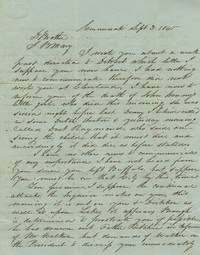
1845réf. List3743Cincinnati Ohio 1845. Autograph letter signed "F. G. Macy" 4 pp. 8 x 10 inches on a folded sheet addressed to his brother John B. Macy. Excellent. A letter bluntly discussing Democratic Party factionalism written scarcely three months after the inauguration of James K. Polk and less than four months before the annexation of Texas formally took effect. The recipient John B. Macy would represent Wisconsin in Congress from 1853 to 1855 before perishing in the burning of the steamer Niagara on Lake Michigan in 1857. At the time of this correspondence he appears to have been embroiled in a political controversy connected to Treasury Secretary Robert J. Walker and the Democratic press. After briefly reporting the death of a relative's child Francis G. Macy turns to national politics commenting on newspaper attacks directed against his brother and expressing frustration with Cincinnati editor John Brough then one of the most influential Democratic journalists in Ohio. The letter captures the bitterness that remained after the Democratic nomination struggle of 1844 when supporters of Martin Van Buren and James K. Polk battled for control of the party: "You perceive I suppose the continual attacks the Inquirer makes on you; this morning it is out on you & Drinker as well as upon Lake. It appears Brough is determined to prostrate you if possible. He has drawn out Father Ritchie in defence of Mr. Walker but demands of Walker or the President to dismiss you immediately. My opinion is that no notice should be taken of his Billingsgate trash but let him go on till Drinker gets his paper underway." Macy believed the attacks stemmed not from policy disagreements but from lingering resentment over the defeat of Martin Van Buren's presidential ambitions and the rise of Polk under the influence of Treasury Secretary Robert J. Walker: "It appears that Brough is determined to put down the Statesman & all other papers that give their support to the present Secretary of the Treasury but I am mistaken in Mr. Walker if he can be influenced by Brough or made to succumb to him & his faction. . Of one thing you may rest assured Brough will never forgive Mr. Walker for defeating Mr. Van Buren & placing Mr. Polk in power for he looks upon the Secretary as the life of the party who was determined that Mr. Van Buren should not again be President & however much he may laud Mr Polk it is only that he may inflict more fatally the wound which he hopes will ruin Mr. Walker." Macy was a self-described "uncompromising whig" but though he was disappointed by the election results he did report grudging admiration for the victors. Referring to Walker's role in securing Polk's nomination and election he observes: "Now I should have felt under many obligations to Mr. Walker if he had killed off both Van & Polk for then good honest Whigs would have once more been in power & Mr. Clay triumphant but as he did not do that good deed and offered us fair fight & manfully vanquished us we submit with as good a grace as possible & wait our time to try it again. . At the same time we hope the Government will be so conducted as to reflect nothing but honour on our Country & I have no hesitation in saying that in relation to Annexation & the conduct of Mr. Polk up to this time & the means he is adopting to secure the peace of the Country meets with the hearty approbation of one uncompromising whig at least." An engaging political letter linking the Polk administration the Texas annexation crisis Democratic Party factionalism and future Wisconsin congressman John B. Macy whose political status made him one of the most famous of the Steamer Niagara victims. books
1945réf. 9116District of Columbia: Government Printing Office 1945. Poster 48.3 x 53 cm. folded as issued. Government Printing Office document 1945--O-629743. A government-issued poster encouraging Americans to grow victory gardens to support the war effort. The poster depicts an arrangement of various vegetables including peas in the shell cabbage and carrots in the foreground. In the background is a view of a garden with a man and woman cultivating and weeding. In an official wartime activity begun two and a half decades earlier in the Great War Americans were urged to supplement the food they had available for personal use by planting vegetable gardens both to support the war effort and due to food shortages and rationing. The gardens known as "victory gardens" were promoted widely by both the government and industry. Gardens were planted during World War I as well but were called "war gardens" until the end of the war when the term "victory garden" came into use. Creased at the folds otherwise very near fine. Government Printing Office unknown
1945réf. 9116District of Columbia: Government Printing Office 1945. Poster 48.3 x 53 cm. folded as issued. Government Printing Office document 1945--O-629743. A government-issued poster encouraging Americans to grow victory gardens to support the war effort. The poster depicts an arrangement of various vegetables including peas in the shell cabbage and carrots in the foreground. In the background is a view of a garden with a man and woman cultivating and weeding. In an official wartime activity begun two and a half decades earlier in the Great War Americans were urged to supplement the food they had available for personal use by planting vegetable gardens both to support the war effort and due to food shortages and rationing. The gardens known as "victory gardens" were promoted widely by both the government and industry. Gardens were planted during World War I as well but were called "war gardens" until the end of the war when the term "victory garden" came into use. Creased at the folds otherwise very near fine. Government Printing Office unknown books
1872réf. 6637Bourg, Imprimerie P. Comte-Milliet, 1872 ; in-8, broché ; 16 pp., couverture grise imprimée.
réf. 206706Paris, Chez Baudouin, 1790 in-8, 4 pp., dérelié.
réf. ORD-8707Du 26e jour de Brumaire, an second de la République...Paris. Imprimerie Nationale Exécutive du Louvre. In-4 (181 x 235mm) de 2 pages imprimées. Signature manuscrite de Charles.
réf. ORD-8709Du 13e jour de Brumaire, an second de la République...Grasse. Guichard. (An II). In-4 (181 x 235mm) de 4 pages imprimées. (3).
réf. 206961S.l.n.d. (c.1790) in-8, 8 pp., dérelié.
réf. 245551[Paris], Imprimé chez Paul Renouard, s.d. (1830), in-12, 4 pp., en feuille.
réf. 204316Paris, Imprimerie Nationale, s.d. in-8, 4 p., dérelié.
réf. 205422Paris, Imprimerie Nationale, (1793) in-8, 2 pp., dérelié.
réf. 204307Paris, Impr. Nationale, (an II) in-12, 4 pp., dérelié.
réf. 239197Paris, Pierre-François Didot, 1790 - 1792 78 livraisons en 3 vol. in-4, titre, [477] pp. mal chiffrées 475 ; 444 pp. ; 420 pp., brochés sous cartonnage d'attente [vol. I & II] ; vélin rigide, dos à nerfs [vol. III] (reliure de l'époque). Rousseurs, petites galeries de vers stoppées au début du vol. I et au milieu du vol. II., des taches d'encre au f. 195-96 du vol. III., manque de papier aux pp. 239-252 du vol. III, avec perte de lettres.
réf. 207429Paris, Imprimerie de Girouard, (1791) in-8, 24 pp., dérelié.
réf. 17186Paris, Imprimerie Nationale, s.d. (1791). In-8° dérelié de 8 pp.
réf. 17197Paris, Imprimerie Nationale, s.d. (1791). In-8° dérelié de 12 pp.[C30]
réf. 202300S.l.n.d. in-8, 48 pp., broché sous couverture d'attente.
réf. 202328Paris, Imprimerie nationale, (1791) in-8, 30 pp., dérelié. Important décret de l'Assemblée nationale après consultation du Comité militaire. XXIII articles fixent les conditions des engagements des recrues, la tenue des registres de recrutement, l'âge des recrues, les réclamations des familles, le prix des engagements, le rôle des recruteurs etc...
réf. 206148Paris, Imprimerie Nationale, (1791) in-8, 26 pp., en feuilles.
réf. 177727À Paris, De l'Imprimerie Royale, 1790 in-4, 10 pp. et 10 pp. de tableaux dont un replié,