8 892 résultats
2002Good clean copy, pages bright and tight. Used
1985réf. RO20172101PRESSES UNIVERSITAIRES DE NANCY / EDITIONS SERPENOISE. 1985. In-8. Broché. Etat d'usage, Couv. convenable, Dos satisfaisant, Intérieur frais. 175 pages - quelques cartes en noir et blanc hors texte - 1er plat illustré en couleur.. . . . Classification Dewey : 350-Administration publique
1969réf. RO80063312DEPARTMENT OF THE ARMY. Sept. 1969. In-4. Broché. Bon état, Couv. défraîchie, Agraffes rouillées, Intérieur frais. Environ 80 / 100 pages. Nombreuses illustrations en noir et blanc, polycopiées, dans le texte et en hors-texte. Ouvrage en anglais.. . . . Classification Dewey : 350-Administration publique
2011réf. 86129Washington DC: National Aeronautics and Space Administration 2011. Xerox-style reproduction. Presumed to be one of only a few copies made for media representatives. Stapled at upper left corner. Very good. 25 1 pages. Illustrations. Contents include Media Services Information; Quick Facts; Jupiter at a Glance; Why Juno; Mission Overview; Mission Phases; Spacecraft; Science Overview; Missions to Jupiter; and Program/Project Management. Juno is a NASA space probe orbiting the planet Jupiter. It was built by Lockheed Martin and is operated by NASA's Jet Propulsion Laboratory. The spacecraft was launched from Cape Canaveral Air Force Station on August 5 2011 UTC as part of the New Frontiers program. Juno entered a polar orbit of Jupiter on July 5 2016 UTC to begin a scientific investigation of the planet. After completing its mission Juno will be intentionally deorbited into Jupiter's atmosphere. Juno's mission is to measure Jupiter's composition gravitational field magnetic field and polar magnetosphere. It will also search for clues about how the planet formed including whether it has a rocky core the amount of water present within the deep atmosphere mass distribution and its deep winds which can reach speeds up to 390 mph. Juno is the second spacecraft to orbit Jupiter after the nuclear powered Galileo orbiter which orbited from 1995 to 2003. Juno is powered by solar panels commonly used by satellites orbiting Earth and working in the inner Solar System whereas radioisotope thermoelectric generators are commonly used for missions to the outer Solar System and beyond. For Juno however the three largest solar panel wings ever deployed on a planetary probe play an integral role in stabilizing the spacecraft as well as generating power. During the science mission infrared and microwave instruments will measure the thermal radiation emanating from deep within Jupiter's atmosphere. These observations will complement previous studies of its composition by assessing the abundance and distribution of water and therefore oxygen. This data will provide insight into Jupiter's origins. Juno will also investigate the convection that drives natural circulation patterns in Jupiter's atmosphere. Other instruments aboard Juno will gather data about its gravitational field and polar magnetosphere. The Juno mission was planned to conclude in February 2018 after completing 37 orbits of Jupiter but now has been commissioned through 2025 to do a further 42 additional orbits of Jupiter as well as close flybys of Ganymede Europa and Io. The probe was then intended to be deorbited and burnt up in Jupiter's outer atmosphere to avoid any possibility of impact and biological contamination of one of its moons. The Juno spacecraft's suite of science instruments will: Determine the ratio of oxygen to hydrogen effectively measuring the abundance of water in Jupiter which will help distinguish among prevailing theories linking Jupiter's formation to the Solar System; Obtain a better estimate of Jupiter's core mass which will also help distinguish among prevailing theories linking Jupiter's formation to the Solar System; Precisely map Jupiter's gravitational field to assess the distribution of mass in Jupiter's interior including properties of its structure and dynamics; Precisely map Jupiter's magnetic field to assess the origin and structure of the field and the depth at which the planet's magnetic field is created. This experiment will also help scientists understand the fundamental physics of dynamo theory; Map the variation in atmospheric composition temperature structure cloud opacity and dynamics to pressures far greater than 100 bar 10 MPa; 1500 psi at all latitudes; Characterize and explore the three-dimensional structure of Jupiter's polar magnetosphere and auroras; and Measure the orbital frame-dragging known also as Lense-Thirring precession caused by the angular momentum of Jupiter and possibly a new test of general relativity effects connected with the Jovian rotation. National Aeronautics and Space Administration unknown
réf. ROD0028296Société Nouvelle des Juris-Classeurs. 1930 c.. In-8. Cartonnage d'éditeurs. Etat passable, Couv. défraîchie, Manque en coiffe de tête, Intérieur bon état. 500 p. environ - Reliure simili-cuir noir - Manques importants sur le 2nd plat - Bordures des plats très frottés - Titre doré.. . . . Classification Dewey : 0-GENERALITES
2007réf. ROD0128386ROBERT LAFFONT. 2007. In-8. Broché. Bon état, Couv. convenable, Dos satisfaisant, Intérieur frais. 169 pages.. . . . Classification Dewey : 350-Administration publique
réf. 205827S.l.n.d. (1787) in-8, 50 pp., dérelié. Manque la page de titre.
1927réf. 3237524Berlin, Liebmann, 1927. 314 S. OPpbd (Stempel auf Einband und Titel).
2013réf. 76282Las Vegas NV: National Nuclear Security Administration Nevada Field Office/National Security Technologies Office of Public Affairs 2013. Presumed First thus. DVD-RW. Very good. Set of 6 DVDs. Volume 1 Welcome Ponomarev Paul Robinson Soloshin and Allen; Volume 2 Historic Panel: Aquilina Shubin Wilkes Hawkins; Volume 3 Historic Panel: Dunlop Turnbull Petrov Sandoval Zucca; Volume 4 Future Panel Browne Warner Wallace McDowell Kostyukov Aheleznov Loparev; Volume 5 Shubin and Future Recommendations PanelKickuck Hecker Lehman Hunter; and Volume 6 Voloshin Vic Reis Next Steps Panel: Cook Harrington Gottemoeller Kamenskikh and Document Signing and Conference Close. The United States part of the Joint Verification Experiment carried out in 1988 as the Kearsarge event in Operation Touchstone. Twenty-five years later a joint commemoration of the event was held at the Nevada Nuclear Security Site formerly the Nevada Test Site. The objective of the JVE was to calibrate the seismic yield estimation capability of underground nuclear explosions conducted in both countries. It involved the unprecedented US yield measurement of a Soviet nuclear explosion at its then nuclear test site in Kazakhstan and the reciprocal Soviet yield measurement of a US nuclear explosion at the Nevada Test Site JVE provided the first opportunity for scientists from US and Soviet nuclear weapons laboratories to meet and work cooperatively. At the Nevada Test Site and at the follow-on experiment at the Soviet Semipalatinsk Test Site they developed confidence-building steps that made possible the ratification of the TTBT in 1990. National Nuclear Security Administration, Nevada Field Office/National Security Technologies, Office of Public Affairs unknown
2013réf. 76280National Nuclear Security Administration 2013. Presumed First thus. CD-RW. Very good. This has one file with 27 powerpoint items on it. These include presentations by Shubin Loparev Zheleznov McDowell Wallace Warner Lehman Hecker Voloshin Reis Zucca Sandoval Petrov Felske Hawkins and Ponomarev plus panel related material and the JVE coin. Among the topics covered include Trust but Verify Optimizing Rosatom JVE Results Seismic Hydrodynamic Monitoring Geophysics Geology Technical Elements Next Steps and Future Cooperation. The United States part of the Joint Verification Experiment carried out in 1988 as the Kearsarge event in Operation Touchstone. Twenty-five years later before tensions increased between Russia and the United States a joint commemoration of the event was held at the Nevada Nuclear Security Site formerly the Nevada Test Site. JVE provided the first opportunity for scientists from US and Soviet nuclear weapons laboratories to meet and work cooperatively. At the Nevada Test Site and at the follow-on experiment at the Soviet Semipalatinsk Test Site they developed confidence-building steps that made possible the ratification of the TTBT in 1990. Both Russians and Americans agree that cooperation between US and Soviet nuclear weapons scientists began with the JVE and the follow-on discussions on the TTBT verification mechanisms during the Geneva negotiations. National Nuclear Security Administration unknown
2013réf. 76281National Nuclear Security Administration 2013. Presumed First thus. CD-RW. Very good. This has one file with 27 powerpoint items on it. In Russian: These appear to include presentations by Shubin Loparev Zheleznov McDowell Wallace Warner Lehman Hecker Voloshin Reis Zucca Sandoval Petrov Felske Hawkins and Ponomarev plus panel related material and the JVE coin. Among the topics covered include Trust but Verify Optimizing Rosatom JVE Results Seismic Hydrodynamic Monitoring Geophysics Geology Technical Elements Next Steps and Future Cooperation. The United States part of the Joint Verification Experiment carried out in 1988 as the Kearsarge event in Operation Touchstone. Twenty-five years later before tensions increased between Russia and the United States a joint commemoration of the event was held at the Nevada Nuclear Security Site formerly the Nevada Test Site. JVE provided the first opportunity for scientists from US and Soviet nuclear weapons laboratories to meet and work cooperatively. At the Nevada Test Site and at the follow-on experiment at the Soviet Semipalatinsk Test Site they developed confidence-building steps that made possible the ratification of the TTBT in 1990. Both Russians and Americans agree that cooperation between US and Soviet nuclear weapons scientists began with the JVE and the follow-on discussions on the TTBT verification mechanisms during the Geneva negotiations. National Nuclear Security Administration unknown
réf. Q-1878592807North American Book Distributors LLC 2038-12-31. hardcover. New. In shrink wrap. Looks like an interesting title! North American Book Distributors, LLC hardcover
1965réf. RO20062568ANSCHUTZ. 1965. In-4. Broché. Bon état, Couv. convenable, Dos satisfaisant, Intérieur frais. 27 pages. Nombreuses illustrations en couleurs, et quelques-unes en noir et blanc dans le texte. Textes en français et en italien.. . . . Classification Dewey : 350-Administration publique
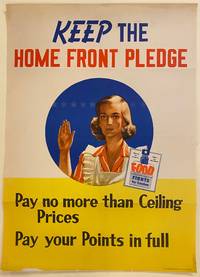
1944réf. 307866Government Printing Office 1944. Fred Cooper. Poster. Color lithograph. Measures 27 3/4" x 19 7/8" This original World War II-era poster was part of an anti-inflation campaign initiated by the Office of Price Administration designed to encourage American citizens to support the war effort. During the previous world war the US experienced an inflation rate of 62%. When WWII began President Roosevelt established the OPA to prevent price-gouging and unfair access to consumer goods. The effort was considered successful with inflation between 1940 and 1944 rising only 28%. The woman wears a red and white striped blouse contrasted against a blue background with stars evoking the American flag. Her hair is coiffed and she wears makeup as well as a white ruffled apron over her blouse. In this way the poster demonstrates how women could contribute to the war effort without sacrificing their femininity a somewhat mixed signal that speaks to cultural dynamics in the United States in the 1940s. A smaller graphic overlays the poster reading "Produce and Conserve / Share and Play Square / Food Fights for Freedom." In very good condition with some wear to margins and along original fold lines. A closed tear to left margin has been professionally repaired. Some cracks and chips to lower margin. The poster is otherwise clean and vibrant. Government Printing Office unknown
1944réf. 307866Government Printing Office 1944. Fred Cooper. Poster. Color lithograph. Measures 27 3/4" x 19 7/8" This original World War II-era poster was part of an anti-inflation campaign initiated by the Office of Price Administration designed to encourage American citizens to support the war effort. During the previous world war the US experienced an inflation rate of 62%. When WWII began President Roosevelt established the OPA to prevent price-gouging and unfair access to consumer goods. The effort was considered successful with inflation between 1940 and 1944 rising only 28%. The woman wears a red and white striped blouse contrasted against a blue background with stars evoking the American flag. Her hair is coiffed and she wears makeup as well as a white ruffled apron over her blouse. In this way the poster demonstrates how women could contribute to the war effort without sacrificing their femininity a somewhat mixed signal that speaks to cultural dynamics in the United States in the 1940s. A smaller graphic overlays the poster reading "Produce and Conserve / Share and Play Square / Food Fights for Freedom." In very good condition with some wear to margins and along original fold lines. A closed tear to left margin has been professionally repaired. Some cracks and chips to lower margin. The poster is otherwise clean and vibrant. Government Printing Office unknown books
2003réf. 86119Kennedy Space Center FL: National Aeronautics and Space Administration Kennedy Space Center 2003. Presumed First Edition First printing. Wraps. Very good. The format is approximately 8.5 inches by 11 inches. 61 3 pages plus covers. Illustrated covers. Illustrations most in color. Contents include Center Director's Message; NASA Vision and Mission; KSC Goals and Principles; The President's Management Agenca; Significant Events; Expendable Launch Vehicle Program; Space Shuttle Program; Shuttle Upgrades; International Space Station and Shuttle Payload Processing; Payload Carriers Program; Spaceport and Range Technologies; Future Vehicles; Safety and Health First; Environmental Stewardship; Partnerships; Outreach to the World; Education; KSC Business Report; Economic Impact; Workforce Diversity; Procurement Report; and Financial Statement. The John F. Kennedy Space Center KSC originally known as the NASA Launch Operations Center located on Merritt Island Florida is one of the National Aeronautics and Space Administration's NASA ten field centers. Since December 1968 KSC has been NASA's primary launch center of human spaceflight. Launch operations for the Apollo Skylab and Space Shuttle programs were carried out from Kennedy Space Center Launch Complex 39 and managed by KSC. Located on the east coast of Florida KSC is adjacent to Cape Canaveral Space Force Station CCSFS. The management of the two entities work very closely together share resources and operate facilities on each other's property. Though the first Apollo flights and all Project Mercury and Project Gemini flights took off from the then-Cape Canaveral Air Force Station the launches were managed by KSC and its previous organization the Launch Operations Directorate. Starting with the fourth Gemini mission the NASA launch control center in Florida Mercury Control Center later the Launch Control Center began handing off control of the vehicle to the Mission Control Center in Houston shortly after liftoff; in prior missions it held control throughout the entire mission. Additionally the center manages launch of robotic and commercial crew missions and researches food production and in-situ resource utilization for off-Earth exploration. Since 2010 the center has worked to become a multi-user spaceport through industry partnerships even adding a new launch pad LC-39C in 2015. There are about 700 facilities and buildings grouped throughout the center's 144000 acres. Among the unique facilities at KSC are the 525-foot tall Vehicle Assembly Building for stacking NASA's largest rockets the Launch Control Center which conducts space launches at KSC the Operations and Checkout Building which houses the astronauts dormitories and suit-up area a Space Station factory and a 3-mile long Shuttle Landing Facility. There is also a Visitor Complex on site that is open to the public. National Aeronautics and Space Administration, Kennedy Space Center paperback
réf. MA04B-01220NASA. Collectible - Good. Kennedy Space Center FL: National Aeronautics and Space Administration 1972. Sm 4to paperback. 286pp. B/W photos throughout. Good book. Typical shelfwear moderate toning and creasing to spine. Tom Crouch's name inked to table of contents. From the library of American aeronautics author historian and curator Tom D. Crouch. space flight space flight aeronautics astronaut apollo Inquire if you need further information. NASA paperback
réf. 1878592815.Ghardcover. Good. Access codes and supplements are not guaranteed with used items. May be an ex-library book. hardcover
2009réf. 86131Washington DC: National Aeronautics and Space Administration 2009. Presumed First Edition First printing. Comb binding. Very good. 31 3 pages including covers. Contents include Media Services Information; Quick Facts; NASA's Search for Habitable Planets; Scientific Goals and Objectives; Mission Overview; Spacecraft; Instrument - Photometer; Selecting the Kepler Star Field; Education and Public Outreach; Other Exoplanet Activities; Science Team; and Project Management. The Kepler space telescope is a disused space telescope launched by NASA in 2009 to discover Earth-sized planets orbiting other stars. Named after astronomer Johannes Kepler the spacecraft was launched into an Earth-trailing heliocentric orbit. The principal investigator was William J. Borucki. After nine and a half years of operation the telescope's reaction control system fuel was depleted and NASA announced its retirement on October 30 2018. Designed to survey a portion of Earth's region of the Milky Way to discover Earth-size exoplanets in or near habitable zones and estimate how many of the billions of stars in the Milky Way have such planets Kepler's sole scientific instrument is a photometer that continually monitored the brightness of approximately 150000 main sequence stars in a fixed field of view. These data were transmitted to Earth then analyzed to detect periodic dimming caused by exoplanets that cross in front of their host star. Only planets whose orbits are seen edge-on from Earth could be detected. Kepler observed 530506 stars and detected 2778 confirmed planets as of June 16 2023. By January 2015 Kepler and its follow-up observations had found 1013 confirmed exoplanets in about 440 star systems along with a further 3199 unconfirmed planet candidates. Four planets have been confirmed through Kepler's K2 mission. In November 2013 astronomers estimated based on Kepler space mission data that there could be as many as 40 billion rocky Earth-size exoplanets orbiting in the habitable zones of Sun-like stars and red dwarfs within the Milky Way. It is estimated that 11 billion of these planets may be orbiting Sun-like stars. The nearest such planet may be 3.7 parsecs 12 ly away according to the scientists. On January 6 2015 NASA announced the 1000th confirmed exoplanet discovered by the Kepler space telescope. Four of the newly confirmed exoplanets were found to orbit within habitable zones of their related stars: three of the four Kepler-438b Kepler-442b and Kepler-452b are almost Earth-size and likely rocky; the fourth Kepler-440b is a super-Earth. On May 10 2016 NASA verified 1284 new exoplanets found by Kepler the single largest finding of planets to date. Kepler data has also helped scientists observe and understand supernovae; measurements were collected every half-hour so the light curves were especially useful for studying these types of astronomical events. National Aeronautics and Space Administration unknown
1941réf. GA001198INew York: Hastings House. Near fine in a very good plus dust jacket. 1941. First edition. Hardcover. Dust jacket missing some chips on the back panel. Inscribed by Corse to Senator Pepper and rare thus. . Hastings House hardcover
réf. 61099bdKey West Fla.; Key West Administration n.d. ca. 1935. Oblong octavo stiff illustrated tan wrappers stapled 32 pp. Color illustrations created by local artists double-page color map color bird’s eye view. Fine. unknown books
1935réf. 61100bdKey West Fla.: Key West Administration n.d. ca. 1935. Oblong octavo stiff black wrappers with art deco decorations stapled 16 pp. Color illustrations double-page color map color bird’s eye view. Fine. Key West Administration, n.d. [ca. 1935]. unknown books
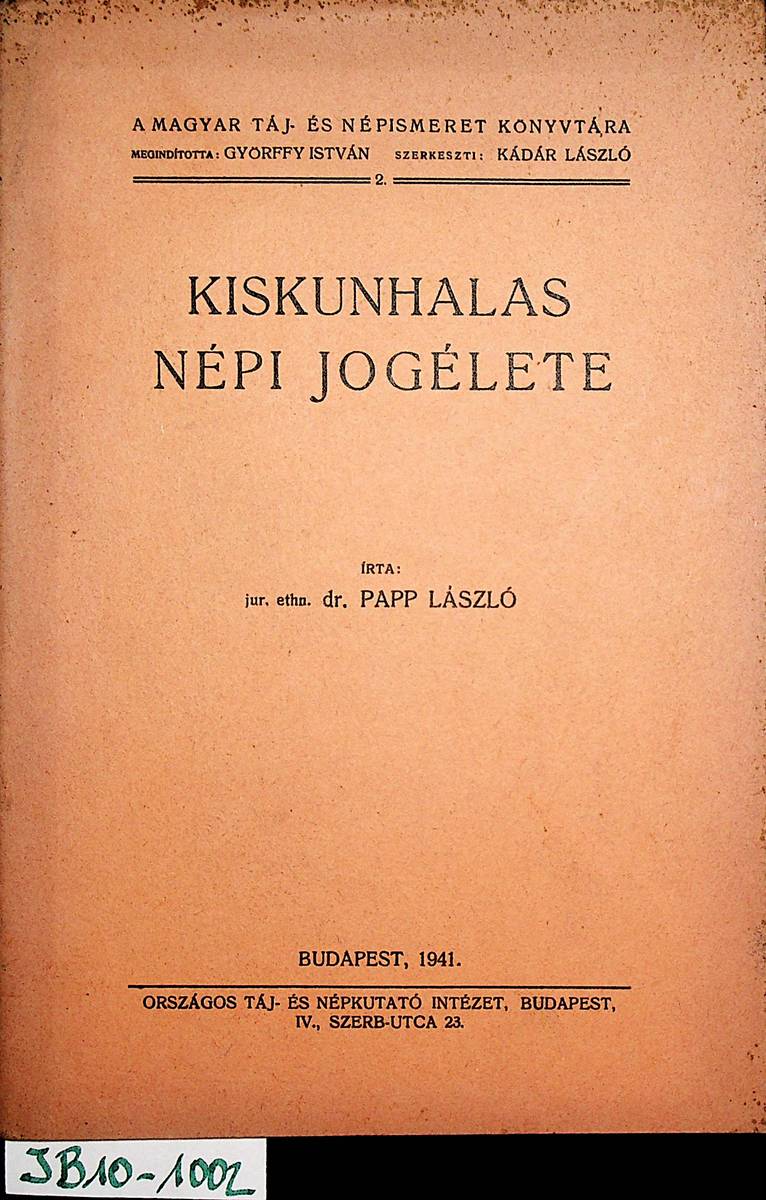
1941réf. JB10-1002Budapest, Orsz. T?j-?s N?pkutat? Int., 1941. original Broschur, 8?, 71 P., a good copy
1985réf. 2092902140602218Not Available 1985. Soft Cover. Fine. Number of pages: 24p Size: A4 Not Available paperback