14 587 résultats
réf. DADAX0812932153New unknown
réf. DADAX023115268XNew unknown
8vo, br. ed. argues that charges of a deliberate soviet policy of genocide by famine in the aerly 1930' are based on inflated figures and fabricated evidence. the campaign was initiated by extreme right-wing in the usa and nazui propagandists. discusses ukrainian involvement in pogroms and assistance to germans, particularly stepan bandera and the ukrainian insurgent army.
réf. DADAX0199974896New unknown
1918Very Good Turkish, Ottoman (1500-1928) Paperback. Demy 8vo. (21 x 15 cm). In Ottoman script. 4, 77 p., 1 plate. Stain some pages, slight tear on the fifth page, text unaffected. Otherwise a good copy. Benaroya was a Jewish socialist, member of the Bulgarian Social Democratic Workers' Party (Narrow Socialists), later leader of the Socialist Workers' Federation in the Ottoman Empire. Benaroya played a key role in the foundation of the Communist Party of Greece in 1918. Idealistic and pragmatic at the same time, in Thessaloniki Benaroya played a leading role in the creation, in 1909, of the mainly Jewish Socialist Workers' Federation, or in Ladino, Federacion. The organization took this name because built on the federative model of the Social Democratic Party of Austria, it was conceived as a federation of separate sections, each representing the four main ethnic groups of the city: Jews, Bulgarians, Greeks, and Turks. It published its literature in the languages of these four groups (i.e., Ladino, Bulgarian, Greek, and Turkish, respectively) but in practice, the two latter sections were under-represented if not nonexistent. The democratic Federacion soon became, under Benaroya's leadership, the strongest socialist party in the Ottoman Empire. It created combative trade unions, attracted important intellectuals, and gained a solid base of support among Macedonian workers while cultivating strong links with the Second International. From 1910 to 1911 Benaroya edited its influential newspaper, the Solidaridad Ovradera, printed in Ladino. Unlike other parties that were organized on ethnic lines, as a cross-community group, the Federacion was allowed by the Ottoman authorities. A prominent Bulgarian member, Dimitar Vlahov, was a socialist MP in the new Ottoman parliament until 1912. Indeed, its leaders initially supported the Young Turks, and Benaroya participated in the "Army of Freedom" march on Istanbul to help put down the Countercoup of 1909. Alarmed by the growing power of socialist groups, the CUP subsequently launched a crackdown, under which Benaroya was jailed three times, in early November 1910, June 1911 (when he was deported to Serbia), and February 1912 (when he was deported to Greece). Benaroya was interested in the Jewish Question since the beginning of his career and made efforts to promote Jewish causes throughout it. His first book was The Jewish Question and Social Democracy (1908) while once in Thessaloniki he founded a group called the Sephardic Circle of Socialist Studies. He also played a leading role in the creation, in 1909, of the mainly Jewish Federation. Apprehensive of what the resurgent Greek self-confidence behind the Megali Idea might mean for Jews in Greece and Asia Minor, at the time he labeled the campaign imperialist. He envisaged a state free from any ethnic divisions where Jews could exist un-persecuted and free, retaining their religion. Some of his fears might have been argued to have been realized when after the city's fire, the Venizelos administration did not rebuild the original Jewish section, adopting instead a French town plan, but a considerable proportion of the Jewish population remained throughout the following decades, with the Greek government guaranteeing their rights in March 1926. Benaroya was always very interested in combating anti-Semitism, while over later years he shifted his emphasis to reflect the sizable Thessaloniki Jewish community that chose to remain within the Greek state. After a historic meeting with Venizelos, Benaroya's tactical abilities resulted in the birth of the Socialist Labour Party of Greece (later named Communist) and the General Confederation of Greek Workers, which helped unite Greek workers. This extremely rare book on stenographic style in the Turkish / Ottoman language. Özege 21579.; TBTK 5898.; Only two institutional copies in OCLC. 777181494 (KOÇ University Library; Universiteitsbibliotheek Leiden). First and Only Edition.
1923Fine Russian In comtemporary cloth bdg. Roy. 8vo. (24 x 17 cm). In Russian. 302, [2] p. From the library of Ismail Hüsrev Tökin, (1902-1992). Signed by Tökin in Ottoman handwritten. Tökin completed his primary, secondary and high school education at the Austrian High School in Istanbul. Between 1922 and 1925 he completed his higher education in KUTV in Moscow. In the same year he continued his economics seminars in KUTV. After returning from the Soviet Union to Turkey, he was sentenced in '1925 Communist Tevfikat'. He is well-known for his works on economics. As understood from his collection, he has studied many religious and economic systems that exist in the world.
réf. DADAX0195182243New unknown
4 volumes gr. In-8, 439; 507; 429; 452 pages. Collection complète des Mémoires de Jules Humbert-Droz. En parfaite condition.
1950Une affiche de dimensions 76x55 cm, représentant un travailleur en train de connecter un sovkhoz (ferme d'état) à l'énergie électrique. Départ de fente sans manque au niveau d'une pliure. Affiche bien fraîche à restaurer. Peu courant. Voir photo.
1954Une affiche en tirage originale, dimensions 83x58 cm; représentant une femme de type asiatique sur fond de drapeau du Parti Communiste Russe. Déchirure sans manque à restaurer sinon bel état. Peu courant. Affiche de propagande de la République Autonome du Kirghistan pour la construction d'un monde nouveau. Petite restauration nécessaire. Voir photo
1963Un tirage original d'une affiche de propagande des Jeunesses Communistes Soviétiques de la période "Khrouchtchev". Dimensions 82x57 cm. Bel état. L'affiche a été pliée sans aucun dommage. Voir photo. Bel exemple de la propagande pour mobiliser les énergies dans la période de la Conquête de l'Espace; mais également d'une relative évolution des libertés dans le pays.
réf. ORD-16275Paris. Aubert. S. d. Avant 1856. Petit in-f°(215 x 306mm) broché, couverture illustrée d'une vignette et 22 planches en noir et blanc de caricatures satiriques d'après les dessins de Bertall, Lorentz, Emy, Vernier, Monta, Tronsens et Morin. Couverture et bord de la 1re planche poussiéreux sinon bon exemplaire. Rare.
1918réf. UUI-11717Brochure agrafée de format in-12, Librairies du PartiSocialiste et de l’Humanité réunies, 1918, 22 pp. Un peu frottée et piquée, petites pliures et déchirures, usure d’usage. Exemplaire éventuellement à relier de ce document précoce, rare et fondamental. Poids 20 g. Envoi lettre verte. Frais d'envoi 2,16 euro sur la France, 3 euros pour l’étranger (tarifs de base hors envois suivis). Twitter : @Pontneuf06.
1897réf. 125701Paris Charpentier 1897 1 vol. Relié in-12, demi-basane bleu, dos à nerfs, 446 pp. Edition originale ornée d'un frontispice gravé à l'eau-forte par Bracquemond, masque mortuaire du révolutionnaire républicain et socialiste Auguste Blanqui (1805-1881) qui passa près de la moitié de sa vie en prison. Bon exemplaire avec un envoi de l'auteur à Arthur Huc, rédacteur en chef de la Dépêche du Midi, relié à son chiffre, sans les couvertures, avec le dos légèrement passé.
réf. 17359Paris Chez les Principaux Libraires 1875 in 8 (23,5x15,5) 1 volume broché, 63 pages (pas de GP), couverture légérement défraichie. Clovis Hugues (1851-1907). Envoi autographe signé de l'auteur à Mr. Peyrat député. Bon exemplaire
1903In 16, pp. 47 + (1b). Lieve abrasione al p. ant. Sottolineature con lapis blu e rosso n.t. Br. ed. Seconda ed. italiana, rarissima (prima trad. italiana, Alessandria, Piccone, 1890) di questo noto pamphlet di Lafargue, secondo per importanza solo a 'Il diritto dell'ozio', uscito in ed. orig. nel 1897. In queste due opere Lafargue procede ad una diffusione del pensiero marxista che attechira' maggiormente tra le masse piuttosto che nell'ambiente dirigenziale del movimento. Anzi, su Lafargue peseranno anche giudizi poco benevoli da parte di chi lo accusera' di essere incline alla frivolezza, alla leggerezza, alle fantasie artistiche, nonche' grossolano ed esageratore. Nella Religione del capitale, Lafargue parla di una 'mistica' del lavoro sfrenato che gli operai, sempre piu' succubi, accettano passivamente. Questa mistica e' fatta di preghiere e professioni di fede in un vero e proprio catechismo imposto al salariato. Secondo l'A., l'ideale sarebbe una giornata lavorativa di tre ore; la riduzione dell'orario di lavoro comporterebbe un guadagmo sia per i salariati sia per i capitalisti (Cfr. 'Inventiva e invettiva nell'Ottocento francese...', p. 126-127).
1918réf. 74544Imprimerie slave | Paris 1918 | 19 x 24.50 cm | broché
1846réf. 25482Au bureau du Populaire | Paris 1846 | 11 x 17.50 cm | broché
1948288 pages. Index. "... A landmark in the history of the labor movement of this country, as the first comprehensive study, in the light of Marxism-Leninism, of the development and present crisis of Canadian monopoly capitalism. It provides a penetrating insight into the fundamentals of Canada's evolution. It will powerfully serve the cause of the fight for peace and democratic advance in our country." - from Foreword. CBC International ink stamp and date stamp inside front board. Card pocket inside back cover. Ink stamp and bit of writing on title page. Hinges starting. Book
1994Signed, without inscription, upon title page by Gary Marcuse. xxi, [xvii], 511 pages. Footnotes, list of primary sources, and index. Many pages of black and white reproductions of archival photos. "Digs past the official moderation and uncovers a systematic state-sponsored repression of communists and the Left, directed at civil servants, scientists, trade unionists, and political activists. Unlike the United States, Canada's purges were shrouded in secrecy imposed by the government and avidly supported by the RCMP security service." - from dust jacket. Clean, bright and unmarked with light wear. Dust jacket, now preserved in glossy new archival-grade Brodart, is sunned along spine. A high quality copy. Book
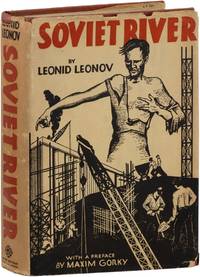
1932réf. 84363New York: Dial Press; Lincoln Mac Veagh 1932. First American Edition. Octavo. 19.5cm. Original deep red cloth titled in black to spine with embossed publisher's imprint to front board. Dustjacket. 383pp. Bumped to spine ends with some minor wear to corners some minor darkening to the cloth in places; internally clean fore-edge untrimmed top edge a trifle dusty; in the John Gram dustjacket with some toning to the spine panel shallow chipping and loss to the spine ends intruding upon the author's first name and a short closed tear to the front upper front spine hinge. A good strong copy with some wear. Leonov's novel of Soviet labor centred around the building of an enormous factory; Sotstroy. Gorky provides the preface; the novel was notable at the time as an antidote to the image of the USSR as an enormous generator of plans progress noble artistic and industrial endeavor and a shining beacon of energy. Leonov tends towards a more on the ground depiction of enthusiastic ineptitude paranoia and fanaticism. Bookplate of Alvin Kapusta to front pastedown a Special Assistant for Soviet Nationalities at the US State Department and a notable scholar of the Soviet Bloc whose collections are housed at the Hoover Institution. Dial Press; Lincoln Mac Veagh unknown
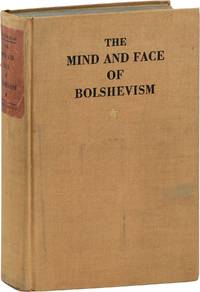
1929réf. 84083New York: Alfred A. Knopf 1929. Large Paper Edition. Large Octavo. 26.5cm. Publisher's pale orange cloth titled in black and gilt to front board with red paper title label to spine. xvi; 308pp. Scuffing and bumping to extremities the cloth uniformly faded to a pale diluted pinkish orange with some scuffing and soiling darkening to the spine label and some very light marginal chipping; internally clean black topstain fore-edge untrimmed lavishly illustrated throughout in color and black and white. A strong and handsome copy about very good due to solidity and completeness but with cosmetic external wear. Significantly taller and more bulky than the trade edition likely a deluxe or large paper edition produced from British sheets the pagination differs considerably from the earlier trade edition with several additional color illustrations for example the "Red Angel of Revolution" color plate is here the recto of the photographic frontis and a rather unusual contemporary small format photograph of Leningrad tipped onto one of the plate pages. The paper title label suggests a slipcase although none is present. Unusual rather than scarce with a pretty solid showing in institutions if none in trade. Alfred A. Knopf unknown
1932réf. 84363New York: Dial Press; Lincoln Mac Veagh 1932. First American Edition. Octavo. 19.5cm. Original deep red cloth titled in black to spine with embossed publisher's imprint to front board. Dustjacket. 383pp. Bumped to spine ends with some minor wear to corners some minor darkening to the cloth in places; internally clean fore-edge untrimmed top edge a trifle dusty; in the John Gram dustjacket with some toning to the spine panel shallow chipping and loss to the spine ends intruding upon the author's first name and a short closed tear to the front upper front spine hinge. A good strong copy with some wear. Leonov's novel of Soviet labor centred around the building of an enormous factory; Sotstroy. Gorky provides the preface; the novel was notable at the time as an antidote to the image of the USSR as an enormous generator of plans progress noble artistic and industrial endeavor and a shining beacon of energy. Leonov tends towards a more on the ground depiction of enthusiastic ineptitude paranoia and fanaticism. Bookplate of Alvin Kapusta to front pastedown a Special Assistant for Soviet Nationalities at the US State Department and a notable scholar of the Soviet Bloc whose collections are housed at the Hoover Institution. Dial Press; Lincoln Mac Veagh unknown books
1929réf. 84083New York: Alfred A. Knopf 1929. Large Paper Edition. Large Octavo. 26.5cm. Publisher's pale orange cloth titled in black and gilt to front board with red paper title label to spine. xvi; 308pp. Scuffing and bumping to extremities the cloth uniformly faded to a pale diluted pinkish orange with some scuffing and soiling darkening to the spine label and some very light marginal chipping; internally clean black topstain fore-edge untrimmed lavishly illustrated throughout in color and black and white. A strong and handsome copy about very good due to solidity and completeness but with cosmetic external wear. Significantly taller and more bulky than the trade edition likely a deluxe or large paper edition produced from British sheets the pagination differs considerably from the earlier trade edition with several additional color illustrations for example the "Red Angel of Revolution" color plate is here the recto of the photographic frontis and a rather unusual contemporary small format photograph of Leningrad tipped onto one of the plate pages. The paper title label suggests a slipcase although none is present. Unusual rather than scarce with a pretty solid showing in institutions if none in trade. Alfred A. Knopf unknown books